As filed with the U.S. Securities and Exchange Commission on May 27, 2026
File No. 001-43265
UNITED STATES
SECURITIES AND EXCHANGE COMMISSION
Washington, D.C. 20549
Amendment No. 1
to
Form 10
GENERAL FORM FOR REGISTRATION OF SECURITIES
PURSUANT TO SECTION 12(b) OR (g) OF
THE SECURITIES EXCHANGE ACT OF 1934
Midera Food Processing, Inc.
(Exact name of registrant as specified in its charter)
| Delaware | 39-3886250 | |
| (State or other jurisdiction of incorporation or organization) |
(I.R.S. Employer Identification No.) |
10275 West Higgins
Road, Suite 300
Rosemont, Illinois 60018
(Address of principal executive offices)
Registrant’s telephone number, including area code:
(847) 857-6696
Securities to be registered pursuant to Section 12(b) of the Exchange Act:
| Title of each class to be so registered |
Name of each exchange on which | |
| Common Stock, par value $0.01 per share | The Nasdaq Stock Market LLC (Nasdaq Global Select Market) |
Securities to be registered pursuant to Section 12(g) of the Exchange Act: None
Indicate by check mark whether the registrant is a large accelerated filer, an accelerated filer, a non-accelerated filer, a smaller reporting company or an emerging growth company. See definitions of “large accelerated filer,” “accelerated filer,” “smaller reporting company,” and “emerging growth company” in Rule 12b-2 of the Exchange Act:
| Large accelerated filer | ☐ | Accelerated filer | ☐ | |||
| Non-accelerated filer | ☒ | Smaller reporting company | ☐ | |||
| Emerging growth company | ☒ | |||||
If an emerging growth company, indicate by check mark if the registrant has elected not to use the extended transition period for complying with any new or revised financial accounting standards provided pursuant to Section 13(a) of the Exchange Act. ☐
Midera Food Processing, Inc.
INFORMATION REQUIRED IN REGISTRATION STATEMENT
CROSS-REFERENCE SHEET BETWEEN INFORMATION STATEMENT AND ITEMS OF
FORM 10
Certain information required to be included in this Form 10 is incorporated by reference to specifically identified portions of the body of the information statement filed herewith as Exhibit 99.1. None of the information contained in the information statement shall be incorporated by reference herein or deemed to be a part hereof unless such information is specifically incorporated by reference.
Item 1. Business.
The information required by this item is contained under the sections of the information statement entitled “Information Statement Summary,” “Summary of the Separation and Distribution,” “Risk Factors,” “Special Note Regarding Forward-Looking Statements,” “The Separation and Distribution,” “Business,” “Management’s Discussion and Analysis of Financial Condition and Results of Operations,” “Certain Relationships and Related Transactions” and “Where You Can Find More Information.” Those sections are incorporated herein by reference.
Item 1A. Risk Factors.
The information required by this item is contained under the sections of the information statement entitled “Information Statement Summary,” “Risk Factors” and “Special Note Regarding Forward-Looking Statements.” Those sections are incorporated herein by reference.
Item 2. Financial Information.
The information required by this item is contained under the sections of the information statement entitled “Summary of Historical and Unaudited Pro Forma Condensed Combined Financial Data,” “Risk Factors,” “Capitalization,” “Unaudited Pro Forma Condensed Combined Financial Information,” “Notes to the Unaudited Pro Forma Condensed Combined Financial Information,” “Management’s Discussion and Analysis of Financial Condition and Results of Operations” and “Index to Combined Financial Statements” (and the financial statements and related notes referenced therein). Those sections are incorporated herein by reference.
Item 3. Properties.
The information required by this item is contained under the section of the information statement entitled “Business—Properties.” That section is incorporated herein by reference.
Item 4. Security Ownership of Certain Beneficial Owners and Management.
The information required by this item is contained under the section of the information statement entitled “Security Ownership of Certain Beneficial Owners and Management.” That section is incorporated herein by reference.
Item 5. Directors and Executive Officers.
The information required by this item is contained under the section of the information statement entitled “Management.” That section is incorporated herein by reference.
Item 6. Executive Compensation.
The information required by this item is contained under the sections of the information statement entitled “Executive Compensation,” “Director Compensation” and “Management—Compensation Committee Interlocks and Insider Participation.” Those sections are incorporated herein by reference.
Item 7. Certain Relationships and Related Transactions, and Director Independence.
The information required by this item is contained under the sections of the information statement entitled “Summary of the Separation and Distribution,” “Risk Factors—Risks Related to the Spin-Off,” “Management” and “Certain Relationships and Related Transactions.” Those sections are incorporated herein by reference.
Item 8. Legal Proceedings.
The information required by this item is contained under the section of the information statement entitled “Business—Legal Proceedings.” That section is incorporated herein by reference.
Item 9. Market Price of and Dividends on the Registrant’s Common Equity and Related Stockholder Matters.
The information required by this item is contained under the sections of the information statement entitled “The Separation and Distribution,” “Dividend Policy,” “Security Ownership of Certain Beneficial Owners and Management” and “Description of Capital Stock.” Those sections are incorporated herein by reference.
Item 10. Recent Sales of Unregistered Securities.
The information required by this item is contained under the section of the information statement entitled “Description of Capital Stock—Sale of Unregistered Securities.” That section is incorporated herein by reference.
Item 11. Description of Registrant’s Securities to be Registered.
The information required by this item is contained under the sections of the information statement entitled “Summary of the Separation and Distribution,” “The Separation and Distribution,” “Dividend Policy” and “Description of Capital Stock.” Those sections are incorporated herein by reference.
Item 12. Indemnification of Directors and Officers.
The information required by this item is contained under the section of the information statement entitled “Description of Capital Stock—Limitations on Director and Officer Liability.” That section is incorporated herein by reference.
Item 13. Financial Statements and Supplementary Data.
The information required by this item is contained under the sections of the information statement entitled “Summary of Historical and Unaudited Pro Forma Condensed Combined Financial Data,” “Unaudited Pro Forma Condensed Combined Financial Information,” “Notes to the Unaudited Pro Forma Condensed Combined Financial Information” and “Index to Combined Financial Statements” (and the financial statements and related notes referenced therein). Those sections are incorporated herein by reference.
Item 14. Changes in and Disagreements with Accountants on Accounting and Financial Disclosure.
Not applicable.
2
Item 15. Financial Statements and Exhibits.
(a) Financial Statements
The information required by this item is contained under the sections of the information statement entitled “Summary of Historical and Unaudited Pro Forma Condensed Combined Financial Data,” “Unaudited Pro Forma Condensed Combined Financial Information,” “Notes to the Unaudited Pro Forma Condensed Combined Financial Information” and “Index to Combined Financial Statements” (and the financial statements and related notes referenced therein). Those sections are incorporated herein by reference.
(b) Exhibits
See below.
The following documents are filed as exhibits hereto:
| * | Previously filed. |
| † | Management contract or compensatory plan or arrangement. |
3
SIGNATURES
Pursuant to the requirements of Section 12 of the Securities Exchange Act of 1934, the registrant has caused this registration statement to be signed on its behalf by the undersigned, thereunto duly authorized.
| Midera Food Processing, Inc. | ||
| By: | /s/ Mark M. Salman | |
| Name: | Mark M. Salman | |
| Title: | Chief Executive Officer | |
Date: May 27, 2026
4
Exhibit 10.5
The Midera Food Processing, Inc. 2026 Long-Term Incentive Plan
Introduction
The Midera Food Processing, Inc. 2026 Long-Term Incentive Plan (the “Plan”) is intended to promote the interests of Midera Food Processing, Inc. (the “Company”) and its stockholders by providing officers and other employees of the Company and its affiliates (including directors who are also employees of the Company or its affiliates) with appropriate incentives and rewards to encourage them to enter into and continue in the employ of the Company and its affiliates and to acquire a proprietary interest in the long-term success of the Company; and to reward the performance of individual officers, other employees, non-employee directors and consultants in fulfilling their personal responsibilities for long-range achievements. The Plan is also designed to encourage stock ownership by such persons, thereby aligning their interest with those of the Company’s stockholders. The Plan has been adopted and approved by the Board (defined below) and shall become effective as of May 20, 2026 (the “Effective Date”), subject to the approval of the stockholders of the Company.
Article I
DEFINITIONS
Section 1.1 “Award Agreement” means an agreement described in Section 3.2 between the Company and an Eligible Participant, setting forth the terms and conditions of an Award granted to an Eligible Participant.
Section 1.2 “Board” means the Company’s Board of Directors.
Section 1.3 A “Change of Control” shall occur on the date on which:
(1) Any Person (as defined below) becomes the beneficial owner directly or indirectly (within the meaning of Rule 13d-3 under the Exchange Act) of more than 35% of the Company’s then outstanding voting securities (measured on the basis of voting power);
(2) There is consummated a merger or consolidation, other than (i) a merger or consolidation immediately following which the voting securities of the Company outstanding immediately prior thereto continue to represent (either by remaining outstanding or by being converted into voting securities of the surviving entity or any parent thereof), in combination with the ownership of any trustee or other fiduciary holding securities under an employee benefit plan of the Company, at least 50% of the combined voting power of the voting securities of the Company, such surviving entity or any parent thereof outstanding immediately after such merger or consolidation, or (ii) a merger or consolidation effected to implement a recapitalization of the Company (or similar transaction) in which no Person acquires more than 35% of the combined voting power of the Company’s then outstanding securities;
(3) individuals who, as of the Effective Date, constituted the Board (the “Incumbent Board”) cease for any reason to constitute at least a majority of the Board; provided, however, that any individual becoming a director subsequent to the Effective Date whose election, or nomination for election by the Company’s stockholders, was approved by a vote of at least a majority of the directors then comprising the Incumbent Board shall be considered as though such individual were a member of the Incumbent Board, but excluding for this purpose any such individual whose initial assumption of office occurs as a result of either an actual or threatened election contest (as such terms are used in Rule 14a-11 of Regulation 14A promulgated under the Exchange Act) or other actual or threatened solicitation of proxies or consents by or on behalf of a Person other than the Board; or
(4) the stockholders of the Company approve a plan of complete liquidation or dissolution of the Company or there is consummated an agreement for the sale or disposition by the Company of all or substantially all of the Company’s assets.
Notwithstanding the foregoing, (x) a “Change of Control” shall not be deemed to have occurred by virtue of the consummation of any transaction or series of integrated transactions immediately following which the record holders of the common stock of the Company immediately prior to such transaction or series of transactions continue to have substantially the same proportionate ownership in an entity which owns all or substantially all of the assets of the Company immediately following such transaction or series of transactions; and (y) for each Grant that constitutes deferred compensation under Section 409A of the Code, and to the extent required to avoid accelerated taxation and/or tax penalties under Section 409A of the Code, a Change of Control shall be deemed to have occurred under the Plan with respect to such Grant only if a change in the ownership or effective control of the Company or a change in ownership of a substantial portion of the assets of the Company shall also be deemed to have occurred under Section 409A of the Code.
For purposes of the Plan, “Person” shall have the meaning given in Section 3(a)(9) of the Exchange Act, as modified and used in Sections 13(d) and 14(d) thereof; however, a Person shall not include (w) the Company or any of its subsidiaries, (x) a trustee or other fiduciary holding securities under an employee benefit plan of the Company or any of its subsidiaries, (y) an underwriter temporarily holding securities pursuant to an offering of such securities, or (z) a corporation owned, directly or indirectly, by the stockholders of the Company in substantially the same proportions as their ownership of Stock.
Section 1.4 “Code” means the Internal Revenue Code of 1986, as amended.
Section 1.5 “Committee” means any committee or subcommittee the Board may appoint to administer the Plan. Subject to the discretion of the Board, the Committee shall be composed entirely of individuals who meet the qualifications of a Non-Employee Director. If at any time or to any extent the Board shall not administer the Plan, then the functions of the administrator specified in the Plan shall be exercised by the Committee.
Section 1.6 “Company” means Midera Food Processing, Inc., a Delaware corporation.
2
Section 1.7 “Date of Grant” means the date specified by the Committee as the date on which a Grant is to be granted (which date may be no earlier than the date the resolution approving the Grant is adopted by the Committee), or if no such date is specified by the Committee, the date on which the Committee adopts a resolution making the Grant.
Section 1.8 “DDE” means a deferred Dividend Equivalent Right, which is a Dividend Equivalent Right that is accrued during the restricted period set forth in an Award Agreement and that becomes payable to an Eligible Participant upon the expiration or termination of such restricted period.
Section 1.9 “Dividend Equivalent Right” means the right of an Eligible Participant, granted at the discretion of the Committee or as otherwise provided by the Plan, to receive a credit for the account of such Eligible Participant in an amount equal to the cash dividends paid on one (1) Share for each Share represented by an Award held by such Eligible Participant.
Section 1.10 “Eligible Participant” means any employee of an Employer, any Non-Employee Director of the Company or service provider, not employed as an employee, providing services to the Company or an affiliate or subsidiary of the Company.
Section 1.11 “Employer” means the Company or any affiliate or subsidiary of the Company.
Section 1.12 “Exchange Act” means the Securities Exchange Act of 1934, as amended from time to time, and as now or hereafter construed, interpreted and applied by regulations, rulings and cases.
Section 1.13 “Fair Market Value” means, as of the relevant date, the closing price of Stock on the national stock exchange or automated quotation system on which the Stock is then listed or, if there was no trading in Stock on that date, the closing price of Stock on such exchange or automated quotation system on the next preceding date on which there was trading in Stock.
Section 1.14 “Grant” means any award of Options, Stock Appreciation Rights, Restricted Stock, Restricted Stock Units, Performance Stock, Performance Stock Units, Phantom Units or Other Equity-Based Award (or any combination thereof) made under this Plan to an Eligible Participant.
Section 1.15 “Incentive Stock Option” means an Option that by its terms qualifies and is intended to qualify as an incentive stock option within the meaning of Section 422 of the Code and the regulations promulgated thereunder.
Section 1.16 “Insider” means an officer or director of the Company or any other person whose transactions in shares of Stock are subject to Section 16 of the Exchange Act.
Section 1.17 “NASDAQ Stock Market Rules” means the Qualitative Listing Requirements for Issuers Listed on the Exchange published by the NASDAQ Stock Market.
3
Section 1.18 “Non-Employee Director” means a member of the Board who is a “non-employee director” within the meaning of Rule 16b-3 and any other qualifications required by the NASDAQ Stock Market Rules.
Section 1.19 “Option” means any stock option granted under this Plan.
Section 1.20 “Other Equity-Based Award” means a Grant made pursuant to Article IX.
Section 1.21 “Performance Goals” means performance goals based on criteria selected by the Committee in its sole discretion, including, without limitation, one or more of the following criteria: (1) return on total stockholder equity (including growth measures); (2) earnings per share or earnings per share growth of Company common stock; (3) net earnings or net income (before or after taxes); (4) earnings before any or all of interest, taxes, minority interest, depreciation and amortization; (5) sales or revenues (including net sales or revenue growth); (6) return or growth on assets, capital or investment; (7) market share; (8) expense reduction goals; (9) implementation or completion of critical projects or processes; (10) cash flow (including operating cash flow, free cash flow, cash flow return on equity, and cash flow return on investment); (11) gross, operating or net profit or margins (including net operating profit or net operating profit after tax); (12) achievement of strategic goals; (13) growth and/or performance of the Company’s sales force or product line; (14) economic value added (net operating profit after tax minus the sum of capital multiplied by the cost of capital); (15) operating measures (including, but not limited to, productivity, efficiency, quality); (16) stock price; and (17) any combination of, or a specified increase in, any of the foregoing. A Performance Goal need not be based upon an increase or positive result under a particular business criterion and could include, for example, maintaining the status quo or limiting economic losses (measured, in each case, by reference to specific business criteria). As determined in the sole discretion of the Committee, the Performance Goals for any performance period may be measured on an absolute basis or in relation to a pre-established target, prior year’s results or a peer group or an index.
The Committee also has the authority in its sole discretion to make equitable adjustments as it deems necessary, to reflect the impact of extraordinary items not reflected in such goals, including, but not limited to: (1) any profit or loss attributable to acquisitions or dispositions of stock or assets, (2) any intangibles/goodwill amortization charges attributable to acquisitions or dispositions of stock or assets, (3) any changes in accounting standards or treatments, (4) all items of gain, loss or expense for the year related to restructuring charges for the Company or its subsidiaries, (5) all items of gain, loss or expense for the year determined to be extraordinary or unusual in nature or infrequent in occurrence or related to the disposal of a segment of a business (including but not limited to any costs allocated to the Company by any entity that acquires the Company), (6) all items of gain, loss or expense for the year related to discontinued operations that do not qualify as a segment of a business, (7) the impact of capital expenditures, (8) the impact of share repurchases and other changes in the number of outstanding shares, (9) fees and expenses associated with a business transaction such as investment banking fees and/or legal, accounting or tax planning fees, and (10) charges or amortization related to intangibles/goodwill. The performance goals may include a threshold level of performance below which no compensation will be earned, levels of performance at which specified compensation will be earned, and a maximum level of performance beyond which no additional compensation will be earned.
4
Section 1.22 “Performance Stock” means Stock issued pursuant to Article VII.
Section 1.23 “Performance Stock Unit” means a bookkeeping entry representing an amount equal to the Fair Market Value of one Share, granted pursuant to Article VII. Each Performance Stock Unit represents an unfunded and unsecured obligation of the Company.
Section 1.24 “Phantom Unit” shall mean the right, granted pursuant to Article VIII, to receive in cash or shares the Fair Market Value of a share of Stock or, in the case of a Grant denominated in cash, to receive the amount of cash per unit that is determined by the Committee in connection with the Grant.
Section 1.25 “Plan” means the Midera Food Processing, Inc. 2026 Long-Term Incentive Plan, as set out in this document and as may be amended and restated from time to time.
Section 1.26 “Recipient” means an Eligible Participant to whom a Grant has been made.
Section 1.27 “Restricted Stock” means Stock transferred to a Recipient in a Grant which is, at the Date of Grant, both (i) not “transferable” and (ii) “subject to a substantial risk of forfeiture,” within the meaning of Section 83 of the Code.
Section 1.28 “Restricted Stock Unit” means a bookkeeping entry representing an amount equal to the Fair Market Value of one Share, granted pursuant to Article VI. Each Restricted Stock Unit represents an unfunded and unsecured obligation of the Company.
Section 1.29 “Rule 16b-3” means Rule 16b-3, as from time to time in effect promulgated by the Securities and Exchange Commission under Section 16 of the Exchange Act, including any successor to such Rule.
Section 1.30 “Stock” means the Company’s authorized common stock, par value $.01 per share.
Section 1.31 “Stock Appreciation Right” means a right transferred to a Recipient under a Grant which entitles the Recipient, upon exercise, to receive a payment (in cash, Stock or a combination of cash and Stock) which is equal to the increase (if any) in the Fair Market Value of a share of Stock between the Date of Grant and the date as of which the right is exercised.
Section 1.32 The masculine gender includes the feminine, and the singular number includes the plural, unless a different meaning is clearly required by the context.
Article II
STOCK AVAILABLE FOR GRANTS
Section 2.1 Subject to adjustment as provided in Section 2.2 herein, a maximum of 3,000,000 shares of Stock are available for Grants under the Plan, which amount shall also be the maximum number of shares of Stock that may be issued under the Plan pursuant to Incentive Stock Options. The Stock available for Grants may include unissued or reacquired shares. If any shares subject to a Grant are forfeited, cancelled, exchanged or surrendered or if a Grant otherwise
5
terminates or expires without a distribution of shares to the Recipient, the shares of Stock with respect to such Grant shall, to the extent of any such forfeiture, cancellation, exchange, surrender, termination or expiration, again be available for Grants under the Plan. Notwithstanding the foregoing, shares of Stock that are exchanged by a Recipient or withheld by the Company as full or partial payment in connection with any Grant under the Plan, as well as any shares of Stock exchanged by a Recipient or withheld by the Company or any subsidiary to satisfy the tax withholding obligations related to any Grant under the Plan, shall not be available for subsequent Grants under the Plan. Upon the exercise of any Grant made in tandem with any other Grants, such related Grants shall be canceled to the extent of the number of shares of Stock as to which the Grant is exercised and, notwithstanding the foregoing, such number of shares shall no longer be available for Grants under the Plan. In addition, shares of Stock underlying Grants that can only be settled in cash shall not be counted against the aggregate number of shares of Stock available for Grants under the Plan.
Section 2.2
(a) Except as provided in an Award Agreement or as otherwise provided in the Plan, in the event that the Board shall determine that any dividend or other distribution (whether in the form of cash, Stock, or other property), recapitalization, Stock split, reverse split, reorganization, merger, consolidation, spin-off, combination, repurchase, or share exchange, or other similar corporate transaction or event, affects the Stock such that an adjustment is appropriate in order to prevent dilution or enlargement of the rights of Recipients under the Plan, then the Board shall make such equitable changes or adjustments as it deems necessary or appropriate to any or all of (i) the number and kind of shares of Stock or other property (including cash) that may thereafter be issued in connection with Grants or the total number of shares of Stock issuable under the Plan pursuant to Section 2.1, (ii) the number and kind of shares of Stock or other property issued or issuable in respect of outstanding Grants, (iii) the exercise price, grant price or purchase price relating to any Grant, and (iv) any individual limitations or Plan limitations applicable to Grants; provided that, with respect to Incentive Stock Options, any adjustment shall be made in accordance with the provisions of Section 424(h) of the Code and any regulations or guidance promulgated thereunder; and provided further that no such adjustment shall cause any Grant hereunder which is or becomes subject to Section 409A of the Code to fail to comply with the requirements of such section.
(b) The Committee may make Grants under the Plan in connection with the acquisition, whether by purchase, merger, consolidation or other corporate transaction, of the business or assets of any corporation or other entity, in substitution for awards previously granted by such corporation or other entity or otherwise. The Committee may also assume any previously granted awards of an employee, director, consultant or other service provider of another corporation or entity that becomes an Eligible Participant by reason of such corporation transaction. The terms and conditions of the substituted or assumed awards may vary from the terms and conditions that would otherwise be required by the Plan solely to the extent the Committee deems necessary for such purpose. To the extent permitted by applicable law and the NASDAQ Stock Market Rules, any such substituted or assumed awards shall not reduce the number of shares available under the Plan set forth in Section 2.1 herein.
6
Article III
MAKING GRANTS
Section 3.1
(a) The Committee may, at any time while the Plan is in effect and there is Stock available for Grants, make Grants to Eligible Participants; provided, that subject to the terms of the Plan, the timing, pricing and amount of a Grant to an Insider shall be made solely by a committee consisting solely of two or more directors who are Non-Employee Directors. The maximum aggregate Grants made during any fiscal year to any Eligible Participant will not exceed (i) 200,000 shares of Stock, or (ii) with respect to any Grant denominated in cash, $10,000,000, in each case subject to adjustment as provided by Section 2.2. subject to adjustment as provided in as provided in Section 2.2(a). Grants of Options intended to be treated as Incentive Stock Options may only be made to employees of an Employer and not to Non-Employee Directors or other service providers. Notwithstanding any provision of the Plan, to the extent that any Grant would be subject to Section 409A of the Code, no such Grant may be made if it would fail to comply with the requirements set forth in Section 409A of the Code and any regulation or guidance promulgated thereunder.
(b) No Grant may be made after the tenth anniversary of the Effective Date.
(c) All Grants and any exercises of Grants are conditioned upon stockholder approval of the Plan as described in Section 11.2.
(d) No individual who is a Non-Employee Director of the Company shall receive Grants during any calendar year that, when aggregated with such Non-Employee Director’s cash fees with respect to such calendar year, exceed $400,000 in total value (calculating the value of any such awards based on the Fair Market Value as of the Date of Grant).
(e) No Option or Stock Appreciation Right may be re-priced, replaced, re-granted through cancellation, or modified without stockholder approval (except as permitted under Section 2.2(b)), if the effect would be to reduce the exercise price for the Stock underlying such Option or Stock Appreciation Right, respectively. In addition, in no event will the Company pay cash or other consideration for Options where at the time of payment the exercise price of the Option is greater than the Fair Market Value of the Stock underlying the Option or pay cash or other consideration for Stock Appreciation Rights where at the time of payment the exercise price established in the Grant is greater than the Fair Market Value of the Stock underlying the Stock Appreciation Right.
Section 3.2
(a) The terms of each Grant will be set out in an Award Agreement in a form approved by the Committee setting forth the number of shares of Stock, as applicable, subject to the Grant, and the price (if any) and term of the Grant and, in the case of performance-based awards, the applicable Performance Goals and performance period. The Award Agreement also may set forth (or incorporate by reference) other material terms and conditions applicable to the Grant as determined by the Committee consistent with the limitations of this Plan.
7
(b) Subject to the applicable provisions of Articles IV through IX, a Grant may contain any terms and conditions which the Board determines, as long as they are consistent with the provisions of the Plan. Such terms may, without limitation, include provisions that Grants shall terminate upon termination of employment in specified circumstances.
Article IV
OPTIONS
Section 4.1 The terms of each Option must include the following:
(a) The name of the Recipient.
(b) The number of shares which are subject to the Option.
(c) The term over which the Option may be exercised.
(d) A requirement that the Option is not transferable by the Recipient except by will or the laws of descent and distribution and that, during his lifetime, it is exercisable only by him. Provided that, subject to the approval of the Board, an Option may be transferable as permitted under 17 C.F.R. sec. 240.16b-3 and 5, as long as such transfers are made to one or more of the following: family members, including children of the Recipient, the spouse of the Recipient, or grandchildren of the Recipient, trusts for such family members or charities (“Transferees”), provided that (i) such transfer is a bona fide gift and accordingly, the Recipient receives no consideration for the transfer, (ii) the Options transferred continue to be subject to the same terms and conditions that were applicable to the Options immediately prior to the transfer and (iii) the Transferee acknowledges that it is subject to such terms and conditions in a form satisfactory to the Company. In the event of such a transfer, the Transferee may not subsequently transfer this Option. The designation of a beneficiary shall not constitute a transfer.
(e) A statement of whether the Option is intended to be an Incentive Stock Option or a “nonstatutory stock option”.
(f) The exercise price per share must be at least 100% of the Stock’s Fair Market Value on the Date of Grant.
Section 4.2 An Option which is intended to be an Incentive Stock Option must contain the following terms:
(a) The exercise price per share must be at least 100% of the Stock’s Fair Market Value on the Date of Grant.
(b) The aggregate Fair Market Value (as of the Date of Grant) of Stock with respect to which Incentive Stock Options are exercisable for the first time by the Recipient during any calendar year (under all stock option plans of the Employers) may not exceed $100,000.
(c) The term over which the Option may be exercised may never exceed ten years from the Date of Grant.
8
(d) If the Recipient, at the time the Option is granted, owns 10% or more of the voting stock of an Employer (including Stock which he is deemed to own under Section 424(d) of the Code), the exercise price must be at least 110% of the Stock’s Fair Market Value as of the Option’s Date of Grant, and the term of the Option may not be more than five (5) years from the Date of Grant.
(e) Each Recipient awarded an Incentive Stock Option under the Plan shall notify the Company in writing immediately after the date he or she makes a “disqualifying disposition” of any shares of Stock acquired pursuant to the exercise of such Incentive Stock Option. A “disqualifying disposition” is any disposition (including any sale) of such Stock before the later of (i) two (2) years after the time of grant of the Incentive Stock Option and (ii) one (1) year after the date the Recipient acquired the shares of Stock by exercising the Incentive Stock Option. The Company may, if determined by the Committee and in accordance with procedures established by it, retain possession of any shares of Stock acquired pursuant to the exercise of an Incentive Stock Option as agent for the applicable Recipient until the end of the period described in the preceding sentence, subject to complying with any instructions from such Recipient as to the sale of such Stock.
Section 4.3
(a) An Option may be exercised, in whole or part, at any time during its term, subject to any specific conditions in the Option’s terms and any rules adopted by the Board for the exercise of Options.
(b) A Recipient may pay the exercise price of an Option on the effective date of such exercise by one or a combination of the following means: (A) in cash or by personal check, certified check, bank cashier’s check or wire transfer; (B) in shares of Stock owned by the Recipient and valued at their Fair Market Value on the effective date of such exercise; or (C) by any such other methods (including broker assisted cashless exercise or by attestation) as the Committee may from time to time authorize; provided, however, that in the case of a Recipient who is subject to Section 16 of the Exchange Act, the method of making such payment shall be in compliance with applicable law. Except as authorized by the Committee, any payment in shares of Stock shall be effected by the delivery of such shares to the Secretary of the Company, duly endorsed in blank or accompanied by stock powers duly executed in blank, together with any other documents and evidences as the Secretary of the Company shall require.
(c) The following rules apply to the exercise of Options, unless otherwise provided in the Award Agreement between the Company and the Recipient:
(i) If a Recipient dies, any Option may, to the extent it was exercisable at his death, be exercised by his estate, within one (1) year after his date of death or such shorter period as the Option may provide. Any portion of the Option that has not vested as of the date of death shall be canceled.
(ii) If a Recipient terminates employment because he has become permanently and totally disabled, he may exercise any Option to the extent it was exercisable at his termination of employment, but only within one (1) year after his termination of employment or such shorter period as the Option may provide. Any portion of the Option that has not vested as of the date of disability shall be canceled.
9
(iii) If a Recipient terminates employment for any reason other than death or permanent and total disability, he may exercise any Option to the extent it was exercisable at his termination of employment, but only within three (3) months after his termination of employment or such shorter or longer period as the Option may provide. Any portion of the Option that has not vested as of the date of termination shall be canceled.
(iv) Subparagraph (i), (ii) or (iii) can never operate to make an Option exercisable beyond the term for which it was granted.
(d) To the extent an Option is not exercised before the expiration of its term or before the expiration of any shorter exercise period under paragraph (c), it will be canceled.
Article V
STOCK APPRECIATION RIGHTS
Section 5.1 The terms of each Grant of Stock Appreciation Rights must include the following:
(a) The name of the Recipient.
(b) The number of Stock Appreciation Rights which are being granted.
(c) The term over which the Stock Appreciation Rights may be exercised. This term may never exceed ten (10) years from the Date of Grant.
(d) The exercise price of the Stock Appreciation Right may never be less than 100% of the Fair Market Value of the Stock on the Date of Grant.
(e) A description of any events which will cause cancellation of the Stock Appreciation Rights before the end of the term described in subparagraph (c).
(f) Whether or not the Stock Appreciation Rights are issued in tandem with any Option, and, if so, the manner in which the Recipient’s exercise of one affects his right to exercise the other.
(g) A requirement that the Stock Appreciation Rights are not transferable by the Recipient except by will or the laws of descent and distribution and that during his lifetime such Rights are exercisable only by him.
Section 5.2 Stock Appreciation Rights which are issued in tandem with an Option which is intended to be an Incentive Stock Option must contain the following terms:
(a) They will expire no later than at the expiration of the Option.
10
(b) Payment under the Stock Appreciation Rights may not exceed 100% of the difference between the exercise price of the Option and the Fair Market Value of Stock on the date the Stock Appreciation Rights are exercised.
(c) They are transferable only when the Option is transferable, and under the same conditions.
(d) They are exercisable only when the Option is exercisable.
(e) They may only be exercised when the Fair Market Value of Stock exceeds the exercise price of the Option.
Section 5.3
(a) Stock Appreciation Rights may be exercised at any time during their term, subject to Section 5.2, to any specific conditions in their terms and to any rules adopted by the Board for the exercise of Stock Appreciation Rights.
(b) Determination of the form of payment upon exercise of a Stock Appreciation Right (cash, Stock or a combination of cash and Stock) is solely in the discretion of the Board.
(c) The following rules apply to the exercise of Stock Appreciation Rights, unless otherwise provided in the Award Agreement between the Company and the Recipient:
(i) If a Recipient dies, any Stock Appreciation Right may, to the extent it was exercisable at his death, be exercised by his estate, within one (1) year after his date of death or such shorter period as the Stock Appreciation Right may provide. Any portion of the Stock Appreciation Right that has not vested as of the date of death shall be canceled.
(ii) If a Recipient terminates employment because he has become permanently and totally disabled, he may exercise any Stock Appreciation Right to the extent it was exercisable at his termination of employment, but only within one (1) year after his termination of employment or such shorter period as the Stock Appreciation Right may provide. Any portion of the Stock Appreciation Right that has not vested as of the date of disability shall be canceled.
(iii) If a Recipient terminates employment for any reason other than death or permanent and total disability, he may exercise any Stock Appreciation Right to the extent it was exercisable at his termination of employment, but only within three (3) months after his termination of employment or such shorter or longer period as the Stock Appreciation Right may provide. Any portion of the Stock Appreciation Right that has not vested as of the date of termination shall be canceled.
(iv) Subparagraph (i), (ii) or (iii) can never operate to make a Stock Appreciation Right exercisable beyond the term for which it was granted.
11
Article VI
RESTRICTED STOCK AND RESTRICTED STOCK UNITS
Section 6.1 The terms of each Grant of Restricted Stock or Restricted Stock Unit, as applicable, must include the following:
(a) the name of the Recipient.
(b) the number of shares of Restricted Stock which are being granted or the number of Restricted Stock Units which are being granted, as applicable.
(c) whether the Recipient must pay any amount in connection with the Grant and if so, the amount and terms of that payment.
(d) description of the restrictions applicable to the Grant and the conditions on which the restriction may be removed.
(e) whether Restricted Stock Units shall, upon vesting and lapse of any restrictions, be settled in cash, shares of Stock, or a combination of both.
(f) provisions for treatment of the Grant upon termination of employment or service with the Company or upon a Change of Control.
Article VII
PERFORMANCE STOCK AND PERFORMANCE STOCK UNITS
Section 7.1 The terms of each grant of Performance Stock or Performance Stock Units must include the following:
(a) the name of the Recipient.
(b) the number of shares of Performance Stock which are being granted or the number of Performance Stock Units which are being granted, as applicable.
(c) details of the applicable performance period, if any, and Performance Goals to apply.
(d) whether the Recipient must pay any amount in connection with the Grant and if so, the amount and terms of that payment.
(e) whether Performance Stock Units shall, upon vesting and lapse of any restrictions, be settled in cash, shares of Stock, or a combination of both.
(f) provisions for treatment of the Grant upon termination of employment or service with the Company or upon a Change of Control.
12
Article VIII
PHANTOM UNITS
Section 8.1 The terms of each Grant of Phantom Units must include the following, subject to Section 409A of the Code:
(a) the name of the Recipient.
(b) the number of shares of Stock underlying the Grant, or in the case of Phantom Units denominated in cash, the amount of cash represented by each Phantom Unit.
(c) description of the restrictions applicable to the Grant and the conditions on which the restriction may be removed, as set forth in Sections 8.2 and 8.3.
(d) provisions for treatment of the Grant upon termination of employment or service with the Company or upon a Change of Control.
Section 8.2 At the time of the grant of Phantom Units, the Committee shall establish a vesting date or vesting dates with respect to such units. Provided that all conditions to the vesting of the Phantom Units imposed are satisfied, and subject to other terms and condition of the Grant, upon the occurrence of the vesting date with respect to the Phantom Units, such units shall vest. The Committee may impose such restrictions or conditions to the vesting of such units as it, in its absolute discretion, deems appropriate, including, but not limited to, achievement of Performance Goals.
Section 8.3 Unless otherwise provided at the time of grant, upon the vesting of Phantom Units, the Participant shall be paid, within thirty (30) days of the date on which such units vest, an amount, in cash and/or shares of Stock, as determined by the Committee. Unless otherwise provided at the time of grant, in the case of Grants denominated in shares of Stock, the amount per Phantom Unit shall be equal to the sum of (1) the Fair Market Value of a share of Stock on the date on which such Phantom Units vest and (2) the aggregate amount of cash dividends paid with respect to a share of Stock during the period commencing on the Date of Grant and terminating on the date on which such units vest. In the case of Grants denominated in cash, the amount per Phantom Unit shall be equal to the cash value of the Phantom Unit on the date on which such Phantom Unit vests.
Article IX
OTHER EQUITY-BASED AWARDS
Section 9.1 Other forms of Grants (“Other Equity-Based Awards”) valued in whole or in part by reference to, or otherwise based on, Stock, including but not limited to Dividend Equivalent Rights, may be granted either alone or in addition to other Grants (other than in connection with Options or Stock Appreciation Rights) under the Plan. Subject to the provisions of the Plan, the Board shall have sole and complete authority to determine the persons to whom and the time or times at which such Other Equity-Based Awards shall be granted, the number of shares of Stock to be granted pursuant to such Other Equity-Based Awards, or the manner in which
13
such Other Equity-Based Awards shall be settled (e.g., in shares of Stock or cash), or the conditions to the vesting and/or payment or settlement of such Other Equity-Based Awards (which may include, but not be limited to, achievement of Performance Goals).
Article X
ADMINISTRATION
Section 10.1 The Plan shall be administered by the Committee and shall be administered in accordance with the requirements of Rule 16b-3, to the extent applicable. The complete authority to control and manage the operation and administration of the Plan is placed in the Committee. The Board will designate the members of the Committee. Notwithstanding the foregoing, any action taken under this Plan by the Committee will be valid and effective whether or not members of the Committee at the time of such action are later determined not to have satisfied the requirements for membership set forth in this Section 10.1 or otherwise provided in any charter of the Committee.
Section 10.2 The Committee has all authority which is necessary or appropriate for the operation and administration of the Plan, including the following:
(a) To make Grants and determine their terms, subject to the provisions of the Plan.
(b) To interpret the provisions of the Plan.
(c) To adopt any rules, procedures and forms necessary for the operation and administration of the Plan which are consistent with its provisions.
(d) To determine all questions relating to the eligibility and other rights of all persons under the Plan.
(e) To keep all records necessary for the operation and administration of the Plan.
(f) To designate or employ agents and counsel (who may also be employed by an Employer) to assist in the administration of the Plan.
(g) To determine whether, to what extent, and under what circumstances any Grant may be settled, cancelled, forfeited, accelerated, exchanged, or surrendered.
(h) To determine the terms and provisions of the Award Agreements (which need not be identical for each Recipient).
(i) To cause any shares of Stock acquired by a Recipient through exercise or settlement of a Grant to be recorded on the Company’s records in the Recipients’ name, and to cause such shares to be issued to the Recipient or to his brokerage account, as he elects.
14
(j) To cause any withholding of tax required in connection with a Grant to be made.
(k) To determine the duration and purpose of leaves of absence which may be granted to an Eligible Participant without constituting termination of the Eligible Participant’s employment or service for purposes of Grants made under the Plan.
(l) To make all other determinations deemed necessary or advisable for the administration of the Plan. Notwithstanding the foregoing, except for adjustments contemplated by Section 2.2, the terms of outstanding Grants may not be amended to reduce the exercise price of outstanding Options or Stock Appreciation Rights or cancel outstanding Options or Stock Appreciation Rights in exchange for cash, other awards or Options or Stock Appreciation Rights with an exercise price that is less than the exercise price of the original Options or Stock Appreciation Rights without stockholder approval. The Board may correct any defect or supply any omission or reconcile any inconsistency in the Plan or in any Award Agreement in the manner and to the extent it shall deem expedient to carry the Plan into effect and shall be the sole and final judge of such expediency. No Board member shall be liable for any action or determination made with respect to the Plan or any Grant made hereunder.
(m) The Committee may, in its sole discretion, delegate its authority, in whole or in part, under this Article X (including, but not limited to, its authority to make Grants under the Plan, other than its authority to make Grants under the Plan to any Eligible Participant who is subject to reporting under Section 16 of the Exchange Act) to one or more officers of the Company, subject to the requirements of applicable law or any stock exchange on which the Stock is traded.
Article XI
AMENDMENT AND TERMINATION
Section 11.1 The Plan may be amended or terminated at any time by action of the Board. However, no amendment may, without stockholder approval (i) increase the aggregate number of shares available for Grants (except to reflect an event described in Section 2.2); (ii) extend the term of the Plan; (iii) materially expand the types of awards available under the Plan; (iv) change the definition of Eligible Participant to add a category or categories of individuals who are eligible to participate in the Plan; (v) delete or limit the prohibition against repricing of Options or Stock Appreciation Rights contained in Section 10.2(l); or (vi) make other changes which require approval by the stockholders of the Company in order to comply with applicable law or the NASDAQ Stock Market Rules.
Section 11.2 If the Plan is not, within twelve (12) months of its Effective Date, approved by a majority of the shares voted at a regular or special meeting of the Company’s stockholders, the Plan will terminate and all Grants made under it will be canceled.
Section 11.3 No amendment or termination of the Plan (other than termination under Section 11.2) may adversely modify any person’s rights under an outstanding Grant unless he consents to the modification in writing.
15
Section 11.4 No Grants may be made under the Plan after the tenth anniversary of the Effective Date; provided, however, that the expiration of the tenth anniversary of the Effective Date shall not affect outstanding Grants under the Plan, which shall remain in full force and effect.
Article XII
MISCELLANEOUS
Section 12.1 Neither the provisions of this Plan, nor the fact that a Recipient receives a Grant will constitute or be evidence of a contract of employment, position or compensation level, or give such Recipient any right to continued employment with the Employer. Neither the provisions of this Plan nor the fact that a Recipient receives a Grant will be construed as the Company’s guarantee of the tax effects for the Recipient of the receipt of a Grant, transfer of the same, exercise of the same, or the retention or sale of the underlying Stock.
Section 12.2 Each Recipient shall, no later than the date as of which the value of a Grant first becomes includible in the gross income of such Recipient for purposes of applicable taxes, pay to the Company, or make arrangements satisfactory to the Company regarding payment of, an amount in respect of such taxes up to the maximum statutory rates in the Recipient’s applicable jurisdiction with respect to the Grant, as determined by the Company. The obligations of the Company under the Plan shall be conditional on the making of such payments or arrangements, and the Company shall, to the extent permitted by law, have the right to deduct any such taxes from any payment of any kind otherwise due to such Recipient. Whenever cash is to be paid pursuant to a Grant, the Company shall have the right to deduct therefrom an amount sufficient to satisfy any applicable withholding tax requirements related thereto as determined by the Company. Whenever Stock or property other than cash are to be delivered pursuant to a Grant, the Company shall have the right to require the Recipient to remit to the Company in cash an amount sufficient to satisfy any related taxes to be withheld and applied to the tax obligations as determined by the Company with respect to the Grant (including with respect to associated dividends, Dividend Equivalents or DDEs); provided, that, with the approval of the Committee, a Recipient may satisfy the foregoing requirement by either (i) electing to have the Company withhold from such delivery Stock or other property, as applicable, or (ii) by delivering already owned unrestricted shares of Stock, in each case, having a value not exceeding the applicable taxes to be withheld and applied to the tax obligations as determined by the Company. Such already owned and unrestricted shares of Stock shall be valued at their Fair Market Value on the date on which the amount of tax to be withheld is determined and any fractional share amounts resulting therefrom shall be settled in cash. Such an election may be made with respect to all or any portion of the Stock to be delivered pursuant to a Grant. The Company may also use any other method of obtaining the necessary payment or proceeds, as permitted by law, to satisfy its withholding obligation with respect to any Grant as determined by the Company.
Section 12.3 The Plan as well as payments and benefits under the Plan are intended to be exempt from, or to the extent subject thereto, to comply with Section 409A of the Code, and, accordingly, to the maximum extent permitted, the Plan shall be interpreted in accordance therewith. Notwithstanding anything contained herein to the contrary, to the extent required in order to avoid accelerated taxation and/or tax penalties under Section 409A of the Code, the Recipient shall not be considered to have terminated employment or service with the Company for
16
purposes of the Plan and no payment shall be due to the Recipient under the Plan or any Grant until the Recipient would be considered to have incurred a “separation from service” from the Company within the meaning of Section 409A of the Code. Any payments described in the Plan that are due within the “short term deferral period” as defined in Section 409A of the Code shall not be treated as deferred compensation unless applicable law requires otherwise. Notwithstanding anything to the contrary in the Plan, to the extent that any Grants (or any other amounts payable under any plan, program or arrangement of the Employer) are payable upon a separation from service and such payment would result in the imposition of any individual tax and penalty interest charges imposed under Section 409A of the Code, the settlement and payment of such Grants (or other amounts) shall instead be made on the first business day after the date that is six (6) months following such separation from service (or upon the Recipient death, if earlier). Each amount to be paid or benefit to be provided under this Plan shall be construed as a separate identified payment for purposes of Section 409A of the Code. The Company makes no representation that any or all of the payments or benefits described in this Plan will be exempt from or comply with Section 409A of the Code and makes no undertaking to preclude Section 409A of the Code from applying to any such payment. The Recipient shall be solely responsible for the payment of any taxes and penalties incurred under Section 409A of the Code.
Section 12.4 If any provision of this Plan is held illegal or invalid for any reason, such illegality or invalidity will not affect the remaining provisions. Instead, each provision is fully severable and this Plan will be construed and enforced as if any illegal or invalid provision had never been included.
Section 12.5 Except as provided in federal law, the provisions of the Plan will be construed in accordance with the laws of Delaware, without giving effect to principles of conflicts of laws
Section 12.6 All Grants made under the Plan shall be subject to any clawback or recoupment policies of the Company as in effect from time to time, or as otherwise required by law or the NASDAQ Stock Market Rules.
Section 12.7 In the event that the Company establishes, for itself or using the services of a third party, an automated system for the documentation, granting or exercise of Grants, such as a system using an internet website or interactive voice response, then the paperless documentation, granting or exercise of Grants by a Recipient may be permitted through the use of such an automated system
Section 12.8 No fractional shares of Stock shall be issued or delivered pursuant to the Plan. The Committee shall determine whether cash, other Grants, or other property shall be issued or paid in lieu of such fractional shares or whether such fractional shares or any rights thereto shall be forfeited or otherwise eliminated.
Section 12.9 No Eligible Participant will have any of the rights of a stockholder with respect to any shares of Stock until the shares of Stock are issued to the Eligible Participant, except for any Dividend Equivalent Rights permitted by an applicable Award Agreement. Any Dividend Equivalent Rights will be subject to the same vesting or performance conditions as the underlying Grant. In addition, the Committee may provide that any Dividend Equivalent Rights permitted by
17
an applicable Award Agreement will be deemed to have been reinvested in additional shares of Stock or otherwise reinvested. After shares of Stock are issued to the Eligible Participant, the Eligible Participant will be a stockholder and have all the rights of a stockholder with respect to such shares of Stock, including the right to vote and receive all dividends or other distributions made or paid with respect to such shares of Stock; provided, that if such shares of Stock are Restricted Stock, then any new, additional or different securities the Eligible Participant may become entitled to receive with respect to such shares of Stock by virtue of a stock dividend, stock split or any other change in the corporate or capital structure of the Company will be subject to the same restrictions as the Restricted Stock; provided, further, that the Eligible Participant will have no right to such stock dividends or stock distributions with respect to unvested Grants, and any such dividends or stock distributions will be accrued and paid only at such time, if any, as such unvested Grants become vested shares of Stock. The Committee, in its discretion, may provide in the Award Agreement evidencing any Grant that the Eligible Participant will be entitled to Dividend Equivalent Rights with respect to the payment of cash dividends on shares of Stock underlying a Grant during the period beginning on the date the Grant is made and ending, with respect to each share of Stock subject to the Award, on the earlier of the date on which the Grant is exercised or settled or the date on which it is forfeited provided, that no Dividend Equivalent Right will be paid with respect to the unvested shares of Stock, and such dividends or stock distributions will be accrued and paid only at such time, if any, as such unvested shares of Stock become vested Grants. Such Dividend Equivalent Rights, if any, will be credited to the Eligible Participant in the form of additional whole shares of Stock as of the date of payment of such cash dividends on shares of Stock.
Section 12.10 The obligations of the Company under the Plan shall be binding upon any successor corporation or organization resulting from the merger, consolidation or other reorganization of the Company, or upon any successor corporation or organization succeeding to substantially all of the assets and business of the Company.
18
Exhibit 10.6
MIDERA FOOD PROCESSING, INC.
2026 LONG-TERM INCENTIVE PLAN
RESTRICTED STOCK UNIT AWARD AGREEMENT FOR NON-EMPLOYEE DIRECTORS
This RESTRICTED STOCK UNIT AWARD AGREEMENT (this “Agreement”), dated as of [DATE] (the “Date of Grant”) is entered into by and between Midera Food Processing, Inc., a Delaware corporation (the “Company”) and (the “Grantee” and, together with the Company, the “Parties”).
RECITALS
Pursuant to the Midera Food Processing, Inc. 2026 Long-Term Incentive Plan (the “Plan”), the Board of Directors of the Company (the “Board”) have determined to grant to the Grantee restricted stock units (the “RSUs”) that will settle in shares of the Company’s common stock, par value $0.01 per share (the “Common Stock”) subject to the vesting, restrictions and other terms and conditions set forth herein, and hereby grants such RSUs. Capitalized terms not otherwise defined herein shall have the meaning ascribed to such terms in the Plan.
NOW, THEREFORE, the Parties hereto agree as follows:
1. Grant of RSUs. The Company hereby grants to the Grantee [●] RSUs, pursuant to the terms and conditions of this Agreement. Each RSU represents the right to receive one (1) share of Common Stock under the terms and conditions of this Agreement.
2. Vesting. The RSUs shall become 100% vested on [DATE], subject to the Grantee’s continued service as a Non-Employee Director through such date, except as provided in Section 3(b) and 3(c) of this Agreement. The number of RSUs set forth in Section 1 above are subject to adjustment in accordance with the terms of this Agreement and the Plan.
3. Cessation of Service; Change of Control.
(a) Forfeiture. If the Grantee’s service as a Non-Employee Director ceases for any reason, then (i) all rights of the Grantee with respect to the RSUs that have not vested shall immediately terminate, (ii) any such unvested RSUs and all rights therein shall be forfeited without payment of any consideration, and (iii) neither the Grantee nor any of the Grantee’s successors, heirs, assigns, or personal representatives shall thereafter have any further rights or interests in such unvested RSUs.
(b) Accelerated Vesting upon Change of Control. In the event of a Change of Control while the Grantee is serving as a Non-Employee Director, all of the RSUs, to the extent not then-vested, will immediately vest as of the date of such Change of Control.
(c) Accelerated Vesting upon Death or Disability. In the event the Grantee ceases to be a Non-Employee Director due to death or Disability, all of the RSUs, to the extent not then-vested, will immediately vest as of the date of such death or Disability of the Grantee.
4. Voting and Dividend Equivalent Rights. The Grantee shall have no rights of a stockholder (including the right to distributions or dividends) until shares of Common Stock are delivered to the Grantee following vesting of the RSUs in accordance with Section 5 hereof.
5. Delivery of Stock.
(a) Any shares of Common Stock in respect of RSUs that have vested in accordance with Section 2 of this Agreement, shall be delivered to the Grantee by no later than thirty (30) business days following the applicable vesting date. No physical certificates evidencing the shares of Common Stock delivered in settlement of vested RSUs will be delivered to the Grantee. Instead, the shares of Common Stock delivered in settlement of vested RSUs will be evidenced by certificates held by or on behalf of the Company, in book-entry form, or otherwise, as determined by the Company.
(b) By accepting the RSUs, the Grantee agrees not to sell shares of Common Stock delivered in settlement of any vested RSUs at a time when applicable laws or the Company’s rules prohibit a sale. This restriction will apply as long as the Grantee is an Eligible Participant (as defined in the Plan).
(c) Notwithstanding the foregoing, all of the RSUs will be automatically forfeited by the Grantee if the Grantee causes “Harm” (as defined below) to the Company prior to settlement. For purposes of this Agreement, “Harm” includes, any actions that adversely affect the Company’s financial standing, reputation, or products, or any actions involving personal dishonesty, a felony conviction related to the Company, or any material violation of any confidentiality or non-competition agreement with the Company, as determined in Company’s sole discretion.
(d) The Company shall have the right to refuse to deliver or transfer any shares of Common Stock under this Agreement if the Company acting in its absolute discretion determines that the issuance or transfer of such Common Stock might violate any applicable law or regulation.
6. Taxes. The Grantee understands that the Grantee (and not the Company) shall be responsible for any tax liability that may arise as a result of the transactions contemplated by this Agreement.
7. Data Privacy. The Grantee hereby explicitly and unambiguously consents to the collection, use and transfer, in electronic or other form, of the Grantee’s personal data as described in this Agreement and any other Grant materials by and among, as applicable, the Company and the Employer for the exclusive purpose of implementing, administering and managing participation in the Plan. The Grantee understands that the Company and any Employer may hold certain personal information about the Grantee, including, but not limited to, the Grantee’s name, home address and telephone number, date of birth, social insurance number or other identification number, salary, nationality, job title, any shares of stock or directorships held in the Company, details of all options or any other entitlement to shares of Common Stock awarded, canceled, exercised, vested, unvested or outstanding in the Grantee’s favor (“Data”), for the exclusive purpose of implementing, administering and managing the Plan. The Grantee understands that Data will be transferred to a third party stock plan service provider as may be selected by the Company in the future, which is assisting the Company with the implementation, administration and management of the Plan. The Grantee understands that the recipients of the
Data may be
2
located in the United States or elsewhere, and that the recipient’s country (e.g., the United States) may have different data privacy laws with a lower level of protection than the Grantee’s country. The Grantee understands that he or she may request a list with the names and addresses of any potential recipients of the Data by contacting his or her local human resources representative. The Grantee authorizes the Company, and any other possible recipients which may assist the Company (presently or in the future) with implementing, administering and managing the Plan to receive, possess, use, retain and transfer the Data, in electronic or other form, for the sole purposes of implementing, administering and managing the Grantee’s participation in the Plan. The Grantee understands that Data will be held only as long as is necessary to implement, administer and manage the Grantee’s participation in the Plan. The Grantee understands that he or she may, at any time, view Data, request additional information about the storage and processing of Data, require any necessary amendments to Data or refuse or withdraw the consents herein, in any case without cost, by contacting in writing his or her local human resources representative. Further, the Grantee understands that he or she is providing the consents herein on a purely voluntary basis. If the Grantee does not consent, or if the Grantee later seeks to revoke his or her consent, the Grantee’s continuous employment and career with the Company or the Employer will not be adversely affected; the only adverse consequence of refusing or withdrawing consent is that the Company would not be able to grant the Grantee restricted stock units or other equity awards or administer or maintain such awards. Therefore, the Grantee understands that refusing or withdrawing consent may affect his or her ability to participate in the Plan. For more information on the consequences of the Grantee’s refusal to consent or withdrawal of consent, the Grantee understands that he or she may contact his or her local human resources representative.
8. Definitions. As used in this Agreement:
(a) “Beneficial Owner” shall have the meaning set forth in Rule 13d-3 under the Exchange Act.
(b) “Cause” shall mean the Grantee’s (i) gross negligence, (ii) willful misconduct, (iii) breach of fiduciary duty involving personal profit, (iv) substance abuse, (v) commission of a felony or (vi) any action that constitutes Harm.
(c) “Code” means the Internal Revenue Code of 1986, as amended.
(d) “Disability” shall mean the Grantee’s physical or mental condition that renders the Grantee unable to substantially perform for a period of 90 aggregate days (regardless of whether or not continuous) during any 360-day period, Grantee’s regular responsibilities to the Company or the Employer, with or without a reasonable accommodation.
(e) “Exchange Act” shall mean the Securities Exchange Act of 1934, as amended from time to time.
(f) “Person” shall have the meaning given in Section 3(a)(9) of the Exchange Act, as modified and used in Sections 13(d) and 14(d) thereof, except that such term shall not include (i) the Company or any of its subsidiaries, (ii) a trustee or other fiduciary holding securities under an employee benefit plan of the Company or any of its subsidiaries or affiliates, (iii) an underwriter temporarily holding securities pursuant to an offering of such securities, or (iv) a corporation owned, directly or indirectly, by the stockholders of the Company in substantially the same proportions as their ownership of stock of the Company.
3
9. Incorporation of Plan. This Agreement is made under the provisions of the Plan (which is incorporated herein by reference) and shall be interpreted in a manner consistent with it. To the extent that this Agreement is silent with respect to, or in any way inconsistent with, the terms of the Plan, the provisions of the Plan shall govern and this Agreement shall be deemed to be modified accordingly.
10. No Right to Continued Service on the Board. Neither the Plan nor this Agreement shall confer upon the Grantee any right to be retained as a Non-Employee Director of the Company or in any other capacity. Further, nothing in the Plan or this Agreement shall be construed to limit the discretion of the Company to terminate the Grantee’s service as a Non-Employee Director of the Company at any time, with or without Cause.
11. Notices. Any notices required or permitted hereunder shall be addressed to the Company, at its principal offices, or to the Grantee at the address then on record with the Company, as the case may be, and deposited, postage prepaid, in the United States mail. Either party may, by notice to the other given in the manner aforesaid, change his or its address for future notices.
12. Successor. This Agreement shall bind and inure to the benefit of the Company, its successors and assigns, and the Grantee and his personal representatives and beneficiaries.
13. Governing Law. This Agreement shall be governed by and construed in accordance with the laws of the State of Delaware. The Board shall have final authority to interpret and construe the Plan and this Agreement and to make any and all determinations under them, and its decision shall be binding and conclusive upon the Grantee and his personal and legal representatives in respect of any questions arising under the Plan or this Agreement.
14. Recoupment. The RSUs shall be subject to any clawback or recoupment policies of the Company as in effect from time to time, or as otherwise required by law or the Nasdaq Stock Market Rules.
15. Section 409A. The RSUs awarded pursuant to this Agreement are intended to be exempt from, or, in the alternative, comply with Code Section 409A. Any reference to a termination of employment shall be construed as a “separation from service” for purposes of Code Section 409A. If, at the time of Grantee’s separation from service (within the meaning of Code Section 409A), (i) the Grantee is a specified employee (within the meaning of Code Section 409A and using the identification methodology selected by the Company from time to time) and (ii) the Company shall make a good faith determination that an amount payable hereunder constitutes deferred compensation (within the meaning of Code Section 409A) the payment of which is required to be delayed pursuant to the six-month delay rule set forth in Code Section 409A in order to avoid taxes or penalties under Code Section 409A, then the Company shall not pay such amount on the otherwise scheduled payment date pursuant to Section 5(a) of this Agreement but shall instead pay it, without interest, on the first business day after such six-month period or, if earlier, upon the Grantee’s death. Neither the Grantee nor the Company, individually or in combination, may accelerate any payment or benefit that is subject to Code Section 409A, except in compliance with Code Section 409A and the provisions of this Agreement, and no amount that is subject to Code
4
Section 409A shall be paid prior to the earliest date on which it may be paid without violating Code Section 409A. Each payment of shares of Common Stock upon settlement of the RSUs under this Agreement, and each payment or benefit payable pursuant to the terms of the benefit plans, programs and policies of the Company, shall be considered a separate payment for purposes of Code Section 409A.
16. No Assignment; Transferability. Notwithstanding anything to the contrary in this Agreement, neither this Agreement nor any rights granted herein shall be transferable or assignable by the Grantee. No rights granted under the Plan or this Agreement and no RSU granted pursuant to this Agreement shall be transferable by the Grantee other than by will or by the laws of descent and distribution prior to the time the Grantee’s interest in such RSU has become fully vested and the shares of Common Stock subject to such RSU have been delivered to the Grantee. Notwithstanding anything in this Agreement to the contrary, if the Grantee dies after the RSUs vest and before the shares of Common Stock subject thereto have been delivered to the Grantee, then the shares of Common Stock will instead be delivered to the Grantee’s beneficiary.
[Signature Page Follows]
5
IN WITNESS WHEREOF, the Parties have executed this Agreement on the day and year first above written.
| MIDERA FOOD PROCESSING, INC. | ||
| By |
| |
| Name: |
| |
| Title: |
| |
The undersigned hereby accepts and agrees to all the terms and provisions of the foregoing Agreement.
|
|
||||
| Grantee |
[Signature Page to Director Restricted Stock Unit Award Agreement]
Exhibit 10.7
MIDERA FOOD PROCESSING, INC.
2026 LONG-TERM INCENTIVE PLAN
RESTRICTED STOCK UNIT AWARD AGREEMENT
This RESTRICTED STOCK UNIT AWARD AGREEMENT (this “Agreement”), dated as of [DATE] (the “Date of Grant”) is entered into by and between Midera Food Processing, Inc., a Delaware corporation (the “Company”) and (the “Grantee” and, together with the Company, the “Parties”).
RECITALS
Pursuant to the Midera Food Processing, Inc. 2026 Long-Term Incentive Plan (the “Plan”), the Board of Directors of the Company (the “Board”) and the Compensation Committee of the Board (the “Committee”), as the administrators of the Plan, have determined to grant to the Grantee Restricted Stock Units (the “RSUs”) that will settle in shares of the Company’s common stock, par value $0.01 per share (the “Common Stock”) subject to the vesting, restrictions and other terms and conditions set forth herein, and hereby grants such RSUs. Capitalized terms not otherwise defined herein shall have the meaning ascribed to such terms in the Plan.
NOW, THEREFORE, the Parties hereto agree as follows:
1. Grant of RSUs. The Company hereby grants to the Grantee a number of RSUs equal to (the “Grant”), pursuant to the terms and conditions of this Agreement and the Plan, all of which shall be subject to time-based vesting pursuant to Section 2(a) of this Agreement. Each RSU represents the right to receive one (1) share of Common Stock under the terms and conditions of this Agreement. The Grant hereunder is subject to and conditioned upon the Grantee’s execution and delivery of the Confidentiality, Assignment of Business Ideas and Non-Competition Agreement in the form attached here to as Schedule A (the “Confidentiality Agreement”); provided, however, if the Grantee has previously executed a Confidentiality Agreement, the Grantee hereby ratifies and confirms such agreement.
2. Vesting.
(a) Time-Based Vesting. The RSUs shall become vested as follows: one-third (1/3) of the RSUs shall vest on [DATE], rounded down to the nearest whole share, an additional one-third (1/3) of the RSUs shall vest on [DATE], rounded down to the nearest whole share, and the remaining one-third (1/3) shall vest on [DATE], subject to the Grantee’s continued employment with the Employer (as defined in the Plan) on each applicable vesting date, except as provided in Section 3(b) of this Agreement.
(b) Adjustment. The number of RSUs set forth in Section 1 above are subject to adjustment in accordance with the terms of this Agreement and the Plan.
3. Cessation of Employment; Change of Control.
(a) Forfeiture. If the Grantee’s employment with the Employer terminates for any reason other than those set forth in Section 3(b) of this Agreement, then (i) all rights of the Grantee with respect to the RSUs that have not vested shall immediately terminate, (ii) any such unvested RSUs and all rights therein shall be forfeited without payment of any consideration, and (iii) neither the Grantee nor any of the Grantee’s successors, heirs, assigns, or personal representatives shall thereafter have any further rights or interests in such unvested RSUs.
(b) Accelerated Vesting upon Certain Terminations of Employment. If the Grantee’s employment is terminated prior to any applicable vesting date set forth in Section 2(a), (A) by the Employer for reasons other than Cause (as defined in this Agreement or the Grantee’s employment agreement, if applicable), or (B) if applicable, pursuant to the Grantee’s employment agreement or participation in the Midera Food Processing, Inc. Executive Severance Plan, by the Grantee for Good Reason (as defined therein), then:
(i) the vesting of the RSUs will immediately accelerate as of the date of such termination with respect to a portion thereof in an amount equal to (A) the total number of RSUs granted pursuant to this Agreement multiplied by a fraction, the numerator of which is the number of days the Grantee was employed from the beginning of the fiscal year in which the Date of Grant occurs to the date of such termination, and the denominator of which is 1,095, less (B) the number of RSUs granted pursuant to this Agreement that vested prior to the date of such termination, if any. Upon such termination of the Grantee’s employment, any RSUs awarded above the amount that becomes vested pursuant to this Section 3(b)(i) will be forfeited to the Company without payment of any consideration therefor. For purposes of this Section 3(b)(i), a termination of employment by the Employer for reasons other than Cause shall include a termination due to death or Disability of the Grantee.
(ii) if such termination occurs within twenty-four (24) months following the effective date of a Change of Control, the foregoing provisions of Section 3(b)(i) shall not apply, and instead, all of the RSUs, to the extent not then-vested, will immediately vest as of the date of such Change of Control. For purposes of this Section 3(b)(ii), a termination of employment by the Employer for reasons other than Cause shall not include a termination due to death or Disability of the Grantee (and such termination shall be treated in the manner described in Section 3(b)(i) above).
4. Voting and Dividend Equivalent Rights. The Grantee shall have no rights of a stockholder (including the right to distributions or dividends) until shares of Common Stock are delivered to the Grantee following vesting of the RSUs in accordance with Section 5 hereof.
5. Delivery of Stock.
(a) Any shares of Common Stock in respect of RSUs that have vested in accordance with Section 2(a) of this Agreement shall be delivered to the Grantee by no later than thirty (30) business days following the applicable vesting date. No physical certificates evidencing the shares of Common Stock delivered in settlement of vested RSUs will be delivered to the Grantee. Instead, the shares of Common Stock delivered in settlement of vested RSUs will be evidenced by certificates held by or on behalf of the Company, in book-entry form, or otherwise, as determined by the Company.
2
(b) The Grantee further acknowledges and agrees that any shares of Common Stock that are delivered upon settlement of the RSUs in accordance with Section 5(a) hereof, shall not be sold, assigned, transferred, pledged, hypothecated or otherwise disposed of by the Grantee until the earlier of (i) [DATE], or (ii) the occurrence of a Change of Control (in either case, the “Lapse Date.” Subject to Section 5(c) below, following the occurrence of the Lapse Date, such shares of Common Stock shall be freely transferable by the Grantee.
(c) By accepting the RSUs, the Grantee agrees not to sell shares of Common Stock delivered in settlement of any vested RSUs at a time when applicable laws or the Company’s rules prohibit a sale. This restriction will apply as long as the Grantee is an Eligible Participant (as defined in the Plan).
(d) Notwithstanding the foregoing, all of the RSUs will be automatically forfeited by the Grantee if the Grantee causes “Harm” (as defined below) to the Company prior to settlement. For purposes of this Agreement, “Harm” includes, any actions that adversely affect the Company’s financial standing, reputation, or products, or any actions involving personal dishonesty, a felony conviction related to the Company, or any material violation of any confidentiality or non-competition agreement with the Company, as determined in Company’s sole discretion.
(e) The Company shall have the right to refuse to deliver or transfer any shares of Common Stock under this Agreement if the Company acting in its absolute discretion determines that the issuance or transfer of such Common Stock might violate any applicable law or regulation.
6. Taxes. The Grantee shall pay to the Company promptly upon request, at the time the Grantee recognizes taxable income in respect of the RSUs, an amount equal to the federal, state and/or local taxes the Company determines it is required to withhold under applicable tax laws with respect to the RSUs. In lieu of collecting payment from the Grantee, the Company may, in its discretion, withhold a number of shares of Common Stock otherwise deliverable upon settlement of vested RSUs with a fair market value equal to the amount of federal, state and local taxes required to be withheld under tax laws applicable for the Grantee’s taxing jurisdiction (but only up to the maximum amount allowed under such applicable taxing jurisdiction). The Grantee understands that the Grantee (and not the Company) shall be responsible for any tax liability that may arise as a result of the transactions contemplated by this Agreement.
7. Data Privacy. The Grantee hereby explicitly and unambiguously consents to the collection, use and transfer, in electronic or other form, of the Grantee’s personal data as described in this Agreement and any other Grant materials by and among, as applicable, the Company and the Employer for the exclusive purpose of implementing, administering and managing participation in the Plan. The Grantee understands that the Company and any Employer may hold certain personal information about the Grantee, including, but not limited to, the Grantee’s name, home address and telephone number, date of birth, social insurance number or other identification number, salary, nationality, job title, any shares of stock or directorships
3
held in the Company, details of all options or any other entitlement to shares of Common Stock awarded, canceled, exercised, vested, unvested or outstanding in the Grantee’s favor (“Data”), for the exclusive purpose of implementing, administering and managing the Plan. The Grantee understands that Data will be transferred to a third party stock plan service provider as may be selected by the Company in the future, which is assisting the Company with the implementation, administration and management of the Plan. The Grantee understands that the recipients of the Data may be located in the United States or elsewhere, and that the recipient’s country (e.g., the United States) may have different data privacy laws with a lower level of protection than the Grantee’s country. The Grantee understands that he or she may request a list with the names and addresses of any potential recipients of the Data by contacting his or her local human resources representative. The Grantee authorizes the Company, and any other possible recipients which may assist the Company (presently or in the future) with implementing, administering and managing the Plan to receive, possess, use, retain and transfer the Data, in electronic or other form, for the sole purposes of implementing, administering and managing the Grantee’s participation in the Plan. The Grantee understands that Data will be held only as long as is necessary to implement, administer and manage the Grantee’s participation in the Plan. The Grantee understands that he or she may, at any time, view Data, request additional information about the storage and processing of Data, require any necessary amendments to Data or refuse or withdraw the consents herein, in any case without cost, by contacting in writing his or her local human resources representative. Further, the Grantee understands that he or she is providing the consents herein on a purely voluntary basis. If the Grantee does not consent, or if the Grantee later seeks to revoke his or her consent, the Grantee’s continuous employment and career with the Company or the Employer will not be adversely affected; the only adverse consequence of refusing or withdrawing consent is that the Company would not be able to grant the Grantee restricted stock units or other equity awards or administer or maintain such awards. Therefore, the Grantee understands that refusing or withdrawing consent may affect his or her ability to participate in the Plan. For more information on the consequences of the Grantee’s refusal to consent or withdrawal of consent, the Grantee understands that he or she may contact his or her local human resources representative.
8. Definitions. As used in this Agreement:
(a) “Cause” shall mean the Grantee’s (i) gross negligence, (ii) willful misconduct, (iii) breach of fiduciary duty involving personal profit, (iv) substance abuse, (v) commission of a felony or (vi) any action that constitutes Harm.
(b) “Code” means the Internal Revenue Code of 1986, as amended.
(c) “Disability” shall mean the Grantee’s physical or mental condition that renders the Grantee unable to substantially perform for a period of 90 aggregate days (regardless of whether or not continuous) during any 360-day period, Grantee’s regular responsibilities to the Company or the Employer, with or without a reasonable accommodation.
9. Incorporation of Plan. This Agreement is made under the provisions of the Plan (which is incorporated herein by reference) and shall be interpreted in a manner consistent with it. To the extent that this Agreement is silent with respect to, or in any way inconsistent with, the terms of the Plan, the provisions of the Plan shall govern and this Agreement shall be deemed to be modified accordingly.
4
10. Notices. Any notices required or permitted hereunder shall be addressed to the Company, at its principal offices, or to the Grantee at the address then on record with the Company, as the case may be, and deposited, postage prepaid, in the United States mail. Either party may, by notice to the other given in the manner aforesaid, change his or its address for future notices.
11. Successor. This Agreement shall bind and inure to the benefit of the Company, its successors and assigns, and the Grantee and his personal representatives and beneficiaries.
12. Governing Law. This Agreement shall be governed by and construed in accordance with the laws of the State of Delaware. The Board shall have final authority to interpret and construe the Plan and this Agreement and to make any and all determinations under them, and its decision shall be binding and conclusive upon the Grantee and his personal and legal representatives in respect of any questions arising under the Plan or this Agreement.
13. Recoupment. The RSUs shall be subject to any clawback or recoupment policies of the Company as in effect from time to time, or as otherwise required by law or the Nasdaq Stock Market Rules.
14. Section 409A. The RSUs awarded pursuant to this Agreement are intended to be exempt from, or, in the alternative, comply with Code Section 409A. Any reference to a termination of employment shall be construed as a “separation from service” for purposes of Code Section 409A. If, at the time of Grantee’s separation from service (within the meaning of Code Section 409A), (i) the Grantee is a specified employee (within the meaning of Code Section 409A and using the identification methodology selected by the Company from time to time) and (ii) the Company shall make a good faith determination that an amount payable hereunder constitutes deferred compensation (within the meaning of Code Section 409A) the payment of which is required to be delayed pursuant to the six-month delay rule set forth in Code Section 409A in order to avoid taxes or penalties under Code Section 409A, then the Company shall not pay such amount on the otherwise scheduled payment date pursuant to Section 5(a) of this Agreement but shall instead pay it, without interest, on the first business day after such six-month period or, if earlier, upon the Grantee’s death. Neither the Grantee nor the Company, individually or in combination, may accelerate any payment or benefit that is subject to Code Section 409A, except in compliance with Code Section 409A and the provisions of this Agreement, and no amount that is subject to Code Section 409A shall be paid prior to the earliest date on which it may be paid without violating Code Section 409A. Each payment of shares of Common Stock upon settlement of the RSUs under this Agreement, and each payment or benefit payable pursuant to the terms of the benefit plans, programs and policies of the Company, shall be considered a separate payment for purposes of Code Section 409A.
15. No Assignment; Transferability. Notwithstanding anything to the contrary in this Agreement, neither this Agreement nor any rights granted herein shall be transferable or assignable by the Grantee. No rights granted under the Plan or this Agreement and no RSU granted pursuant to this Agreement shall be transferable by the Grantee other than by will or by
5
the laws of descent and distribution prior to the time the Grantee’s interest in such RSU has become fully vested and the shares of Common Stock subject to such RSU have been delivered to the Grantee. Notwithstanding anything in this Agreement to the contrary, if the Grantee dies after the RSUs vest and before the shares of Common Stock subject thereto have been delivered to the Grantee, then the shares of Common Stock will instead be delivered to the Grantee’s beneficiary.
[Signature Page Follows]
6
IN WITNESS WHEREOF, the Parties have executed this Agreement on the day and year first above written.
| MIDERA FOOD PROCESSING, INC. | ||
| By |
| |
| Name: |
| |
| Title: |
| |
The undersigned hereby accepts and agrees to all the terms and provisions of the foregoing Agreement.
|
|
| Grantee |
[Signature Page to Restricted Stock Unit Award Agreement]
Schedule A
Schedule A
See attached.
Exhibit 10.8
MIDERA FOOD PROCESSING, INC.
2026 LONG-TERM INCENTIVE PLAN
RESTRICTED STOCK UNIT AWARD AGREEMENT
This RESTRICTED STOCK UNIT AWARD AGREEMENT (this “Agreement”), dated as of [DATE] (the “Date of Grant”) is entered into by and between Midera Food Processing, Inc., a Delaware corporation (the “Company”) and (the “Grantee” and, together with the Company, the “Parties”).
RECITALS
Pursuant to the Midera Food Processing, Inc. 2026 Long-Term Incentive Plan (the “Plan”), the Board of Directors of the Company (the “Board”) and the Compensation Committee of the Board (the “Committee”), as the administrators of the Plan, have determined to grant to the Grantee Restricted Stock Units (the “RSUs”) that will settle in shares of the Company’s common stock, par value $0.01 per share (the “Common Stock”) subject to the vesting, restrictions and other terms and conditions set forth herein, and hereby grants such RSUs. Capitalized terms not otherwise defined herein shall have the meaning ascribed to such terms in the Plan.
NOW, THEREFORE, the Parties hereto agree as follows:
1. Grant of RSUs. The Company hereby grants to the Grantee a number of RSUs equal to (the “Grant”), pursuant to the terms and conditions of this Agreement and the Plan, all of which shall be subject to time-based vesting pursuant to Section 2(a) of this Agreement. Each RSU represents the right to receive one (1) share of Common Stock under the terms and conditions of this Agreement. The Grant hereunder is subject to and conditioned upon the Grantee’s execution and delivery of the Confidentiality, Assignment of Business Ideas and Non-Competition Agreement in the form attached here to as Schedule A (the “Confidentiality Agreement”); provided, however, if the Grantee has previously executed a Confidentiality Agreement, the Grantee hereby ratifies and confirms such agreement.
2. Vesting.
(a) Time-Based Vesting. [The RSUs shall become vested as follows: one-third (1/3) of the RSUs shall vest on [DATE], rounded down to the nearest whole share, an additional one-third (1/3) of the RSUs shall vest on [DATE], rounded down to the nearest whole share, and the remaining one-third (1/3) shall vest on [DATE], subject to the Grantee’s continued employment with the Employer (as defined in the Plan) on each applicable vesting date, except as provided in Section 3(b) or 3(c) of this Agreement.]
(b) Adjustment. The number of RSUs set forth in Section 1 above are subject to adjustment in accordance with the terms of this Agreement and the Plan.
3. Cessation of Employment; Change of Control.
(a) Forfeiture. If the Grantee’s employment with the Employer terminates for any reason other than those set forth in Section 3(b) of this Agreement, then (i) all rights of the Grantee with respect to the RSUs that have not vested shall immediately terminate, (ii) any such unvested RSUs and all rights therein shall be forfeited without payment of any consideration, and (iii) neither the Grantee nor any of the Grantee’s successors, heirs, assigns, or personal representatives shall thereafter have any further rights or interests in such unvested RSUs.
(b) Accelerated Vesting upon Certain Terminations of Employment. If the Grantee’s employment is terminated prior to any applicable vesting date set forth in Section 2(a), (A) by the Employer for reasons other than Cause (as defined in this Agreement or the Grantee’s employment agreement, if applicable), or (B) if applicable, pursuant to the Grantee’s employment agreement or participation in the Midera Food Processing, Inc. Executive Severance Plan, by the Grantee for Good Reason (as defined therein), then the vesting of the RSUs will immediately accelerate as of the date of such termination with respect to a portion thereof in an amount equal to (A) the total number of RSUs granted pursuant to this Agreement multiplied by a fraction, the numerator of which is the number of days the Grantee was employed from the beginning of the fiscal year in which the Date of Grant occurs to the date of such termination, and the denominator of which is 1,095, less (B) the number of RSUs granted pursuant to this Agreement that vested prior to the date of such termination, if any. Upon such termination of the Grantee’s employment, any RSUs awarded above the amount that becomes vested pursuant to this Section 3(b) will be forfeited to the Company without payment of any consideration therefor. For purposes of this Section 3(b), a termination of employment by the Employer for reasons other than Cause shall include a termination due to death or Disability of the Grantee.
(c) Accelerated Vesting upon Change of Control. In the event of a Change of Control, all of the RSUs, to the extent not then-vested, will immediately vest as of the date of such Change of Control.
4. Voting and Dividend Equivalent Rights. The Grantee shall have no rights of a stockholder (including the right to distributions or dividends) until shares of Common Stock are delivered to the Grantee following vesting of the RSUs in accordance with Section 5 hereof.
5. Delivery of Stock.
(a) Any shares of Common Stock in respect of RSUs that have vested in accordance with Section 2(a) of this Agreement shall be delivered to the Grantee by no later than thirty (30) business days following the applicable vesting date. No physical certificates evidencing the shares of Common Stock delivered in settlement of vested RSUs will be delivered to the Grantee. Instead, the shares of Common Stock delivered in settlement of vested RSUs will be evidenced by certificates held by or on behalf of the Company, in book-entry form, or otherwise, as determined by the Company.
(b) The Grantee further acknowledges and agrees that any shares of Common Stock that are delivered upon settlement of the RSUs in accordance with Section 5(a) hereof, shall not be sold, assigned, transferred, pledged, hypothecated or otherwise disposed of by the Grantee until the earlier of (i) [DATE], or (ii) the occurrence of a Change of Control (in either case, the “Lapse Date.” Subject to Section 5(c) below, following the occurrence of the Lapse Date, such shares of Common Stock shall be freely transferable by the Grantee.
2
(c) By accepting the RSUs, the Grantee agrees not to sell shares of Common Stock delivered in settlement of any vested RSUs at a time when applicable laws or the Company’s rules prohibit a sale. This restriction will apply as long as the Grantee is an Eligible Participant (as defined in the Plan).
(d) Notwithstanding the foregoing, all of the RSUs will be automatically forfeited by the Grantee if the Grantee causes “Harm” (as defined below) to the Company prior to settlement. For purposes of this Agreement, “Harm” includes, any actions that adversely affect the Company’s financial standing, reputation, or products, or any actions involving personal dishonesty, a felony conviction related to the Company, or any material violation of any confidentiality or non-competition agreement with the Company, as determined in Company’s sole discretion.
(e) The Company shall have the right to refuse to deliver or transfer any shares of Common Stock under this Agreement if the Company acting in its absolute discretion determines that the issuance or transfer of such Common Stock might violate any applicable law or regulation.
6. Taxes. The Grantee shall pay to the Company promptly upon request, at the time the Grantee recognizes taxable income in respect of the RSUs, an amount equal to the federal, state and/or local taxes the Company determines it is required to withhold under applicable tax laws with respect to the RSUs. In lieu of collecting payment from the Grantee, the Company may, in its discretion, withhold a number of shares of Common Stock otherwise deliverable upon settlement of vested RSUs with a fair market value equal to the amount of federal, state and local taxes required to be withheld under tax laws applicable for the Grantee’s taxing jurisdiction (but only up to the maximum amount allowed under such applicable taxing jurisdiction). The Grantee understands that the Grantee (and not the Company) shall be responsible for any tax liability that may arise as a result of the transactions contemplated by this Agreement.
7. Data Privacy. The Grantee hereby explicitly and unambiguously consents to the collection, use and transfer, in electronic or other form, of the Grantee’s personal data as described in this Agreement and any other Grant materials by and among, as applicable, the Company and the Employer for the exclusive purpose of implementing, administering and managing participation in the Plan. The Grantee understands that the Company and any Employer may hold certain personal information about the Grantee, including, but not limited to, the Grantee’s name, home address and telephone number, date of birth, social insurance number or other identification number, salary, nationality, job title, any shares of stock or directorships held in the Company, details of all options or any other entitlement to shares of Common Stock awarded, canceled, exercised, vested, unvested or outstanding in the Grantee’s favor (“Data”), for the exclusive purpose of implementing, administering and managing the Plan. The Grantee understands that Data will be transferred to a third party stock plan service provider as may be selected by the Company in the future, which is assisting the Company with the implementation, administration and management of the Plan. The Grantee understands that the recipients of the Data may be located in the United States or elsewhere, and that the recipient’s country (e.g., the
3
United States) may have different data privacy laws with a lower level of protection than the Grantee’s country. The Grantee understands that he or she may request a list with the names and addresses of any potential recipients of the Data by contacting his or her local human resources representative. The Grantee authorizes the Company, and any other possible recipients which may assist the Company (presently or in the future) with implementing, administering and managing the Plan to receive, possess, use, retain and transfer the Data, in electronic or other form, for the sole purposes of implementing, administering and managing the Grantee’s participation in the Plan. The Grantee understands that Data will be held only as long as is necessary to implement, administer and manage the Grantee’s participation in the Plan. The Grantee understands that he or she may, at any time, view Data, request additional information about the storage and processing of Data, require any necessary amendments to Data or refuse or withdraw the consents herein, in any case without cost, by contacting in writing his or her local human resources representative. Further, the Grantee understands that he or she is providing the consents herein on a purely voluntary basis. If the Grantee does not consent, or if the Grantee later seeks to revoke his or her consent, the Grantee’s continuous employment and career with the Company or the Employer will not be adversely affected; the only adverse consequence of refusing or withdrawing consent is that the Company would not be able to grant the Grantee restricted stock units or other equity awards or administer or maintain such awards. Therefore, the Grantee understands that refusing or withdrawing consent may affect his or her ability to participate in the Plan. For more information on the consequences of the Grantee’s refusal to consent or withdrawal of consent, the Grantee understands that he or she may contact his or her local human resources representative.
8. Definitions. As used in this Agreement:
(a) “Cause” shall mean the Grantee’s (i) gross negligence, (ii) willful misconduct, (iii) breach of fiduciary duty involving personal profit, (iv) substance abuse, (v) commission of a felony or (vi) any action that constitutes Harm.
(b) “Code” means the Internal Revenue Code of 1986, as amended.
(c) “Disability” shall mean the Grantee’s physical or mental condition that renders the Grantee unable to substantially perform for a period of 90 aggregate days (regardless of whether or not continuous) during any 360-day period, Grantee’s regular responsibilities to the Company or the Employer, with or without a reasonable accommodation.
9. Incorporation of Plan. This Agreement is made under the provisions of the Plan (which is incorporated herein by reference) and shall be interpreted in a manner consistent with it. To the extent that this Agreement is silent with respect to, or in any way inconsistent with, the terms of the Plan, the provisions of the Plan shall govern and this Agreement shall be deemed to be modified accordingly.
10. Notices. Any notices required or permitted hereunder shall be addressed to the Company, at its principal offices, or to the Grantee at the address then on record with the Company, as the case may be, and deposited, postage prepaid, in the United States mail. Either party may, by notice to the other given in the manner aforesaid, change his or its address for future notices.
4
11. Successor. This Agreement shall bind and inure to the benefit of the Company, its successors and assigns, and the Grantee and his personal representatives and beneficiaries.
12. Governing Law. This Agreement shall be governed by and construed in accordance with the laws of the State of Delaware. The Board shall have final authority to interpret and construe the Plan and this Agreement and to make any and all determinations under them, and its decision shall be binding and conclusive upon the Grantee and his personal and legal representatives in respect of any questions arising under the Plan or this Agreement.
13. Recoupment. The RSUs shall be subject to any clawback or recoupment policies of the Company as in effect from time to time, or as otherwise required by law or the Nasdaq Stock Market Rules.
14. Section 409A. The RSUs awarded pursuant to this Agreement are intended to be exempt from, or, in the alternative, comply with Code Section 409A. Any reference to a termination of employment shall be construed as a “separation from service” for purposes of Code Section 409A. If, at the time of Grantee’s separation from service (within the meaning of Code Section 409A), (i) the Grantee is a specified employee (within the meaning of Code Section 409A and using the identification methodology selected by the Company from time to time) and (ii) the Company shall make a good faith determination that an amount payable hereunder constitutes deferred compensation (within the meaning of Code Section 409A) the payment of which is required to be delayed pursuant to the six-month delay rule set forth in Code Section 409A in order to avoid taxes or penalties under Code Section 409A, then the Company shall not pay such amount on the otherwise scheduled payment date pursuant to Section 5(a) of this Agreement but shall instead pay it, without interest, on the first business day after such six-month period or, if earlier, upon the Grantee’s death. Neither the Grantee nor the Company, individually or in combination, may accelerate any payment or benefit that is subject to Code Section 409A, except in compliance with Code Section 409A and the provisions of this Agreement, and no amount that is subject to Code Section 409A shall be paid prior to the earliest date on which it may be paid without violating Code Section 409A. Each payment of shares of Common Stock upon settlement of the RSUs under this Agreement, and each payment or benefit payable pursuant to the terms of the benefit plans, programs and policies of the Company, shall be considered a separate payment for purposes of Code Section 409A.
15. No Assignment; Transferability. Notwithstanding anything to the contrary in this Agreement, neither this Agreement nor any rights granted herein shall be transferable or assignable by the Grantee. No rights granted under the Plan or this Agreement and no RSU granted pursuant to this Agreement shall be transferable by the Grantee other than by will or by the laws of descent and distribution prior to the time the Grantee’s interest in such RSU has become fully vested and the shares of Common Stock subject to such RSU have been delivered to the Grantee. Notwithstanding anything in this Agreement to the contrary, if the Grantee dies after the RSUs vest and before the shares of Common Stock subject thereto have been delivered to the Grantee, then the shares of Common Stock will instead be delivered to the Grantee’s beneficiary.
[Signature Page Follows]
5
IN WITNESS WHEREOF, the Parties have executed this Agreement on the day and year first above written.
| MIDERA FOOD PROCESSING, INC. | ||
| By |
| |
| Name: |
| |
| Title: |
| |
The undersigned hereby accepts and agrees to all the terms and provisions of the foregoing Agreement.
|
|
||||
| Grantee |
[Signature Page to Restricted Stock Unit Award Agreement]
Schedule A
Schedule A
See attached.
Exhibit 10.9
MIDERA FOOD PROCESSING, INC.
2026 LONG-TERM INCENTIVE PLAN
PERFORMANCE STOCK UNIT AWARD AGREEMENT
This PERFORMANCE STOCK UNIT AWARD AGREEMENT (this “Agreement”), dated as of [DATE] (the “Date of Grant”) is entered into by and between Midera Food Processing, Inc., a Delaware corporation (the “Company”) and (the “Grantee” and, together with the Company, the “Parties”).
RECITALS
Pursuant to the Midera Food Processing, Inc. 2026 Long-Term Incentive Plan (the “Plan”), the Board of Directors of the Company (the “Board”) and the Compensation Committee of the Board (the “Committee”), as the administrators of the Plan, have determined to grant to the Grantee Performance Stock Units (the “PSUs”) that will settle in shares of the Company’s common stock, par value $0.01 per share (the “Common Stock”) subject to the vesting, restrictions and other terms and conditions set forth herein, and hereby grants such PSUs. Capitalized terms not otherwise defined herein shall have the meaning ascribed to such terms in the Plan.
NOW, THEREFORE, the Parties hereto agree as follows:
1. Grant of PSUs. The Company hereby grants to the Grantee a target number of PSUs equal to [●] (as adjusted in accordance with Schedule A, the “Grant”), pursuant to the terms and conditions of this Agreement, Schedule A hereto and the Plan, of which [●] PSUs at target shall be subject to performance-vesting related to the Company’s adjusted earnings per share growth pursuant to Section 2(a) of this Agreement and Schedule A hereto (the “Adjusted EPS Performance Stock Units”), and of which [●] PSUs at target shall be subject to performance-based vesting related to the Company’s average return on invested capital pursuant to Section 2(b) of this Agreement and Schedule A hereto (the “ROIC Performance Stock Units”). The PSUs will also be subject to the Company’s relative total shareholder return percentile rank for the Performance Period. Each PSU represents the right to receive one (1) share of Common Stock under the terms and conditions of this Agreement. The Grant hereunder is subject to and conditioned upon the Grantee’s execution and delivery of the Confidentiality, Assignment of Business Ideas and Non-Competition Agreement in the form attached here to as Schedule B (the “Confidentiality Agreement”); provided, however, if the Grantee has previously executed a Confidentiality Agreement, the Grantee hereby ratifies and confirms such agreement.
2. Performance-Based Vesting.
(a) Adjusted EPS Performance Stock Units. In accordance with Schedule A hereto, a number of Adjusted EPS Performance Stock Units shall vest on the date the Committee determines the level of achievement of the Company’s adjusted earnings per share growth for the Performance Period as modified based on the Company’s relative total shareholder return percentile rank for the Performance Period, subject to the Grantee’s continued employment with the Employer through the applicable vesting date, except as provided in Section 3(b) of this Agreement. Subject to Section 3(b) of this Agreement, any Adjusted EPS Performance Stock
Units that do not become vested as of the applicable vesting date, in accordance with Schedule A, as determined by the Committee, shall be forfeited to the Company without payment of any consideration therefor.
(b) ROIC Performance Stock Units. In accordance with Schedule A hereto, a number of ROIC Performance Stock Units shall vest on the date the Committee determines the level of achievement of the Company’s ROIC goal for the Performance Period (as defined on Schedule A hereto), as modified based on the Company’s relative total shareholder return percentile rank for the Performance Period (the date of the Committee’s determination for each performance goal, the “vesting date”), subject to the Grantee’s continued employment with the Employer through the applicable vesting date, except as provided in Section 3(b) of this Agreement. Subject to Sections 3(b) of this Agreement, any ROIC Performance Stock Units that do not become vested as of the applicable vesting date, in accordance with Schedule A, as determined by the Committee, shall be forfeited to the Company without payment of any consideration therefor.
(c) Adjustment. The number of PSUs set forth in Section 1 above are subject to adjustment in accordance with the terms of this Agreement and the Plan.
(d) Notification. The Company shall promptly notify the Grantee of the Committee’s determination of achievement of the performance goals applicable to the PSUs pursuant to Sections 2(a) and 2(b) of this Agreement.
3. Cessation of Employment; Change of Control.
(a) Forfeiture. If the Grantee’s employment with the Employer terminates for any reason other than those set forth in Section 3(b) of this Agreement, then (i) all rights of the Grantee with respect to the PSUs that have not vested shall immediately terminate, (ii) any such unvested PSUs and all rights therein shall be forfeited without payment of any consideration, and (iii) neither the Grantee nor any of the Grantee’s successors, heirs, assigns, or personal representatives shall thereafter have any further rights or interests in such unvested PSUs.
(b) Prorated Vesting upon Certain Terminations of Employment. If the Grantee’s employment is terminated prior to the end of the Performance Period (A) by the Employer for reasons other than Cause (as defined in this Agreement or the Grantee’s employment agreement, if applicable), or (B) if applicable, pursuant to the Grantee’s employment agreement or participation in the Midera Food Processing, Inc. Executive Severance Plan, by the Grantee for Good Reason (as defined therein), then:
(i) the PSUs shall vest upon the end of the Performance Period in an amount equal to the total number of PSUs granted pursuant to this Agreement that would vest based upon the actual level of performance achieved in accordance with Schedule A hereto measured through the end of the Performance Period, and pro-rated for the number of days during the Performance Period which the Grantee was employed beginning on the commencement date of the Performance Period and ending on such date of termination. Upon the end of the Performance Period, any PSUs awarded above the amount that becomes vested pursuant to this Section 3(b)(i) will be forfeited to the Company without payment of any consideration therefor. For purposes of this Section 3(b)(i), a termination of employment by the Employer for reasons other than Cause shall include a termination due to death or Disability of the Grantee.
2
(ii) if such termination occurs within twenty-four (24) months following the effective date of a Change of Control, the foregoing provisions of Section 3(b)(i) shall not apply, and instead, a number of PSUs will immediately vest in an amount equal to the greater of (A) the number of PSUs that would vest assuming achievement of performance goals at the target level of performance as set forth on Schedule A hereto, or (B) the number of PSUs that would otherwise vest based on actual performance measured immediately prior to the Change of Control, as determined by the Committee in accordance with Schedule A hereto. Upon such Change of Control, any PSUs awarded above the amount that becomes vested pursuant to this Section 3(b)(ii) will be forfeited to the Company without payment of any consideration therefor. For purposes of this Section 3(b)(ii), a termination of employment by the Employer for reasons other than Cause shall not include a termination due to death or Disability of the Grantee (and such termination shall be treated in the manner described in Section 3(b)(i) above).
4. Voting and Dividend Equivalent Rights. The Grantee shall have no rights of a stockholder (including the right to distributions or dividends) until shares of Common Stock are delivered to the Grantee following vesting of the PSUs in accordance with Section 5 hereof.
5. Delivery of Stock.
(a) Any shares of Common Stock in respect of PSUs that have vested in accordance with Schedule A of this Agreement shall be delivered to the Grantee by no later than thirty (30) business days following the applicable vesting date. No physical certificates evidencing the shares of Common Stock delivered in settlement of vested PSUs will be delivered to the Grantee. Instead, the shares of Common Stock delivered in settlement of vested PSUs will be evidenced by certificates held by or on behalf of the Company, in book-entry form, or otherwise, as determined by the Company.
(b) By accepting the PSUs, the Grantee agrees not to sell shares of Common Stock delivered in settlement of any vested PSUs at a time when applicable laws or the Company’s rules prohibit a sale. This restriction will apply as long as the Grantee is an Eligible Participant (as defined in the Plan).
(c) Notwithstanding the foregoing, all of the PSUs will be automatically forfeited by the Grantee if the Grantee causes “Harm” (as defined below) to the Company prior to settlement. For purposes of this Agreement, “Harm” includes, any actions that adversely affect the Company’s financial standing, reputation, or products, or any actions involving personal dishonesty, a felony conviction related to the Company, or any material violation of any confidentiality or non-competition agreement with the Company, as determined in Company’s sole discretion.
(d) The Company shall have the right to refuse to deliver or transfer any shares of Common Stock under this Agreement if the Company acting in its absolute discretion determines that the issuance or transfer of such Common Stock might violate any applicable law or regulation.
3
6. Taxes. The Grantee shall pay to the Company promptly upon request, at the time the Grantee recognizes taxable income in respect of the PSUs, an amount equal to the federal, state and/or local taxes the Company determines it is required to withhold under applicable tax laws with respect to the PSUs. In lieu of collecting payment from the Grantee, the Company may, in its discretion, withhold a number of shares of Common Stock otherwise deliverable upon settlement of vested PSUs with a fair market value equal to the amount of federal, state and local taxes required to be withheld under tax laws applicable for the Grantee’s taxing jurisdiction (but only up to the maximum amount allowed under such applicable taxing jurisdiction). The Grantee understands that the Grantee (and not the Company) shall be responsible for any tax liability that may arise as a result of the transactions contemplated by this Agreement.
7. Data Privacy. The Grantee hereby explicitly and unambiguously consents to the collection, use and transfer, in electronic or other form, of the Grantee’s personal data as described in this Agreement and any other Grant materials by and among, as applicable, the Company and the Employer for the exclusive purpose of implementing, administering and managing participation in the Plan. The Grantee understands that the Company and any Employer may hold certain personal information about the Grantee, including, but not limited to, the Grantee’s name, home address and telephone number, date of birth, social insurance number or other identification number, salary, nationality, job title, any shares of stock or directorships held in the Company, details of all options or any other entitlement to shares of Common Stock awarded, canceled, exercised, vested, unvested or outstanding in the Grantee’s favor (“Data”), for the exclusive purpose of implementing, administering and managing the Plan. The Grantee understands that Data will be transferred to a third party stock plan service provider as may be selected by the Company in the future, which is assisting the Company with the implementation, administration and management of the Plan. The Grantee understands that the recipients of the Data may be located in the United States or elsewhere, and that the recipient’s country (e.g., the United States) may have different data privacy laws with a lower level of protection than the Grantee’s country. The Grantee understands that he or she may request a list with the names and addresses of any potential recipients of the Data by contacting his or her local human resources representative. The Grantee authorizes the Company, and any other possible recipients which may assist the Company (presently or in the future) with implementing, administering and managing the Plan to receive, possess, use, retain and transfer the Data, in electronic or other form, for the sole purposes of implementing, administering and managing the Grantee’s participation in the Plan. The Grantee understands that Data will be held only as long as is necessary to implement, administer and manage the Grantee’s participation in the Plan. The Grantee understands that he or she may, at any time, view Data, request additional information about the storage and processing of Data, require any necessary amendments to Data or refuse or withdraw the consents herein, in any case without cost, by contacting in writing his or her local human resources representative. Further, the Grantee understands that he or she is providing the consents herein on a purely voluntary basis. If the Grantee does not consent, or if the Grantee later seeks to revoke his or her consent, the Grantee’s continuous employment and career with the Company or the Employer will not be adversely affected; the only adverse consequence of refusing or withdrawing consent is that the Company would not be able to grant the Grantee restricted stock units or other equity awards or administer or maintain such awards. Therefore, the Grantee understands that refusing or withdrawing consent may affect his or her ability to participate in the Plan. For more information on the consequences of the Grantee’s refusal to consent or withdrawal of consent, the Grantee understands that he or she may contact his or her local human resources representative.
4
8. Definitions. As used in this Agreement:
(a) “Cause” shall mean the Grantee’s (i) gross negligence, (ii) willful misconduct, (iii) breach of fiduciary duty involving personal profit, (iv) substance abuse, (v) commission of a felony or (vi) any action that constitutes Harm.
(b) “Code” means the Internal Revenue Code of 1986, as amended.
(c) “Disability” shall mean the Grantee’s physical or mental condition that renders the Grantee unable to substantially perform for a period of 90 aggregate days (regardless of whether or not continuous) during any 360-day period, Grantee’s regular responsibilities to the Company or the Employer, with or without a reasonable accommodation.
9. Retained Discretion of the Committee. In applying the vesting criteria applicable to the PSUs, the Committee may adjust ROIC and adjusted earnings per share growth in its sole discretion.
10. Incorporation of Plan. This Agreement is made under the provisions of the Plan (which is incorporated herein by reference) and shall be interpreted in a manner consistent with it. To the extent that this Agreement is silent with respect to, or in any way inconsistent with, the terms of the Plan, the provisions of the Plan shall govern and this Agreement shall be deemed to be modified accordingly.
11. Notices. Any notices required or permitted hereunder shall be addressed to the Company, at its principal offices, or to the Grantee at the address then on record with the Company, as the case may be, and deposited, postage prepaid, in the United States mail. Either party may, by notice to the other given in the manner aforesaid, change his or its address for future notices.
12. Successor. This Agreement shall bind and inure to the benefit of the Company, its successors and assigns, and the Grantee and his personal representatives and beneficiaries.
13. Governing Law. This Agreement shall be governed by and construed in accordance with the laws of the State of Delaware. The Board shall have final authority to interpret and construe the Plan and this Agreement and to make any and all determinations under them, and its decision shall be binding and conclusive upon the Grantee and his personal and legal representatives in respect of any questions arising under the Plan or this Agreement.
14. Recoupment. The PSUs shall be subject to any clawback or recoupment policies of the Company as in effect from time to time, or as otherwise required by law or the Nasdaq Stock Market Rules.
15. Section 409A. The PSUs awarded pursuant to this Agreement are intended to be exempt from, or, in the alternative, comply with Code Section 409A. Any reference to a termination of employment shall be construed as a “separation from service” for purposes of Code Section 409A. If, at the time of Grantee’s separation from service (within the meaning of Code Section 409A), (i) the Grantee is a specified employee (within the meaning of Code Section 409A and using the identification methodology selected by the Company from time to time) and (ii) the Company shall make a good faith determination that an amount payable hereunder constitutes deferred compensation (within the meaning of Code Section 409A) the
5
payment of which is required to be delayed pursuant to the six-month delay rule set forth in Code Section 409A in order to avoid taxes or penalties under Code Section 409A, then the Company shall not pay such amount on the otherwise scheduled payment date pursuant to Section 5(a) of this Agreement but shall instead pay it, without interest, on the first business day after such six-month period or, if earlier, upon the Grantee’s death. Neither the Grantee nor the Company, individually or in combination, may accelerate any payment or benefit that is subject to Code Section 409A, except in compliance with Code Section 409A and the provisions of this Agreement and Schedule A hereto, and no amount that is subject to Code Section 409A shall be paid prior to the earliest date on which it may be paid without violating Code Section 409A. Each payment of shares of Common Stock upon settlement of the PSUs under this Agreement, and each payment or benefit payable pursuant to the terms of the benefit plans, programs and policies of the Company, shall be considered a separate payment for purposes of Code Section 409A.
16. No Assignment; Transferability. Notwithstanding anything to the contrary in this Agreement, neither this Agreement nor any rights granted herein shall be transferable or assignable by the Grantee. No rights granted under the Plan or this Agreement and no PSU granted pursuant to this Agreement shall be transferable by the Grantee other than by will or by the laws of descent and distribution prior to the time the Grantee’s interest in such PSU has become fully vested and the shares of Common Stock subject to such PSU have been delivered to the Grantee. Notwithstanding anything in this Agreement to the contrary, if the Grantee dies after the PSUs vest and before the shares of Common Stock subject thereto have been delivered to the Grantee, then the shares of Common Stock will instead be delivered to the Grantee’s beneficiary.
[Signature Page Follows]
6
IN WITNESS WHEREOF, the Parties have executed this Agreement on the day and year first above written.
| MIDERA FOOD PROCESSING, INC. | ||
| By |
| |
| Name: |
| |
| Title: |
| |
The undersigned hereby accepts and agrees to all the terms and provisions of the foregoing Agreement.
|
|
| Grantee |
[Signature Page to Performance Stock Unit Award Agreement]
Schedule A
PSUs
This Schedule A shall be incorporated in and form a part of the Performance Stock Unit Award Agreement to which this Schedule A is attached (the “Agreement”). Capitalized terms not otherwise defined herein shall have the meanings set forth in the Agreement.
1. Performance Goals. Subject to and conditioned upon the Grantee’s continued employment with the Employer through the end of the Performance Period, except as provided in Section 3(b) of the Agreement, the PSUs shall become vested based on the Company’s achievement of ROIC and adjusted earnings per share (“Adjusted EPS”) growth, each as set forth in Table 1 below, as modified by the Company’s relative total shareholder return percentile rank during the Performance Period.
(a) Adjusted EPS Performance Stock Unit. The Adjusted EPS Performance Stock Units shall conditionally vest based on the achievement of adjusted earnings per share growth as set forth in Table 1 below relating to the Performance Period in an amount equal to (x) the target number of Adjusted EPS Performance Stock Units awarded, multiplied by (y) the Vesting Percentage set forth in Table 1 below based on actual performance for the Performance Period measured against the Adjusted EPS growth goals thereunder; provided, that the number of Adjusted EPS Performance Stock Units earned will be further adjusted based on the Company’s Relative TSR for the Performance Period relative to the companies in the Peer Group as set forth in Table 2 below.
(b) ROIC Performance Stock Units. The ROIC Performance Stock Units shall conditionally vest based on the achievement of ROIC as set forth in Table 1 below relating to the Performance Period in an amount equal to (x) the target number of ROIC Performance Stock Units awarded, multiplied by (y) the vesting percentage set forth in Table 1 below (the “Vesting Percentage”) based on actual performance for the Performance Period measured against the ROIC goals thereunder; provided, that the number of ROIC Performance Stock Units earned will be further adjusted based on the Company’s Relative TSR for the Performance Period relative to the companies in the Peer Group as set forth in Table 2 below.
(c) Relative TSR Modifier. The result of the calculation of Adjusted EPS Performance Stock Units and the ROIC Performance Stock Units, in each case, as obtained in Table 1 below shall be multiplied by the Relative TSR Modifier as set forth in Table 2 below based on the Company’s Relative TSR for the Performance Period to determine the total payout of the ROIC Performance Stock Units and Adjusted EPS Performance Stock Unit.
2. Calculation of Performance. Table 1 below sets forth the ROIC and Adjusted EPS growth goals and the corresponding Vesting Percentage, together with the percentage of threshold, target, target plus and maximum, with respect to ROIC Performance Stock Units and Adjusted EPS Performance Stock Unit, respectively, that may vest, not to exceed in the aggregate [260]% of the total number of shares of PSUs awarded pursuant to the Agreement and subject to the application of the Relative TSR Modifier in Table 2. The attainment of the specified ROIC and Adjusted EPS growth goals and the Relative TSR Modifier as of the end of
the Performance Period to which such goals relate shall be determined by the Committee after the audited results are available for such Performance Period, but in no event later than March 15th following the year which includes the last day of the Performance Period, except as otherwise provided in the Agreement. For purposes of the Agreement, the target number of Adjusted EPS Performance Stock Units awarded to the Grantee is [●], the target number of ROIC Performance Stock Units awarded to the Grantee is [●]. Subject to the application of the Relative TSR Modifier set forth in Table 2 below, the actual performance must meet or exceed the threshold percentage goal of ROIC set forth in Table 1 below or the threshold percentage goal of Adjusted EPS growth set forth in Table 1 below, in each case, for the Performance Period in order for any portion of the ROIC Performance Stock Units or Adjusted EPS Performance Stock Unit, respectively, to vest. The maximum number of PSUs that may vest based on achievement at the maximum level of the performance goals after application of the Relative TSR Modifier is [260]% of the target number of PSUs granted under the Agreement. The Grant is in an amount of PSUs equal to the maximum number of PSUs that may vest pursuant to this Agreement and this Schedule A, an amount which is equal to [●] PSUs. Except as otherwise provided in the Agreement, any ROIC Performance Stock Units or Adjusted EPS Performance Stock Units that do not become vested pursuant to paragraphs 1 or 2 above, respectively, shall be immediately forfeited, effective as of the end of the Performance Period, without any further action of the Company and without any consideration being paid therefor, subject to Section 3(b) of the Agreement, as applicable. The actual number of ROIC Performance Stock Units or Adjusted EPS Performance Stock Units that become vested hereunder shall be rounded up to the nearest whole unit.
A-2
Performance Tables
| TABLE 1 | ||||
| ROIC for Performance Period |
Adjusted EPS Growth for Performance Period | Vesting Percentage (of Target) | ||
| [ ]% (Threshold) |
[ ]% (Threshold) |
[50]% | ||
| [ ]% (Target) |
[ ]% (Target) |
[100]% | ||
| [ ]% (Target Plus) |
[ ]% (Target Plus) |
[150]% | ||
| [ ]% (Maximum) |
[ ]% (Maximum) |
[200]% | ||
| TABLE 2 | ||
| Relative TSR Modifier | ||
| TSR Performance |
Payout Modifier | |
| Below 25th Percentile |
[ ]X | |
| 25th to 75th Percentile |
[ ]X | |
| Above 75th Percentile |
[ ]X | |
A-3
3. Determination of Performance Goals. ROIC and Adjusted EPS growth shall be determined in the discretion of the Committee administering the Plan in accordance with the accounting records of the Company. The Relative TSR Modifier will be determined based on the Company’s Relative TSR Percentile Rank for the Performance Period, in accordance with Table 2 hereof.
The determination of ROIC for the Performance Period is calculated as follows: (a) adding together the sum of the relevant metric for each fiscal year of the Performance Period and then (b) dividing such sum by the number of fiscal years in the Performance Period. The result of this calculation will be the ROIC.
The determination of Adjusted EPS growth for the Performance Period is calculated as follows, (a) the cumulative average annual growth rate achieved during the final fiscal year of the Performance Period as compared with (b) the fiscal year end results for the fiscal year immediately preceding the Performance Period. It is calculated by using the formula for cumulative average growth rate, which is calculated by (i) taking the Adjusted EPS for the final fiscal year of the Performance Period divided by the Adjusted EPS for the fiscal year immediately preceding the Performance Period, (ii) raising it to the power of 1/n where n is the number of years in the Performance Period (which is 3) and (iii) subtracting 1 from that sum. The Adjusted EPS growth is expressed as a percentage. For example, if Adjusted EPS in the base year is $[ ] and Adjusted EPS for the final fiscal year of the Performance Period is $[ ], Adjusted EPS growth would be [ ]%.
The Committee shall have the authority to make appropriate adjustments to the ROIC and Adjusted EPS growth goals and determination of the Relative TSR Modifier in its sole discretion, including, without limitation, to reflect the impact of any extraordinary items not reflected in such goals.
4. Interpolation of Results. If the actual amount of ROIC or Adjusted EPS growth for the Performance Period as determined by the Committee is in between two of the numbers in Table 1, the resulting Vesting Percentage shall be derived by interpolating between the two relevant, adjacent numbers in the row corresponding to the ROIC or Adjusted EPS growth result, respectively. There is no linear interpolation between TSR percentile ranks.
5. Definitions.
For purposes of this Schedule A, the following terms have the following meanings:
(a) “Beginning Stock Price” with respect to any company means the average of the closing prices of such company’s stock for each of the sixty (60) trading days ending on (and including) the day immediately prior to the first day of the Performance Period.
(b) “Ending Stock Price” with respect to any company means the average of the closing prices of such company’s stock for each of the sixty (60) trading days ending on (and including) the last day of the Performance Period.
A-4
(c) “Peer Group” means the companies included in the Company’s peer group as reported in the Company’s most recent annual proxy statement as of the Date of Grant. A company in the Peer Group may be changed in the Committee’s sole discretion with consideration of the companies included in the Company’s peer group as reported in the Company’s most recent annual proxy statement immediately prior to the end of the Performance Period.
(d) “Performance Period” means the three (3) fiscal year period beginning on the first day of the fiscal year in which the Date of Grant occurs.
(e) “Relative TSR” means the percentile rank of the TSR of the Company relative to the TSR of the companies in the Peer Group, in each case, for the Performance Period, equal to the product of (i) the quotient of (a) the numeric rank of Company’s TSR relative to the Peer Group, where the lowest TSR in the Peer Group is ranked number 1, and (b) the total number of companies in the Peer Group plus 1, rounded to the nearest hundredth, and (ii) 100.
(f) “Return on Invested Capital” or “ROIC” means adjusted net operating profit after tax for a fiscal year period divided by average invested capital for the same fiscal year period, as determined in the discretion of the Committee administering the Plan in accordance with the accounting records of the Company.
(g) “TSR” as of a given date means the percentage change in the value of the Company’s Common Stock from the Beginning Stock Price to the Ending Stock Price calculated as the quotient of (i) (a) the applicable Ending Stock Price minus the applicable Beginning Stock Price, plus (b) dividends paid with respect to a record date occurring during the Performance Period, divided by (ii) the applicable Beginning Stock Price.
A-5
Schedule B
See attached.
Exhibit 10.10
MIDERA FOOD PROCESSING, INC.
2026 LONG-TERM INCENTIVE PLAN
PERFORMANCE STOCK UNIT AWARD AGREEMENT
This PERFORMANCE STOCK UNIT AWARD AGREEMENT (this “Agreement”), dated as of [DATE] (the “Date of Grant”) is entered into by and between Midera Food Processing, Inc., a Delaware corporation (the “Company”) and __________________________ (the “Grantee” and, together with the Company, the “Parties”).
RECITALS
Pursuant to the Midera Food Processing, Inc. 2026 Long-Term Incentive Plan (the “Plan”), the Board of Directors of the Company (the “Board”) and the Compensation Committee of the Board (the “Committee”), as the administrators of the Plan, have determined to grant to the Grantee Performance Stock Units (the “PSUs”) that will settle in shares of the Company’s common stock, par value $0.01 per share (the “Common Stock”) subject to the vesting, restrictions and other terms and conditions set forth herein, and hereby grants such PSUs. Capitalized terms not otherwise defined herein shall have the meaning ascribed to such terms in the Plan.
NOW, THEREFORE, the Parties hereto agree as follows:
1. Grant of PSUs. The Company hereby grants to the Grantee a target number of PSUs equal to [●] (as adjusted in accordance with Schedule A, the “Grant”), pursuant to the terms and conditions of this Agreement, Schedule A hereto and the Plan, of which [●] PSUs at target shall be subject to performance-vesting related to the Company’s adjusted earnings per share growth pursuant to Section 2(a) of this Agreement and Schedule A hereto (the “Adjusted EPS Performance Stock Units”), and of which [●] PSUs at target shall be subject to performance-based vesting related to the Company’s average return on invested capital pursuant to Section 2(b) of this Agreement and Schedule A hereto (the “ROIC Performance Stock Units”). The PSUs will also be subject to the Company’s relative total shareholder return percentile rank for the Performance Period. Each PSU represents the right to receive one (1) share of Common Stock under the terms and conditions of this Agreement. The Grant hereunder is subject to and conditioned upon the Grantee’s execution and delivery of the Confidentiality, Assignment of Business Ideas and Non-Competition Agreement in the form attached here to as Schedule B (the “Confidentiality Agreement”); provided, however, if the Grantee has previously executed a Confidentiality Agreement, the Grantee hereby ratifies and confirms such agreement.
2. Performance-Based Vesting.
(a) Adjusted EPS Performance Stock Units. In accordance with Schedule A hereto, a number of Adjusted EPS Performance Stock Units shall vest on the date the Committee determines the level of achievement of the Company’s adjusted earnings per share growth for the Performance Period as modified based on the Company’s relative total shareholder return percentile rank for the Performance Period, subject to the Grantee’s continued employment with the Employer through the applicable vesting date, except as provided in Section 3(b) or 3(c) of this Agreement. Subject to Sections 3(b) and 3(c) of this Agreement, any Adjusted EPS
Performance Stock Units that do not become vested as of the applicable vesting date, in accordance with Schedule A, as determined by the Committee, shall be forfeited to the Company without payment of any consideration therefor.
(b) ROIC Performance Stock Units. In accordance with Schedule A hereto, a number of ROIC Performance Stock Units shall vest on the date the Committee determines the level of achievement of the Company’s ROIC goal for the Performance Period (as defined on Schedule A hereto), as modified based on the Company’s relative total shareholder return percentile rank for the Performance Period (the date of the Committee’s determination for each performance goal, the “vesting date”), subject to the Grantee’s continued employment with the Employer through the applicable vesting date, except as provided in Section 3(b) or 3(c) of this Agreement. Subject to Sections 3(b) and 3(c) of this Agreement, any ROIC Performance Stock Units that do not become vested as of the applicable vesting date, in accordance with Schedule A, as determined by the Committee, shall be forfeited to the Company without payment of any consideration therefor.
(c) Adjustment. The number of PSUs set forth in Section 1 above are subject to adjustment in accordance with the terms of this Agreement and the Plan.
(d) Notification. The Company shall promptly notify the Grantee of the Committee’s determination of achievement of the performance goals applicable to the PSUs pursuant to Sections 2(a) and 2(b) of this Agreement.
3. Cessation of Employment; Change of Control.
(a) Forfeiture. If the Grantee’s employment with the Employer terminates for any reason other than those set forth in Section 3(b) of this Agreement, then (i) all rights of the Grantee with respect to the PSUs that have not vested shall immediately terminate, (ii) any such unvested PSUs and all rights therein shall be forfeited without payment of any consideration, and (iii) neither the Grantee nor any of the Grantee’s successors, heirs, assigns, or personal representatives shall thereafter have any further rights or interests in such unvested PSUs.
(b) Prorated Vesting upon Certain Terminations of Employment. If the Grantee’s employment is terminated prior to the end of the Performance Period (A) by the Employer for reasons other than Cause (as defined in this Agreement or the Grantee’s employment agreement, if applicable), or (B) if applicable, pursuant to the Grantee’s employment agreement or participation in the Midera Food Processing, Inc. Executive Severance Plan, by the Grantee for Good Reason (as defined therein), then the PSUs shall vest upon the end of the Performance Period in an amount equal to the total number of PSUs granted pursuant to this Agreement that would vest based upon the actual level of performance achieved in accordance with Schedule A hereto measured through the end of the Performance Period, and pro-rated for the number of days during the Performance Period which the Grantee was employed beginning on the commencement date of the Performance Period and ending on such date of termination. Upon the end of the Performance Period, any PSUs awarded above the amount that becomes vested pursuant to this Section 3(b) will be forfeited to the Company without payment of any consideration therefor. For purposes of this Section 3(b), a termination of employment by the Employer for reasons other than Cause shall include a termination due to death or Disability of the Grantee.
2
(c) Accelerated Vesting upon Change of Control. In the event of a Change of Control, a number of PSUs will immediately vest in an amount equal to the greater of (A) the number of PSUs that would vest assuming achievement of performance goals at the target level of performance as set forth on Schedule A hereto, or (B) the number of PSUs that would otherwise vest based on actual performance measured immediately prior to the Change of Control, as determined by the Committee in accordance with Schedule A hereto. Upon such Change of Control, any PSUs awarded above the amount that becomes vested pursuant to this Section 3(c) will be forfeited to the Company without payment of any consideration therefor.
4. Voting and Dividend Equivalent Rights. The Grantee shall have no rights of a stockholder (including the right to distributions or dividends) until shares of Common Stock are delivered to the Grantee following vesting of the PSUs in accordance with Section 5 hereof.
5. Delivery of Stock.
(a) Any shares of Common Stock in respect of PSUs that have vested in accordance with Schedule A of this Agreement shall be delivered to the Grantee by no later than thirty (30) business days following the applicable vesting date. No physical certificates evidencing the shares of Common Stock delivered in settlement of vested PSUs will be delivered to the Grantee. Instead, the shares of Common Stock delivered in settlement of vested PSUs will be evidenced by certificates held by or on behalf of the Company, in book-entry form, or otherwise, as determined by the Company.
(b) By accepting the PSUs, the Grantee agrees not to sell shares of Common Stock delivered in settlement of any vested PSUs at a time when applicable laws or the Company’s rules prohibit a sale. This restriction will apply as long as the Grantee is an Eligible Participant (as defined in the Plan).
(c) Notwithstanding the foregoing, all of the PSUs will be automatically forfeited by the Grantee if the Grantee causes “Harm” (as defined below) to the Company prior to settlement. For purposes of this Agreement, “Harm” includes, any actions that adversely affect the Company’s financial standing, reputation, or products, or any actions involving personal dishonesty, a felony conviction related to the Company, or any material violation of any confidentiality or non-competition agreement with the Company, as determined in Company’s sole discretion.
(d) The Company shall have the right to refuse to deliver or transfer any shares of Common Stock under this Agreement if the Company acting in its absolute discretion determines that the issuance or transfer of such Common Stock might violate any applicable law or regulation.
6. Taxes. The Grantee shall pay to the Company promptly upon request, at the time the Grantee recognizes taxable income in respect of the PSUs, an amount equal to the federal, state and/or local taxes the Company determines it is required to withhold under applicable tax laws with respect to the PSUs. In lieu of collecting payment from the Grantee, the Company may, in its discretion, withhold a number of shares of Common Stock otherwise deliverable upon settlement of vested PSUs with a fair market value equal to the amount of federal, state and local taxes required to be withheld under tax laws applicable for the Grantee’s taxing jurisdiction (but
3
only up to the maximum amount allowed under such applicable taxing jurisdiction). The Grantee understands that the Grantee (and not the Company) shall be responsible for any tax liability that may arise as a result of the transactions contemplated by this Agreement.
7. Data Privacy. The Grantee hereby explicitly and unambiguously consents to the collection, use and transfer, in electronic or other form, of the Grantee’s personal data as described in this Agreement and any other Grant materials by and among, as applicable, the Company and the Employer for the exclusive purpose of implementing, administering and managing participation in the Plan. The Grantee understands that the Company and any Employer may hold certain personal information about the Grantee, including, but not limited to, the Grantee’s name, home address and telephone number, date of birth, social insurance number or other identification number, salary, nationality, job title, any shares of stock or directorships held in the Company, details of all options or any other entitlement to shares of Common Stock awarded, canceled, exercised, vested, unvested or outstanding in the Grantee’s favor (“Data”), for the exclusive purpose of implementing, administering and managing the Plan. The Grantee understands that Data will be transferred to a third party stock plan service provider as may be selected by the Company in the future, which is assisting the Company with the implementation, administration and management of the Plan. The Grantee understands that the recipients of the Data may be located in the United States or elsewhere, and that the recipient’s country (e.g., the United States) may have different data privacy laws with a lower level of protection than the Grantee’s country. The Grantee understands that he or she may request a list with the names and addresses of any potential recipients of the Data by contacting his or her local human resources representative. The Grantee authorizes the Company, and any other possible recipients which may assist the Company (presently or in the future) with implementing, administering and managing the Plan to receive, possess, use, retain and transfer the Data, in electronic or other form, for the sole purposes of implementing, administering and managing the Grantee’s participation in the Plan. The Grantee understands that Data will be held only as long as is necessary to implement, administer and manage the Grantee’s participation in the Plan. The Grantee understands that he or she may, at any time, view Data, request additional information about the storage and processing of Data, require any necessary amendments to Data or refuse or withdraw the consents herein, in any case without cost, by contacting in writing his or her local human resources representative. Further, the Grantee understands that he or she is providing the consents herein on a purely voluntary basis. If the Grantee does not consent, or if the Grantee later seeks to revoke his or her consent, the Grantee’s continuous employment and career with the Company or the Employer will not be adversely affected; the only adverse consequence of refusing or withdrawing consent is that the Company would not be able to grant the Grantee restricted stock units or other equity awards or administer or maintain such awards. Therefore, the Grantee understands that refusing or withdrawing consent may affect his or her ability to participate in the Plan. For more information on the consequences of the Grantee’s refusal to consent or withdrawal of consent, the Grantee understands that he or she may contact his or her local human resources representative.
8. Definitions. As used in this Agreement:
(a) “Cause” shall mean the Grantee’s (i) gross negligence, (ii) willful misconduct, (iii) breach of fiduciary duty involving personal profit, (iv) substance abuse, (v) commission of a felony or (vi) any action that constitutes Harm.
4
(b) “Code” means the Internal Revenue Code of 1986, as amended.
(c) “Disability” shall mean the Grantee’s physical or mental condition that renders the Grantee unable to substantially perform for a period of 90 aggregate days (regardless of whether or not continuous) during any 360-day period, Grantee’s regular responsibilities to the Company or the Employer, with or without a reasonable accommodation.
9. Retained Discretion of the Committee. In applying the vesting criteria applicable to the PSUs, the Committee may adjust ROIC and adjusted earnings per share growth in its sole discretion.
10. Incorporation of Plan. This Agreement is made under the provisions of the Plan (which is incorporated herein by reference) and shall be interpreted in a manner consistent with it. To the extent that this Agreement is silent with respect to, or in any way inconsistent with, the terms of the Plan, the provisions of the Plan shall govern and this Agreement shall be deemed to be modified accordingly.
11. Notices. Any notices required or permitted hereunder shall be addressed to the Company, at its principal offices, or to the Grantee at the address then on record with the Company, as the case may be, and deposited, postage prepaid, in the United States mail. Either party may, by notice to the other given in the manner aforesaid, change his or its address for future notices.
12. Successor. This Agreement shall bind and inure to the benefit of the Company, its successors and assigns, and the Grantee and his personal representatives and beneficiaries.
13. Governing Law. This Agreement shall be governed by and construed in accordance with the laws of the State of Delaware. The Board shall have final authority to interpret and construe the Plan and this Agreement and to make any and all determinations under them, and its decision shall be binding and conclusive upon the Grantee and his personal and legal representatives in respect of any questions arising under the Plan or this Agreement.
14. Recoupment. The PSUs shall be subject to any clawback or recoupment policies of the Company as in effect from time to time, or as otherwise required by law or the Nasdaq Stock Market Rules.
15. Section 409A. The PSUs awarded pursuant to this Agreement are intended to be exempt from, or, in the alternative, comply with Code Section 409A. Any reference to a termination of employment shall be construed as a “separation from service” for purposes of Code Section 409A. If, at the time of Grantee’s separation from service (within the meaning of Code Section 409A), (i) the Grantee is a specified employee (within the meaning of Code Section 409A and using the identification methodology selected by the Company from time to time) and (ii) the Company shall make a good faith determination that an amount payable hereunder constitutes deferred compensation (within the meaning of Code Section 409A) the payment of which is required to be delayed pursuant to the six-month delay rule set forth in Code Section 409A in order to avoid taxes or penalties under Code Section 409A, then the Company shall not pay such amount on the otherwise scheduled payment date pursuant to Section 5(a) of this Agreement but shall instead pay it, without interest, on the first business day after such six-month period or, if earlier, upon the Grantee’s death. Neither the Grantee nor the Company, individually or in combination, may accelerate any payment or benefit that is subject to Code
5
Section 409A, except in compliance with Code Section 409A and the provisions of this Agreement and Schedule A hereto, and no amount that is subject to Code Section 409A shall be paid prior to the earliest date on which it may be paid without violating Code Section 409A. Each payment of shares of Common Stock upon settlement of the PSUs under this Agreement, and each payment or benefit payable pursuant to the terms of the benefit plans, programs and policies of the Company, shall be considered a separate payment for purposes of Code Section 409A.
16. No Assignment; Transferability. Notwithstanding anything to the contrary in this Agreement, neither this Agreement nor any rights granted herein shall be transferable or assignable by the Grantee. No rights granted under the Plan or this Agreement and no PSU granted pursuant to this Agreement shall be transferable by the Grantee other than by will or by the laws of descent and distribution prior to the time the Grantee’s interest in such PSU has become fully vested and the shares of Common Stock subject to such PSU have been delivered to the Grantee. Notwithstanding anything in this Agreement to the contrary, if the Grantee dies after the PSUs vest and before the shares of Common Stock subject thereto have been delivered to the Grantee, then the shares of Common Stock will instead be delivered to the Grantee’s beneficiary.
[Signature Page Follows]
6
IN WITNESS WHEREOF, the Parties have executed this Agreement on the day and year first above written.
| MIDERA FOOD PROCESSING, INC. | ||
| By |
| |
| Name: |
| |
| Title: |
| |
The undersigned hereby accepts and agrees to all the terms and provisions of the foregoing Agreement.
|
|
||
| Grantee |
[Signature Page to Performance Stock Unit Award Agreement]
Schedule A
PSUs
This Schedule A shall be incorporated in and form a part of the Performance Stock Unit Award Agreement to which this Schedule A is attached (the “Agreement”). Capitalized terms not otherwise defined herein shall have the meanings set forth in the Agreement.
1. Performance Goals. Subject to and conditioned upon the Grantee’s continued employment with the Employer through the end of the Performance Period, except as provided in Section 3(b) or 3(c) of the Agreement, the PSUs shall become vested based on the Company’s achievement of ROIC and adjusted earnings per share (“Adjusted EPS”) growth, each as set forth in Table 1 below, as modified by the Company’s relative total shareholder return percentile rank during the Performance Period.
(a) Adjusted EPS Performance Stock Unit. The Adjusted EPS Performance Stock Units shall conditionally vest based on the achievement of adjusted earnings per share growth as set forth in Table 1 below relating to the Performance Period in an amount equal to (x) the target number of Adjusted EPS Performance Stock Units awarded, multiplied by (y) the Vesting Percentage set forth in Table 1 below based on actual performance for the Performance Period measured against the Adjusted EPS growth goals thereunder; provided, that the number of Adjusted EPS Performance Stock Units earned will be further adjusted based on the Company’s Relative TSR for the Performance Period relative to the companies in the Peer Group as set forth in Table 2 below.
(b) ROIC Performance Stock Units. The ROIC Performance Stock Units shall conditionally vest based on the achievement of ROIC as set forth in Table 1 below relating to the Performance Period in an amount equal to (x) the target number of ROIC Performance Stock Units awarded, multiplied by (y) the vesting percentage set forth in Table 1 below (the “Vesting Percentage”) based on actual performance for the Performance Period measured against the ROIC goals thereunder; provided, that the number of ROIC Performance Stock Units earned will be further adjusted based on the Company’s Relative TSR for the Performance Period relative to the companies in the Peer Group as set forth in Table 2 below.
(c) Relative TSR Modifier. The result of the calculation of Adjusted EPS Performance Stock Units and the ROIC Performance Stock Units, in each case, as obtained in Table 1 below shall be multiplied by the Relative TSR Modifier as set forth in Table 2 below based on the Company’s Relative TSR for the Performance Period to determine the total payout of the ROIC Performance Stock Units and Adjusted EPS Performance Stock Unit.
2. Calculation of Performance. Table 1 below sets forth the ROIC and Adjusted EPS growth goals and the corresponding Vesting Percentage, together with the percentage of threshold, target, target plus and maximum, with respect to ROIC Performance Stock Units and Adjusted EPS Performance Stock Unit, respectively, that may vest, not to exceed in the aggregate [260]% of the total number of shares of PSUs awarded pursuant to the Agreement and subject to the application of the Relative TSR Modifier in Table 2. The attainment of the specified ROIC and Adjusted EPS growth goals and the Relative TSR Modifier as of the end of
the Performance Period to which such goals relate shall be determined by the Committee after the audited results are available for such Performance Period, but in no event later than March 15th following the year which includes the last day of the Performance Period, except as otherwise provided in the Agreement. For purposes of the Agreement, the target number of Adjusted EPS Performance Stock Units awarded to the Grantee is [●], the target number of ROIC Performance Stock Units awarded to the Grantee is [●]. Subject to the application of the Relative TSR Modifier set forth in Table 2 below, the actual performance must meet or exceed the threshold percentage goal of ROIC set forth in Table 1 below or the threshold percentage goal of Adjusted EPS growth set forth in Table 1 below, in each case, for the Performance Period in order for any portion of the ROIC Performance Stock Units or Adjusted EPS Performance Stock Unit, respectively, to vest. The maximum number of PSUs that may vest based on achievement at the maximum level of the performance goals after application of the Relative TSR Modifier is [260]% of the target number of PSUs granted under the Agreement. The Grant is in an amount of PSUs equal to the maximum number of PSUs that may vest pursuant to this Agreement and this Schedule A, an amount which is equal to [●] PSUs. Except as otherwise provided in the Agreement, any ROIC Performance Stock Units or Adjusted EPS Performance Stock Units that do not become vested pursuant to paragraphs 1 or 2 above, respectively, shall be immediately forfeited, effective as of the end of the Performance Period, without any further action of the Company and without any consideration being paid therefor, subject to Section 3(b) or 3(c) of the Agreement, as applicable. The actual number of ROIC Performance Stock Units or Adjusted EPS Performance Stock Units that become vested hereunder shall be rounded up to the nearest whole unit.
A-2
Performance Tables
| TABLE 1 | ||||
| ROIC for |
Adjusted |
Vesting | ||
| [ ]%
(Threshold) |
[ ]%
(Threshold) |
[50]% | ||
| [ ]%
(Target) |
[ ]%
(Target) |
[100]% | ||
| [ ]%
(Target Plus) |
[ ]%
(Target Plus) |
[150]% | ||
| [ ]%
(Maximum) |
[ ]%
(Maximum) |
[200]% | ||
| TABLE 2 | ||
| Relative TSR Modifier | ||
| TSR Performance |
Payout Modifier | |
| Below 25th Percentile | [ ]X | |
| 25th to 75th Percentile | [ ]X | |
| Above 75th Percentile | [ ]X | |
A-3
3. Determination of Performance Goals. ROIC and Adjusted EPS growth shall be determined in the discretion of the Committee administering the Plan in accordance with the accounting records of the Company. The Relative TSR Modifier will be determined based on the Company’s Relative TSR Percentile Rank for the Performance Period, in accordance with Table 2 hereof.
The determination of ROIC for the Performance Period is calculated as follows: (a) adding together the sum of the relevant metric for each fiscal year of the Performance Period and then (b) dividing such sum by the number of fiscal years in the Performance Period. The result of this calculation will be the ROIC.
The determination of Adjusted EPS growth for the Performance Period is calculated as follows, (a) the cumulative average annual growth rate achieved during the final fiscal year of the Performance Period as compared with (b) the fiscal year end results for the fiscal year immediately preceding the Performance Period. It is calculated by using the formula for cumulative average growth rate, which is calculated by (i) taking the Adjusted EPS for the final fiscal year of the Performance Period divided by the Adjusted EPS for the fiscal year immediately preceding the Performance Period, (ii) raising it to the power of 1/n where n is the number of years in the Performance Period (which is 3) and (iii) subtracting 1 from that sum. The Adjusted EPS growth is expressed as a percentage. For example, if Adjusted EPS in the base year is $[__] and Adjusted EPS for the final fiscal year of the Performance Period is $[__], Adjusted EPS growth would be [__]%.
The Committee shall have the authority to make appropriate adjustments to the ROIC and Adjusted EPS growth goals and determination of the Relative TSR Modifier in its sole discretion, including, without limitation, to reflect the impact of any extraordinary items not reflected in such goals.
4. Interpolation of Results. If the actual amount of ROIC or Adjusted EPS growth for the Performance Period as determined by the Committee is in between two of the numbers in Table 1, the resulting Vesting Percentage shall be derived by interpolating between the two relevant, adjacent numbers in the row corresponding to the ROIC or Adjusted EPS growth result, respectively. There is no linear interpolation between TSR percentile ranks.
5. Definitions.
For purposes of this Schedule A, the following terms have the following meanings:
(a) “Beginning Stock Price” with respect to any company means the average of the closing prices of such company’s stock for each of the sixty (60) trading days ending on (and including) the day immediately prior to the first day of the Performance Period.
(b) “Ending Stock Price” with respect to any company means the average of the closing prices of such company’s stock for each of the sixty (60) trading days ending on (and including) the last day of the Performance Period.
(c) “Peer Group” means the companies included in the Company’s peer group as reported in the Company’s most recent annual proxy statement as of the Date of Grant. A
A-4
company in the Peer Group may be changed in the Committee’s sole discretion with consideration of the companies included in the Company’s peer group as reported in the Company’s most recent annual proxy statement immediately prior to the end of the Performance Period.
(d) “Performance Period” means the three (3) fiscal year period beginning on the first day of the fiscal year in which the Date of Grant occurs.
(e) “Relative TSR” means the percentile rank of the TSR of the Company relative to the TSR of the companies in the Peer Group, in each case, for the Performance Period, equal to the product of (i) the quotient of (a) the numeric rank of Company’s TSR relative to the Peer Group, where the lowest TSR in the Peer Group is ranked number 1, and (b) the total number of companies in the Peer Group plus 1, rounded to the nearest hundredth, and (ii) 100.
(f) “Return on Invested Capital” or “ROIC” means adjusted net operating profit after tax for a fiscal year period divided by average invested capital for the same fiscal year period, as determined in the discretion of the Committee administering the Plan in accordance with the accounting records of the Company.
(g) “TSR” as of a given date means the percentage change in the value of the Company’s Common Stock from the Beginning Stock Price to the Ending Stock Price calculated as the quotient of (i) (a) the applicable Ending Stock Price minus the applicable Beginning Stock Price, plus (b) dividends paid with respect to a record date occurring during the Performance Period, divided by (ii) the applicable Beginning Stock Price.
A-5
Schedule B
See attached.
Exhibit 10.11
EMPLOYMENT AGREEMENT
THIS EMPLOYMENT AGREEMENT (this “Agreement”) dated as of [●]1 (the “Effective Date”) is entered into by and between Midera Food Processing, Inc. (the “Parent”), Alkar Holdings, Inc. (the “Company” and collectively with the Parent, the “Employer”) and Mark M. Salman (“Employee”).
R E C I T A L S
The Employer desires to extend an offer of employment to Employee as Chief Executive Officer of the Employer and Employee desires to serve the Employer in such capacities, all on the terms and conditions hereinafter provided.
NOW, THEREFORE, in consideration of the mutual covenants contained in this Agreement, Employee’s employment by the Employer, the compensation to be paid to Employee while employed by the Employer, and other good and valuable consideration, the receipt and sufficiency of which is acknowledged, the parties agree as follows:
| 1. | Employment. The Employer agrees to employ Employee and Employee agrees to be employed by the Employer subject to the terms and provisions of this Agreement. |
| 2. | Term. The term of this Agreement shall be for a period commencing on the Effective Date and ending on the third anniversary thereof (the “Initial Term Conclusion Date”), unless sooner terminated as provided in Section 5; provided, however, that the term of this Agreement shall be deemed to be automatically extended, upon the same terms and conditions, for successive periods of one (1) year each for periods after the Initial Term Conclusion Date, unless Employee or the Employer, as the case may be, provides at least ninety (90) days prior written notice to the other party of an intention not to renew this Agreement. |
| 3. | Duties. Employee shall serve as Chief Executive Officer of the Employer and shall have such powers and duties as may be from time to time prescribed by the Employer’s Board of Directors (the “Board”). Employee shall devote substantially all of his time and effort as reasonably may be required for him to perform the duties and responsibilities to be performed by him under the terms of this Agreement. |
| 4. | Compensation. |
| (a) | Base Salary. The Employer shall pay to Employee a base salary at a rate per annum of $750,000, payable in accordance with the normal payroll practices of the Employer. |
| (b) | Incentive Compensation. Employee shall be eligible to participate in, and earn an annual bonus under, the annual management incentive programs adopted by the |
| 1 | Note to Draft: To be the effective date of the spin-off. |
| Employer from time to time, including, if applicable, the Value Creation Incentive Plan (“VCIP”) or other plan in effect from time to time, subject to all terms and conditions thereof, based upon the achievement of performance targets established in the sole discretion of the Employer. |
| 5. | Termination. |
| (a) | Employee’s employment hereunder may be terminated by the Employer or by Employee at any time, or by the death of Employee. Such termination shall automatically terminate all of the Employer’s obligations not theretofore accrued under this Agreement other than as specifically set forth in this Agreement or in any employee benefit plan, program or arrangement in which Employee participates. If the Employer terminates Employee’s employment under this Agreement (as hereafter amended or extended) without “Cause,” as defined below, or if employment is terminated due to Employee’s death or disability, incentive compensation under the Employer’s annual management incentive programs for any year shall be deemed to have accrued as of the date of termination if and to the extent that incentive compensation under such annual management incentive programs would have been payable to Employee if he had been employed on the last day of such fiscal year and shall be (i) pro rated based on the number of days that Employee was employed during the fiscal year and (ii) payable in the following fiscal year, on the earlier of March 15 or at the same time as incentive compensation under the annual management incentive programs for such year is paid to those employees who are still employed by the Employer. Notwithstanding the foregoing, to the extent applicable under any annual management incentive program then in effect (including any VCIP, if applicable) in which Employee participates, upon the occurrence of a Change of Control (as defined in any such applicable annual management incentive or if not defined in such plan, then as defined in any then-current equity plan of Parent), as applicable, (i) the applicable provisions of any such annual management incentive program shall apply with respect to Employee’s entitlement to any incentive compensation subject to such annual management incentive program with respect to the then-current performance period and any completed performance periods at the time of the Change of Control and (ii) the administrator of such annual management incentive program may, in its sole discretion, determine that the amount of incentive compensation to be paid under the applicable annual management incentive program shall be in respect of the full performance period for the year of the Change of Control. |
| (b) | Notwithstanding anything to the contrary contained in this Agreement: |
| (i) | in the event that the Employer terminates Employee’s employment under this Agreement (as hereafter amended or extended) without “Cause,” as defined below, (for this purpose, not including termination due to Employee’s death or disability), Employee shall, subject to execution and effectiveness of a release of claims provided by the Employer and non-breach of any restrictive covenants that are applicable to the Employee, be entitled to (i) a lump sum amount equal to three (3.0) times the sum of |
2
| (A) Employee’s annual base salary as in effect immediately prior to the date of the termination and (B) Employee’s target annual bonus pursuant to the annual cash incentive plan maintained by the Employer for the performance period in which the termination occurs, payable in one lump sum within thirty (30) days of the date of termination, and (ii) subject to Employee’s timely election of health care coverage pursuant to the Consolidated Omnibus Budget Reconciliation Act of 1985, as amended (“COBRA”), payment by the Employer, on an after-tax basis, for up to eighteen (18) months (the “Continuation Period”) of the portion of Employee’s COBRA premiums for such coverage that exceeds the amount that Employee would have incurred in premiums for such coverage under the Employer’s health plan if then employed by the Employer; provided that the Employer’s obligation shall only apply to the extent COBRA coverage is elected and in effect during the Continuation Period. Following the end of the Continuation Period, Employee will be responsible for the full amount of all future premium payments should he wish to continue COBRA coverage. However, if Employee becomes eligible for group health coverage sponsored by another employer (regardless of whether such coverage is actually elected) or for any other reason Employee’s COBRA coverage terminates, the Employer shall not be obligated to pay any portion of the premiums provided hereunder for periods after Employee becomes eligible for such other coverage or Employee’s COBRA coverage terminates. Employee shall have the obligation to notify the Employer if he becomes eligible for group health coverage sponsored by another employer. |
| (c) | If the duties assigned by the Employer to Employee are materially diminished, and such change in duties is not cured by the Employer within sixty (60) days following receipt by the Board of written notice from Employee within ten (10) days of the occurrence of the event giving rise to such claim, Employee shall be entitled to resign his employment hereunder within ten (10) days after expiration of the cure period and such change in duties shall be deemed a termination by the Employer of Employee’s employment without Cause, pursuant to the terms of this Agreement, and Employee shall be entitled to thereafter receive all rights, benefits and payments set forth in Section 5(a) and Section 5(b)(i), subject to the terms and requirements thereof. |
| (d) | For purposes of this Section 5, the term “Cause” shall mean termination of Employee’s employment due to his willful misconduct in respect of his obligations to the Employer occurring during the course of his employment, including violations of the Employer’s code of conduct or code of ethics, which in either case results in or would reasonably be expected to result in material damage to the property, business or reputation of the Employer or its affiliates; provided, however, that in no event shall unsatisfactory job performance alone be deemed to be Cause; and provided, further, that, to the extent curable, Employee shall have thirty (30) calendar days after receiving written notice from the Employer in which to cure any of the actions or inactions that would otherwise result in Cause. |
3
| (e) | Notwithstanding anything to the contrary contained herein (or any other agreement entered into by and between the Employer and Employee or any incentive arrangement or plan offered by the Employer), in the event that any amount or benefit paid or distributed to Employee pursuant to this Agreement, taken together with any amounts or benefits otherwise paid to Employee by the Employer (collectively, the “Covered Payments”), would constitute an “excess parachute payment” as defined in Section 280G of the Internal Revenue Code of 1986, as amended (the “Code”), and would thereby subject Employee to an excise tax under Section 4999 of the Code (an “Excise Tax”), the provisions of this Section 5(e) shall apply. If the aggregate present value (as determined for purposes of Section 280G of the Code) of the Covered Payments exceeds the amount which can be paid to Employee without Employee incurring an Excise Tax, then, solely to the extent that Employee would be better off on an after tax basis by receiving the maximum amount which may be paid without Employee becoming subject to the Excise Tax, as determined by Employee in his sole discretion, the amounts payable to Employee under this Agreement (or under any other agreement by and between the Employer and Employee or pursuant to any incentive arrangement or plan offered by the Employer) shall be reduced (but not below zero) to the maximum amount which may be paid without Employee becoming subject to the Excise Tax (such reduced payments to be referred to as the “Payment Cap”). In the event Employee receives reduced payments and benefits as a result of application of this Section 5(e), Employee shall have the right to designate which of the payments and benefits otherwise set forth herein (or in any other agreement between the Employer and Employee or any incentive arrangement or plan offered by the Employer) shall be received in connection with the application of the Payment Cap, subject to the following sentence. Reduction shall first be made from payments and benefits which are determined not to be nonqualified deferred compensation for purposes of Section 409A of the Code and the regulations and other guidance issued thereunder (“Section 409A”), and then shall be made (to the extent necessary) out of payments and benefits which are subject to Section 409A and which are due at the latest future date. |
| 6. | Payment. Payment of all compensation and benefits to Employee hereunder shall be made in accordance with the relevant policies of the Employer in effect from time to time and shall be subject to all applicable employment and withholding taxes. |
| 7. | Successors. This Agreement shall be binding upon, and inure to the benefit of and be enforceable by, the Employer and its successors and assigns. |
This Agreement shall inure to the benefit of Employee’s heirs, legatees, legal representatives and assigns, but neither this Agreement nor any right or interest hereunder shall be assignable by Employee without the Employer’s prior written consent.
| 8. | Notices. All notices, requests, demands and other communications made or given in connection with this Agreement shall be in writing and shall be deemed to have been duly given (a) if delivered, at the time delivered or (b) if mailed, at the time mailed at any general |
4
| or branch United States Post Office enclosed in a certified post-paid envelope addressed to the address of the respective parties as follows: |
To the Employer:
[Midera Food Processing, Inc.
1400 Toastmaster Dr.
Elgin, IL 60120
Attn: Legal Department]
With a copy to (which shall not constitute notice):
Skadden, Arps, Slate, Meagher & Flom LLP
320 S. Canal St.
Chicago, IL 60606
Attention: Shilpi Gupta
Email: Shilpi.Gupta@skadden.com
To Employee:
Mark Salman
[●]
or to such other address as the party to whom notice is to be given may have previously furnished to the other party in writing in the manner set forth above; provided that notices of changes of address shall only be effective upon receipt.
| 9. | Modifications and Waivers. This Agreement may be modified or amended only by a written instrument executed by the Employer and Employee. No term or condition of this Agreement shall be deemed to have been waived nor shall there be any estoppel to enforce any provision of this Agreement except by written instrument of the party charged with such waiver or estoppel. |
| 10. | Entire Agreement. This Agreement supersedes all prior agreements between the parties hereto relating to the subject matter hereof and constitutes the entire agreement of the parties hereto relating to the subject matter hereof. |
| 11. | Law Governing. The validity, interpretation, construction, performance and enforcement of this Agreement shall be governed by the laws of the State of Illinois without regard to principles of conflicts of laws. |
| 12. | Invalidity. The invalidity or unenforceability of any term or terms of this Agreement shall not invalidate, make unenforceable or otherwise affect any other term of this Agreement which shall remain in full force and effect. |
| 13. | Headings. The headings contained herein are for reference only and shall not affect the meaning or interpretation of this Agreement. |
| 14. | Counterparts. This Agreement may be executed in one or more counterparts, each of which shall be deemed an original, but all of which together shall constitute one and the same instrument. |
5
| 15. | Section 409A. It is intended that the payments and benefits under this Agreement comply with, or as applicable, constitute a short-term deferral or otherwise be exempt from, the provisions of Section 409A. The Employer shall administer and interpret this Agreement in a manner so that such payments and benefits comply with, or are otherwise exempt from, the provisions of Section 409A. Any provision that would cause this Agreement to fail to satisfy Section 409A will have no force and effect until amended to comply therewith (which amendment may be retroactive to the extent permitted by Section 409A). Notwithstanding anything contained herein to the contrary, to the extent required in order to avoid accelerated taxation and/or tax penalties under Section 409A, Employee shall not be considered to have terminated employment with the Employer for purposes of this Agreement and no payments shall be due to Employee under this Agreement providing for payment of amounts on termination of employment unless Employee would be considered to have incurred a “separation from service” from the Employer within the meaning of Section 409A. To the extent required in order to avoid accelerated taxation and/or tax penalties under Section 409A, amounts that would otherwise be payable and benefits that would otherwise be provided pursuant to this Agreement during the six-month period immediately following Employee’s termination of employment shall instead be paid on the first business day after the date that is six months following Employee’s termination of employment (or upon death, if earlier). In addition, for purposes of this Agreement, each amount to be paid or benefit to be provided to Employee pursuant to this Agreement which constitutes deferred compensation subject to Section 409A shall be construed as a separate identified payment for purposes of Section 409A. With regard to any provision herein that provides for reimbursement of costs and expenses or in-kind benefits, except as permitted by Section 409A, (i) the right to reimbursement or in-kind benefits shall not be subject to liquidation or exchange for another benefit, (ii) the amount of expenses eligible for reimbursement, of in-kind benefits, provided during any taxable year shall not affect the expenses eligible for reimbursement, or in-kind benefits to be provided, in any other taxable year, and (iii) such payments shall be made on or before the last day of Employee’s taxable year following the taxable year in which the expense occurred. Any reimbursement of expenses incurred due to a tax audit or litigation shall be made no later than the end of the calendar year immediately following the calendar year in which the taxes that are the subject of the audit or litigation are remitted to the taxing authority, or, if no taxes are to be remitted, the end of the calendar year following the calendar year in which the audit or litigation is completed. |
| 16. | Indemnification. In his capacity as a director, manager, officer, or employee of the Employer or serving or having served any other entity as a director, manager, officer, or employee at the Employer’s request, Employee shall be indemnified and held harmless by the Employer to the fullest extent allowed by law from and against any and all losses, claims, damages, liabilities, expenses (including legal fees and expenses), judgments, fines, settlements and other amounts arising from any and all claims, demands, actions, suits or proceedings, civil, criminal, administrative or investigative, in which Employee may be involved, or threatened to be involved, as a party or otherwise by reason of Employee’s status, which relate to or arise out of the Employer, their assets, business or affairs. The Employer shall advance all expenses incurred by Employee in connection with the investigation, defense, settlement or appeal of any civil or criminal action or proceeding referenced in this Section 16, including but not necessarily limited to legal counsel, expert |
6
| witnesses or other litigation-related expenses. Employee shall be entitled to coverage under the Employer’s or the Employer’s directors and officers liability insurance policy in effect at any time in the future to no lesser extent than any other officers or directors of the Employer. After Employee is no longer employed by the Employer, the Employer shall keep in effect the provisions of this Section 16, which provision shall not be amended except as required by applicable law or except to make changes permitted by law that would enlarge the right of indemnification of Employee. Notwithstanding anything herein to the contrary, the provisions of this Section 16 shall survive the termination of this Agreement for any reason and the expiration of the term of this Agreement. |
[Remainder of Page Intentionally Left Blank]
7
IN WITNESS WHEREOF, the parties hereto have executed this Agreement as of the day and year first set forth above.
| MIDERA FOOD PROCESSING, INC. | ||
| By: | /s/ | |
| [Name of Signatory] | ||
| [Position of Signatory] | ||
| ALKAR HOLDINGS INC. | ||
| By: | /s/ | |
| [Name of Signatory] | ||
| [Position of Signatory] | ||
| EMPLOYEE | ||
| By: | /s/ | |
| Mark M. Salman | ||
8
Exhibit 10.12
The Midera Food Processing, Inc.
Value Creation Incentive Plan
1. General.
The Midera Food Processing, Inc. (the “Company”) Value Creation Incentive Plan (hereinafter, the “Plan” or “VCIP”) was adopted and approved on May 20, 2026.
2. Purpose.
The VCIP is intended to provide an incentive for superior performance and to motivate participating employees toward the highest levels of achievement and business results, to tie their goals and interests to those of the Company and its stockholders, and to enable the Company to attract and retain highly qualified executive officers.
3. Definitions. When used in the Plan, the following terms shall have the following meanings.
Board: The Board of Directors of the Company.
Bonus: The amount payable to any Participant with respect to a Performance Period under the VCIP.
Code: The Internal Revenue Code of 1986, as amended, and the regulations and interpretations promulgated thereunder.
Committee: The Committee described in Section 4.
Company: Midera Food Processing, Inc.
Eligible Employee: A person who is eligible to participate in the VCIP in accordance with Section 5.
Exchange Act: The Securities Exchange Act of 1934, as amended, and the regulations and interpretations promulgated thereunder.
Participant: An Eligible Employee who is designated as a Participant in a Performance Period pursuant to Section 5.
Performance Goal: A Performance Goal as defined in Section 6.
Performance Period: The Performance Period with respect to which Bonuses shall be calculated and paid under the VCIP shall be one fiscal year of the Company or such longer or shorter period as the Committee may designate.
VCIP: The Midera Food Processing, Inc. Value Creation Incentive Plan, as amended from time to time.
4. Administration.
The VCIP shall be administered by the Compensation Committee of the Board or a subcommittee of such committee (the “Committee”). The Committee shall have full power and authority to administer and interpret the provisions of the VCIP and to adopt such rules, regulations, agreements, guidelines and instruments for the administration of the VCIP and for the conduct of its business as the Committee deems necessary or advisable. Except with respect to matters which under the Code are required to be determined in the sole and absolute discretion of the Committee, the Committee shall have full power to delegate to any officer or employee of the Company the authority to administer and interpret the VCIP, subject to the VCIP’s terms, including adopting and enforcing rules to decide procedural and administrative issues. The Committee may rely on opinions, reports or statements of officers or employees of the Company or any subsidiary thereof and of Company counsel (inside or retained counsel), public accountants and other professional or expert persons. No member of the Committee shall be liable for any action taken or determination made in good faith with respect to the VCIP.
5. Eligibility and Participation.
Employees of the Company or any affiliate or subsidiary of the Company shall be Eligible Employees if selected by the Committee as such. For each Performance Period, the Committee may designate as Participants one or more Eligible Employees.
6. Performance Criteria and Goals.
All Bonuses shall be based upon one or more of the following criteria or such other criteria as determined by the Committee, which may be Company-wide or specific to a subsidiary, affiliate, division, strategic business unit, department, function, product, and/or geographic area: (1) return on total stockholder equity (including growth measures); (2) earnings per share or earnings per share growth of Company common stock; (3) net earnings or net income (before or after taxes); (4) earnings before any or all of interest, taxes, minority interest, depreciation and amortization; (5) sales or revenues (including net sales or revenue growth); (6) return or growth on assets, capital or investment; (7) market share; (8) expense reduction goals; (9) implementation or completion of critical projects or processes; (10) cash flow (including operating cash flow, free cash flow, cash flow return on equity, and cash flow return on investment); (11) gross, operating or net profit or margins (including net operating profit or net operating profit after tax); (12) achievement of strategic goals; (13) growth and/or performance of the Company’s sales force or product line; (14) economic value added (net operating profit after tax minus the sum of capital multiplied by the cost of capital); (15) operating measures (including, but not limited to, productivity, efficiency, quality); (16) stock price; and (17) any combination of, or a specified increase in, any of the foregoing. A Performance Goal need not be based upon an increase or positive result under a particular business criterion and could include, for example, maintaining the status quo or limiting economic losses (measured, in each case, by reference to specific business criteria). As determined in the sole discretion of the Committee, the Performance Goals for any Performance Period may be measured on an absolute basis or in relation to a pre-established target, prior year’s results or a peer group or an index.
For each Performance Period and for each Participant, the Committee shall designate one or more objective performance goals based upon one or more of the criteria listed above or other criteria determined by the Committee (“Performance Goals”), the achievement of which shall determine the Participant’s eligibility for a Bonus.
2
Performance Goals may include a threshold level of performance at which no payment will be made, levels of performance at which specified payments will be made and a maximum level of performance above which no additional payment will be made.
The Committee shall have the authority to make appropriate adjustments to the relevant Performance Goals to reflect the impact of extraordinary items not reflected in such goals. For purposes of the VCIP, extraordinary items shall include (1) any profit or loss attributable to acquisitions or dispositions of stock or assets, (2) any intangibles/goodwill amortization charges attributable to acquisitions or dispositions of stock or assets, (3) any changes in accounting standards or treatments that may be required or permitted by the Financial Accounting Standards Board or adopted by the Company or its subsidiaries after the goal is established, (4) all items of gain, loss or expense for the year related to restructuring charges for the Company or its subsidiaries, (5) all items of gain, loss or expense for the year determined to be extraordinary or unusual in nature or infrequent in occurrence or related to the disposal of a segment of a business (including, but not limited to, any costs allocated to the Company by any entity that acquires the Company), (6) all items of gain, loss or expense for the year related to discontinued operations that do not qualify as a segment of a business as defined in APB Opinion No. 30 (or successor literature), (7) the impact of capital expenditures, (8) the impact of share repurchases and other changes in the number of outstanding shares, (9) fees and expenses associated with a business transaction such as investment banking fees and/or legal, accounting or tax planning fees, and (10) such other items as may be prescribed by the Code and the treasury regulations thereunder as may be in effect from time to time, and any amendments, revisions or successor provisions and any changes thereto.
7. Amount of Bonus. For each Performance Period, the Committee shall designate an objective formula or standard relating to the selected Performance Goals for determining the dollar amount of each Participant’s Bonus.
Notwithstanding failure to satisfy the applicable Performance Goal(s), the Committee shall have the discretion to increase or reduce the amount of any Participant’s Bonus above or below the standard or formula amount to reflect individual performance and/or unanticipated factors.
8. Payment of Bonuses.
After the close of each Performance Period, the Committee shall certify in writing the achievement of the applicable Performance Goal(s) and the amount of any Bonuses payable under the applicable formula(s) or standard(s). All or part of the Bonuses payable to Participants may be paid prior to the end of a Performance Period on an estimated basis, subject to adjustment in the discretion of the Committee.
As a condition to receiving a payment, each Participant must have been employed by the Company for a minimum of six (6) months during the Company’s fiscal year and must have been employed on the last day of the applicable Performance Period; provided, however, that the Committee may elect to pay a pro rata Bonus (after the year-end audit) to any Participant whose employment with
3
the Company was involuntarily terminated (as determined by the Committee) prior to the end of the applicable Performance Period if such Participant was otherwise eligible to receive a Bonus hereunder. Notwithstanding anything to the contrary herein, the Committee may also elect to pay pro rata Bonuses prior to end of the Performance Period based upon the achievement of pro rata Performance Goals. Payment of Bonuses under the VCIP may be subject to such additional requirements as the Committee may determine.
Notwithstanding the foregoing, payments pursuant to the VCIP, if any, shall be made in cash no later than the date which is two and one-half (21⁄2) months following the end of the fiscal year in which the applicable Performance Period ends.
9. No Right to Continued Employment.
Nothing in the VCIP or in any Bonus opportunity granted pursuant hereto shall confer upon any Participant the right to continue in the employ of the Company or to be entitled to any remuneration or benefits not set forth in the VCIP or to interfere with or limit in any way the right of the Company to terminate such Participant’s employment.
10. Withholding Taxes.
Where a Participant is entitled to receive a payment hereunder, the Company shall have the right either to deduct from the payment, or to require the Participant to pay to the Company prior to delivery of such payment, an amount sufficient to satisfy any federal, state, local or other withholding tax requirements.
11. Amendment and Termination of the VCIP.
The Board or the Committee may at any time and from time to time alter, amend, suspend, or terminate the VCIP in whole or in part. Notwithstanding the foregoing, no amendment shall affect adversely any of the rights of any Participant to receive any Bonus following the date the Participant is notified of his or her Bonus opportunity; provided that the adjustment of Performance Goals or the payment of a pro rata Bonus as contemplated herein are expressly permitted.
12. Participant Rights.
No Participant shall have any claim to be granted any Bonus under the VCIP, and there is no obligation for uniformity of treatment for Participants.
13. Governing Law.
The VCIP and all determinations made and actions taken pursuant hereto shall be governed by the laws of the State of Delaware without giving effect to the conflict of laws principles thereof.
14. Interpretation.
The VCIP is designed and intended to comply, to the extent applicable, with Section 409A of the Code, and all provisions hereof shall be construed in a manner to so comply.
4
15. Unfunded Status of Awards.
The VCIP is intended to constitute an “unfunded” plan for incentive compensation. With respect to any payments not yet made to a Participant pursuant to a Bonus opportunity, nothing contained in the VCIP or any Bonus shall give any such Participant any rights that are greater than those of a general creditor of the Company.
16. Recoupment.
Any Bonus awarded under the VCIP shall be subject to any clawback or recoupment policies of the Company as in effect from time to time, or as otherwise required by law or the rules of the Nasdaq Stock Market.
5
Exhibit 10.13
MIDERA FOOD PROCESSING, INC.
EXECUTIVE SEVERANCE PLAN
Plan Document and Summary Plan Description
Effective May 20, 2026
TABLE OF CONTENTS
| Page | ||||||
| ARTICLE ONE FOREWORD | 1 | |||||
| Section 1.01 |
Purpose of the Plan | 1 | ||||
| ARTICLE TWO DEFINITIONS | 1 | |||||
| Section 2.01 |
“Accounting Firm” | 1 | ||||
| Section 2.02 |
“Affiliate” | 1 | ||||
| Section 2.03 |
“Midera Food Processing Group” | 1 | ||||
| Section 2.04 |
“Base Salary” | 1 | ||||
| Section 2.05 |
“Board” | 1 | ||||
| Section 2.06 |
“Cause” | 1 | ||||
| Section 2.07 |
“Change in Control” | 2 | ||||
| Section 2.08 |
“Code” | 2 | ||||
| Section 2.09 |
“Committee” | 2 | ||||
| Section 2.10 |
“Company” | 2 | ||||
| Section 2.11 |
“Company Services” | 2 | ||||
| Section 2.12 |
“Customer” | 2 | ||||
| Section 2.13 |
“Director” | 3 | ||||
| Section 2.14 |
“Effective Date” | 3 | ||||
| Section 2.15 |
“Employer” | 3 | ||||
| Section 2.16 |
“ERISA” | 3 | ||||
| Section 2.17 |
“Exchange Act” | 3 | ||||
| Section 2.18 |
“Excise Tax” | 3 | ||||
| Section 2.19 |
“Good Reason” | 3 | ||||
| Section 2.20 |
“LTIP” | 3 | ||||
| Section 2.21 |
“Participant” | 3 | ||||
| Section 2.22 |
“Person” | 4 | ||||
| Section 2.23 |
“Plan” | 4 | ||||
| Section 2.24 |
“Prospective Customer” | 4 | ||||
| Section 2.25 |
“Qualifying Termination” | 4 | ||||
| Section 2.26 |
“Release” | 4 | ||||
| Section 2.27 |
“Release Consideration and Revocation Period” | 4 | ||||
| Section 2.28 |
“Release Consideration Period” | 4 | ||||
| Section 2.29 |
“Release Revocation Period” | 4 | ||||
| Section 2.30 |
“Restricted Employee” | 4 | ||||
| Section 2.31 |
“Restricted Period” | 5 | ||||
| Section 2.32 |
“Separation from Service” | 5 | ||||
| Section 2.33 |
“Severance Benefits” | 5 | ||||
| Section 2.34 |
“Subsidiary” | 5 | ||||
| Section 2.35 |
“Target Bonus” | 5 | ||||
i
| ARTICLE THREE ELIGIBILITY AND PARTICIPATION | 5 | |||||
| Section 3.01 |
Eligibility | 5 | ||||
| Section 3.02 |
Future Eligibility | 5 | ||||
| Section 3.03 |
Exclusive Benefits | 5 | ||||
| Section 3.04 |
End of Participation | 6 | ||||
| ARTICLE FOUR SEVERANCE BENEFITS | 6 | |||||
| Section 4.01 |
Qualifying Termination | 6 | ||||
| Section 4.02 |
Sections 409A and 457A | 9 | ||||
| Section 4.03 |
Section 280G | 10 | ||||
| Section 4.04 |
ERISA | 11 | ||||
| ARTICLE FIVE AMENDMENT AND TERMINATION | 11 | |||||
| ARTICLE SIX ERISA CLAIMS PROCEDURES | 12 | |||||
| Section 6.01 |
Claim for Benefits | 12 | ||||
| Section 6.02 |
Denial of Claim | 12 | ||||
| Section 6.03 |
Notice of Claim Denial | 12 | ||||
| Section 6.04 |
Review of Denial | 13 | ||||
| Section 6.05 |
Decision on Review | 13 | ||||
| Section 6.06 |
Notice of Decision on Review | 13 | ||||
| ARTICLE SEVEN MISCELLANEOUS | 14 | |||||
| Section 7.01 |
Clawback | 14 | ||||
| Section 7.02 |
Participant Rights | 14 | ||||
| Section 7.03 |
Plan Administration; Committee Authority | 14 | ||||
| Section 7.04 |
Expenses | 16 | ||||
| Section 7.05 |
Successors | 16 | ||||
| Section 7.06 |
Gender and Number | 16 | ||||
| Section 7.07 |
References to Other Plans and Programs | 16 | ||||
| Section 7.08 |
Notices | 16 | ||||
| Section 7.09 |
No Duty to Mitigate | 17 | ||||
| Section 7.10 |
Withholding of Taxes | 17 | ||||
| Section 7.11 |
Choice of Law; Jurisdiction | 17 | ||||
| Section 7.12 |
Waiver of Jury Trial; Legal Fees | 17 | ||||
| Section 7.13 |
Validity/Severability | 18 | ||||
| Section 7.14 |
Miscellaneous | 18 | ||||
| Section 7.15 |
Source of Payments | 18 | ||||
| Section 7.16 |
Survival of Provisions | 18 | ||||
| Section 7.17 |
ERISA Rights Statement | 18 | ||||
| Section 7.18 |
General Plan Information | 20 | ||||
| EXHIBIT A | A-1 | |||||
| EXHIBIT B | B-1 | |||||
ii
ARTICLE ONE
FOREWORD
Section 1.01 Purpose of the Plan
The purpose of the Midera Food Processing, Inc. Executive Severance Plan, which became effective on May 20, 2026, is to provide severance benefits to certain key employees of the Company and its affiliates whose employment is terminated under the circumstances described herein. Capitalized terms used throughout the Plan have the meanings set forth in Article Two, except as otherwise defined in the Plan or where the context clearly requires otherwise.
ARTICLE TWO
DEFINITIONS
Where the following words and phrases appear in this Plan with initial capital letters, they shall have the meaning set forth below, unless a different meaning is plainly required by the context.
Section 2.01 “Accounting Firm” means a nationally recognized accounting firm or a nationally recognized consulting firm with expertise in the area of executive compensation tax law, which shall be designated by the Company.
Section 2.02 “Affiliate” means, with respect to any particular “person” or “group” (as those terms are used in Sections 13(d) and 14(d) of the Exchange Act), any other person or group controlling, controlled by or under common control with such particular person or group. A Subsidiary of the Company shall be an Affiliate of the Company.
Section 2.03 “Midera Food Processing Group” means the Company and its Affiliates.
Section 2.04 “Base Salary” means, with respect to a Participant and without regard to any reduction therein which constitutes Good Reason, if applicable, the Participant’s annual base salary in effect on the date of the Participant’s Separation from Service.
Section 2.05 “Board” means the Board of Directors of the Company.
Section 2.06 “Cause” shall have the meaning ascribed in a Participant’s employment agreement with the Employer; provided that, if no such employment agreement exists, “Cause” shall mean, with respect to a Participant, the Participant’s Separation from Service for any of the following:
| (i) | other than as a result of the Participant having a disability, the Participant’s willful and continued failure to substantially perform the Participant’s duties with the Company within a reasonable period of time after a written demand for substantial performance is delivered to the Participant by the Company, which demand will specifically identify the manner in which the Company believes that the Participant has not substantially performed the Participant’s duties; |
1
| (ii) | the Participant’s entry of a plea of guilty or nolo contendere to, or judgment entered after trial finding the Participant guilty of, any felony or crime of moral turpitude (or local law equivalent); |
| (iii) | the Participant’s gross negligence or willful engagement in conduct that violates Midera Food Processing Group’s written policies (including, but not limited to, Midera Food Processing Group’s Code of Conduct, as may be amended from time to time) or that the Participant knows or reasonably should know is materially detrimental to the reputation, character or standing or otherwise injurious to the Company or any of its shareholders, direct or indirect subsidiaries and affiliates, monetarily or otherwise; |
| (iv) | the Participant’s willful unauthorized disclosure of Confidential Information; or |
| (v) | Participant’s breach of the provisions of a non-compete or non-disclosure agreement, or any similar agreement or understanding, which would in any material way limit, as determined by the Company, the Participant’s ability to perform the Participant’s duties with the Company now or in the future. |
The Participant will have fifteen (15) calendar days from the giving of written notice within which to cure and during which period the Company cannot terminate the Participant’s employment for the stated reasons and, if so cured, after which the Company cannot terminate the Participant’s employment for the stated reasons; provided, however, that this sentence will not apply with respect to events which by their nature cannot be cured.
Section 2.07 “Change in Control” shall have the meaning set forth in the LTIP or any successor plan to the LTIP.
Section 2.08 “Code” means the Internal Revenue Code of 1986, as amended and the proposed, temporary and final regulations promulgated thereunder. Reference to any section or subsection of the Code includes reference to any comparable or succeeding provisions of any legislation that amends, supplements or replaces such section or subsection.
Section 2.09 “Committee” means any committee or subcommittee the Board may appoint to administer the Plan.
Section 2.10 “Company” means Midera Food Processing, Inc., a Delaware corporation, or its successor or assignee (or both, or more than one of each or both).
Section 2.11 “Company Services” means the design, manufacture, development, promotion, distribution, marketing, provision or sale of, food processing equipment, technology solutions and aftermarket parts and service.
Section 2.12 “Customer” means any Person to whom or which the Midera Food Processing Group supplied Company Services and with whom or which: (A) the Participant had dealings pursuant to his or her employment, or (B) any employee who was under the direct or indirect supervision of the Participant had dealings pursuant to his or her employment, or (C) the Participant was responsible in a client management capacity on behalf of the Company, or (D) the Participant was provided access to Confidential Information regarding Company Services.
2
Section 2.13 “Director” means a member of the Board.
Section 2.14 “Effective Date” means May 20, 2026.
Section 2.15 “Employer” means the Company and the Subsidiaries.
Section 2.16 “ERISA” means the Employee Retirement Income Act of 1974, as amended.
Section 2.17 “Exchange Act” means the Securities Exchange Act of 1934, as amended, and the regulations promulgated thereunder. Reference to any section or subsection of the Exchange Act includes reference to any comparable or succeeding provisions of any legislation that amends, supplements or replaces such section or subsection.
Section 2.18 “Excise Tax” means, collectively, (i) the tax imposed by Code Section 4999 by reason of being “contingent on a change in ownership or control” of the Company, within the meaning of Code Section 280G, and (ii) any similar tax imposed by state or local law, and (iii) any interest or penalties with respect to any tax described in clause (i) or (ii).
Section 2.19 “Good Reason” means the occurrence within twenty-four (24) months following the effective date of a Change in Control and without the affected Participant’s written consent, of (i) a material reduction in the Participant’s Base Salary, (ii) a material reduction in the Participant’s annual target bonus opportunity, (iii), a material adverse alteration in the nature or status of the Participant’s responsibilities, duties or title from those in effect immediately prior to the Change in Control, including without limitation, if the Participant was, immediately prior to the Change in Control, an executive officer of a public company, the Participant ceasing to be an executive officer of a public company, (iv) a relocation of the Participant’s principal place of employment to a location more than fifty (50) miles from the Participant’s principal place of employment immediately prior to the Change in Control or (v) on or after the date of a Change in Control, the failure of a successor to assume and agree to perform the obligations under this Plan. Notwithstanding the occurrence of any of the foregoing events or circumstances, a resignation shall not be deemed to constitute resignation for Good Reason unless (x) the Participant gives the Employer a written notice of the purported Good Reason (no more than sixty (60) days after the initial existence of such event or circumstance), (y) such event or circumstance has not been fully corrected (and the Participant has not been reasonably compensated to the written satisfaction of the Participant for any losses or damages resulting therefrom) within thirty (30) days following the Employer’s receipt of such notice, and (z) if the Employer does not correct, the Participant ends employment not more than thirty (30) days following the period to correct in the foregoing clause (y).
Section 2.20 “LTIP” means the Midera Food Processing, Inc. 2026 Long-Term Incentive Plan, as it may be amended from time to time.
Section 2.21 “Participant” means each individual who has become a Participant under Section 3.01 or Section 3.02 and who has not ceased to be a Participant under Section 3.04.
3
Section 2.22 “Person” means any individual, firm, company, corporation, partnership, trust, incorporated or unincorporated association, joint venture, limited liability company, joint stock company or other entity of any kind.
Section 2.23 “Plan” means this Midera Food Processing, Inc. Executive Severance Plan, as it may be amended from time to time, or any successor plan, program or arrangement thereto.
Section 2.24 “Prospective Customer” means any Person with whom or which Midera Food Processing Group shall have had negotiations or material discussions regarding the possible distribution, sale or supply of Company Services and with whom or which: (A) the Participant shall have had dealings pursuant to his or her employment, or (B) any employee who was under the direct or indirect supervision of the Participant shall have had dealings pursuant to his or her employment, (C) the Participant was responsible in a client management capacity on behalf of the Company during the Restricted Period, or (D) the Participant was provided access to Confidential Information regarding Company Services during the Restricted Period.
Section 2.25 “Qualifying Termination” means a Participant’s Separation from Service initiated either by the Employer other than for Cause or, if applicable, by the Participant with Good Reason.
Section 2.26 “Release” means an agreement under which a Participant provides a legally binding release of claims against the Employer substantially in the form attached as Exhibit A hereto, which may be amended from time to time but which following a Change in Control, shall not be amended to subject a Participant to additional material covenants in exchange for receiving the Severance Benefits hereunder.
Section 2.27 “Release Consideration and Revocation Period” means the combined total of the Release Consideration Period and the Release Revocation Period.
Section 2.28 “Release Consideration Period” means the period of time specified by the Release, not to exceed forty-five (45) days, during which the affected Participant is permitted to consider whether or not to sign the Release.
Section 2.29 “Release Revocation Period” means the period of time specified by the Release, not to exceed seven (7) days, during which the Participant is permitted to revoke the executed Release.
Section 2.30 “Restricted Employee” means any person who on the date of the Participant’s termination of employment by the Employer was at the level of director, manager, or salesperson with whom the Participant had material contact or dealings in the course of his or her employment during the Restricted Period.
Section 2.31 “Restricted Period” means the period of twelve (12) months ending on the last day of the Participant’s employment with the Employer.
Section 2.32 “Separation from Service” means a termination of employment for any reason from the Employer; provided, however, in respect of amounts that are Deferred Compensation (as defined in Section 4.02), a Separation from Services means a “separation from service” from the affiliated companies as described under Code Section 409A(a)(2)(A)(i) and any governing Internal Revenue Service guidance and Treasury regulations. For this purpose, the term “affiliated companies” means the Employer and any affiliate with which any entity comprising the Employer is treated as a single employer under Code Section 414(b) or 414(c).
4
Section 2.33 “Severance Benefits” means the severance pay and the other benefits payable to a Participant pursuant to Article Four of the Plan.
Section 2.34 “Subsidiary” means any subsidiary corporation of the Company within the meaning of Section 424(f) of the Code.
Section 2.35 “Target Bonus” means, with respect to a Participant and without regard to any reduction therein which constitutes Good Reason, if applicable, the Participant’s target annual bonus pursuant to the annual cash incentive plan maintained by the Employer for the performance period in which the Qualifying Termination occurs; provided, that where a Participant’s target annual bonus is expressed as a percentage of Base Salary, then the Target Bonus shall be calculated by multiplying such percentage immediately prior to the date of the Qualifying Termination by the Participant’s Base Salary.
ARTICLE THREE
ELIGIBILITY AND PARTICIPATION
Section 3.01 Eligibility
As of the Effective Date, the Committee has approved certain executives for participation in the Plan and has provided notice to each such executive of his or her selection for Plan participation in the manner provided by Section 7.08. Each Participant will be notified by the Committee as to the commencement date of his or her participation in the Plan. In order to participate in the Plan on the terms set forth as of the Effective Date, each Participant must execute an agreement substantially in the form attached as Exhibit B hereto (the “Participation Agreement”). In addition, in accordance with Schedule 1 to the Plan, the Committee shall designate whether the Participant is a “Tier I Participant”, a “Tier II Participant” or a “Tier III Participant” in the Participation Agreement.
Section 3.02 Future Eligibility
The Committee may approve additional executives as Participants subsequent to the Effective Date and will provide notice to each such executive of his or her selection for Plan participation in the manner provided by Section 7.08.
Section 3.03 Exclusive Benefits
Any Severance Benefits payable to a Participant under this Plan will be paid solely in lieu of, and not in addition to, and will supersede any severance benefits payable under any offer letter, employment agreement, severance arrangement or other program or agreement on account of the Participant’s termination of employment with the Employer.
5
Section 3.04 End of Participation
An individual shall cease to be a Participant on the date on which the individual ceases to be an employee of the Employer other than by way of a Qualifying Termination. Except as provided in the next sentence, the Committee may, by resolution, discontinue an individual’s status as a Participant; provided, however, that no such discontinuance shall become effective (i) during the one-year period following the date on which advance written notice of such discontinuance is provided to the affected Participant in the manner specified in Section 7.08, or (ii) during the period beginning on the effective date of a Change in Control and ending twenty-four (24) months after the effective date of such Change in Control. In the event that an individual incurs a Qualifying Termination while still a Participant, such individual shall remain a Participant until all compensation and benefits required to be provided to the Participant under the terms of the Plan on account of such Qualified Termination have been so provided.
ARTICLE FOUR
SEVERANCE BENEFITS
Section 4.01 Qualifying Termination
(a) Eligibility. Upon a Qualifying Termination, a Participant shall be entitled to receive (i) the Base Salary accrued through the date on which the Participant’s employment is terminated, (ii) any amounts owing to the Participant for reimbursement of expenses properly incurred by the Participant prior to the date on which the Participant’s employment is terminated and which are reimbursable in accordance with the Employer’s policies and procedures as in effect from time to time, and (iii) any other vested accrued benefits of the Participant under the plans, programs and arrangements of the Employer. In addition, a Participant will be eligible for the Severance Benefits described in this Section 4.01 upon a Qualifying Termination, subject to (i) the Participant executing the Participation Agreement in accordance with Section 3.01 and (ii) the Release requirement specified below. Within seven (7) days following the date of the Participant’s Separation from Service, the Company shall provide the Participant with a Release. As a condition of receiving the Severance Benefits described in subsections (b), (c), (d) and (e), the Participant must execute and deliver the Release to the Company within the Release Consideration Period, the Release Revocation Period must expire without revocation of the Release by the Participant, and the Participant must comply with the restrictive covenants set forth in the Participation Agreement and any similar such covenants set forth in any equity incentive award agreement or other agreement between Participant and the Company or any Affiliate of the Company. In the event the Participant breaches one or more of such restrictive covenants, the Participant will forfeit any such Severance Benefits that have not been paid or provided to the Participant and must repay to the Company the amount (or equivalent cash value) of any such Severance Benefit that has been paid to the Participant.
(b) Severance Amount. The Company shall pay to the Participant an amount equal to the following: for Tier I Participants, 3.00 times the sum of (i) the Base Salary and (ii) the Target Bonus; for Tier II Participants, 1.00 times the sum of (i) the Base Salary and (ii) the Target Bonus; and for Tier III Participants, 1.00 times the sum of (i) the Base Salary and (ii) the Target Bonus (in either case, the “Severance Amount”); provided, however, that if the Participant’s Qualifying Termination occurs within twenty-four (24) months following the effective date of a Change in Control, then the Severance Amount shall instead be an amount equal to the following: for Tier I Participants, 3.00 times the sum of (i) the Base Salary and (ii) the Target Bonus; for Tier II
6
Participants, 2.00 times the sum of (i) the Base Salary and (ii) the Target Bonus; and for Tier III Participants, 1.00 times the sum of (i) the Base Salary and (ii) the Target Bonus. Other than relating to a Qualifying Termination that occurs within twenty-four (24) months following the effective date of a Change in Control, the Severance Amount shall be paid to the Participant in substantially equal installments over a thirty-six (36)-month period for Tier I Participants, over a twelve (12)-month period for Tier II Participants, and over a twelve (12)-month period for Tier III participants, payable in accordance with the Company’s normal payroll practices and except as provided in Section 4.02(d) and subject to the requirements of Section 4.02(e), shall commence within sixty (60) days following the date of the Participant’s Separation from Service (such date payment commences, the “Payment Commencement Date”); provided that, notwithstanding the foregoing, the portion of the Severance Amount provided under this Section 4.01(b) that is payable on the Payment Commencement Date shall include a lump-sum amount equal to the portion of the severance amount that would have been payable commencing on the date of the Participant’s Separation from Service and ending on the Payment Commencement Date. If the Participant’s Qualifying Termination occurs within twenty-four (24) months following the effective date of a Change in Control, then the Severance Amount shall be paid to the Participant in a lump sum within sixty (60) days following the date of the Participant’s Separation from Service (except as provided in Section 4.02(d) and subject to the requirements of Section 4.02(e)).
(c) Pro-Rata Bonus for Year of Termination.
| (i) | Upon the Participant’s Qualifying Termination occurring prior to a Change in Control, the Company shall pay to the Participant a lump sum cash amount equal to the annual cash incentive payment to which the Participant would have been entitled under the annual cash incentive plan maintained by the Employer for the performance period containing the date of the Qualifying Termination, determined on the basis of actual achievement of the performance goals applicable under such plan for such performance period, multiplied by a fraction (i) the numerator of which equals the number of days in such performance period during which the Participant was employed by the Employer (rounded up to the next highest number of days in the case of a partial day of employment), and (ii) the denominator of which is the total number of days in such performance period (the “Actual Pro-Rata Bonus”). This amount shall be paid to the Participant in a lump sum on the later of (x) the date on which the Actual Pro-Rata Bonus would have been paid to the Participant under such plan but for the Participant’s termination of employment during such performance period, or (y) within sixty (60) days following the date of the Participant’s Separation from Service (except as provided in Section 4.02(d) and subject to the requirements of Section 4.02(e)). |
| (ii) | Upon the Participant’s Qualifying Termination occurring within twenty-four (24) months following the effective date of a Change in Control, the Company shall pay to the Participant an amount equal to the Participant’s Target Bonus, multiplied by a fraction (i) the numerator of which equals the number of days in such performance period during which the Participant was employed by the Employer (rounded up to the next highest number of |
7
| days in the case of a partial day of employment), and (ii) the denominator of which is the total number of days in such performance period (the “CIC Pro-Rata Bonus”). The CIC Pro-Rata Bonus shall be paid to the Participant in a lump sum within sixty (60) days following the date of the Participant’s Separation from Service (except as provided in Section 4.02(d) and subject to the requirements of Section 4.02(e)). |
(d) Prior Year Bonus. If, on account of the Participant’s termination of employment with the Employer, the Participant forfeits the Participant’s right to earn a payment under an annual cash incentive plan maintained by the Employer for the performance period ending immediately prior to the date of such termination of employment, the Company shall pay to the Participant a lump sum cash payment equal to the amount of the annual cash incentive payment to which the Participant would have been entitled under such plan for such performance period but for the Participant’s termination of employment, determined on the basis of actual achievement of the performance goals applicable under such plan for such performance period (the “Prior Year Bonus”). This amount shall be paid to the Participant in a lump sum on the later of (x) the date on which the Prior Year Bonus would have been paid to the Participant under such plan but for the Participant’s termination of employment during such performance period, or (y) within sixty (60) days following the date of the Participant’s Separation from Service (except as provided in Section 4.02(d) and subject to the requirements of Section 4.02(e)).
(e) COBRA. (US Participants only) Upon the Participant’s Separation from Service, the Participant may elect health care coverage pursuant to the Consolidated Omnibus Budget Reconciliation Act of 1985, as amended (“COBRA”). Subject to Section 4.02(d) and the requirements of Section 4.02(e), the Employer will pay for up to eighteen (18) months for Tier I Participants, up to twelve (12) months for Tier II Participants, and up to twelve (12) months for Tier III participants (in either case, the “Continuation Period”), on an after-tax basis, the portion of the Participant’s COBRA premiums for such coverage that exceeds the amount that the Participant would have incurred in premiums for such coverage under the Employer’s health plan if then employed by the Employer; provided, however, that if the Participant’s Qualifying Termination occurs within twenty-four (24) months following the effective date of a Change in Control, then the Continuation Period shall instead be up to eighteen (18) months for Tier I Participants, Tier II Participants and Tier III participants; provided, further, that the Employer’s obligation shall only apply to the extent COBRA coverage is elected and in effect during the Continuation Period. Following the end of the Continuation Period, the Participant will be responsible for the full amount of all future premium payments should he or she wish to continue COBRA coverage. However, if the Participant becomes eligible for group health coverage sponsored by another employer (regardless of whether such coverage is actually elected) or for any other reason the Participant’s COBRA coverage terminates, the Employer shall not be obligated to pay any portion of the premiums provided hereunder for periods after the Participant becomes eligible for such other coverage or the Participant’s COBRA coverage terminates. The Participant shall have the obligation to notify the Employer if he or she becomes eligible for group health coverage sponsored by another employer.
(f) Equity Awards. The Participant’s outstanding equity and equity-based awards shall be treated in the manner set forth in the LTIP and the applicable award agreements issued thereunder.
8
Section 4.02 Sections 409A and 457A
(a) Severance Benefits under the Plan are intended to comply with the applicable requirements of Section 409A of the Code (“Section 409A”) and Section 457A of the Code (“Section 457A”), or the requirements for exemption from Section 409A or Section 457A, as applicable, and shall be construed and administered accordingly. In no event shall the Company, the Subsidiaries, or their respective directors, officers, employees and advisers be liable for any tax, penalty, or other loss in connection with any failure or alleged failure to comply with Section 409A or Section 457A, or an exemption therefrom. Sections 4.02(b), (c), (d) and (e) will apply to the extent Severance Benefits are non-exempt deferred compensation subject to the requirements of Section 409A (“Deferred Compensation”), as determined by the Company, notwithstanding anything in the Plan to the contrary.
(b) All references in the Plan to “termination of employment” or similar or correlative phrases shall be construed to require a Separation from Service from the Employer and from all other corporations and trades or businesses, if any, that would be treated as a “service recipient” with the Employer under Section 409A. Any written election by the Company for purposes of determining whether a “separation from service” has occurred under Section 409A (subject to any applicable limitations therein) shall be deemed part of this Plan.
(c) Any right to Deferred Compensation that would be paid in a series of installment payments is to be treated as a right to a series of separate payments.
(d) If a Participant is a “specified employee” at the relevant time (as determined by the Company in accordance with Section 409A) (the “Severance Event”), Deferred Compensation that would (but for this sentence) be payable within six (6) months following such Severance Event shall instead be accumulated and paid, without interest, on the date that follows the date of such Severance Event by six (6) months and one day (or, if earlier, the date of the Participant’s death). A “specified employee” means an individual who is determined by the Company to be a specified employee within the meaning of Section 409A. Any written election by the Company for purposes of determining “specified employee” status under Section 409A (subject any applicable limitations therein) shall be deemed part of the Plan.
(e) If the timing of the payment or commencement of Deferred Compensation is contingent upon the expiration of all applicable rights of revocation with respect to any Release and if the designated period within which such Release can be revoked begins in one calendar year and ends in the next calendar year, such Deferred Compensation shall be paid or commence, if at all, in the next calendar year.
(f) To the extent required in order to avoid an accelerated or additional tax under Section 409A, amounts reimbursable to the Participant under this Plan shall be paid to the Participant on or before the last day of the year following the year in which the expense was incurred and the amount of expenses eligible for reimbursement (and in-kind benefits provided to the Participant) during one year may not affect amounts reimbursable or provided in any subsequent year.
9
Section 4.03 Section 280G
(a) A Participant shall bear all expense of, and be solely responsible for, any Excise Tax; provided, however, that any payment or benefit received or to be received by the Participant (whether payable under the terms of this Plan or any other plan, arrangement or agreement with the Employer or any of its Affiliates) (collectively, the “Payments”) that would constitute a “parachute payment” within the meaning of Code Section 280G shall be reduced to the extent necessary so that no portion thereof shall be subject to the Excise Tax but only if, by reason of such reduction, the net after-tax benefit received by the Participant shall exceed the net after-tax benefit that would be received by the Participant if no such reduction was made.
(b) The “net after-tax benefit” shall mean (i) the Payments which the Participant receives or is then entitled to receive from the Employer that would constitute “parachute payments” within the meaning of Code Section 280G, less (ii) the amount of all federal, state and local income and employment taxes payable by the Participant with respect to the foregoing calculated at the highest marginal income tax rate for each year in which the foregoing shall be paid to the Participant (based on the rate in effect for such year as set forth in the Code as in effect at the time of the first payment of the foregoing), less (iii) the amount of Excise Tax imposed with respect to the payments and benefits described in (b)(i) above.
(c) All determinations under this Section 4.03 will be made by an Accounting Firm. The Accounting Firm shall be required, in part, to evaluate the extent to which payments are exempt from Section 280G as reasonable compensation for services rendered before or after the Change in Control. All fees and expenses of the Accounting Firm shall be paid solely by the Company. The Company will direct the Accounting Firm to submit any determination it makes under this Section 4.03 and detailed supporting calculations to both the Participant and the Company as soon as reasonably practicable following the Change in Control.
(d) If, the Accounting Firm determines that one or more reductions are required under this Section 4.03, such Payments shall be reduced in the order that would provide the Participant with the largest amount of after-tax proceeds (with such order, to the extent permitted by Code Sections 280G and 409A designated by the Participant, or otherwise determined by the Accounting Firm) to the extent necessary so that no portion thereof shall be subject to the Excise Tax, and the Company shall pay such reduced amount to the Participant. The Participant shall at any time have the unilateral right to forfeit any equity award in whole or in part.
(e) As a result of the uncertainty in the application of Code Section 280G at the time that the Accounting Firm makes its determinations under this Section 4.03, it is possible that amounts will have been paid or distributed to the Participant that should not have been paid or distributed (collectively, the “Overpayments”), or that additional amounts should be paid or distributed to the Participant (collectively, the “Underpayments”). If the Accounting Firm determines, based on either the assertion of a deficiency by the Internal Revenue Service against the Employer or the Participant, which assertion the Accounting Firm believes has a high probability of success or is otherwise based on controlling precedent or substantial authority, that an Overpayment has been made, the Participant must repay the Overpayment to the Company, without interest; provided, however, that no loan will be deemed to have been made and no amount will be payable by the Participant to the Company unless, and then only to the extent that, the
10
deemed loan and payment would either reduce the amount on which the Participant is subject to tax under Code Section 4999 or generate a refund of tax imposed under Code Section 4999. If the Accounting Firm determines, based upon controlling precedent or substantial authority, that an Underpayment has occurred, the Accounting Firm will notify the Participant and the Company of that determination, and the Company will promptly pay the amount of that Underpayment to the Participant without interest.
(f) The parties will provide the Accounting Firm access to and copies of any books, records, and documents in their possession as reasonably requested by the Accounting Firm, and otherwise cooperate with the Accounting Firm in connection with the preparation and issuance of the determinations and calculations contemplated by this Section 4.03. For purposes of making the calculations required by this Section 4.03, the Accounting Firm may rely on reasonable, good faith interpretations concerning the application of Code Sections 280G and 4999.
Section 4.04 ERISA
(a) The Plan is established pursuant to, and governed by, ERISA. The Plan is intended to constitute a “severance pay arrangement” within the meaning of Section 3(2)(B)(i) of ERISA so as to be excepted from the definitions of “employee pension benefit plan” and “pension plan” set forth under section 3(2) of ERISA, and is intended to meet the descriptive requirements of a plan constituting a “severance pay plan” within the meaning of regulations published by the Secretary of Labor at Title 29, Code of Federal Regulations § 2510.3-2(b). In the event that the Plan does not meet the requirements a “severance pay arrangement” or “severance pay plan” as described above, the Plan is intended is intended to be “a plan which is unfunded and maintained by an employer primarily for the purpose of providing deferred compensation for a select group of management or highly compensation employees”, within the meaning of Sections 201(2), 301(a)(3) and 401(a)(1) of ERISA. The Plan shall be interpreted consistent with the foregoing.
(b) The benefits provided herein shall be funded by the Company’s general assets. The Plan shall constitute an unfunded mechanism for the Company to pay Plan benefits to the Participants determined to be eligible for payments hereunder. No fund or trust is created with respect to the Plan, and no Person shall have any security or other interest in the assets of the Company.
(c) The Company is the plan sponsor and “named fiduciary” of the Plan within the meaning of Section 402(a) of ERISA.
(d) This document is intended to serve as both the Plan’s legal plan document and summary plan description for all purposes under ERISA.
ARTICLE FIVE
AMENDMENT AND TERMINATION
Subject to the next sentence, the Committee shall have the right at any time and from time to time, by instrument in writing, to amend, modify, alter, or terminate the Plan in whole or in part. Notwithstanding the foregoing or anything in this Plan to the contrary, the Committee may not amend, modify, alter or terminate this Plan so as to adversely affect payments or benefits then payable, or which could become payable, to a Participant under the Plan, except to the minimum
11
extent required to comply with any applicable law, (i) during the one-year period following the date on which advance written notice of such amendment, modification, alteration or termination is provided to the affected Participant in the manner specified in Section 7.08, or (ii) during the period beginning on the effective date of a Change in Control and ending twenty-four (24) months after the effective date of such Change in Control.
ARTICLE SIX
ERISA CLAIMS PROCEDURES
Section 6.01 Claim for Benefits
If a Participant is not paid benefits under the Plan at the time of termination of his or her employment, any claim for benefits payable under the Plan must be made in writing and received by the Company within ninety (90) days of the Participant’s termination of employment. Claims for benefits under the Plan shall be made in writing to the Company.
Section 6.02 Denial of Claim
If a claim for benefits is wholly or partially denied, the Company shall notify the claimant of the Plan’s adverse benefit determination within a reasonable period of time, but not later than ninety (90) days after receipt of the claim by the Plan, unless the Company determines that special circumstances require an extension of time for processing the claim. If the Company determines that an extension of time for processing is required, written notice of the extension shall be furnished to the claimant prior to the termination of the initial ninety-day period. In no event shall such extension exceed a period of ninety (90) days from the end of such initial period. The extension notice shall indicate the special circumstances requiring an extension of time and the date by which the Plan expects to render the benefit determination. The period of time within which a benefit determination is required to be made shall begin at the time a claim is filed in accordance with the reasonable procedures established by the Committee, without regard to whether all the information necessary to make a benefit determination accompanies the filing.
Section 6.03 Notice of Claim Denial
Notwithstanding any provision in the Plan to the contrary, the Company shall provide a claimant with written or electronic notification of any adverse benefit determination. Any electronic notification shall comply with the standards imposed by 29 CFR 2520.104b-l(c)(l)(i), (iii), and (iv). The notification shall set forth, in a manner calculated to be understood by the claimant: (i) the specific reason or reasons for the adverse determination; (ii) reference to the specific Plan provisions on which the determination is based; (iii) a description of any additional material or information necessary for the claimant to perfect the claim and an explanation of why such material or information is necessary; and (iv) a description of the Plan’s review procedures and the time limits applicable to such procedures, including a statement of the claimant’s right to bring a civil action under section 502(a) of ERISA following an adverse benefit determination on review. Such notification shall provide the claimant the opportunity to submit written comments, documents, records, and other information relating to the claim for benefits. The claimant shall be provided, upon request and free of charge, reasonable access to, and copies of, all documents, records, and other information relevant to the claimant’s claim for benefits. A document, record, or other
12
information shall be considered “relevant” to a claimant’s claim if such document, record, or other information: (i) was relied upon in making the benefit determination; (ii) was submitted, considered, or generated in the course of making the benefit determination, without regard to whether such document, record, or other information was relied upon in making the benefit determination; or (iii) demonstrates compliance with the administrative processes and safeguards established by the Committee to ensure and to verify that benefit claim determinations are made in accordance with governing plan documents and that, where appropriate, the Plan provisions have been applied consistently with respect to similarly situated claimants.
Section 6.04 Review of Denial
Within sixty (60) days of the receipt by the claimant of written or permitted electronic notification of an adverse benefit determination, the claimant may file a written request with the Committee that it conduct a full and fair review of the denial of the claimant’s claim for benefits. A review by the Committee shall take into account all comments, documents, records, and other information submitted by the claimant relating to the claim, without regard to whether such information was submitted or considered in the initial benefit determination. The period of time within which a benefit determination on review is required to be made shall begin at the time an appeal is filed in accordance with the reasonable procedures established by the Committee, without regard to whether all the information necessary to make a benefit determination on review accompanies the filing. In the event that a period of time is extended due to a claimant’s failure to submit information necessary to decide a claim, the period for making the benefit determination on review shall be tolled from the date on which the notification of the extension is sent to the claimant until the date on which the claimant responds to the request for additional information.
Section 6.05 Decision on Review
The Committee shall notify a claimant, in accordance with Section 7.08 of the Plan, of its benefit determination on review of a claimant’s appeal of an adverse benefit determination within a reasonable period of time, but not later than sixty (60) days after receipt of the claimant’s request for review by the Committee, unless the Committee determines that special circumstances (such as the need to hold a hearing, if the Plan’s procedures provide for a hearing) require an extension of time for processing the claim. If the Committee determines that an extension of time for processing is required, written notice of the extension shall be furnished to the claimant prior to the termination of the initial sixty-day period. In no event shall such extension exceed a period of sixty (60) days from the end of the initial period. The extension notice shall indicate the special circumstances requiring an extension of time and the date by which the Committee expects to render the determination on review.
Section 6.06 Notice of Decision on Review
The Committee shall notify the claimant of the benefit determination as soon as possible, but not later than five (5) days after the benefit determination is made with written or electronic notification of the Committee’s benefit determination of the claimant’s appeal of the benefit denial. Any electronic notification shall comply with the standards imposed by 29 CFR 2520.104b-1(c)(I)(i), (iii), and (iv). In the case of an adverse benefit determination, the notification shall set forth, in a manner calculated to be understood by the claimant: (i) the specific reason or reasons
13
for the adverse determination; (ii) reference to the specific plan provisions on which the benefit determination is based; (iii) a statement that the claimant is entitled to receive, upon request and free of charge, reasonable access to, and copies of, all documents, records, and other information relevant to the claimant’s claim for benefits; and (iv) a statement of the claimant’s right to bring an action under section 502(a) of ERISA.
ARTICLE SEVEN
MISCELLANEOUS
Section 7.01 Clawback
Notwithstanding any provision in the Plan to the contrary, any portion of the payments and benefits provided under the Plan, as well as any other payments and benefits which a Participant receives pursuant to a Midera Food Processing Group plan or other arrangement, shall be subject to a clawback (a) to the extent necessary to comply with the requirements of the Dodd-Frank Wall Street Reform and Consumer Protection Act or any Securities and Exchange Commission rule or (b) as provided for under any clawback policy adopted by the Company from time to time.
Section 7.02 Participant Rights
Except to the extent required or provided for by mandatorily imposed law as in effect and applicable hereto from time to time, neither the establishment of the Plan, nor any modification thereof, nor the creation of any fund or account, nor the payment of any benefits, shall be construed as giving to any Participant or other person any legal or equitable right against the Employer, or any officer or employee thereof, or the Board or the Committee or any Director thereof, except as herein provided; nor shall any Participant have any legal right, title or interest in the assets of the Employer, except in the event and to the extent that benefits may actually be payable to him or her hereunder. This Plan shall not constitute a contract of employment nor afford any individual any right to be retained or continued in the employ of the Employer or in any way limit the right of the Employer to discharge any of its employees, with or without cause. Participants have no right to receive any payments or benefits that the Employer is prohibited by applicable law from making.
Section 7.03 Plan Administration; Committee Authority
(a) The general administration of the Plan shall be vested in the Committee. For purposes of ERISA, the Committee shall be the “Plan Administrator” and shall be a “fiduciary” with respect to the administration of the Plan.
(b) The members of the Committee shall not receive compensation with respect to their services for the Committee in respect of this Plan. To the extent required by ERISA or other applicable law, or required by the Company, members of the Committee shall furnish bond or security for the performance of their duties hereunder. Any expenses properly incurred by the Committee incident to the administration, termination or protection of the Plan, including the cost of furnishing any bond or security, shall be paid by the Company.
14
(c) The Committee will administer the Plan and have the full authority and discretion necessary to accomplish that purpose, including, without limitation, the authority and discretion to:
| (i) | resolve all questions relating to the eligibility of Participants; |
| (ii) | determine the amount of benefits, if any, payable to Participants under the Plan and determine the time and manner in which such benefits are to be paid; |
| (iii) | engage any administrative, legal, tax, actuarial, accounting, clerical, or other services it deems appropriate in administering the Plan; |
| (iv) | construe and interpret the Plan, supply omissions from, correct deficiencies in and resolve inconsistencies or ambiguities in the language of the Plan, resolve inconsistencies or ambiguities between the provisions of this document, and adopt rules for the administration of the Plan which are not inconsistent with the terms of the Plan document; |
| (v) | modify or supplement the terms of the Plan to the extent necessary to ensure that the Plan complies with local law; |
| (vi) | compile and maintain all records it determines to be necessary, appropriate or convenient in connection with the administration of the Plan; |
| (vii) | prepare, file and distribute, in such manner as the Committee determines to be appropriate, such information and material as is required by the reporting and disclosure requirements of ERISA; and |
| (viii) | resolve all questions of fact relating to any matter for which it has administrative responsibility. |
(d) The Committee shall perform all of the duties and may exercise all of the powers and discretion that the Committee deems necessary or appropriate for the proper administration of the Plan, including, but not limited to, delegation of any of its duties to one or more authorized officers. All references to the authority of the Committee in this Plan shall be read to include the authority of any party to which the Committee delegates such authority.
(e) Any failure by the Committee to apply any provisions of this Plan to any particular situation shall not represent a waiver of the Committee’s authority to apply such provisions thereafter. Every interpretation, choice, determination or other exercise of any power or discretion given either expressly or by implication to the Committee shall be final, conclusive and binding upon all parties having or claiming to have an interest under the Plan or otherwise directly or indirectly affected by such action, without restriction, however, on the right of the Committee to reconsider and re-determine such action.
(f) Any decision, determination, or other action rendered or made by the Committee shall be final and binding upon the parties, and any review of such decision, determination or other action shall be limited to determining whether the decision, determination or action was so arbitrary and capricious as to be an abuse of discretion. It is intended that a court will give deference to any discretionary determination of the Committee when adjudicating any action or claim brought under Section 502 of ERISA that challenges such Committee determination.
15
(g) The Committee may adopt such rules and procedures for the administration of the Plan as are consistent with the terms hereof.
Section 7.04 Expenses
All Plan administration expenses shall be paid by the Company.
Section 7.05 Successors
(a) This Plan shall bind any successor of or to the Company, its assets or its businesses (whether direct or indirect, by purchase, merger, consolidation or otherwise), in the same manner and to the same extent that the Company would be obligated under this Plan if no succession had taken place. In the case of any transaction in which a successor would not by the foregoing provision or by operation of law be bound by this Plan, the Company shall require such successor expressly and unconditionally to assume and agree to perform the Company’s obligations under this Plan, in the same manner and to the same extent that the Company would be required to perform if no such succession had taken place.
(b) The Plan shall inure to the benefit of and be binding upon and enforceable by the Company and the Participants and their personal and legal representatives, executors, administrators, successors, assigns, heirs, distributees, devisees and legatees. If a Participant should die while any amount would still be payable to the Participant hereunder had the Participant continued to live, all such amounts, unless otherwise provided herein, shall be paid in accordance with the terms of Plan to the Participant’s estate.
Section 7.06 Gender and Number
In determining the meaning of the Plan, words imparting the masculine gender shall include the feminine and the singular shall include the plural, unless the context requires otherwise. Unless otherwise stated, references to Sections are references to Sections of this Plan.
Section 7.07 References to Other Plans and Programs
Each reference in the Plan to any plan, policy or program, the Plan or document of the Employer or any of its Affiliates shall include any amendments or successor provisions thereto without the necessity of amending the Plan for such changes.
Section 7.08 Notices
Notices and all other communications contemplated by this Plan shall be in writing and shall be deemed to have been duly given when personally delivered or when mailed by U.S. registered or certified mail, return receipt requested and postage prepaid or when sent by express U.S. mail or overnight delivery through a national delivery service (or an international delivery service in the case of an address outside the U.S.) with signature required. Notice to the Company, the Board or the Committee shall be directed to the attention of the General Counsel of the Company at the address of the Company’s headquarters, and notice to a Participant shall be directed to the Participant as the most recent personal residence on file with the Company.
16
Section 7.09 No Duty to Mitigate
The Participant shall not be required to mitigate the amount of any payment provided pursuant to this Plan, nor shall the amount of any such payment be reduced by any compensation that the Participant receives from any other source, except as provided in this Plan.
Section 7.10 Withholding of Taxes
The Employer may withhold from any amount payable or benefit provided under this Plan such Federal, state, local, foreign and other taxes as are required to be withheld pursuant to any applicable law or regulation.
Section 7.11 Choice of Law; Jurisdiction
All questions or disputes concerning this Plan shall be governed by and construed in accordance with ERISA or, to the extent not preempted by ERISA, in accordance with the internal laws of the State of Delaware, without giving effect to any choice of law or conflict of law provision or rule (whether of the State of Delaware, or any other jurisdiction) that would cause the application of the laws of any jurisdiction other than the State of Delaware. To the extent applicable, the Participants hereby: (i) submit to the non-exclusive jurisdiction of any federal court sitting in the State of Delaware, in any action or proceeding arising out of or relating to this Plan; and (ii) agree that all claims in respect of such action or proceeding may be heard or determined in any such court. The Employer and the Participants hereby waive any defense of inconvenient forum to the maintenance of any action or proceeding so brought. The Employer and the Participants hereby agree that a final judgment in any action or proceeding so brought shall be conclusive and may be enforced by suit on the judgment or in any other manner provided by law.
Section 7.12 Waiver of Jury Trial; Legal Fees
(a) The Employer and the Participants agree that any action, demand, claim or counterclaim relating to the terms and provisions of this Plan, or to its breach, may be commenced in federal court in the State of Delaware. The Employer and the Participants further agree that any action, demand, claim or counterclaim shall be resolved by a judge alone, and the Employer and the Participants hereby waive and forever renounce that right to a trial before a civil jury.
(b) Without limiting the generality of the foregoing, on or following a Change in Control, the Company shall pay to the Participant all legal fees and expenses incurred by the Participant in disputing in good faith any issue under the Plan relating to the termination of the Participant’s employment, in seeking in good faith to obtain or enforce any benefit or right provided by this Plan or in connection with any tax audit or proceeding to the extent attributable to the application of Section 4999 of the Code to any payment or benefit provided under the Plan. Such payments shall be made within five (5) business days after delivery of the Executive’s written requests for payment accompanied with such evidence of fees and expenses incurred as the Company reasonably may require.
17
Section 7.13 Validity/Severability
If any provision of this Plan or the application of any provision to any person or circumstances is held invalid, unenforceable or otherwise illegal, the remainder of this Plan and the application of such provision to any other person or circumstances will not be affected, and the provision so held to be invalid or unenforceable will be reformed to the extent (and only to the extent) necessary to make it enforceable or valid. To the extent any provisions held to be invalid or unenforceable cannot be reformed, such provisions are to be stricken here from and the remainder of this Plan will be binding on the Parties and their successors and assigns as if such invalid or illegal provisions were never included in this Plan from the first instance.
Section 7.14 Miscellaneous
No waiver by a Participant or the Employer at any time of any breach by the other party of, or compliance with, any condition or provision of this Plan to be performed by such other party shall be deemed a waiver of similar or dissimilar provisions or conditions at the time or at any prior or subsequent time. No agreements or representations, oral or otherwise, express or implied, with respect to the subject matter hereof have been made by either party that are not expressly set forth in this Plan.
Section 7.15 Source of Payments
All payments provided under this Plan, other than payments made pursuant to any Employer employee benefit plan which provides otherwise, shall be paid in cash from the general funds of the Company, and no special or separate fund shall be required to be established, and no other segregation of assets required to be made, to assure payment. To the extent that any person acquires a right to receive payments from the Company under this Plan, such right shall be no greater than the right of an unsecured creditor of the Company.
Section 7.16 Survival of Provisions
Notwithstanding any other provision of this Plan, the rights and obligations of the Company and the Participants under Article Four and Sections 7.06 through 7.16 will survive any termination or expiration of this Plan or the termination of the Participant’s employment for any reason whatsoever.
Section 7.17 ERISA Rights Statement
Plan Participants are entitled to certain rights and protections under ERISA. ERISA provides that all Plan Participants will be entitled to:
(a) Receive Information About Your Plan and Benefits
Examine, without charge, at the Plan Administrator’s office and at other specified locations, all Plan documents, including the Plan and a copy of the latest annual report (Form 5500 Series) filed by the Plan with the U.S. Department of Labor and available at the Public Disclosure Room of the Employee Benefits Security Administration.
18
Obtain, upon written request to the Plan Administrator, copies of Plan documents, including the Plan and copies of the latest annual report (Form 5500 Series). The Plan Administrator may require a reasonable charge for the copies.
(b) Prudent Actions by Plan Fiduciaries
In addition to creating rights for Plan Participants ERISA imposes duties upon the people who are responsible for the operation of the employee benefit plan. The people who operate your Plan, called “fiduciaries” of the Plan, have a duty to do so prudently and in the interest of you and other Plan participants and beneficiaries. No one, including your employer or any other person, may fire you or otherwise discriminate against you in any way to prevent you from obtaining a welfare benefit or exercising your rights under ERISA.
(c) Enforce Your Rights
If your claim for a welfare benefit is denied or ignored, in whole or in part, you have a right to know why this was done, to obtain copies of documents relating to the decision without charge, and to appeal any denial, all within certain time schedules.
Under ERISA, there are steps you can take to enforce the above rights. For instance, if you request a copy of the Plan documents or the latest annual report from the Plan and do not receive them within thirty (30) days, you may file suit in a federal court. In such a case, the court may require the Plan Administrator to provide the materials and pay you up to $110 a day until you receive the materials, unless the materials were not sent because of reasons beyond the control of the Plan Administrator. If you have a claim for benefits which is denied or ignored, in whole or in part, you may file suit in a state or Federal court. In addition, if you disagree with the Plan’s decision or lack thereof concerning the qualified status of a domestic relations order or a medical child support order, you may file suit in a Federal court.
If it should happen that the Plan fiduciaries misuse the Plan’s money or if you are discriminated against for asserting your rights, you may seek assistance from the U.S. Department of Labor, or you may file suit in a Federal court. The court will decide who should pay court costs and legal fees. If you are successful the court may order the person you have sued to pay these costs and fees. If you lose, the court may order you to pay these costs and fees, for example, if it finds your claim is frivolous. However, no legal action may be commenced or maintained against the Plan prior until after you exhaust the Plan’s claims procedures, which are described in Article Seven.
(d) Assistance with Your Questions
If you have any questions about your Plan, you should contact the Plan Administrator. If you have any questions about this statement or about your rights under ERISA, or if you need assistance in obtaining documents from the Plan Administrator, you should contact the nearest office of the Employee Benefits Security Administration, U.S. Department of Labor, listed in your telephone directory or the Division of Technical Assistance and Inquiries, Employee Benefits Security Administration, U.S. Department of Labor, 200 Constitution Avenue N.W., Washington, D.C. 20210. You may also obtain certain publications about your rights and responsibilities under ERISA by calling the publications hotline of the Employee Benefits Security Administration.
19
Section 7.18 General Plan Information
The following details are provided to for Participants’ information and possible use:
| Name of Plan: | Midera Food Processing, Inc. Executive Severance Plan | |
| Type of Plan: | The Plan is intended to be an employee welfare benefit plan, providing for the payment of severance benefits. To the extent that the Plan does not meet the requirements of an employee welfare benefit plan, the Plan is intended to be a “top-hat” pension benefit plan, providing for the payment of severance benefits to a select group of management or highly compensated employees. All benefits under the Plan are paid from the general assets of the Company. | |
| Plan Sponsor: | Midera Food Processing, Inc. 10275 W. Higgins Road, Suite 300 Rosemont, Illinois 60018 | |
| Plan Year: | January 1 – December 31 | |
| Recordkeeping: | The Plan and its records are kept on a calendar year basis, January 1 – December 31. | |
| Source of Contributions: | The Plan is unfunded and the Company pays for the cost of benefits out of its general assets. | |
| Plan Administrator: | Benefits Committee of Midera Food Processing, Inc. c/o Midera Food Processing, Inc. 10275 W. Higgins Road, Suite 300 Rosemont, Illinois 60018 | |
| Agent for Service of Legal Process: | Benefits Committee of Midera Food Processing, Inc. c/o Midera Food Processing, Inc. 10275 W. Higgins Road, Suite 300 Rosemont, Illinois 60018 | |
| Plan Sponsor EIN: | 39-3886250 | |
| Plan Number: | 501 | |
20
Schedule 1
CLASSIFICATION OF PARTICIPANT TIERS
| Tier | ||
| Tier I | The chief executive officer (CEO) of the Company. | |
| Tier II | Each executive, other than the CEO of the Company, who is either one or both of (i) a current “named executive officer” of the Company (as “named executive officer” is defined in Item 402 of Regulation S-K), and (ii) a direct report of the CEO. | |
| Tier III | Each executive, not otherwise covered by Tier I or Tier II above, who, in the Committee’s reasonable discretion, is considered a key executive of the Company. | |
Exhibit A
See attached.
A-1
Exhibit B
See attached.
B-1
EXHIBIT 21.1
Subsidiaries of Midera Food Processing, Inc.(1)
| Name of Subsidiary |
State/Country of Incorporation/Organization | |
| Alkar Holdings, Inc. | Wisconsin | |
| Alkar-RapidPak, Inc. | Wisconsin | |
| Armor Inox Holding France S.A.S. | France | |
| Armor Inox Production S.a.r.l. | France | |
| Armor Inox S.A.S. | France | |
| Armor Inox Services S.A.S. | France | |
| Armor Inox USA LLC | Delaware | |
| Auto-Bake Acquisition Pty. Ltd | Australia | |
| Auto-Bake Pty Ltd | Australia | |
| Baker Thermal Solutions LLC | Delaware | |
| Burford Bakery Solutions Limited | United Kingdom | |
| Burford Corp | Oklahoma | |
| Colussi AWS, Inc. | Delaware | |
| Colussi Ermes CH Sagl | Switzerland | |
| Colussi Ermes S.r.l. | Italy | |
| Cozzini Middleby de Mexico, S. de R.L.de C.V. | Mexico | |
| Cozzini, LLC | Delaware | |
| Danfotech Holdings, LLC | Delaware | |
| Danfotech Inc. | Missouri | |
| Escher Mixers S.r.l. | Italy | |
| F.R. Drake Company | Delaware | |
| Filtration Automation, LLC | Texas | |
| Food Processing Holdings Ltd | United Kingdom | |
| Frigomeccanica S.p.A. | Italy | |
| GBT Middleby Bakery GmbH | Germany | |
| Gorreri S.r.l. | Italy | |
| Inline Filling Systems, LLC | Florida | |
| J.C. Ford Company, LLC | Delaware | |
| Key-Log S.r.l. | Italy | |
| Maurer-Atmos Middleby GmbH | Germany | |
| Maxmac Comercio, Importacao, Exportacao De Maquinas Equipamentos Ltda | Brazil | |
| Middleby Company | Saudi Arabia | |
| Middleby Denmark Holdings ApS | Denmark | |
| Middleby Food Equipment Worldwide FZCO | United Arab Emirates (Dubai) | |
| Middleby Food Processing Europe S.r.l. | Italy | |
| Middleby Food Processing Holding GmbH | Germany | |
| Middleby India Engineering Pvt Ltd | India | |
| Middleby Packaging Solutions, LLC | Delaware | |
| Middleby Sweden Holdings AB | Sweden | |
| Midera Holdco Inc. | Delaware | |
| Midera Sweden Holdco LLC | Delaware |
| MP Equipment, LLC | Delaware | |
| MWW Food Processing USA LLC | Delaware | |
| OKA-Spezialmaschinenfabrik GmbH & Co. KG | Germany | |
| Pacproinc, LLC | Delaware | |
| Proxaut S.r.l. | Italy | |
| Scanico A/S | Denmark | |
| Spooner Vicars Bakery Systems | United Kingdom | |
| Steel Union S.r.l. | Italy | |
| Stewart Systems Baking, LLC | Delaware | |
| Sveba-Dahlen Aktiebolag | Sweden | |
| Sveba-Dahlen España | Spain | |
| Thurne-Middleby Ltd | United Kingdom | |
| Ve.Ma.C. S.r.l. | Italy |
| (1) | Certain subsidiaries have been omitted as allowed. |
Table of Contents
Exhibit 99.1

Dear The Middleby Corporation Stockholder:
In February 2025, we announced our plan to separate The Middleby Corporation’s (“Middleby”) food processing business (the “Food Processing business”) into a standalone public company, resulting in two industry leading technology-driven innovators in their respective markets. This separation will create a heightened strategic focus at each business, with dedicated leadership teams having deep domain expertise. Middleby believes that both the long-term potential and overall valuation of each business segment will be enhanced from this business separation.
Middleby has successfully built a premier food processing equipment business with the necessary scale to take this next strategic step. Middleby’s Food Processing business is today positioned with best-in-class solutions serving large, attractive markets supported by favorable industry trends. The separation will enable Middleby’s Food Processing business, which following the separation will operate as Midera Food Processing, Inc., to accelerate growth strategies and more quickly scale the business through both organic initiatives and strategic acquisitions.
Following the completion of the separation, Middleby will specialize entirely in kitchen equipment across restaurant, institutional and commercial markets, with a focus on driving product innovation and organic growth across its portfolio of industry-leading brands. Middleby expects to realize the benefits from forward-looking investments in next generation kitchen technologies, enhancing our value proposition to customers in rapidly changing markets. We expect to further develop our growing product offerings in the ice & beverage category, a targeted market with attractive growth and emerging customer trends. Middleby will continue expanding its differentiated go-to-market capabilities, leveraging the scale of the portfolio to drive added services and elevated experiences to our customers. Building upon its long-standing strong financial foundation, Middleby will continue delivering top-tier margins, returns and cash generation.
The spin-off will be effected through a pro rata distribution of all of the outstanding shares of SpinCo common stock to holders of Middleby common stock in a transaction that is intended to be tax-free to holders of Middleby common stock for U.S. federal income tax purposes. Each Middleby stockholder will receive one share of SpinCo common stock for every one share of Middleby common stock held of record by such Middleby stockholder as of Central Time on , the record date for the distribution. Stockholder approval of the distribution is not required, and you do not need to take any action to receive the shares of SpinCo common stock to which you are entitled as a Middleby stockholder. In addition, you do not need to pay any consideration or surrender or exchange your Middleby common stock in order to receive shares of SpinCo common stock.
We intend to apply to list SpinCo common stock on the Nasdaq Stock Market LLC (“Nasdaq”) under the ticker symbol “MFP.” Following the spin-off, we expect shares of Middleby common stock will continue to trade on Nasdaq.
I encourage you to read the attached information statement, which is being made available to all holders of Middleby common stock as of . The information statement describes the separation and distribution in detail and contains important business and financial information about SpinCo.
We believe the separation provides tremendous opportunities for our businesses as we work to continue to build long-term value. We appreciate your continued support of Middleby and look forward to your future support of SpinCo.
Sincerely,
The Middleby Corporation
Table of Contents
Dear Future Midera Food Processing, Inc. Stockholder:
I am delighted to welcome you as a future stockholder of our new company, Midera Food Processing, Inc. (“Midera”), which will soon begin operating independently as a pure-play leader in food processing technology for industrial protein, bakery and snack processors, following completion of our planned spin-off from Middleby.
We are eager to enter the next chapter in the evolution of our growing business. As explained in the enclosed information statement, Midera aims to leverage its industry-leading food processing brands, proven operating model and innovative solutions designed to help our customers accelerate throughput, increase yields, expand capacity, maximize sanitation, maintain product consistency, practice sustainability and lower their total cost of ownership.
Our product portfolio includes a comprehensive set of food preparation, forming, portioning, automation, thermal processing, slicing/packaging and equipment sanitation solutions. We seek to offer highly integrated total line solutions, from further processing through end-of-line, that provide a food processing operation with an engineered solution indexed to customers’ evolving demands. Our business is also well-positioned to advance our aftermarket parts, service and modernization offerings, which increase customer satisfaction and create opportunities for our customers to be informed about our newer technologies.
Operating in attractive markets with favorable industry trends and leveraging existing relationships with leading industrial customers, Midera will continue its focus on total line solutions, further expansion into adjacent markets and launching new product innovations to bolster its growth trajectory. Alongside its actionable organic initiatives, Midera’s proven M&A track record and strong pipeline supports a significant growth opportunity and ability to quickly scale.
We intend to apply to list Midera common stock on the Nasdaq Stock Market LLC under the ticker symbol “MFP” and invite you to learn more about Midera by reviewing the enclosed information statement. Our prospects are very bright, and we thank you in advance for your support as a future stockholder of Midera.
Sincerely,
Midera Food Processing, Inc.
Table of Contents
Information contained herein is subject to completion or amendment. A Registration Statement on Form 10 relating to these securities has been filed with the United States Securities and Exchange Commission under the United States Securities Exchange Act of 1934, as amended.
PRELIMINARY INFORMATION STATEMENT AND SUBJECT TO COMPLETION, DATED MAY 27, 2026
INFORMATION STATEMENT
Midera Food Processing, Inc.
Common Stock
(par value $0.01 per share)
This information statement is being furnished in connection with the distribution by The Middleby Corporation (“Middleby”) to its stockholders of shares of common stock of Midera Food Processing, Inc. (“SpinCo”), a wholly owned subsidiary of Middleby. Prior to such distribution, Middleby, SpinCo and their applicable affiliates will consummate a series of transactions to separate Middleby and SpinCo, resulting in Middleby (and its subsidiaries) continuing to own Middleby’s commercial foodservice equipment group (the “Commercial Foodservice business”) and SpinCo (and its subsidiaries) owning Middleby’s food processing equipment group (the “Food Processing business”), as more fully described in this information statement (the separation and distribution transactions together, the “spin-off”). Middleby will effect the distribution by distributing 100% of the outstanding shares of SpinCo common stock owned by Middleby on a pro rata basis to stockholders of record of Middleby as of the record date. The distribution is subject to certain conditions, as set forth in this information statement.
For every one share of Middleby common stock held of record by you as of Central Time on , the record date for the distribution (as defined below), you will receive one share of SpinCo common stock. We expect SpinCo common stock will be distributed by Middleby on or about , the distribution date. As discussed under the section of this information statement entitled “The Separation and Distribution—Trading Between the Record Date and the Distribution Date,” if you sell your shares of Middleby common stock in the “regular-way” market after the record date for the distribution and before the distribution date, you also will be selling your right to receive shares of SpinCo common stock in connection with the spin-off.
We are not asking you for a proxy and you are not requested to send Middleby a proxy. No vote of Middleby stockholders is required in connection with the spin-off. You will not be required to pay any consideration or to exchange or surrender your existing shares of Middleby common stock or take any other action to receive shares of SpinCo common stock to which you are entitled on the distribution date.
The distribution is intended to be tax-free to our stockholders for U.S. federal income tax purposes. You should consult your tax advisor as to the particular consequences of the distribution to you, including the applicability and effect of any U.S. federal, state and local, and any foreign, tax laws.
SpinCo is an “emerging growth company,” as defined in the Jumpstart Our Business Startups Act of 2012 (the “JOBS Act”), and, as such, is allowed to provide in this information statement more limited disclosures than an issuer that would not so qualify. In addition, for so long as SpinCo remains an emerging growth company, it may also take advantage of certain limited exceptions from investor protection laws such as the Sarbanes-Oxley Act of 2002, as amended (the “Sarbanes-Oxley Act”), and the Investor Protection and Securities Reform Act of 2010, for limited periods. See “Information Statement Summary—Emerging Growth Company Status of SpinCo.”
There is no current trading market for SpinCo common stock, although we expect that a limited market, commonly known as a “when-issued” trading market, will develop shortly before the distribution date, and we expect “regular-way” trading of SpinCo common stock to begin on the first trading day following the completion of the distribution. We intend to apply to list SpinCo common stock on the Nasdaq Stock Market LLC (“Nasdaq”) under the symbol “MFP.”
This information statement is being furnished solely to provide information to Middleby stockholders who are entitled to receive shares of SpinCo common stock in the distribution. The information statement is not, and is not to be construed as, an offer to sell or the solicitation of an offer to buy any of our securities or an inducement or encouragement to buy, hold or sell any of our securities or securities of Middleby. We believe that the information in this information statement is accurate as of the date set forth on the cover. Changes to the information contained in this information statement may occur after that date, and none of us, Middleby, the board of directors of SpinCo (the “SpinCo Board”) or the board of directors of Middleby (the “Middleby Board”) undertakes any obligation to update such information, except in the normal course of our and Middleby’s public disclosure obligations and practices and as required by applicable federal securities laws.
At the time our registration statement, of which this information statement is a part, is declared effective by the United States Securities and Exchange Commission (the “SEC”), SpinCo will become subject to the information and reporting requirements of the Securities Exchange Act of 1934 (the “Exchange Act”), and, in accordance with the Exchange Act, will be required to file periodic reports (including Annual Reports on Form 10-K, Quarterly Reports on Form 10-Q and Current Reports on Form 8-K), proxy statements and other information with the SEC. The SEC maintains a website, www.sec.gov, that contains periodic reports, proxy statements and information statements and other information regarding issuers, like us, that file electronically with the SEC. We encourage you to review our periodic reports, proxy statements and information statements, and any other information we file with the SEC when they are made available, as they will contain important information about SpinCo, in particular for periods after the date of this information statement.
In reviewing the information statement, you should carefully consider the matters described under the caption “Risk Factors” beginning on page 35.
Neither the SEC nor any state securities commission has approved or disapproved of these securities or determined if this information statement is truthful or complete. Any representation to the contrary is a criminal offense.
This information statement is first being made available to Middleby stockholders on or about , 2026, and a Notice of Internet Availability of Information Statement Materials containing instructions describing how to access this information statement was first mailed to Middleby stockholders on or about , 2026. This information statement will be mailed to any Middleby stockholders who previously elected to receive a paper copy of Middleby’s materials.
The date of this information statement is , 2026.
Table of Contents
i
Table of Contents
PRESENTATION OF INFORMATION
Unless the context otherwise requires, references in this information statement to “SpinCo,” the “Company,” “we,” “us,” “our” and “our company” refer to Midera Food Processing, Inc. and its consolidated subsidiaries. References in this information statement to “Middleby” refer to The Middleby Corporation and its consolidated subsidiaries (other than SpinCo and its consolidated subsidiaries), unless the context otherwise requires or as otherwise specified herein.
Unless the context otherwise requires, the information included in this information statement about SpinCo assumes the completion of all of the transactions referred to in this information statement in connection with the spin-off. This information statement describes the business to be transferred to SpinCo by Middleby in the separation as if the transferred business was our business for all historical periods described. References in this information statement to our historical assets, liabilities, products, businesses or activities are generally intended to refer to the historical assets, liabilities, products, businesses or activities of the transferred business as the business was conducted as part of Middleby and its subsidiaries prior to the completion of all the transactions referred to in this information statement in connection with the spin-off.
This information statement is being furnished solely to provide information to Middleby stockholders who are entitled to receive shares of SpinCo common stock in the distribution. It is not, and is not to be construed as, an offer to sell or the solicitation of an offer to buy any of our securities or an inducement or encouragement to buy, hold or sell any of our securities or securities of Middleby. This information statement describes SpinCo’s business, SpinCo’s relationship with Middleby and how the spin-off affects Middleby and its stockholders and provides other information to assist you in evaluating the benefits and risks of holding or disposing of SpinCo common stock that you will receive in the distribution. You should carefully consider the risks relating to the spin-off, SpinCo’s business and ownership of SpinCo common stock, which are described under the section of this information statement entitled “Risk Factors.”
FINANCIAL STATEMENT INFORMATION
This information statement includes certain historical combined financial information and other information for SpinCo (referred to as “Food Processing Equipment Group,” “Spinco,” the “company” or “FPG” in the historical combined financial statements and related notes thereto) and certain historical combined financial information and other information for Middleby. In connection with the spin-off, SpinCo will become the holder of the assets and liabilities of the Food Processing business. SpinCo is the registrant under the registration statement of which this information statement forms a part and will be the financial reporting entity following the completion of the spin-off. Middleby is presently a financial reporting entity and will continue to be a financial reporting entity following the spin-off. This information statement also includes summary unaudited pro forma condensed combined balance sheet information as of April 4, 2026, and summary unaudited pro forma condensed combined statements of earnings information for the three months ended April 4, 2026 and the fiscal year ended January 3, 2026, which present our combined financial position and results of operations after giving effect to the spin-off and the other transactions described under “Unaudited Pro Forma Condensed Combined Financial Information.” The unaudited pro forma condensed combined financial statements are presented for illustrative purposes only and may not reflect what our financial condition or results of operations would have been if we had been a standalone company during the periods presented. In addition, the unaudited pro forma condensed combined financial statements may not reflect what our financial condition or results of operations may be in the future. You should read the sections of this information statement entitled “Unaudited Pro Forma Condensed Combined Financial Information” and “Notes to the Unaudited Pro Forma Condensed Combined Financial Information,” which are qualified in their entirety by reference to our historical combined financial statements and related notes thereto and the financial and other information in the sections of this information statement entitled “Risk Factors,” “Capitalization” and “Management’s Discussion and Analysis of Financial Condition and Results of Operations.”
Table of Contents
NON-GAAP FINANCIAL INFORMATION
This information statement also contains certain financial measures, including Adjusted EBITDA, that are not required by, or prepared in accordance with, accounting principles generally accepted in the United States (“GAAP”). We refer to these measures as “non-GAAP” financial measures. See “Management’s Discussion and Analysis of Financial Condition and Results of Operations—Non-GAAP Financial Measures” for our definitions of these non-GAAP measures, information about how and why we use these non-GAAP measures and a reconciliation of each of these non-GAAP measures to its most directly comparable financial measure calculated in accordance with GAAP.
MARKET, INDUSTRY AND OTHER DATA
Unless otherwise indicated, information contained in this information statement concerning our industry and the markets in which we operate, including our general expectations and market position, market opportunity and market share, is based on information from third-party sources, our own analysis of data received from these third-party sources, our own internal data, market research that we commission and management estimates. Our management estimates are derived from publicly available information, our knowledge of our industry and assumptions based on such information and knowledge, which we believe to be reasonable. Assumptions and estimates of our and our industry’s future performance are necessarily subject to a high degree of uncertainty and risk due to a variety of factors, including those described under the section of this information statement entitled “Risk Factors.” These and other factors could cause future performance to differ materially from our assumptions and estimates. For additional information, see the sections of this information statement entitled “Risk Factors” and “Special Note Regarding Forward-Looking Statements.”
TRADEMARKS AND TRADE NAMES
We own or have rights to various trademarks, logos, service marks and trade names that we use in connection with the operation of the Food Processing business (including certain trademarks, logos and trade names that are used under license from Middleby). We also own or have the rights to copyrights that protect the content of our products. Solely for convenience, certain of our trademarks, service marks, trade names and copyrights referred to in this information statement are listed without the ™, ® or © symbols, but such references do not constitute a waiver of any rights that might be associated with the respective trademarks, service marks, trade names and copyrights included or referred to in this information statement.
2
Table of Contents
This summary highlights some of the information in this information statement relating to SpinCo, our separation from Middleby and the distribution of SpinCo common stock by Middleby to its stockholders. For a more complete understanding of our business and the separation and distribution, you should read carefully the more detailed information set forth under the sections of this information statement entitled “Risk Factors,” “Management’s Discussion and Analysis of Financial Condition and Results of Operations,” “Business” and “The Separation and Distribution” and the other information included in this information statement.
Midera Food Processing, Inc.
On February 25, 2025, Middleby announced its intent to separate the Food Processing business into a standalone public company through a distribution of SpinCo common stock to Middleby stockholders. SpinCo will operate the Food Processing business, and Middleby will continue to operate the Commercial Foodservice business.
Business Overview
SpinCo is a technology-focused, global leader in the design and manufacturing of equipment and aftermarket service for a broad line of solutions for industrial protein, bakery and snack food processors. We are a growth-oriented, food processing pure-play, driven by our portfolio of innovative, complementary and industry-leading brands, with a nimble and profitable operating model and proven M&A track record. Our global reach—supported by established regional offices and dedicated local operating teams across key international markets—is a core strategic advantage, enabling us to serve customers with regional expertise and on-the-ground responsiveness at scale.
SpinCo operates within the large and growing global food processing equipment and packaging industry. Global demand for food processing equipment and packaging is estimated to be in excess of $70 billion worldwide and growing at an annual rate of 3% to 4% through 2028.
We generate revenue from the design, manufacturing and installation of food processing equipment and technology solutions and aftermarket parts and service. In 2025, we generated $853 million in net sales, comprised of $512 million, or 60% of net sales, from equipment and installation and $341 million, or 40% of net sales, from aftermarket parts and service. We delivered $83 million in net earnings and $152 million in Adjusted EBITDA, representing 9.7% and 17.8% of 2025 net sales, respectively.
Our brands operate in 29 total manufacturing sites globally, including 13 in the United States and 16 internationally across Denmark, France, Germany, India, Italy, Sweden and the United Kingdom. We supplement these manufacturing sites with state-of-the-art innovation centers in the United States, India and Italy, which support our brands and are available for development with technical performance and product testing for customers. Our operating footprint, supported by strategically located sales, parts and service offices, enables us to reach customers across six continents. We generated 56% of net sales in the United States and Canada and 44% of net sales in the Europe, Middle East and Africa, Latin America and Asia Pacific regions in 2025.
3
Table of Contents
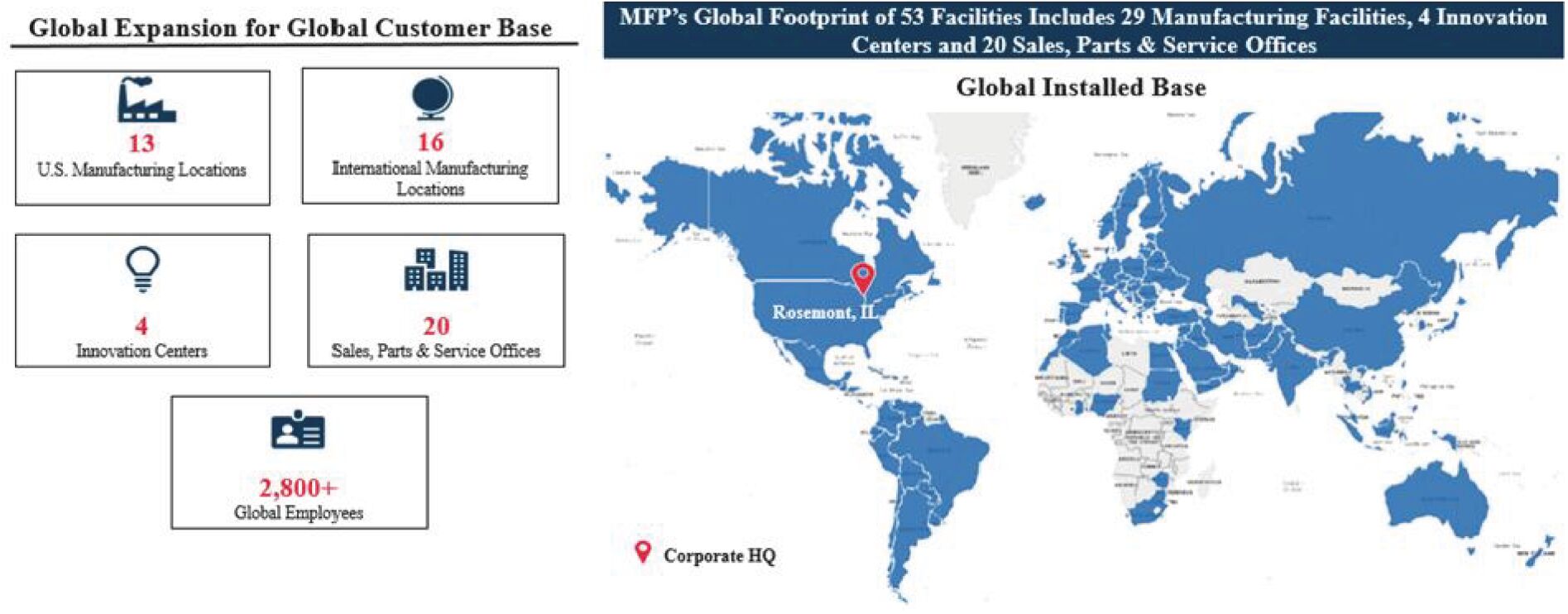
Our customers include a diversified base of some of the largest international food processing companies and producers of protein products, such as bacon, charcuterie, sausage and hot dogs, egg bites, poultry, alternative protein, case ready, lunch meat and pet food, and producers of bakery products, such as bread and buns, artisan bread, sweet goods, cakes and muffins, biscuits, crackers, pizza and pastries, tortilla and snacks. We are witnessing food processors increasingly demand solutions to transform their operations, lowering their total cost of ownership, enhancing food quality and safety and addressing their operational safety and sustainability initiatives. No customer accounts for 10% or more of SpinCo’s net sales. As SpinCo serves a wide variety of markets, customer concentrations are not significant.
Through our broad and synergistic line of innovative technology and solutions, we are able to deliver a wide range of food preparation, thermal processing, slicing/packaging, automation and equipment sanitation solutions to service a variety of food processing requirements demanded by our customers across protein, bakery and snack categories. Further, we offer highly integrated total line solutions, from further processing through end-of-line, designed to provide our customers even greater financial and operational efficiencies. Following the installation of our solutions, we recognize the ongoing value in sustaining performance and reducing downtime during our customers’ food processing operations, and we strive to build upon our growing, profitable aftermarket capabilities to support our intimate customer relationships, which can span multiple decades.
4
Table of Contents
Growing Platform
Since 2005, SpinCo has successfully created a leading portfolio of innovative food processing brands, allocating over $800 million across more than 30 acquisitions. These investments have enabled us to become a leading partner in the global food processing market and expand into new product lines, end markets and geographies, allowing the company to diversify its revenue streams and more effectively insulate itself from a downturn in any one end market. Highlights of our acquisition history are illustrated below.
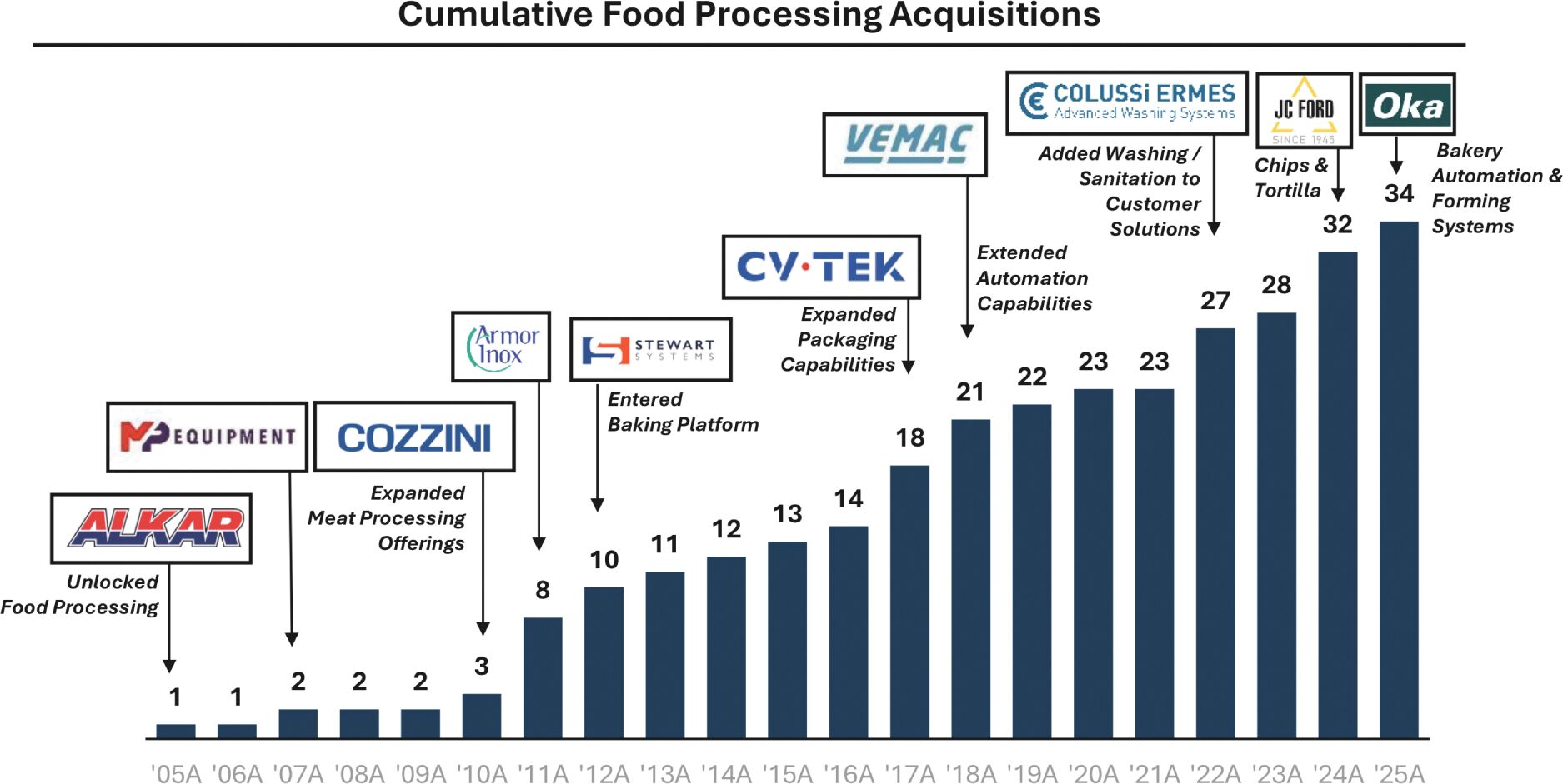
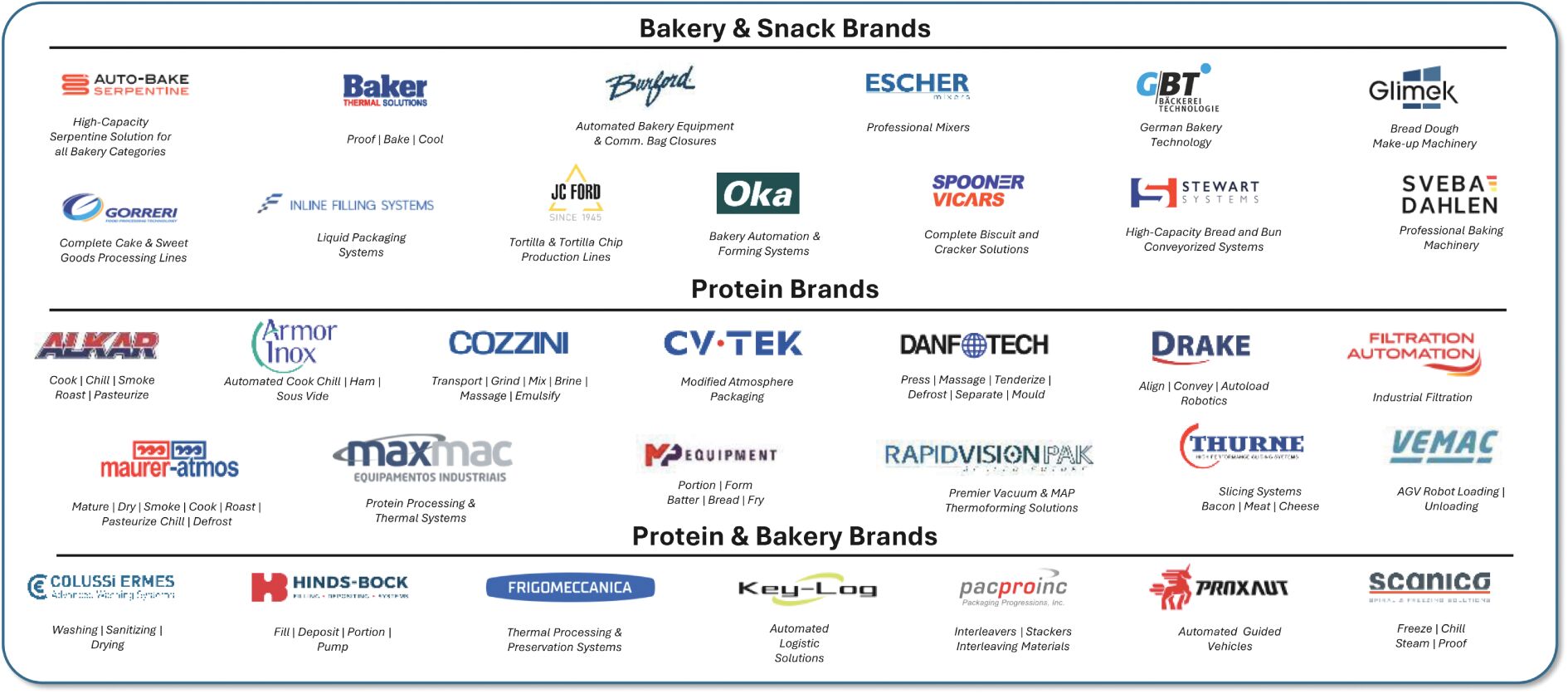
There has been substantial consolidation among food processors across the industry, which is driving a need for equipment and solutions capable of processing large volumes of quality products consistently across the world in quicker cycle times for a variety of end product markets. Through the acquisition and integration of numerous equipment, packaging and automation solutions, SpinCo has created total line solutions for targeted value-added niches of the end product markets including buns, bacon, charcuterie and hot dogs.
5
Table of Contents
We believe the food processing equipment and packaging industry remains substantially fragmented and is in the early stages of a consolidation cycle which presents an opportunity for SpinCo. Our pipeline of prospective M&A targets is robust, and we expect to make strategic investments to offer additional high value solutions for our customers in attractive protein, bakery and snack end markets.
Customer Value Proposition
Through a proven, collaborative, customer-centric operating model, we provide innovative, customized solutions to meet our customers’ evolving needs. We aim to improve our customers’ ROI by lowering their cost of ownership and transforming their operations with unique solutions designed to:
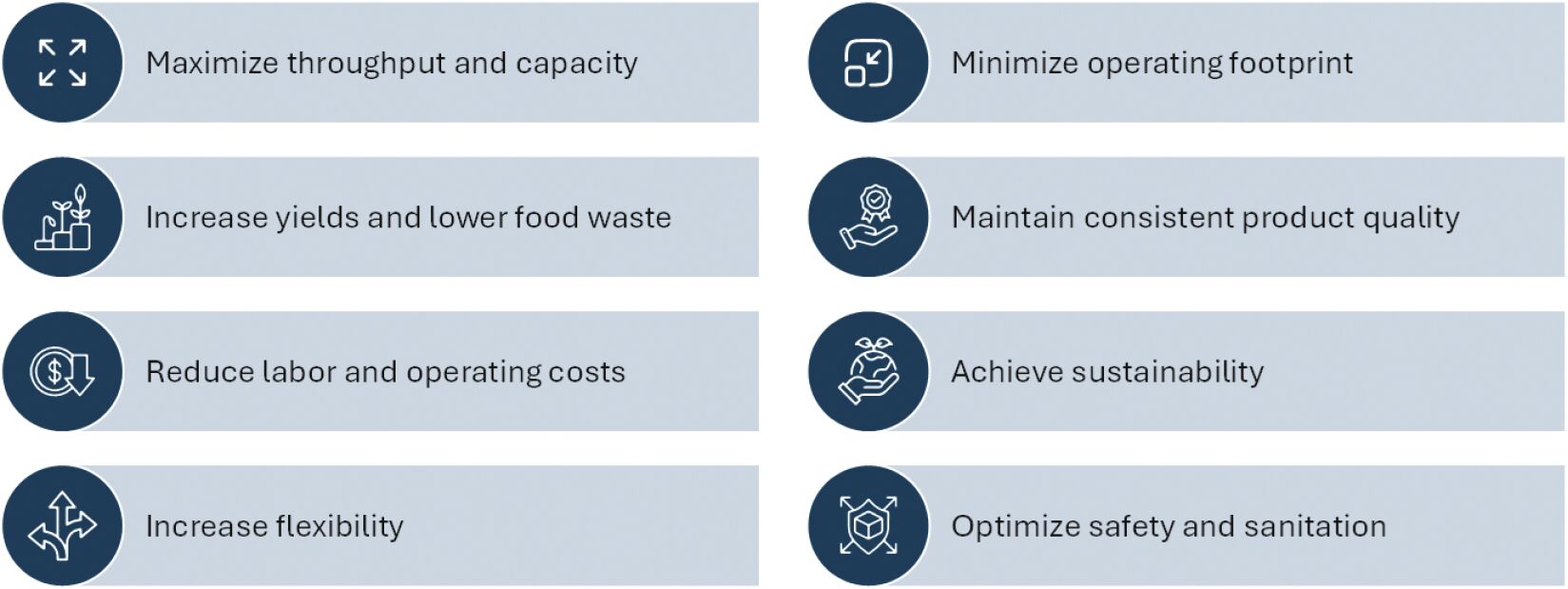
Our Competitive Strengths
| • | Industry-Leading Brands: We have grown to over 30 industry-leading brands across the global protein, bakery and snack food processing markets, led by passionate management teams with extensive experience within the industry. The combination of their proven track record in new technology development, food science, operations management and deep industry knowledge positions us to build upon our long-standing customer relationships, including with some of the largest international food processing companies. The strong balance of brand identity and collaboration on customer success supports both our decentralized operating model and our ability to offer integrated solutions to drive higher ROI for our customers. |
6
Table of Contents
| • | Technology, Automation and Innovation: We develop innovative new products and automation solutions designed to help our customers improve product quality and consistency, increase throughput and yields, reduce operating and capital expenses, maximize sanitation and practice sustainability. We operate four state-of-the-art innovation centers in the United States, Italy and India. The innovative culture of SpinCo is fostered in our innovation centers, havens for development with technical performance and product testing. Food scientists and specialized engineers are readily available and dedicated to helping customers achieve operational efficiency and exceptional product quality. Select highlights of our recent innovative product developments and the range of benefits to our customers are illustrated below: |
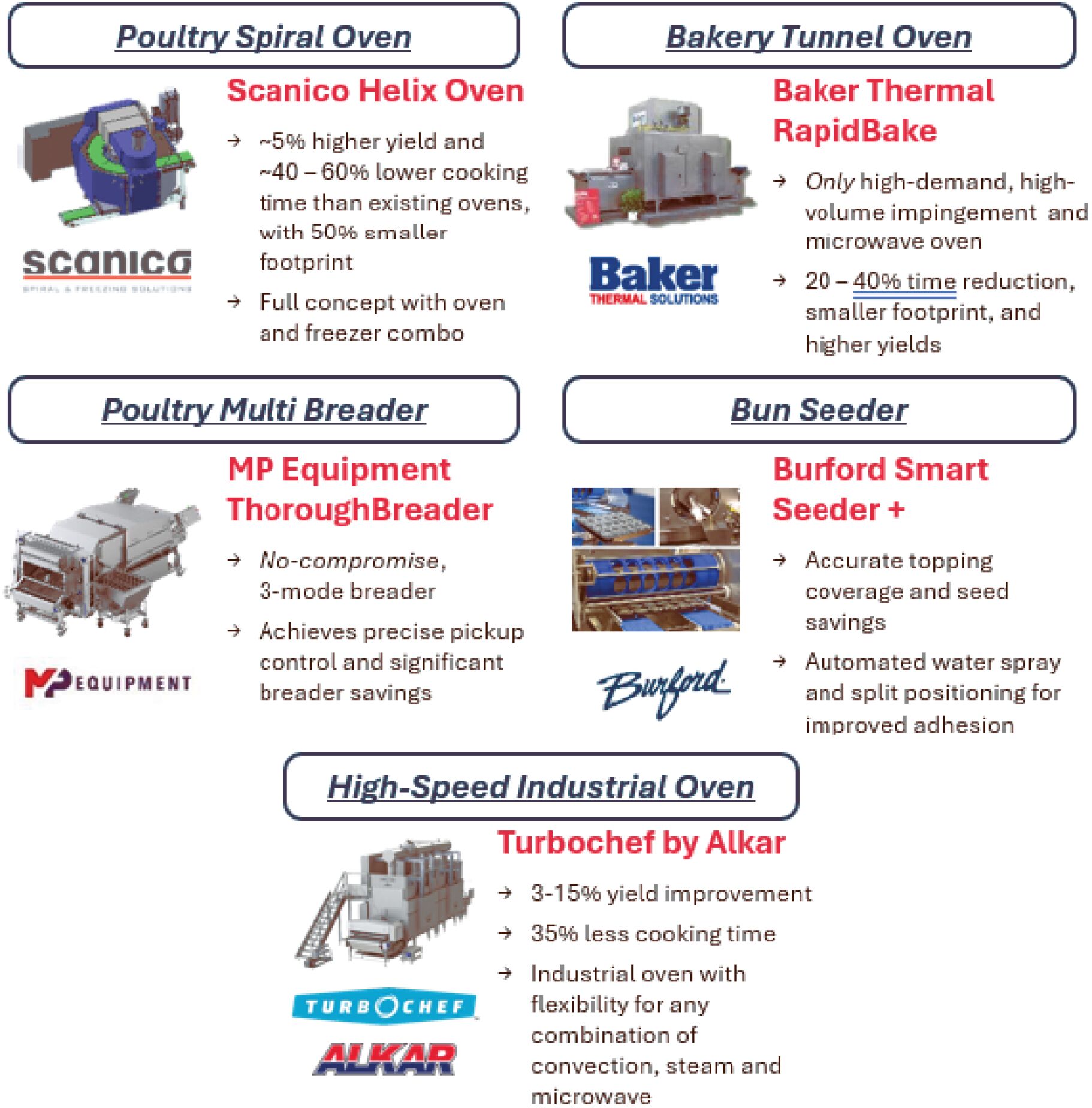
| • | Nimble, Decentralized Operating Model: We empower our brands to operate in an entrepreneurial fashion and take ownership of organic growth and profitability initiatives, while leveraging scaling opportunities at the SpinCo level in customer reach, supply chain and engineering and design services |
7
Table of Contents
| areas. We believe the attractive cash returns generated from this model enable us to enhance our value proposition for customers in an evolving food processing market through strategic organic and inorganic investments. |
| • | M&A Track Record: SpinCo’s industry-leading food processing platform has been built with our expertise in identifying, executing and integrating over 30 strategic acquisitions within SpinCo’s business representing highly complementary brands and product innovations for targeted food applications since 2005. We strive to be the acquirer of choice in part due to our global reach, entrepreneurial operating model and strong corporate culture. As a pure-play food processing company, SpinCo will no longer have to compete for corporate resources and capital to execute on inorganic growth, a benefit which we believe will drive enhanced operating and strategic performance. |
| • | Leadership Team and Culture: Our management team carries deep industry expertise and a commitment to fostering a culture of innovation, collaboration and integrity to drive exceptional value for our customers. |
| • | Obsession with quality, which is our top priority |
| • | Lean cost structure preserving margins and contributing to our competitive advantage |
| • | Knowledgeable and passionate front-line managers who act as our ambassadors |
| • | Innovative spirit that permeates our people and our products |
| • | Entrepreneurial, brand-driven platform, with strong balance of brand identity and collaboration on customer success |
| • | Ease of conducting business, which has led to establishment of a sticky customer base |
| • | Strong global footprint with locally-based teams, designed to enable us to leverage existing relationships and drive continued growth in key markets |
Business and Growth Strategies
| • | Lead with Technology, Automation and Innovation: We expect food processors to increasingly demand new and innovative equipment that addresses food quality and safety, automation, reliability, flexibility and sustainability. We strive to extend our leadership in food processing technology, leveraging our industry expertise and proven, collaborative, customer-centric operating model to be considered the most valuable partner as food processors transform their operations. |
8
Table of Contents
| • | Drive Competitive Advantage with Total Line Solutions: The breadth of our industry-leading food processing brands, manufacturing and service capabilities positions us to offer highly integrated total line solutions in further processing through end-of-line, providing customers a uniquely integrated solution, lowering their total cost of ownership and streamlining their operations relative to disparate solutions across multiple partners. From food preparation, thermal processing, slicing, packaging, automation and equipment sanitation solutions, we are able to construct valuable bundled and full line offerings for the protein and bakery markets, including the illustrative examples shown below: |
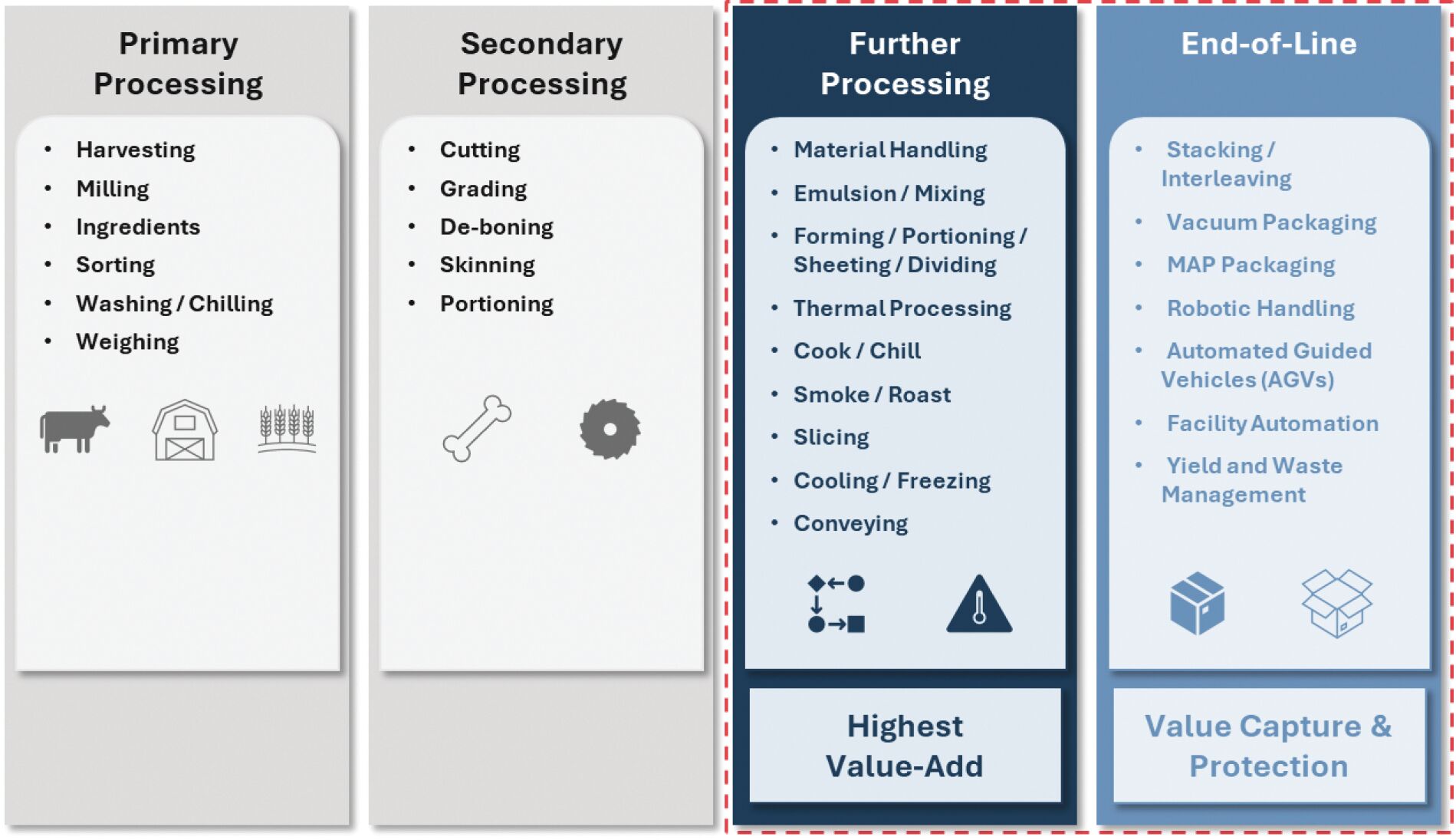
9
Table of Contents
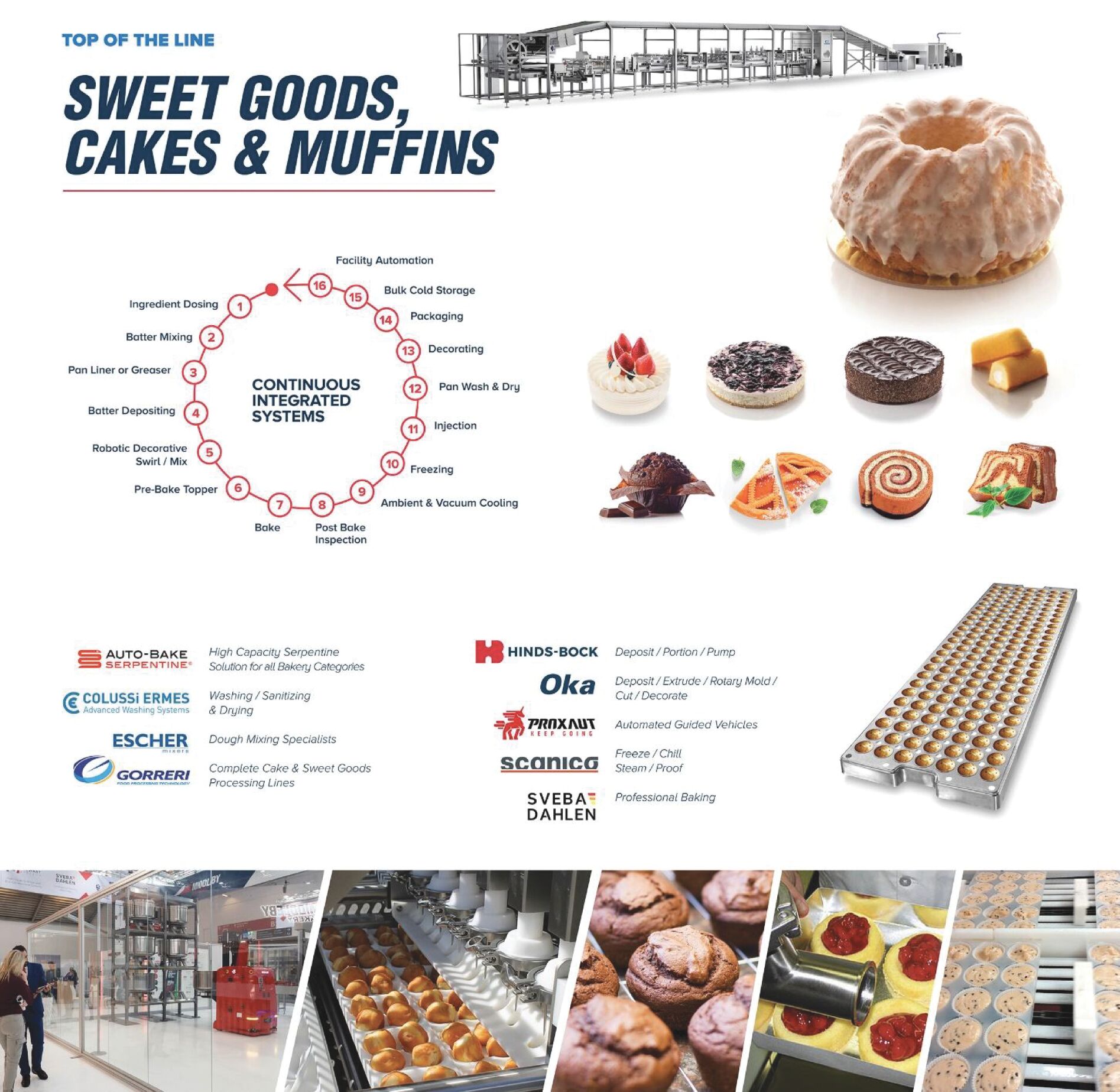
10
Table of Contents
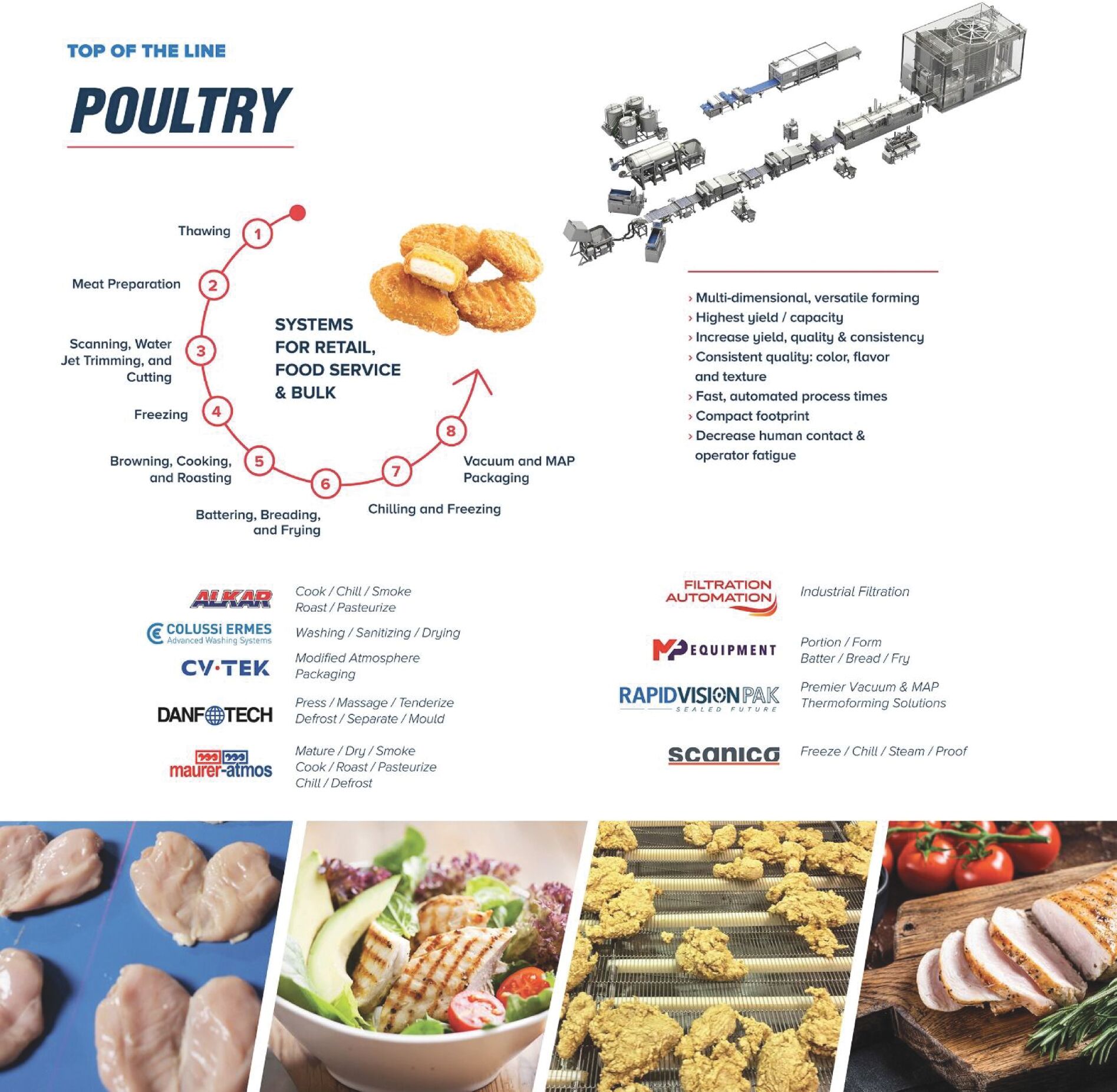
| • | Accelerate Growth and Profitability from Aftermarket: Leveraging our growing, global equipment installed base, we aim to aggressively grow our aftermarket parts and service revenues, maximizing this reoccurring and profitable portion of our portfolio. Our customer relationships include some that span multiple decades, and we recognize the ongoing value in sustaining performance and reducing downtime during food processing operations. We believe further localization of our parts and service platform and strategic investments in software and AI capabilities can allow us to improve speed and quality of service for our customers while expanding these profitable and reoccurring revenue sources. |
11
Table of Contents
| • | Aligned Geographic Presence with Market Opportunity: The global food processing equipment and packaging industry is expected to grow at an annual rate of 3% to 4% through 2028, in part due to tailwinds fueled by secular growth drivers including those listed below. We believe our manufacturing, sales and aftermarket reach positions us well to capitalize on these growth trends including in Asia, Latin America and the Middle East. |
| • | Expanding middle class in developing economies driving purchasing power and accelerated demand for protein, bakery and snack products |
| • | Food security initiatives are leading governments and industries to invest in domestic food processing capabilities to ensure supply chain resilience and support local manufacturing |
| • | M&A as a Strategic Pillar: We expect our strong cash flow generation will allow us to build upon our proven track record and prioritize M&A as a key pillar of our capital allocation strategy. We maintain a robust pipeline of acquisition targets and evaluate opportunities with a focus on driving innovation, advancing our bundled and total line solutions, accessing adjacent markets, improving post-acquisition profitability and generating attractive ROI. |
Our Products
Our products include a comprehensive suite of cooking and baking solutions, including mixers, make-up lines, batch ovens, proofers, conveyor belt ovens, spiral ovens, serpentine ovens and other continuous processing ovens, frying systems and automated thermal processing systems. SpinCo also provides a comprehensive portfolio of complementary food preparation equipment such as tumblers, massagers, grinders, slicers, reduction and emulsion systems, mixers, blenders, battering equipment, breading equipment, seeding equipment, water cutting systems, food presses, food suspension equipment, filling and depositing solutions and forming equipment, as well as a variety of automated loading and unloading systems, automated washing systems, auto-guided vehicles, food safety, food handling, cooling, freezing, defrosting and packaging equipment.
Our Industry
The food processing industry historically was highly fragmented; however, increasing competition has led to more consolidation with the emergence of large conglomerates that possess a variety of food brands. The consolidation of food processing plants associated with industry mergers and acquisitions drives a need for more flexible and efficient equipment that is capable of processing large volumes of consistent quality products in quicker cycle times. In recent years, food processors have had to conform to the demands of “big box” retailers and the restaurant industry, including, most importantly, greater product consistency and exact package weights. Food processors increasingly are partnering with equipment manufacturers like SpinCo that develop technologies offering better process control for proven product consistency, innovative packaging designs and other solutions. To protect their own brands and reputations, retailers and large restaurant chains are also dictating food safety standards that are often stricter than government regulations.
Some of the positive trends and tailwinds we have identified in the industry are as follows:
Increased Importance on Technology and Innovation to Drive Productivity and Profitability
A number of factors, including raw material prices, cost of ownership of their equipment and labor and healthcare costs, are driving food processors to focus on ways to improve their profitability. In order to increase the profitability of and efficiency in processing plants, food processors increasingly pay more attention to the performance and flexibility in the functionality of their equipment. Further, food processors are continuously looking for ways to leverage automation and other solutions to make their plants safer and reduce labor-intensive activities. Food processors are increasingly recognizing the value of new technology as an important vehicle to drive productivity and profitability in their plants. Due to customer requirements, food processors are expected to
12
Table of Contents
continue to demand new and innovative equipment that addresses food safety, food quality, automation, flexibility and sustainability.
Improved Living Standards in Developing Countries Leading to Increased Demand
Improving living standards in developing countries are spurring increased worldwide demand for pre-cooked and convenience food products. As industrializing countries create more jobs, consumers in these countries will have the means to buy pre-cooked food products. In industrialized regions, such as Western Europe and the United States, consumers are demanding more pre-cooked and convenience food products, such as deli tray variety packs, frozen food products and ready-to-eat varieties of ethnic foods.
Change in Consumer Preferences and Sentiment
A number of consumer trends across the industry have begun to change preference towards more attractive and convenient food alternatives, driving demand for supporting food processing equipment. The rise in “snacking culture,” paired with consumer preferences of on-the-go snacking options, has fueled demand for advanced processing equipment in the category. The convenience and ever-growing accessibility of eCommerce as a method of reaching end-consumers aligns with the fast-paced snacking culture, further fueling demand in the category. In the cake & pastry category, evolving celebration culture and growing demand for customized cakes is expected to catalyze demand for equipment.
SpinCo continues to monitor developments in the food industry related to rising consumer adoption of weight-loss treatments including Glucagon-like peptide-1 (GLP-1) products, particularly in the United States and Europe. While the expected long-term effect of such adoption is evolving, we expect a continued rise in adoption of GLP-1 products to create both disruption and opportunity for SpinCo and its food processing customers. The appetite suppression impact of GLP-1 products on its users could result in a decrease in food consumption volumes. However, we also observe changes in the types of food being consumed by GLP-1 users, including a greater focus on foods high in protein. Changes in consumer preferences, including those related to GLP-1 or otherwise, often result in food processors needing to invest in new or modified equipment and technology solutions to meet consumer demand. SpinCo believes it is well-positioned to continue partnering with its food processing customers to deliver solutions allowing them to meet evolving consumer demands.
Shift in Protein Sources
Change in consumer preferences is spearheading a shift from red meat products to other protein sources, such as poultry, driving increased demand in food processing equipment in the category. Red meat’s relatively higher price point versus poultry continues to prove a point of contention for customers making the change.
Emerging Growth Company Status of SpinCo
SpinCo is an “emerging growth company” as defined in the JOBS Act. As such, SpinCo will be eligible to take advantage of certain exemptions from various reporting requirements that apply to other public companies that are not emerging growth companies, including compliance with the auditor attestation requirements of Section 404 of the Sarbanes-Oxley Act and the requirements to hold a non-binding advisory vote on executive compensation and any golden parachute payments not previously approved. We will remain an emerging growth company until the earliest of (i) the last day of the fiscal year following the fifth anniversary of our first sale of equity securities under a Securities Act registration statement, (ii) the last day of the fiscal year in which we have total annual gross revenue of at least $1.235 billion, (iii) the last day of the fiscal year on which we are deemed to be a “large accelerated filer” under the Exchange Act and (iv) the date on which we have issued more than $1 billion in non-convertible debt securities during the prior three-year period.
13
Table of Contents
We have not made a decision whether to take advantage of any or all of these exemptions. If we do take advantage of some or all of these exemptions, some investors may find SpinCo common stock less attractive. If SpinCo common stock becomes publicly traded, the result may be a less active trading market for SpinCo common stock and our stock price may be more volatile.
In addition, Section 107 of the JOBS Act provides that an emerging growth company may take advantage of the extended transition period provided in Section 13(a) of the Exchange Act, for complying with new or revised accounting standards, meaning that we, as an emerging growth company, can delay the adoption of certain accounting standards until those standards would otherwise apply to private companies. We have elected to take advantage of this extended transition period, and therefore our financial statements may not be comparable to those of companies that comply with such new or revised accounting standards. Section 107 of the JOBS Act provides that our decision not to opt out of the extended transition period for complying with new or revised accounting standards is irrevocable.
Summary of Risk Factors
An investment in SpinCo common stock is subject to a number of risks, including risks related to our business, risks related to the spin-off and our separation from Middleby and risks related to SpinCo common stock. Set forth below are some, but not all, of these risks.
Risks Related to the Business
| • | Current and future economic conditions could materially adversely affect our business, financial condition, results of operations, cash flows and prospects; |
| • | Our level of indebtedness could adversely affect our business, financial condition, results of operations, cash flows and prospects; |
| • | We have a significant amount of goodwill and indefinite life intangibles, which could suffer losses due to asset impairment charges; |
| • | We face intense competition in the food processing industry, and failure to successfully compete could impact our results of operations and cash flows; |
| • | We are subject to risks associated with developing products and technologies, which could delay product introductions and result in significant expenditures; |
| • | Price increases in some materials and disruptions in supply could affect our profitability; |
| • | We may be the subject of product liability claims or product recalls, and we may be unable to obtain or maintain insurance adequate to cover potential liabilities; |
| • | An increase in warranty expenses could adversely affect our financial performance; |
| • | Our financial performance is subject to significant fluctuations; |
| • | Our acquisition, investment and alliance strategy involves risks. If we are unable to effectively manage these risks, our business will be materially harmed; |
| • | An inability to identify or complete future acquisitions could adversely affect future growth; |
| • | Expansion of our international operations involves special challenges that we may not be able to meet. Our failure to meet these challenges could adversely affect our business, financial condition, results of operations, cash flows and prospects; |
| • | The impact of future transactions on SpinCo common stock is uncertain; |
14
Table of Contents
| • | We may not be able to adequately protect our intellectual property rights, which may materially harm our business, financial condition, results of operations, cash flows and prospects; |
| • | We are subject to information technology system failures, network disruptions, cybersecurity attacks and breaches in data security, which may materially adversely affect our operations, financial condition and operating results; |
| • | We may be subject to litigation, tax and other legal compliance risks; |
| • | We are subject to potential liability under environmental laws; and |
| • | Unfavorable tax law changes and tax authority rulings may adversely affect financial results. |
Risks Related to the Spin-Off
| • | We may not achieve some or all of the expected benefits of the spin-off, and the spin-off may adversely impact our business, financial condition, results of operations, cash flows and prospects; |
| • | We are being spun-off from our parent company, Middleby, and our historical and pro forma financial information is not necessarily representative of the results that we would have achieved as a separate, publicly traded company and therefore may not be a reliable indicator of our future results; |
| • | In connection with the spin-off, Middleby will indemnify us for certain liabilities. However, there can be no assurance that the indemnity will be sufficient to protect us against the full amount of such liabilities, or that Middleby’s ability to satisfy its indemnification obligation will not be impaired in the future; |
| • | In connection with our separation, we will assume, and indemnify Middleby for, certain liabilities. If we are required to make payments pursuant to these indemnities to Middleby, we would need to meet those obligations and our financial results could be adversely impacted; |
| • | If there is a determination that the distribution of shares of SpinCo common stock or certain related transactions are taxable for U.S. federal income tax purposes, Middleby and its stockholders could incur significant tax liabilities, and we could incur significant liabilities pursuant to our indemnification obligations under the tax matters agreement; |
| • | We may be affected by significant restrictions under the tax matters agreement, including on our ability to engage in certain corporate transactions for a two-year period after the distribution, in order to avoid triggering significant tax-related liabilities; |
| • | The spin-off and related internal restructuring transactions may expose us to potential liabilities arising out of state and federal fraudulent conveyance laws and legal dividend requirements; and |
| • | Following the spin-off, the value of your common stock in Middleby and SpinCo may collectively trade at an aggregate price less than what Middleby common stock might have traded at had the spin-off not occurred. |
Risks Related to SpinCo Common Stock
| • | We cannot be certain that an active trading market for SpinCo common stock will develop or be sustained after the spin-off, and, following the spin-off, our stock price may fluctuate significantly; |
| • | Any sales of substantial amounts of shares of SpinCo common stock in the public market, or the perception that such sales might occur, in connection with the distribution or otherwise, may cause the market price of SpinCo common stock to decline; |
| • | Certain provisions in our amended and restated certificate of incorporation, our amended and restated bylaws and Delaware law may prevent or delay an acquisition of our company, which could decrease the market price of SpinCo common stock; and |
15
Table of Contents
| • | The price of Middleby common stock historically has been volatile, and the price of SpinCo common stock may be volatile as well. This volatility may affect the price at which you could sell SpinCo common stock, and the sale of substantial amounts of SpinCo common stock could adversely affect the price of SpinCo common stock. |
These and other risks relating to our business, the spin-off and SpinCo common stock are discussed in greater detail under the section of this information statement entitled “Risk Factors.” You should read and consider all of these risks carefully.
16
Table of Contents
SUMMARY OF THE SEPARATION AND DISTRIBUTION
The following provides a summary of the terms of the separation and distribution. For a more detailed description of the matters described below, see the section of this information statement entitled “The Separation and Distribution.”
Distributing Company
The Middleby Corporation is a Delaware corporation. Following the spin-off, Middleby will not own any shares of SpinCo common stock.
Distributed Company
Midera Food Processing, Inc. is a Delaware corporation and, prior to the spin-off, a wholly owned subsidiary of Middleby. Middleby formed SpinCo as a corporation in Delaware on July 17, 2025, for the purpose of effectuating the spin-off. SpinCo has engaged in no business activities to date and it has no material assets or liabilities of any kind, other than those incident to its formation and those incurred in connection with the spin-off. Pursuant to a reorganization, prior to the spin-off, we will receive the legal entities containing the Food Processing business of Middleby and its subsidiaries. After completion of the separation and distribution, we will be an independent, publicly traded company.
Distribution Ratio
Each Middleby stockholder will receive one share of SpinCo common stock for every one share of Middleby common stock held of record by such Middleby stockholder as of Central Time on , the record date for the distribution (the “distribution ratio”). Please note that if you sell your shares of Middleby common stock on or before the distribution date, then the buyer of those shares may, in certain circumstances, be entitled to receive the shares of SpinCo common stock distributed on the distribution date.
Distributed Securities
Middleby will distribute all of the shares of SpinCo common stock owned by Middleby, which will be 100% of SpinCo common stock outstanding immediately prior to the distribution. Based on the 45,214,588 shares of Middleby common stock outstanding on May 21, 2026, and applying the distribution ratio of one share of SpinCo common stock for every one share of Middleby common stock, Middleby will distribute 45,214,588 shares of SpinCo common stock to Middleby stockholders who hold Middleby common stock as of the record date.
Record Date
The record date for the distribution is expected to be Central Time on (the “record date for the distribution”).
Distribution Date
The distribution date is expected to be on or about .
17
Table of Contents
Distribution
On the distribution date, Middleby, with the assistance of Computershare Trust Company, N.A. (“Computershare”), the distribution agent, will electronically distribute shares of SpinCo common stock to your bank or brokerage firm on your behalf or through the systems of The Depository Trust Company (“DTC”) (if you hold your shares of Middleby common stock through a bank or brokerage firm that uses DTC) or to you in book-entry form (if you hold your shares of Middleby common stock in book-entry form). You will not be required to make any payment or surrender or exchange your shares of Middleby common stock or take any other action to receive your shares of SpinCo on the distribution date. Your bank or brokerage firm will credit your account for the shares of SpinCo common stock or the distribution agent or the transfer agent will mail you a book-entry account statement that reflects your shares of SpinCo. Please note that if you sell your shares of Middleby common stock on or before the distribution date, then the buyer of those shares may, in certain circumstances, be entitled to receive the shares of SpinCo common stock distributed on the distribution date. For more information, see the section of this information statement entitled “The Separation and Distribution—Trading Between the Record Date and the Distribution Date.”
Distribution Agent
The distribution agent, transfer agent and registrar for SpinCo common stock will be Computershare.
Reasons for the Spin-Off
Middleby has made significant strides in creating a leading Commercial Foodservice business while continuing to strengthen and grow the Food Processing business. To enhance the growth of each of these businesses, the Middleby Board approved a plan to separate Middleby and SpinCo into two independent, publicly traded companies. The spin-off will create two strong, stand-alone businesses, which will have leading positions in the markets they serve and will be better positioned to deliver long-term growth and sustainable value creation for Middleby and SpinCo:
| • | Middleby will focus on the remaining Commercial Foodservice business; and |
| • | SpinCo will hold the Food Processing business. |
The Middleby Board believes that separating the Food Processing business from the remainder of Middleby and distributing shares of SpinCo common stock to Middleby stockholders will create value for Middleby and SpinCo through the following benefits:
| • | Next chapter of growth for highly successful but inherently different businesses that will benefit from a renewed focus on individual core strategies, driving a full valuation in line with best-in-class peers for each of Middleby and SpinCo. |
| • | Creating market-leading businesses, recognized as technology-driven product innovators in their respective industries. |
| • | Enabling the Food Processing business to be valued in-line with key food processing peers. |
| • | Allowing each of Middleby and SpinCo to implement an optimized capital structure and capital allocation policy, best supporting growth opportunities for their respective businesses. |
| • | Creating financial flexibility to pursue optimal growth strategies throughout investment cycles. |
| • | Enhanced financial and strategic impact of M&A for each business. |
| • | Provides greater exposure to and deeper understanding of each of Middleby’s and SpinCo’s standalone growth story, business strategies and performance, aligned with respective macroeconomic trends. |
| • | Focused boards of directors and management teams with deep domain expertise. |
18
Table of Contents
The Middleby Board also considered potentially negative factors in evaluating the spin-off, including:
| • | The potential for increased aggregate ongoing administrative costs for the two companies operating on a stand-alone basis post-spin-off. |
| • | SpinCo and Middleby currently take advantage of pre-spin-off Middleby’s size and purchasing power in procuring certain goods and services. After the spin-off, as standalone companies, SpinCo and/or Middleby may be unable to obtain these goods and services at prices or on terms as favorable as those currently obtained by pre-spin-off Middleby. |
| • | One-time costs we expect to incur related to the spin-off and in connection with the transition to becoming a stand-alone public company that are likely to include, among others, professional services costs, tax expense, recruiting and other costs associated with hiring for two stand-alone corporate structures and costs to separate IT systems and create two separate stand-alone IT structures. |
| • | The potential for execution risks related to the spin-off, including disruption to the business as a result of the spin-off and the possibility that SpinCo and/or Middleby do not achieve the expected benefits of the spin-off for a variety of reasons. |
| • | The spin-off may divert management’s time and attention, which could have a material adverse effect on the business, results of operations, financial condition and cash flows of SpinCo and/or Middleby. |
| • | Following the spin-off, SpinCo and/or Middleby may be more susceptible to market fluctuations and other events particular to one or more of their products than they currently are as pre-spin-off Middleby. |
| • | The potential that reduced business diversification, with each post-spin-off company operating in fewer industries, could increase the volatility of earnings and cash flow. |
| • | Certain costs and liabilities that were otherwise less significant to pre-spin-off Middleby could be more significant to Middleby and/or SpinCo after the spin-off as smaller, stand-alone companies. |
| • | Middleby common stock and SpinCo common stock could experience selling pressure after the spin-off as certain pre-spin-off stockholders may not be interested in holding an investment in one of the two post-spin-off companies. |
| • | Middleby stockholders who have an investment strategy of tracking an index fund may sell the shares of SpinCo common stock that they receive in the distribution if SpinCo is not listed on the same index. As a result, the price of SpinCo common stock may decline or experience volatility as SpinCo’s stockholder base changes. |
The Middleby Board concluded that the potential benefits of the spin-off outweighed these factors and risks. The Middleby Board also considered these potential benefits and potentially negative factors in light of the risk that the spin-off is abandoned or otherwise not completed, resulting in Middleby not separating into two independent, publicly traded companies.
The anticipated benefits of the spin-off are based on a number of assumptions, and there can be no assurance that such benefits will materialize to the extent anticipated, or at all. In the event the spin-off does not result in such benefits, the costs associated with the spin-off could have an adverse effect on each company individually and in the aggregate. For more information, see the sections of this information statement entitled “The Separation and Distribution—General—Reasons for the Spin-Off” and “Risk Factors.”
19
Table of Contents
Conditions to the Distribution
The distribution of SpinCo common stock by Middleby is subject to the satisfaction or waiver of the following conditions, among others:
| • | The SEC will have declared effective the registration statement of which this information statement forms a part, with no stop order relating to the registration statement in effect, and no proceedings for such purpose will be pending before, or threatened by, the SEC. |
| • | Nasdaq will have approved the listing of SpinCo common stock, subject to official notice of issuance. |
| • | Middleby will have received a tax opinion (the “Tax Opinion”) of Skadden, Arps, Slate, Meagher & Flom LLP (“Skadden”), tax counsel to Middleby, substantially to the effect that, among other things, the distribution will qualify as tax-free to Middleby and its stockholders for U.S. federal income tax purposes under Section 355 of the Internal Revenue Code of 1986, as amended (the “Code,” and such treatment, the “Intended Tax Treatment”). See the section of this information statement entitled “Material U.S. Federal Income Tax Consequences of the Distribution.” |
| • | All actions and filings necessary or appropriate under applicable securities laws or “blue sky” laws and the rules and regulations thereunder will have been taken. |
| • | No preliminary or permanent injunction or other order, decree or ruling issued by a governmental authority, and no statute, rule, regulation or executive order promulgated or enacted by any governmental authority, shall be in effect preventing the consummation of, or materially limiting the benefits of, the transactions contemplated by the separation and distribution agreement. |
| • | Those reorganization transactions with respect to the Commercial Foodservice business and Food Processing business to be completed prior to the distribution will have been effectuated in all material respects. |
| • | The Middleby Board shall have declared the distribution and finally approved all related transactions (and such declaration or approval shall not have been withdrawn). |
| • | No event or development shall have occurred or failed to occur that, in the judgment of the Middleby Board, in its sole discretion, prevents the consummation of, or makes it inadvisable to effect the separation, the distribution or the other related transactions. |
| • | Any required governmental approvals necessary to consummate the distribution and the transactions contemplated by the separation and distribution agreement and the ancillary agreements (as defined below) shall have been obtained and be in full force and effect. |
| • | The mailing of this information statement (or notice of internet availability thereof) to record holders of Middleby common stock as of , the record date for the distribution. |
| • | Each of the separation and distribution agreement, the transition services agreement, the tax matters agreement, the employee matters agreement, the intellectual property matters agreement and the other agreements to be entered into to effectuate, or in connection with, the spin-off (other than the separation and distribution agreement, such agreements, collectively, the “ancillary agreements”) shall have been executed and delivered by each party thereto. |
| • | An independent appraisal firm shall have delivered (A) opinions, dated as of (x) the date of the declaration of the distribution by the Middleby Board and (y) the distribution date (or, with respect to clause (y), a bringdown of such opinion as of the distribution date), to the Middleby Board that (1) after giving effect to the consummation of the transactions, (a) the assets of Middleby, at a fair valuation, exceed its debts (including contingent liabilities), (b) Middleby will be able to pay its debts (including contingent liabilities) as they become due and Middleby will not have an unreasonably small amount of |
20
Table of Contents
| either assets or capital for the operations of the business in which it is engaged or in which management has indicated it intends to engage and (2) immediately prior to giving effect to the distribution and pursuant to Section 170 of the General Corporation Law of the State of Delaware (the “DGCL”), the surplus of Middleby exceeds the net amount of the distribution and (B) opinions, dated as of (x) the date of the declaration of the cash dividend to be paid in connection with the transactions by Alkar Holdings Inc. (“SpinCo OpCo”) and (y) the payment date of such cash dividend (or, with respect to clause (y), a bringdown of such opinion as of such payment date), to the Middleby Board, SpinCo Board and board of directors of SpinCo OpCo that (1) after giving effect to the consummation of the transactions, (a) the assets of SpinCo OpCo, at a fair valuation, exceed its debts (including contingent liabilities), (b) SpinCo OpCo will be able to pay its debts (including contingent liabilities) as they become due and SpinCo OpCo not will have an unreasonably small amount of either assets or capital for the operations of the business in which it is engaged or in which management has indicated it intends to engage and (2) immediately prior to giving effect to the dividend and pursuant to Section 180.0640 of the Business Corporations Law of Wisconsin, the fair value of the assets of SpinCo OpCo exceeds the sum of (I) its liabilities (including contingent liabilities) plus (II) the amount that would be needed, if SpinCo OpCo were to be dissolved at the time of the dividend, to satisfy the preferential rights upon dissolution of shareholders whose preferential rights are superior to those receiving the dividend (the opinions to be delivered pursuant to clause (A) and clause (B), collectively, the “Solvency Opinions”); and such Solvency Opinions shall be reasonably acceptable to Middleby in form and substance; and such Solvency Opinions shall not have been withdrawn or rescinded or modified in any respect adverse to Middleby. |
| • | Prior to or substantially concurrently with the distribution, SpinCo and each of its consolidated subsidiaries shall be released from its guaranty and other obligations under Middleby’s financing documents, and all security interests granted over their respective assets (including the equity interests of SpinCo) shall be released. |
| • | SpinCo OpCo shall have consummated the necessary debt financing transactions and paid the related cash dividend. |
Middleby and SpinCo cannot assure you that any or all of these conditions will be met, and the Middleby Board may also waive conditions to the distribution in its sole discretion. If the spin-off is completed and the Middleby Board waives any such condition, such waiver could have a material adverse effect on Middleby’s and SpinCo’s respective business, financial condition or results of operations, including, without limitation, as a result of illiquid trading due to the failure of SpinCo common stock to be accepted for listing, litigation relating to any preliminary or permanent injunctions that sought to prevent the consummation of the spin-off, or the failure of Middleby and SpinCo to obtain any required regulatory approvals. As of the date hereof, the Middleby Board does not intend to waive any of the conditions described herein. Middleby does not intend to notify its stockholders of any modifications to the terms of the spin-off, including the waiver of any conditions to the distribution, that, in the judgment of the Middleby Board, are not material. However, the Middleby Board would likely consider material such matters as significant changes to the distribution ratio, or significant changes to the assets to be contributed or the liabilities to be assumed in the separation, as well as the waiver of the condition that the Middleby Board receives the Tax Opinion with respect to the spin-off. To the extent that the Middleby Board determines that any modification by Middleby materially changes the material terms of the spin-off, including through the waiver of a condition to the distribution, Middleby will notify its stockholders in a manner reasonably calculated to inform them about the modification as may be required by law, by, for example, publishing a press release, filing a current report on Form 8-K or circulating a supplement to this information statement.
The fulfillment of the above conditions will not create any obligation on behalf of Middleby to effect the spin-off, and Middleby may at any time decline to go forward with the spin-off. Until the spin-off has occurred,
21
Table of Contents
Middleby has the right not to complete the spin-off, even if all the conditions have been satisfied, if, at any time prior to the distribution, the Middleby Board determines, in its sole discretion, that the spin-off is not in the best interests of Middleby or its stockholders, that a sale or other alternative is in the best interests of Middleby or its stockholders, or that market conditions or other circumstances are such that it is not advisable at that time to separate the Food Processing business from Middleby. For a more detailed description, see the section of this information statement entitled “The Separation and Distribution—General—Conditions to the Distribution.”
Stock Exchange Listing
We intend to apply to list SpinCo common stock on Nasdaq under the symbol “MFP.”
Tax Considerations
So long as the distribution qualifies for the Intended Tax Treatment, no gain or loss will be recognized by you for U.S. federal income tax purposes, and no amount will be included in your income, for U.S. federal income tax purposes, upon the receipt of shares of SpinCo common stock pursuant to the distribution.
For more information regarding the potential U.S. federal income tax consequences to SpinCo, Middleby and to you of the spin-off, see the section of this information statement entitled “Material U.S. Federal Income Tax Consequences of the Distribution.”
You should consult your tax advisor as to the particular consequences of the spin-off to you, including the applicability and effect of any U.S. federal, state and local, and any foreign, tax laws.
Relationship Between Middleby and SpinCo Following the Spin-Off
Following the completion of the spin-off, Middleby and SpinCo will be independent companies. Middleby will not own any shares of SpinCo common stock, and we expect that the relationship between Middleby and SpinCo will be governed by the ancillary agreements. These agreements will provide for the allocation between SpinCo and Middleby of Middleby and SpinCo’s assets, employees, liabilities and obligations (including employee benefits and tax-related assets and liabilities) attributable to periods prior to, at and after the spin-off. For additional information regarding these agreements, see the sections of this information statement entitled “Risk Factors—Risks Related to the Spin-Off” and “Certain Relationships and Related Transactions.”
Principal Executive Office
As part of the spin-off, SpinCo was incorporated as a corporation in Delaware on July 17, 2025. Our principal executive offices are currently located at 10275 West Higgins Road, Suite 300, Rosemont, IL 60018, and our telephone number is currently (847) 857-6696. We maintain a website at www.midera.com. The information contained on our website, or that can be accessed through our website, neither constitutes part of this information statement nor is incorporated by reference herein, and investors should not rely on any such information in deciding whether to invest in SpinCo common stock.
Reasons for Furnishing This Information Statement; Changes in the Terms of the Spin-Off
This information statement is being furnished solely to provide information to Middleby stockholders who will receive shares of SpinCo common stock in the distribution. It is not, and is not to be construed as, an inducement or encouragement to buy or sell any of our securities. We believe the information contained in this information statement to be accurate as of the date set forth on the cover of this information statement. Changes may occur
22
Table of Contents
after that date, and none of us, Middleby, the Middleby Board or the SpinCo Board undertake any obligation to update such information except in the normal course of our respective disclosure obligations and practices, or as required by applicable law.
Middleby does not intend to notify its stockholders of any modifications to the terms of the spin-off, including the waiver of any conditions to the distribution, that, in the judgment of the Middleby Board, are not material.
However, the Middleby Board would likely consider material matters such as significant changes to the distribution ratio, or significant changes to the assets to be contributed or the liabilities to be assumed in the separation, as well as the waiver of the condition that the Middleby Board receives the Tax Opinion with respect to the spin-off. To the extent that the Middleby Board determines that any modification by Middleby materially changes the material terms of the spin-off, including through the waiver of a condition to the distribution, Middleby will notify Middleby stockholders in a manner reasonably calculated to inform them about the modification as may be required by law, by, for example, publishing a press release, filing a current report on Form 8-K or making available a supplement to this information statement. As of the date hereof, the Middleby Board does not intend to waive any of the conditions described herein.
23
Table of Contents
SUMMARY OF HISTORICAL AND UNAUDITED PRO FORMA CONDENSED COMBINED FINANCIAL DATA
The following tables present certain selected historical combined financial information, which was prepared on a “carve-out” basis in connection with the expected spin-off and has been derived from the consolidated financial statements and historical accounting records of Middleby. The summary historical condensed combined statements of earnings information for the three months ended April 4, 2026 and March 29, 2025 and the summary historical condensed combined balance sheet information as of April 4, 2026 have been derived from our unaudited historical condensed combined financial statements and the accompanying notes included elsewhere in this information statement. The summary historical combined statements of earnings information for the fiscal years ended January 3, 2026, December 28, 2024 and December 30, 2023 and the summary historical combined balance sheets information as of January 3, 2026 and December 28, 2024 have been derived from our audited historical combined financial statements and accompanying notes included elsewhere in this information statement.
The summary unaudited pro forma condensed combined financial information as of April 4, 2026, for the three months ended April 4, 2026, and for the fiscal year ended January 3, 2026 has been derived from our unaudited pro forma condensed combined financial statements included in the section of this information statement entitled “Unaudited Pro Forma Condensed Combined Financial Information.” The unaudited pro forma condensed combined financial statements have been derived from our unaudited historical condensed combined statement of earnings for the three months ended April 4, 2026, our audited historical combined statement of earnings for the fiscal year ended January 3, 2026, and our unaudited historical condensed combined balance sheet as of April 4, 2026. The pro forma adjustments to the unaudited pro forma condensed combined statements of earnings for the three months ended April 4, 2026 and fiscal year ended January 3, 2026 assume that the spin-off and related transactions occurred on December 29, 2024. The unaudited pro forma condensed combined balance sheet information gives effect to the spin-off and related transactions as if they had occurred on April 4, 2026. See “Unaudited Pro Forma Condensed Combined Financial Information.” The unaudited pro forma condensed combined financial information is based upon available information and assumptions that we believe are reasonable and supportable. The unaudited pro forma condensed combined financial information is for illustrative and informational purposes only.
The summary historical combined financial information below is only a summary and should be read in conjunction with the section of this information statement entitled “Management’s Discussion and Analysis of Financial Condition and Results of Operations” as well as our audited historical combined financial statements and accompanying notes and unaudited historical condensed combined financial statements and accompanying notes included elsewhere in this information statement. The unaudited pro forma condensed combined financial information below is only a summary and should be read in conjunction with the section of this information statement entitled “Unaudited Pro Forma Condensed Combined Financial Information.”
The historical combined financial information and the unaudited pro forma condensed combined financial information may not reflect what our financial condition or results of operations would have been had we been a standalone company during the periods presented. In addition, the historical combined financial information and the unaudited pro forma condensed combined financial information may not reflect what our financial condition and results of operations may be in the future. See “Risk Factors—Risks Related to the Spin-Off— We are being spun-off from our parent company, Middleby, and our historical and pro forma financial information is not necessarily representative of the results that we would have achieved as a separate, publicly traded company and therefore may not be a reliable indicator of our future results.”
24
Table of Contents
Combined Statements of Earnings Information
| Pro Forma | Historical | |||||||||||||||||||||||||||
| Three Months Ended |
Fiscal Year |
Three Months Ended | Fiscal Years | |||||||||||||||||||||||||
| (in thousands) | April 4, 2026 |
2025 | April 4, 2026 |
March 29, 2025 |
2025 | 2024 | 2023 | |||||||||||||||||||||
| Net sales |
$ | 225,046 | $ | 853,157 | $ | 225,046 | $ | 168,500 | $ | 853,157 | $ | 771,996 | $ | 759,268 | ||||||||||||||
| Cost of sales |
147,638 | 544,283 | 147,638 | 107,548 | 544,283 | 466,565 | 470,970 | |||||||||||||||||||||
|
|
|
|
|
|
|
|
|
|
|
|
|
|
|
|||||||||||||||
| Gross profit |
77,408 | 308,874 | 77,408 | 60,952 | 308,874 | 305,431 | 288,298 | |||||||||||||||||||||
| Selling, general, and administrative expenses |
59,129 | 245,045 | 59,073 | 45,299 | 207,023 | 146,619 | 138,509 | |||||||||||||||||||||
| Restructuring expenses |
(57 | ) | 519 | (57 | ) | 111 | 519 | 2,620 | 1,839 | |||||||||||||||||||
| Gain on sale of plant |
— | — | — | — | — | (1,139 | ) | — | ||||||||||||||||||||
|
|
|
|
|
|
|
|
|
|
|
|
|
|
|
|||||||||||||||
| Income from operations |
18,336 | 63,310 | 18,392 | 15,542 | 101,332 | 157,331 | 147,950 | |||||||||||||||||||||
| Interest expense (income), net |
3,570 | 14,207 | (2 | ) | (406 | ) | (2,018 | ) | (2,168 | ) | (1,416 | ) | ||||||||||||||||
| Other income, net |
(614 | ) | (8,694 | ) | (614 | ) | (475 | ) | (8,694 | ) | (1,147 | ) | (8,765 | ) | ||||||||||||||
|
|
|
|
|
|
|
|
|
|
|
|
|
|
|
|||||||||||||||
| Earnings before income taxes |
15,380 | 57,797 | 19,008 | 16,423 | 112,044 | 160,646 | 158,131 | |||||||||||||||||||||
| Provision for income taxes |
3,799 | 25,313 | 4,689 | 4,179 | 29,346 | 38,367 | 37,848 | |||||||||||||||||||||
|
|
|
|
|
|
|
|
|
|
|
|
|
|
|
|||||||||||||||
| Net earnings |
$ | 11,581 | $ | 32,484 | $ | 14,319 | $ | 12,244 | $ | 82,698 | $ | 122,279 | $ | 120,283 | ||||||||||||||
|
|
|
|
|
|
|
|
|
|
|
|
|
|
|
|||||||||||||||
Combined Balance Sheets Information
| Pro Forma | Historical | |||||||||||||||
| (in thousands) | April 4, 2026 | April 4, 2026 | January 3, 2026 | December 28, 2024 | ||||||||||||
| Cash and cash equivalents |
$ | 77,929 | $ | 57,929 | $ | 90,913 | $ | 59,221 | ||||||||
| Total assets |
1,426,593 | 1,413,675 | 1,461,013 | 1,282,897 | ||||||||||||
| Current maturities of long-term debt |
4,482 | 4,482 | 4,765 | 1,192 | ||||||||||||
| Long-term debt |
279,547 | 27,547 | 28,722 | 6,450 | ||||||||||||
| Total equity |
776,102 | 1,016,598 | 1,060,737 | 999,787 | ||||||||||||
| Total liabilities and equity |
1,426,593 | 1,413,675 | 1,461,013 | 1,282,897 | ||||||||||||
25
Table of Contents
QUESTIONS AND ANSWERS ABOUT THE SEPARATION AND DISTRIBUTION
| What is SpinCo and why is Middleby separating SpinCo’s business and distributing SpinCo common stock? |
SpinCo currently is a wholly owned subsidiary of Middleby that was formed to hold assets and liabilities related to the Food Processing business. The separation of SpinCo from Middleby and the distribution of SpinCo common stock are intended to provide you with equity investments in two separate companies, each of which will be able to focus on their respective businesses. Middleby and SpinCo believe that the spin-off will result in enhanced long-term performance of each business for the reasons discussed in the section of this information statement entitled “The Separation and Distribution—General—Reasons for the Spin-Off.” |
| Why am I receiving this document? |
Middleby is making this document available to you because you are a holder of Middleby common stock. If you are a holder of Middleby common stock as of Central Time on , the record date for the distribution, you will be entitled to receive a number of shares of SpinCo common stock equal to the distribution ratio for each share of Middleby common stock that you hold at such time. This document will help you understand how the separation and distribution will affect your investment in Middleby and your investment in SpinCo after the spin-off. |
| How will the spin-off of SpinCo from Middleby work? |
To effect the spin-off, Middleby will undertake a series of internal reorganization transactions pursuant to which, among other transactions, SpinCo will hold the Food Processing business and Middleby will distribute 100% of the outstanding shares of SpinCo common stock as of the distribution date to Middleby stockholders on a pro rata basis as a distribution. Following the completion of the spin-off, SpinCo, holding the Food Processing business, will be an independent, publicly traded company. |
| What business will SpinCo engage in after the spin-off? |
SpinCo will continue to focus on the Food Processing business. For additional details regarding SpinCo’s business, see the section of this information statement entitled “Business.” |
| Why is the spin-off of SpinCo structured as a distribution? |
Middleby believes that a distribution of shares of SpinCo common stock to Middleby stockholders, which Middleby intends to be tax-free for U.S. federal income tax purposes, is an efficient way to separate the Food Processing business in a manner that is expected to create long-term benefits and value for Middleby and SpinCo. Middleby will not retain any shares of SpinCo common stock following the spin-off. |
26
Table of Contents
| What will be distributed in the distribution? |
As a holder of Middleby common stock, you will receive a dividend of a number of shares of SpinCo common stock equal to the distribution ratio for each share of Middleby common stock you hold as of Central Time on , the record date for the distribution. Your proportionate interest in Middleby will not change as a result of the distribution. For a more detailed description, see the section of this information statement entitled “The Separation and Distribution.” |
| What is the record date for the distribution? |
The record date for the distribution is Central Time on . |
| When will the distribution occur? |
It is expected that 100% of the shares of SpinCo common stock held by Middleby will be distributed by Middleby on or about , to holders of record of Middleby common stock as of Central Time on , the record date for the distribution. However, no assurance can be provided as to the timing of the distribution or that all conditions to the distribution will be met. |
| Is a stockholder vote required to approve the spin-off? |
No stockholder vote is required to approve the spin-off. |
| What do stockholders need to do to participate in the distribution? |
Middleby stockholders entitled to receive shares of SpinCo common stock in the distribution will not be required to take any action to receive SpinCo common stock in the distribution, but you are urged to read this entire information statement carefully. No stockholder approval of the distribution is required. You are not being asked for a proxy. You do not need to pay any consideration or exchange or surrender your existing Middleby common stock or take any other action to receive your shares of SpinCo common stock. |
| What will govern my rights as a SpinCo stockholder? |
Your rights as a SpinCo stockholder will be governed by Delaware law, as well as our amended and restated certificate of incorporation and our amended and restated bylaws. Except with respect to the exclusive forum provisions, there are no material changes in stockholder rights between the stockholder rights at Middleby and SpinCo. For additional details regarding SpinCo common stock and SpinCo stockholder rights, see the section of this information statement entitled “Description of Capital Stock.” |
| Will I receive physical certificates representing shares of SpinCo common stock following the spin-off? |
No. Following the spin-off, SpinCo will not issue physical certificates representing shares of SpinCo common stock, even if requested. If you own Middleby common stock as of the record date for the distribution, Middleby, with the assistance of the distribution agent, will electronically distribute shares of SpinCo common stock to you or to your brokerage firm on your behalf by way of direct registration form. “Direct registration form” refers to a method of recording share |
27
Table of Contents
| ownership when no physical share certificates are issued to stockholders, as is the case in this distribution. The distribution agent or the transfer agent will mail you a book-entry account statement that reflects your shares of SpinCo common stock, or your bank or brokerage firm will credit your account for the shares. |
| Following the spin-off, stockholders whose shares are held in book-entry form may request that their shares of SpinCo common stock held in book-entry form be transferred to a brokerage or other account at any time. |
| How many shares of SpinCo common stock will I receive in the distribution? |
Middleby will distribute to you a number of shares of SpinCo common stock equal to the distribution ratio for each share of Middleby common stock held by you as of the record date for the distribution. Based on 45,214,588 shares of Middleby common stock outstanding as of May 21, 2026, an aggregate of 45,214,588 shares of SpinCo common stock will be distributed. For additional information on the distribution, see the section of this information statement entitled “The Separation and Distribution.” |
| What are the conditions to the distribution? |
The distribution of SpinCo common stock by Middleby is subject to the satisfaction or waiver of the following conditions, among others: |
| • | The SEC will have declared effective the registration statement of which this information statement forms a part, with no stop order relating to the registration statement in effect, and no proceedings for such purpose will be pending before, or threatened by, the SEC. |
| • | Nasdaq will have approved the listing of SpinCo common stock, subject to official notice of issuance. |
| • | Middleby will have received the Tax Opinion from its tax counsel, Skadden, substantially to the effect that, among other things, the distribution will qualify for the Intended Tax Treatment. See the section of this information statement entitled “Material U.S. Federal Income Tax Consequences of the Distribution.” |
| • | All actions and filings necessary or appropriate under applicable securities laws or “blue sky” laws and the rules and regulations thereunder will have been taken. |
| • | No preliminary or permanent injunction or other order, decree or ruling issued by a governmental authority, and no statute, rule, regulation or executive order promulgated or enacted by any governmental authority, shall be in effect preventing the consummation of, or materially limiting the benefits of, the transactions contemplated by the separation and distribution agreement. |
28
Table of Contents
| • | Those reorganization transactions with respect to the Commercial Foodservice business and Food Processing business to be completed prior to the distribution will have been effectuated in all material respects. |
| • | The Middleby Board shall have declared the distribution and finally approved all related transactions (and such declaration or approval shall not have been withdrawn). |
| • | No event or development shall have occurred or failed to occur that, in the judgment of the Middleby Board, in its sole discretion, prevents the consummation of, or makes it inadvisable to effect the separation, the distribution or the other related transactions. |
| • | Any required governmental approvals necessary to consummate the distribution and the transactions contemplated by the separation and distribution agreement and the ancillary agreements shall have been obtained and be in full force and effect. |
| • | The mailing of this information statement (or notice of internet availability thereof) to record holders of Middleby common stock as of , the record date for the distribution. |
| • | Each of the ancillary agreements shall have been executed and delivered by each party thereto. |
| • | An independent appraisal firm shall have delivered the Solvency Opinions; and such Solvency Opinions shall be reasonably acceptable to Middleby in form and substance; and such Solvency Opinions shall not have been withdrawn or rescinded or modified in any respect adverse to Middleby. |
| • | Prior to or substantially concurrently with the distribution, SpinCo and each of its consolidated subsidiaries shall be released from its guaranty and other obligations under Middleby’s financing documents, and all security interests granted over their respective assets (including the equity interests of SpinCo) shall be released. |
| • | SpinCo OpCo shall have consummated the debt financing transactions and paid the related cash dividend. |
| • | Middleby and SpinCo cannot assure you that any or all of these conditions will be met, and the Middleby Board may also waive conditions to the distribution in its sole discretion. Middleby may decline at any time to go forward with the distribution, whether or not the conditions are satisfied, and the spin-off would then not occur. For a more detailed description, see the section of this information statement entitled “The Separation and Distribution—General—Conditions to the Distribution.” |
29
Table of Contents
| What is the expected date of completion of the spin-off? |
The completion and timing of the spin-off are dependent upon a number of conditions. It is expected that the shares of SpinCo common stock will be distributed by Middleby on or about to the holders of record of Middleby common stock as of the record date for the distribution. However, no assurance can be provided as to the timing of the spin-off or that all conditions to the spin-off will be met. |
| Can Middleby decide to cancel the spin-off even if all the conditions have been met? |
Yes. The spin-off will not be effective until the distribution is complete. The distribution is subject to the satisfaction or waiver by Middleby of certain conditions. See “The Separation and Distribution—General—Conditions to the Distribution.” The fulfillment of such conditions will not create any obligation on behalf of Middleby to effect the spin-off, and Middleby may at any time decline to go forward with the spin-off. Until the spin-off has occurred, Middleby has the right not to complete the distribution, even if all the conditions have been satisfied, if, at any time prior to the distribution, the Middleby Board determines, in its sole discretion, that the spin-off is not in the best interests of Middleby or its stockholders, that a sale or other alternative is in the best interests of Middleby or its stockholders, or that market conditions or other circumstances are such that it is not advisable at that time to separate the Food Processing business from Middleby. |
| What if I want to sell my Middleby common stock or my SpinCo common stock? |
You should consult with your financial advisors, such as your stockbroker, bank or tax advisor. |
| What is “regular-way” and “ex-distribution” trading? |
Beginning on or shortly before the record date for the distribution and continuing up to and through the distribution date, it is expected that there will be two markets in Middleby common stock: a “regular-way” market and an “ex-distribution” market. Shares of Middleby common stock that trade in the “regular-way” market will trade with an entitlement to shares of SpinCo common stock distributed pursuant to the distribution. Shares that trade in the “ex-distribution” market will trade without an entitlement to shares of SpinCo common stock distributed pursuant to the distribution. Each stockholder trading in shares of Middleby common stock would make any decision as to whether to trade one or more of such stockholder’s shares of Middleby common stock in the “regular-way” market or the “ex-distribution” market. |
| If you decide to sell any shares of your Middleby common stock after the record date for the distribution and before the distribution date, you should make sure your stockbroker, bank or other nominee understands whether you want to sell your Middleby common stock with or without your entitlement to SpinCo common stock pursuant to the distribution. |
30
Table of Contents
| Where will I be able to trade shares of SpinCo common stock? |
SpinCo intends to apply to list its common stock on Nasdaq under the symbol “MFP.” SpinCo expects that trading in shares of SpinCo common stock will begin on a “when-issued” basis shortly before the distribution date and will continue up to and through the distribution date and that “regular-way” trading in SpinCo common stock will begin on the first trading day following the distribution date. “When-issued” trading refers to a sale or purchase made conditionally because the security has been authorized but not yet issued. If trading begins on a “when-issued” basis, you may purchase or sell SpinCo common stock up to and through the distribution date, but your transaction will not settle until after the distribution date. SpinCo cannot predict the trading prices for SpinCo common stock before, on or after the distribution date. |
| What will happen to the listing of Middleby common stock? |
Prior to the completion of the spin-off, Middleby will continue to trade on Nasdaq under the symbol “MIDD.” Any changes to Middleby’s name or ticker symbol will be announced separately by Middleby. |
| Will the number of shares of Middleby common stock that I own change as a result of the distribution? |
No. The number of shares of Middleby common stock that you own will not change as a result of the distribution. |
| What are the U.S. federal income tax consequences of the separation and distribution? |
It is a condition to the completion of the distribution that Middleby receives the Tax Opinion, substantially to the effect that, among other things, the distribution will qualify for the Intended Tax Treatment, although this condition may be waived by Middleby in its sole discretion. |
| Accordingly, and so long as the distribution qualifies for the Intended Tax Treatment, no gain or loss will be recognized by you for U.S. federal income tax purposes, and no amount will be included in your income, for U.S. federal income tax purposes, upon the receipt of shares of SpinCo common stock pursuant to the distribution. |
| For more information regarding the potential U.S. federal income tax consequences of the spin-off to SpinCo, Middleby and to you, see the section of this information statement entitled “Material U.S. Federal Income Tax Consequences of the Distribution.” |
| You should consult your tax advisor as to the particular consequences of the spin-off to you, including the applicability and effect of any U.S. federal, state and local, and any foreign tax laws. |
31
Table of Contents
| How will I determine my tax basis in the SpinCo shares I receive in the distribution? |
Assuming that the distribution is tax-free to Middleby stockholders for U.S. federal income tax purposes, your aggregate tax basis in your shares of Middleby common stock held by you immediately prior to the distribution will be allocated between your shares of Middleby common stock and the shares of SpinCo common stock that you receive in the distribution in proportion to the relative fair market values of each immediately following the distribution. Middleby will provide its stockholders with information to enable them to compute their tax basis in both shares of Middleby common stock and shares of SpinCo common stock. This information will be posted on Middleby’s website following the distribution date. |
| You should consult your tax advisor about the particular consequences of the spin-off to you, including a situation where you have purchased shares at different times or for different amounts and the application of state, local and foreign tax laws. |
| For a more detailed description, see the section of this information statement entitled “Material U.S. Federal Income Tax Consequences of the Distribution.” |
| What will SpinCo’s relationship be with Middleby following the spin-off? |
Following the completion of the spin-off, Middleby and SpinCo will be independent companies. Middleby will not retain any SpinCo common stock following the distribution, and we expect that the relationship between Middleby and SpinCo will be governed by the ancillary agreements. These agreements will provide for the allocation between SpinCo and Middleby of Middleby’s and SpinCo’s assets, employees, liabilities and obligations (including employee benefits and tax-related assets and liabilities) attributable to periods prior to, at and after the spin-off. For additional information regarding these agreements, see the sections of this information statement entitled “Risk Factors—Risks Related to the Spin-Off” and “Certain Relationships and Related Transactions.” |
| Will I have appraisal rights in connection with the distribution? |
No. Holders of Middleby common stock are not entitled to appraisal rights in connection with the distribution. |
| Are there risks associated with owning SpinCo common stock? |
Yes. Ownership of SpinCo common stock is subject to both general and specific risks relating to SpinCo’s business, the industry in which it operates, its ongoing contractual relationships with Middleby and its status as a separate, publicly traded company. Ownership of SpinCo common stock is also subject to risks relating to the spin-off, including that following the spin-off, SpinCo’s business will be less diversified than Middleby’s business prior to the spin-off. These risks are described in the section of this information statement entitled “Risk Factors.” You are encouraged to read that section carefully. |
32
Table of Contents
| Who will manage SpinCo after the spin-off? |
Following the spin-off, SpinCo will be led by Mark M. Salman, who will be SpinCo’s Chief Executive Officer. |
| For more information regarding SpinCo’s expected named executive officers and other members of its management team, see the section of this information statement entitled “Management.” |
| What will SpinCo’s dividend policy be after the spin-off? |
We do not currently intend to pay any cash dividends in the foreseeable future. We currently intend to retain all available funds and future earnings, if any, for the operation of our business and to strengthen our financial position and flexibility. The payment of any cash dividends in the future will be at the discretion of the SpinCo Board and will depend upon our results of operations, earnings, capital requirements and general financial condition, as well as applicable law, regulatory constraints, industry practice and other factors deemed relevant by the SpinCo Board. In addition, the terms governing our current or future debt may also limit or prohibit dividend payments. Accordingly, we cannot guarantee that we will ever pay dividends in the future or that we would continue to pay any dividends that we may commence in the future. |
| In addition, under Delaware law, the SpinCo Board may declare dividends only to the extent of our surplus (which is defined as total assets at fair market value, minus total liabilities, minus statutory capital) or, if there is no surplus, out of our net profits for the then-current and/or immediately preceding fiscal year. For more information regarding SpinCo’s dividend policy, see the section of this information statement entitled “Dividend Policy.” |
| What will happen to Middleby equity awards in connection with the spin-off? |
Any equity awards relating to shares of Middleby common stock that are outstanding at the time of distribution will be adjusted to reflect the impact of the separation. Middleby RSU and PSU awards outstanding and held by SpinCo employees, former employees and non-employee directors (if any) immediately prior to the spin-off will be converted into RSU and PSU awards (as applicable) denominated in shares of SpinCo common stock, such number of shares to be determined using a conversion ratio intended to preserve the intrinsic value of the awards. Middleby RSU and PSU awards outstanding and held by Middleby employees, former employees and non-employee directors immediately prior to the spin-off will be converted into adjusted Middleby RSU and PSU awards (as applicable), continuing to be denominated in shares of Middleby common stock, such adjusted number of Middleby shares to be determined using a conversion ratio intended to preserve the intrinsic value of the awards. In either case of SpinCo and Middleby PSU awards, the SpinCo or Middleby Board (or respective applicable committee thereof), as applicable, will adjust the performance measures applicable to any PSU awards relating to their respective entity. |
33
Table of Contents
| For further discussion of the treatment of equity awards in relation to the spin-off, see the section of this information statement entitled “Certain Relationships and Related Transactions—Material Agreements with Middleby—Employee Matters Agreement.” |
| Will the distribution of SpinCo common stock affect the market price of Middleby common stock? |
As a result of the distribution, we expect the trading price of shares of Middleby common stock to be different from the trading price of Middleby common stock immediately prior to the distribution because the trading price will no longer reflect the combined value of the businesses. Furthermore, until the market has fully analyzed the value of Middleby without the business comprising SpinCo, the price of shares of Middleby common stock may fluctuate. There can be no assurance that, following the spin-off, the combined value of Middleby common stock and SpinCo common stock will equal or exceed what the value of Middleby common stock would have been as of the same time and date in the absence of the distribution. |
| Will SpinCo incur any debt prior to or at the time of the distribution? |
SpinCo expects to enter into certain financing arrangements prior to or substantially concurrent with the spin-off. However, no assurance can be given whether such financing arrangements will occur in the anticipated time frame or on favorable terms, or at all. |
| Who will be the distribution agent, transfer agent and registrar for SpinCo common stock? |
The distribution agent, transfer agent and registrar for SpinCo common stock will be Computershare. For questions relating to the transfer or mechanics of the stock distribution, you should contact Computershare’s toll free number at (800) 522-6645. |
| Where can I find more information about Middleby and SpinCo? |
If you have any questions relating to Middleby, you should contact: |
| The Middleby Corporation |
1400 Toastmaster Drive
Elgin, Illinois 60120
Attention: Investor Relations
Telephone: (847) 741-3300
Website: https://investors.middleby.com
| After the distribution, SpinCo stockholders who have any questions relating to SpinCo should contact SpinCo through any means set forth below, or at the phone numbers or email addresses posted on our website, www.midera.com. |
Midera Food Processing, Inc.
10275 West Higgins Road,
Suite 300
Rosemont, Illinois 60018
Attention: Investor Relations
Telephone: (847) 857-6696
Website: www.midera.com
34
Table of Contents
The risks and uncertainties described below could materially and adversely impact our business, financial condition, results of operations, cash flows and prospects, could cause actual results to differ materially from our expectations, and could cause the market value of our stock to decline. You should consider these risk factors when evaluating us and SpinCo common stock and when reading the rest of this information statement, including the sections entitled “Business” and “Management’s Discussion and Analysis of Financial Condition and Results of Operations” and our financial statements and related notes included elsewhere in this document. These risk factors may not include all of the important factors that could affect our business or our industry or that could cause our future financial results to differ materially from historic or expected results or cause the market price of SpinCo common stock to fluctuate or decline. Additional risks and uncertainties not currently known to us or that we currently believe are immaterial also may impair our business, financial condition, results of operations, cash flows and prospects.
Risks Related to the Business
Economic Risks
Current and future economic conditions could materially adversely affect our business, financial condition, results of operations, cash flows and prospects.
SpinCo’s operating results are impacted by the health of the North American, European, Middle Eastern, Asian and Latin American economies. SpinCo’s business and financial performance, including collection of its accounts receivable, may be materially adversely affected by current and future economic conditions that may cause a decline in business and consumer spending, a reduction in the availability of credit and decreased growth of its existing customers, resulting in customers electing to delay the replacement of aging equipment. Higher energy costs, fluctuating interest rates, financial market volatility, inflation, recession, global hostilities and acts of terrorism, tariffs or changes in tariff policies have and may in the future also adversely affect SpinCo’s business and financial performance. For example, recent significant trade policy and tariff actions by the U.S. government and many other countries have created significant uncertainty and potential risks for SpinCo. The tariffs imposed to date have increased the cost of certain raw materials and components. There can be no assurance of SpinCo’s ability to offset the impact of these tariffs, fully or at all. Furthermore, the imposition of retaliatory tariffs from other countries on SpinCo’s exported products could negatively affect demand and future sales volumes. The long-term effects of current and future tariffs and any future trade policy changes on the global economy and the industries in which the company operates remain uncertain and could have a material adverse effect on our business, results of operations or financial condition. Furthermore, SpinCo may experience difficulties in scaling its operations due to economic pressures in the U.S. and international markets.
We are subject to currency fluctuations and other risks from our operations outside the United States.
SpinCo has manufacturing and distribution operations located in Asia, Europe and Latin America. SpinCo’s operations are subject to the impact of economic downturns, political instability and foreign trade restrictions, which may adversely affect SpinCo’s business, financial condition and operating results. SpinCo anticipates that international sales will continue to account for a significant portion of consolidated net sales in the foreseeable future. Some sales and operating costs of SpinCo’s foreign operations are realized in local currencies, and an increase in the relative value of the U.S. dollar against such currencies would lead to a reduction in consolidated sales and earnings. Additionally, foreign currency exposures are not fully hedged, and there can be no assurance that SpinCo’s future results of operations will not be adversely affected by currency fluctuations. Furthermore, currency fluctuations may affect the prices paid to SpinCo’s suppliers for materials SpinCo uses in production. As a result, operating margins may also be negatively impacted by worldwide currency fluctuations that result in higher costs for certain cross-border transactions.
35
Table of Contents
Business and Operational Risks
Our level of indebtedness could adversely affect our business, financial condition, results of operations, cash flows and prospects.
In connection with the separation, SpinCo expects to incur and utilize debt financing in its capital structure, and in the future, SpinCo may incur additional debt. The amount of debt may be substantial and may be on terms less favorable to us than those historically provided to Middleby. To the extent SpinCo requires additional capital resources, there can be no assurance that such funds will be available on favorable terms, or at all. The unavailability of funds could have a material adverse effect on SpinCo’s financial condition, results of operations and ability to expand SpinCo’s operations.
SpinCo’s level of indebtedness could have adverse consequences to its business and operations, including the following:
| • | SpinCo may be unable to obtain additional financing for working capital, capital expenditures, product development, acquisitions and other general corporate purposes; |
| • | a significant portion of SpinCo’s cash flow from operations may be dedicated to debt service, which reduces the amount of cash SpinCo has available for other purposes; |
| • | SpinCo may be more vulnerable in the event of a downturn in SpinCo’s business or general economic and industry conditions and have limited flexibility in planning for, or reacting to, changes in its business and/or industry; |
| • | SpinCo may be disadvantaged compared to its competitors that are less leveraged and thereby have greater financial flexibility; and |
| • | SpinCo may be restricted in its ability to make strategic acquisitions and to pursue new business opportunities. |
Fluctuations in interest rates could adversely affect our results of operations and financial position.
SpinCo’s profitability has been and may in the future be adversely affected during any periods of unexpected or rapid increases in interest rates. A significant increase in any of the forgoing rates would significantly increase SpinCo’s cost of borrowings, reduce the availability and increase the cost of obtaining new debt and refinancing existing indebtedness and/or negatively impact the market price of SpinCo common stock.
We have a significant amount of goodwill and indefinite life intangibles, which could suffer losses due to asset impairment charges.
SpinCo’s balance sheet includes a significant amount of goodwill and indefinite life intangible assets, which represent approximately 34% and 9%, respectively, of its total assets as of January 3, 2026. The excess of the purchase price over the fair value of assets acquired, including identifiable intangible assets, and liabilities assumed in conjunction with acquisitions is recorded as goodwill. In accordance with Accounting Standards Codification 350, Intangibles-Goodwill and Other, SpinCo’s goodwill and indefinite life intangibles are reviewed for impairment annually and whenever events or changes in circumstances indicate that the carrying amount of an asset may not be recoverable. In assessing the recoverability of goodwill and indefinite life intangibles, SpinCo considers changes in economic conditions and makes assumptions regarding estimated future cash flows and other factors. Various uncertainties, including continued adverse conditions in the capital markets or changes in general economic conditions, could impact the future operating performance at one or more of SpinCo’s businesses, which could significantly affect SpinCo’s valuations and could result in additional future impairments. Also, estimates of future cash flows are judgments based on SpinCo’s experience and knowledge of operations. These estimates could be significantly impacted by many factors, including changes in global and local business and economic conditions, operating costs, inflation, competition and consumer and demographic
36
Table of Contents
trends. If SpinCo’s estimates or the underlying assumptions change in the future, SpinCo may be required to record impairment charges that, if incurred, could have a material adverse effect on SpinCo’s reported net earnings.
We face intense competition in the food processing industry, and failure to successfully compete could impact our results of operations and cash flows.
SpinCo operates in a highly competitive industry. In the food processing industry, competition is based on a variety of factors, including product features and design, brand recognition, reliability, durability, technology, energy efficiency, breadth of product offerings, price, customer relationships, delivery lead-times, serviceability and after-sale service. SpinCo has numerous competitors in the food processing industry. Many of SpinCo’s competitors are substantially larger and enjoy substantially greater financial, marketing, technological and personnel resources. These factors may enable them to develop similar or superior products, to provide lower cost products and to carry out their business strategies more quickly and efficiently than SpinCo can. In addition, some competitors focus on particular product lines or geographic regions or emphasize their local manufacturing presence or local market knowledge. Some competitors have different pricing structures and may be able to deliver their products at lower prices. Although SpinCo believes that the performance and price characteristics of its products will provide competitive solutions for its customers’ needs, there can be no assurance that SpinCo’s customers will continue to choose SpinCo’s products over products offered by its competitors.
Further, the markets for SpinCo’s products are characterized by changing technology and evolving industry standards, including a focus on developing and manufacturing energy efficient products in a sustainable way. SpinCo’s ability to compete successfully will depend, in large part, on its ability to enhance and improve its existing products, including its energy efficient products and products manufactured through a process designed to reduce emissions, to continue to bring innovative products to market in a timely fashion, to adapt SpinCo’s products to the needs and standards of its current and potential customers and to continue to improve operating efficiencies and lower manufacturing costs. Moreover, competitors may develop technologies or products that render SpinCo’s products obsolete or less marketable. If SpinCo is unable to successfully compete in this highly competitive environment, SpinCo’s business, financial condition and operating results will be materially harmed.
To remain competitive, we need to rapidly and successfully develop and introduce complex new solutions in a global, competitive, demanding and changing environment.
If SpinCo loses its significant technology advantage in its products and services, its market share and growth could be materially adversely affected. In addition, if SpinCo is unable to deliver products, features and functionality as projected, SpinCo may be unable to meet its commitments to customers, which could have a material adverse effect on its reputation and business. Investments into new equipment can involve significant development time, high upfront investments and the need for careful market validation. Significant investments in research and development efforts that do not lead to successful products, features and functionality could also materially adversely affect SpinCo’s business, financial condition and results of operations. SpinCo’s business, financial condition, results of operations and cash flows could be materially adversely affected by competing technology.
We are subject to risks associated with developing products and technologies, which could delay product introductions and result in significant expenditures.
The product, program and service needs of SpinCo’s customers change and evolve regularly, and SpinCo invests substantial amounts in research and development efforts to pursue advancements in a wide range of technologies, products and services. Also, SpinCo continually seeks to refine and improve upon the performance, utility and physical attributes of its existing products and to develop new products. As a result, SpinCo’s business is subject to risks associated with new product and technological development, including unanticipated technical or other problems, meeting development, production, certification and regulatory approval schedules, execution of
37
Table of Contents
internal and external performance plans, availability of supplier- and internally-produced parts and materials, performance of suppliers and subcontractors, hiring and training of qualified personnel, achieving cost and production efficiencies, identification of emerging technological trends in SpinCo’s target end-markets, validation of innovative technologies, the level of customer interest in new technologies and products and customer acceptance of SpinCo’s products and products that incorporate technologies that SpinCo develops. These factors involve significant risks and uncertainties. Also, any development efforts divert resources from other potential investments in SpinCo’s businesses, and these efforts may not lead to the development of new technologies or products on a timely basis or meet the needs of SpinCo’s customers as fully as competitive offerings. In addition, the markets for SpinCo’s products or products that incorporate SpinCo’s technologies may not develop or grow as SpinCo anticipates. SpinCo or its suppliers and subcontractors may encounter difficulties in developing and producing these new products and services, and may not realize the degree or timing of benefits initially anticipated. Due to the design complexity of SpinCo’s products, SpinCo may in the future experience delays in completing the development and introduction of new products. Any delays could result in increased development costs or deflect resources from other projects. The occurrence of any of these risks could cause a substantial change in the design, delay in the development, or abandonment of new technologies and products. Consequently, there can be no assurance that SpinCo will develop new technologies superior to SpinCo’s current technologies or successfully bring new products to market.
Additionally, there can be no assurance that new technologies or products, if developed, will meet SpinCo’s current price or performance objectives, be developed on a timely basis, or prove to be as effective as products based on other technologies. The inability to successfully complete the development of a product, or a determination by SpinCo, for financial, technical or other reasons, not to complete development of a product, particularly in instances in which SpinCo has made significant expenditures, could have a material adverse effect on SpinCo’s financial condition and operating results.
Price increases in some materials and disruptions in supply could affect our profitability.
SpinCo uses large amounts of stainless steel, aluminized steel and other commodities in the manufacture of its products. Significant increases in the prices of steel or any other commodity, or changes in trade policies, including the imposition of tariffs or other trade restrictions, have in the past created, and have the potential in the future to create, upward pressure on commodity prices, leading to a potentially unfavorable impact on operating results. Unanticipated delays in delivery of raw materials and component inventories by suppliers—including delays due to capacity constraints, labor disputes, attacks on maritime ocean shipments, impaired financial condition of suppliers, natural disasters, extreme weather patterns and climate change, pandemics or other events outside of our control—have and may increase SpinCo’s production costs, cause delays in the shipment of products or impair the ability of SpinCo to satisfy customer demand. An interruption in or the cessation of an important supply by any third party and SpinCo’s inability to make alternative arrangements in a timely manner, or at all, could have a material adverse effect on SpinCo’s business, financial condition and operating results.
Changes to trade regulation, quotas, duties or tariffs, caused by the changing U.S. and geopolitical environments or otherwise, may increase our costs or limit the amount of raw materials and products that we can import, or may otherwise adversely impact our business, financial condition, results of operations, cash flows and prospects.
The U.S. government imposes the import duties or other restrictions on products or raw materials sourced from countries that it perceives as engaging in unfair trade practices. For instance, since 2018, the U.S. government has imposed tariffs on steel and aluminum imports and on specified imports from China. In response to these tariffs, several major U.S. trading partners have imposed, or announced their intention to impose, tariffs on U.S. goods. SpinCo imports raw materials from China and other such countries subject to these tariffs. Any such duties or restrictions could have a material adverse effect on SpinCo’s business, results of operations or financial condition.
38
Table of Contents
Moreover, these tariffs, or other changes in U.S. trade policy, could trigger retaliatory actions by affected countries. A “trade war” of this nature or other governmental action related to tariffs or international trade agreements or policies has the potential to adversely impact demand for SpinCo’s products, SpinCo’s costs, customers, suppliers and/or the U.S. economy or certain sectors thereof and, thus, to adversely impact SpinCo’s businesses.
Our business may be adversely affected by the imposition of new, postponed or increased tariffs, trade sanctions or similar government actions.
Our operations in various countries and jurisdictions subject us to the legal, political, regulatory and social requirements and economic conditions in these jurisdictions. The recent imposition by the United States of tariffs, sanctions or other restrictions on goods exported from the United States or imported into the United States, or countermeasures imposed in response to such government actions, could increase the cost of goods for our products or reduce our ability to sell our products globally, which may adversely affect our operating results and financial condition. The materials subject to these new tariffs may impact the cost or availability of raw materials used by our suppliers or in our customers’ products. We may not be able to fully mitigate the impact of these increased costs or pass price increases on to our customers. The situation around tariffs is fluid and we cannot predict further developments, and any existing or future tariffs could have a material adverse effect on our results of operations, financial position and cash flows.
Additionally, the imposition of further tariffs by the United States on a broader range of imports, or further retaliatory trade measures taken by other countries’ governments in response to additional tariffs imposed by the United States, could increase costs in our supply chain or reduce demand for our and/or our customers’ products, either of which could adversely affect our results of operations. Any increase in trade-related costs associated with such measures may impair the profitability of our international production, may strain our suppliers’ ability to reliably provide inputs necessary to produce our products, and may otherwise affect our abilities to provide our products at previously contracted prices. Tariffs may also indirectly impair our business by causing a negative effect on global economic conditions and financial markets. Modifying our business operations to continuously adapt to or comply with rapidly evolving tariffs may be time-consuming and costly. The ultimate impact of these trade measures on our business operations and financial results is uncertain and may be affected by various factors, including whether and when such trade measures are implemented, when such trade measures may become effective, and the amount, scope and nature of such trade measures, as well as our ability to execute strategies to mitigate any negative impacts.
An increase in energy or raw material prices may reduce the profitability of our customers, which ultimately could negatively affect our business, financial condition, results of operations and cash flows.
Energy prices are volatile globally, but are especially high as a result of ongoing geopolitical conflicts including in Ukraine, Iran and the Middle East. High energy prices have a negative trickledown effect on SpinCo’s customers’ business operations by reducing their profitability because of increased operating costs. SpinCo’s customers require large amounts of energy to run their businesses and higher energy prices also increase food processors’ operating costs through increased energy and utility costs to run their plants, higher priced chemical and petroleum based raw materials used in food processing, and higher fuel costs to run their logistics and service fleet vehicles.
Food processors are also affected by the cost and availability of raw materials such as feed grains, livestock, produce and dairy products. Increases in the cost and limitations in the availability of such raw materials can negatively affect the profitability of food processors’ operations. In particular, during recessions and economic downturns, levels of investment by food processors in greenfield and large projects, standard equipment and modernization may decline. A protracted decline in investment levels by SpinCo’s customers may reduce SpinCo’s revenues generated by greenfield and large projects and sales of modernization and standard equipment and related installations and negatively impact the growth of SpinCo’s installed base, thereby also impeding
39
Table of Contents
growth in aftermarket revenue opportunities in the longer term. Any reduction in SpinCo’s customers’ profitability due to higher energy or raw material costs or otherwise may reduce their future expenditures for the food processing equipment that SpinCo provides. This reduction may have a material adverse effect on SpinCo’s business, financial condition, results of operations and cash flows.
Changes in food consumption patterns due to dietary trends or economic conditions may adversely affect our business, financial condition, results of operations and cash flows.
Dietary trends can create demand for protein food products but negatively impact demand for high-carbohydrate foods, or create demand for easy to prepare, transportable meals but negatively impact traditional canned food products. Because different food types and food packaging can quickly go in and out of style as a function of dietary, health, convenience or sustainability trends, food processors can be challenged in accurately forecasting their needed manufacturing capacity and the related investment in equipment and services. Rising food and other input costs, and recessionary fears, may negatively impact our customer’s ability to forecast consumer demand for protein products or processed food products and as a result negatively impact our customer’s demand for our goods and services. A demand shift away from protein products or processed foods could have a material adverse effect on our business, financial condition, results of operations, cash flows and prospects.
Changes in eating habits could reduce demand from our customer base, which could adversely affect our business, financial condition, results of operations, cash flows and prospects. For example, there is a growing dietary preference for plant based/alternative proteins. If dietary preferences change significantly, we may be required to modify our sales strategy or invest in new or modified equipment or technology solutions, and we may experience losses as a result. Furthermore, new and current medical treatments such as GLP-1 agonists, which suppress a person’s appetite, may shift dietary preferences and impact consumer demand for our products. Our failure to quickly and effectively adapt to any significant shift in dietary preference could materially adversely affect our financial performance.
We face risks related to health epidemics and other widespread outbreaks of contagious disease, which could significantly disrupt our operations and impact our operating results.
The spread of contagious diseases or other adverse public health developments has had a material and adverse effect on our business operations. These effects have, in the past, included and may in the future include disruptions or restrictions on our ability to travel, temporary closures of our or our customers’ facilities and disruptions to our supply chain. Any disruption of our, our suppliers’ or our customers’ businesses due to adverse public health developments could have a material impact on our sales and operating results.
We may be the subject of product liability claims or product recalls, and we may be unable to obtain or maintain insurance adequate to cover potential liabilities.
Product liability is a significant commercial risk to SpinCo. SpinCo’s business exposes it to potential liability risks that arise from the manufacturing, marketing and selling of SpinCo’s products. In addition to direct expenditures for damages, settlement and defense costs, there is a possibility of adverse publicity as a result of product liability claims. Plaintiffs in some jurisdictions have received substantial damage awards against companies based upon claims for injuries allegedly caused by the use of their products. In addition, it may be necessary for SpinCo to recall products that do not meet approved specifications, which could result in adverse publicity as well as costs connected to the recall and loss of revenue.
SpinCo cannot be certain that a product liability claim or series of claims brought against it would not have an adverse effect on SpinCo’s business, financial condition or results of operations. If any claim is brought against SpinCo, regardless of the success or failure of the claim, there can be no assurance that SpinCo will be able to obtain or maintain product liability insurance in the future on acceptable terms or with adequate coverage against potential liabilities or the cost of a recall. SpinCo will maintain insurance programs consisting of self-insurance
40
Table of Contents
up to certain limits and excess insurance coverage for claims over established limits. There can be no assurance that SpinCo’s insurance programs will provide adequate protection against actual losses. In addition, SpinCo is subject to the risk that one or more of its insurers may become insolvent or become unable to pay claims that may be made in the future.
An increase in warranty expenses could adversely affect our financial performance.
SpinCo offers purchasers of its products warranties covering workmanship and materials typically for one year and, in certain circumstances, for longer periods, during which periods SpinCo or an authorized service representative will make repairs and replace parts that have become defective in the course of normal use. SpinCo estimates and records its future warranty costs based upon past experience. These warranty expenses may increase in the future and may exceed SpinCo’s warranty reserves, which, in turn, could adversely affect SpinCo’s financial performance.
Our financial performance is subject to significant fluctuations.
SpinCo’s financial performance is subject to quarterly and annual fluctuations due to a number of factors, including:
| • | general economic conditions; |
| • | the lengthy, unpredictable sales cycle for food processing equipment; |
| • | the gain or loss of significant customers; |
| • | unexpected delays in new product introductions; |
| • | the level of market acceptance of new or enhanced versions of SpinCo’s products; |
| • | unexpected changes in the levels of SpinCo’s operating expenses; and |
| • | competitive product offerings and pricing actions. |
Each of these factors could result in a material and adverse change in SpinCo’s business, financial condition, results of operations and prospects.
We may be unable to manage our growth.
SpinCo may experience rapid growth in its business, which could place a strain on SpinCo’s management, operations and financial resources. There also will be additional demands on SpinCo’s sales, marketing and information systems and on SpinCo’s administrative infrastructure as it develops and offers additional products and enters new markets. SpinCo cannot be certain that SpinCo’s operating and financial control systems, administrative infrastructure, outsourced and internal production capacity, facilities and personnel will be adequate to support SpinCo’s future operations or to effectively adapt to future growth. If SpinCo cannot manage SpinCo’s growth effectively, SpinCo’s business may be harmed.
Strategic and Organizational Risks
Our acquisition, investment and alliance strategy involves risks. If we are unable to effectively manage these risks, our business will be materially harmed.
To achieve SpinCo’s strategic objectives, SpinCo may pursue strategic acquisitions of and investments in other companies, businesses or technologies. Acquisitions and investments entail numerous risks, including, among others:
| • | difficulties in the assimilation of acquired businesses or technologies and the inability to fully realize some of the expected synergies or otherwise achieve anticipated revenues and profits; |
41
Table of Contents
| • | inability to operate acquired businesses or utilize acquired technologies profitably; |
| • | the significant amount of management time and attention needed to identify, execute and integrate any acquired businesses; |
| • | potential assumption of unknown material liabilities; |
| • | failure to achieve financial or operating objectives; |
| • | unanticipated costs relating to acquisitions or to the integration of acquired businesses; |
| • | loss of customers, suppliers or key employees; and |
| • | the impact on SpinCo’s internal controls and compliance with the regulatory requirements under the Sarbanes-Oxley Act. |
SpinCo may not be able to successfully integrate any operations, personnel, services or products that it may acquire in the future.
SpinCo may seek to expand or enhance some of its operations by forming joint ventures or alliances with various strategic partners throughout the world. Entering into joint ventures and alliances also entails risks, including difficulties in developing and expanding the businesses of newly formed joint ventures, exercising influence over the activities of joint ventures in which SpinCo does not have a controlling interest and potential conflicts with SpinCo’s joint venture or alliance partners. SpinCo cannot assure that any joint venture or alliance entered into or that may be entered into in the future will be successful.
An inability to identify or complete future acquisitions could adversely affect future growth.
SpinCo intends to implement a growth strategy of identifying and acquiring businesses with complementary products and services by pursuing acquisitions that provide opportunities for profitable growth. While SpinCo evaluates potential acquisitions, it may not be able to identify and successfully negotiate suitable acquisitions, obtain financing for future acquisitions on satisfactory terms, obtain regulatory approval for certain acquisitions or otherwise complete acquisitions in the future. An inability to identify or complete future acquisitions could limit SpinCo’s growth.
Expansion of our international operations involves special challenges that we may not be able to meet. Our failure to meet these challenges could adversely affect our business, financial condition, results of operations, cash flows and prospects.
SpinCo plans to expand its international operations. SpinCo faces certain risks inherent in doing business in international markets. These risks include:
| • | extensive regulations and oversight, tariffs, including with respect to certain products imported from China or exported to China, retaliatory tariffs by China and certain other countries in response to tariffs implemented by the United States and other trade barriers; |
| • | withdrawal from or renegotiation of international trade agreements and other restrictions on trade between the United States and China, the European Union, Canada, Mexico and other countries; |
| • | uncertain impact on operations, suppliers and customers related to business disruptions in international jurisdictions; |
| • | reduced protection for intellectual property rights; |
| • | difficulties in staffing and managing foreign operations; |
| • | potentially adverse tax consequences and adverse changes in tax laws; |
| • | limitations on ownership and on repatriation of earnings; |
42
Table of Contents
| • | transportation delays and interruptions; |
| • | political, social and economic instability and disruptions; |
| • | labor unrests or shortages; |
| • | potential for nationalization of enterprises; and |
| • | limitations on SpinCo’s ability to enforce legal rights and remedies. |
In addition, SpinCo is and will be required to comply with the laws and regulations of foreign governmental and regulatory authorities of each country in which SpinCo conducts business.
There can be no assurance that SpinCo will be able to succeed in marketing its products and services in international markets. SpinCo may also experience difficulty in managing its international operations because of, among other things, competitive conditions overseas, geopolitical threats or hostilities, management of foreign exchange risk, established domestic markets and language and cultural differences. Any of these factors could have a material adverse effect on the success of SpinCo’s international operations and, consequently, on SpinCo’s business, financial condition and operating results.
The impact of future transactions on SpinCo common stock is uncertain.
SpinCo will periodically review potential transactions related to products or product rights and businesses complementary to SpinCo’s business. Such transactions could include mergers, acquisitions, joint ventures, alliances or licensing agreements. In the future, SpinCo may choose to enter into such transactions at any time. The impact of transactions on the market price of SpinCo common stock is often uncertain and may include substantial fluctuations. Consequently, any announcement of any such transaction could have a material adverse effect upon the market price of SpinCo common stock. Moreover, depending upon the nature of any transaction, SpinCo may experience a charge to earnings, which could be material and have an adverse impact upon the market price of SpinCo common stock.
Our business could suffer in the event of labor disruptions, changes in laws and other labor regulations and increases to our labor expenses.
Because SpinCo has 104 workers whose employment is subject to collective bargaining agreements and who are represented by a union, works council or other employee representative body, SpinCo is vulnerable to possible organized work stoppages and similar actions. Employees represented by unions or works councils accounted for approximately 4% of SpinCo’s workforce as of January 3, 2026. SpinCo has union contracts with employees at its facilities in Algona, Iowa and Lodi, Wisconsin that extend through December 2026 and December 2027, respectively. Less than 2% of SpinCo’s workforce is covered by collective bargaining agreements that expire within one year. Any future strikes, employee slowdowns or similar actions by one or more unions or works councils, in connection with labor contract negotiations or otherwise, could have a material adverse effect on SpinCo’s ability to operate its business. While SpinCo has not experienced any material work stoppages at any of its facilities, any stoppage or slowdown could cause material interruptions in SpinCo’s business, and it cannot assure investors that alternate qualified personnel would be available on a timely basis, or at all.
While SpinCo is already subject to oversight by works councils in certain European countries, if SpinCo becomes subject to oversight by any works councils in additional jurisdictions, it may be required to consult with such works councils with respect to certain decisions and to provide specific information and records upon request. Any failure to engage with or provide information to a works council could result in actual or threatened legal challenges or proceedings. Additionally, consultation with and/or obtaining approvals from works councils may involve additional expense and unanticipated delays, particularly if SpinCo is required to make changes to accommodate feedback and recommendations from such works councils. If consultations with a works council does not yield a desired result, or if a works council withholds or delays its approvals, SpinCo may be unable to
43
Table of Contents
execute key transactions in a timely fashion or at all, which may impede the ability of SpinCo to execute its growth strategy and/or have a material adverse effect on its business, financial condition and results of operations.
We depend significantly on our key personnel.
SpinCo depends significantly on SpinCo’s executive officers and certain other key personnel, who could be difficult to replace. The incapacity, inability or unwillingness of certain personnel to perform their services may have a material adverse effect on SpinCo. There is intense competition for qualified personnel within SpinCo’s industry, and there can be no assurance that SpinCo will be able to continue to attract, motivate and retain personnel with the skills and experience needed to successfully manage SpinCo’s business and operations.
Technology and Cybersecurity Risks
We may not be able to adequately protect our intellectual property rights, which may materially harm our business, financial condition, results of operations, cash flows and prospects.
SpinCo relies primarily on trade secret, copyright, service mark, trademark and patent law and contractual protections to protect SpinCo’s proprietary technology and other proprietary rights. It is possible that third parties may copy or otherwise obtain and use SpinCo’s proprietary technology without authorization or may otherwise infringe on SpinCo’s rights. In some cases, including with respect to a number of SpinCo’s most important products, there may be no effective legal recourse against duplication by competitors as the legal systems of certain countries, particularly certain developing countries, do not favor the enforcement of patents and other intellectual property protection. This could make it difficult for us to stop the infringement of our patents and future patents we may own, or, generally, prevent the marketing of competing products in violation of our proprietary rights. Further, the laws of some foreign countries do not protect proprietary rights to the same extent or in the same manner as the laws of the United States. In the future, SpinCo may have to rely on litigation to enforce its intellectual property rights, protect its trade secrets, determine the validity and scope of the proprietary rights of others or defend against claims of infringement or invalidity. Any such litigation, whether successful or unsuccessful, could result in substantial costs to SpinCo and diversions of SpinCo’s resources, either of which could adversely affect SpinCo’s business.
Any infringement by us of a third party’s patent rights could result in litigation and adversely affect our ability to provide, or could increase the cost of providing, our products and services.
Patents of third parties may have an important bearing on SpinCo’s ability to offer some of its products and services. SpinCo’s competitors, as well as other companies and individuals, may obtain patents related to the types of products and services SpinCo offers or plans to offer. There can be no assurance that SpinCo is or will be aware of all patents containing claims that may pose a risk of infringement by its products and services. In addition, some patent applications in the United States are confidential until a patent is issued and, therefore, SpinCo cannot evaluate the extent to which its products and services may be covered or asserted to be covered by claims contained in pending patent applications. In general, if one or more of SpinCo’s products or services were to infringe patents held by others, SpinCo may be required to stop developing or marketing the products or services, to obtain licenses from the holders of the patents to develop and market the services, or to redesign the products or services in such a way as to avoid infringing on the patent claims. SpinCo cannot assess the extent to which it may be required in the future to obtain licenses with respect to patents held by others, whether such licenses would be available or, if available, whether it would be able to obtain such licenses on commercially reasonable terms. If SpinCo is unable to obtain such licenses, it also may not be able to redesign SpinCo’s products or services to avoid infringement, which could materially adversely affect SpinCo’s business, financial condition and operating results.
44
Table of Contents
We are subject to information technology system failures, network disruptions, cybersecurity attacks and breaches in data security, which may materially adversely affect our operations, financial condition and operating results.
SpinCo depends on information technology as an enabler to improve the effectiveness of its operations and to interface with its customers, as well as to maintain financial accuracy and efficiency. Information technology system failures, including suppliers’ or vendors’ system failures, could in the future disrupt SpinCo’s operations by causing transaction errors, processing inefficiencies, delays or cancellation of customer orders, the loss of customers, impediments to the manufacture or shipment of products, other business disruptions or the loss of or damage to intellectual property through a security breach.
SpinCo’s information systems, or those of its third-party service providers, have and may in the future be intent on extracting information, corrupting information or disrupting business processes. Such unauthorized access could materially disrupt SpinCo’s business, increase costs and/or result in the loss of assets. Cybersecurity attacks are becoming more sophisticated and include, but are not limited to, malicious software, attempts to gain unauthorized access to data and other electronic security breaches that could lead to disruptions in critical systems, unauthorized release of confidential or otherwise protected information, corruption or destruction of data and other manipulation or improper use of systems or networks. These events could negatively impact SpinCo’s customers and/or reputation and lead to financial losses from remediation actions, loss of business, production downtimes, operational delays or potential liability, penalties, fines or other increases in expense, all of which may have a material adverse effect on SpinCo’s business. In addition, as security threats and cybersecurity and data privacy and protection laws and regulations, including those related to the collection, storage, handling, use, disclosure, transfer and security of personally identifiable information, continue to evolve and become more sophisticated, we may invest additional resources in the security of our systems. Any such increased investment could materially increase our costs and adversely affect our financial condition or results of operations. Further, as governmental authorities around the world continue to consider legislative and regulatory proposals concerning data protection in addition to those already in place, we are and may continue to be subject to substantial penalties if we fail to comply with data protection laws and regulations.
Tax, Legal and Regulatory Risks
We may be subject to litigation, tax and other legal compliance risks.
In addition to product liability claims, SpinCo is subject to a variety of litigation, tax and other legal compliance risks. These risks include, among other things, possible liability relating to personal injuries, intellectual property rights, contract-related claims, taxes and compliance with U.S. and foreign export laws, competition laws and laws governing improper business practices. SpinCo or one of its business units could be charged with wrongdoing as a result of such matters. If convicted or found liable, SpinCo could be subject to significant fines, penalties, repayments or other damages.
Our reputation, ability to do business and results of operations may be impaired by the improper conduct of any of our employees, agents or business partners.
While SpinCo strives to maintain high standards, SpinCo cannot provide assurance that its internal controls and compliance systems will always protect SpinCo from acts committed by its employees, agents or business partners that violate U.S. and/or foreign laws or fail to protect SpinCo’s confidential information, including the laws governing payments to government officials, bribery, fraud, anti-kickback and false claims rules, competition, export and import compliance, money laundering and data privacy laws, as well as the improper use of proprietary information or social media. Any such violations of law or improper actions could subject SpinCo to civil or criminal investigations in the United States and in other jurisdictions, lead to substantial civil or criminal monetary and non-monetary penalties, and related stockholder lawsuits, lead to increased costs of compliance and damage SpinCo’s reputation.
45
Table of Contents
We are subject to potential liability under environmental laws.
SpinCo’s operations are regulated by a number of federal, state and local environmental laws and regulations that govern, among other things, the discharge of hazardous materials into the air and water as well as the handling, storage and disposal of these materials. Compliance with these environmental laws and regulations is a significant consideration for SpinCo because it uses hazardous materials in its manufacturing processes. In addition, because SpinCo is a generator of hazardous wastes, even if it fully complies with applicable environmental laws, it may be subject to financial exposure for costs associated with an investigation and remediation of sites at which it has arranged for the disposal of hazardous wastes if these sites become contaminated. In the event of a violation of environmental laws, SpinCo could be held liable for damages and for the costs of remedial actions. Environmental laws could also become more stringent over time, imposing greater compliance costs and increasing risks and penalties associated with any violation, which could negatively affect SpinCo’s operating results. There can be no assurance that identification of presently unidentified environmental conditions, more vigorous enforcement by regulatory authorities or other unanticipated events will not arise in the future resulting in additional environmental liabilities, compliance costs and penalties that could be material. Environmental laws and regulations are constantly evolving, and it is impossible to accurately predict the effect they may have upon the financial condition, results of operations or cash flows of SpinCo.
We are subject to risks associated with climate change legislation, regulation and international accords. In addition, failure to achieve or demonstrate progress towards our climate goals may expose us to liability and reputational harm.
Government mandates, standards or regulations intended to reduce greenhouse gas emissions or projected climate change impacts have resulted in, and are likely to continue resulting in, increased energy, manufacturing, transportation and raw material costs. Governmental requirements directed at regulating greenhouse gas emissions could cause us to incur expenses that we cannot recover or that will require us to increase the price of products we sell, which could impact the demand for those products.
We anticipate that we will make statements about our sustainability initiatives through information provided on our website, press releases and other communications. Disclosures regarding sustainability considerations and the implementation of related initiatives involve risks and uncertainties. There can be no assurance that we will achieve our climate-related goals on the timeline anticipated or at all. Further, future events or circumstances could lead us to prioritize other business interests over progressing toward our current climate goals due to factors such as business strategy, economic conditions, regulatory changes or pressure from stakeholders. If we fail or are perceived to fail to progress toward achieving our climate-related goals and commitments or meet evolving and varied expectations and standards from our investors, customers or other stakeholders, we could face adverse publicity or legal and regulatory proceedings, which could have a material adverse impact on our business, financial condition, results of operations, cash flows and prospects.
Unfavorable tax law changes and tax authority rulings may adversely affect financial results.
SpinCo is subject to income taxes in the United States and in various foreign jurisdictions. Domestic and international tax liabilities are based on the income and expenses in various tax jurisdictions. The amount of SpinCo’s income and other tax liability is subject to ongoing audits by U.S. federal, state and local tax authorities and by non-U.S. authorities. If these audits result in assessments different from amounts recorded, future financial results may include unfavorable tax adjustments.
In December 2021, The Organisation for Economic Co-operation and Development (“OECD”) issued Pillar II model rules which would establish a global per-country minimum tax of 15%. While it is uncertain whether the United States will enact legislation to adopt Pillar II, numerous countries have enacted legislation effective in 2024 and 2025, or have indicated their intent to adopt legislation, to implement certain aspects of Pillar II tax rules. The OECD and implementing countries are expected to continue to make further revisions to their legislation and release additional guidance.
46
Table of Contents
In recent years, the OECD has issued Administrative Guidance, including the most recent agreement to a side-by-side system released on January 5, 2026. The side-by-side agreement is intended to complement the OECD’s Pillar II model rules with the addition of new safe harbors, as well as other simplification measures, that are designed to provide clarity and reduce compliance complexity for eligible multinational companies. The Administrative Guidance generally requires further legislative or regulatory action to be effective. These potential changes increase tax uncertainty and may impact income tax expense in future years. SpinCo will continue to monitor pending legislation and implementation by individual countries and evaluate the potential impact on SpinCo’s business in future periods.
Risks Related to the Spin-Off
We may not achieve some or all of the expected benefits of the spin-off, and the spin-off may adversely impact our business, financial condition, results of operations, cash flows and prospects.
We may not realize any strategic, financial, operational or other benefits from the spin-off. We cannot predict with certainty if or when anticipated benefits will occur or the extent to which they will be achieved. Following the completion of the spin-off, our operational and financial profile will change and we will face new risks. Following the completion of the spin-off, we will be a smaller and less-diversified company compared to Middleby prior to the spin-off, and we may be more vulnerable to changing market conditions. While we believe that the spin-off will position each company to better unlock its full standalone long-term potential, we cannot assure you that following the spin-off we will be successful. Further, there can be no assurance that the combined value of the common stock of the two resulting companies will be equal to or greater than what the value of Middleby common stock would have been had the spin-off not occurred.
After the spin-off, Middleby or SpinCo may offer products or engage in businesses that compete with the other company’s products or businesses. In addition, under the terms of the tax matters agreement that SpinCo will enter into with Middleby, it will be restricted from taking certain actions that could cause the distribution or certain related transactions to fail to qualify as tax-free and these restrictions may limit us for a period of time from pursuing certain strategic transactions and equity issuances or engaging in other transactions that might increase the value of its business.
We may incur material costs and expenses as a result of the spin-off.
We may incur costs and expenses greater than those we currently expect to incur as a result of the spin-off. These increased costs and expenses may arise from various factors, including financial reporting and costs associated with complying with federal securities laws (including compliance with the Sarbanes-Oxley Act). We will also incur ongoing costs and dis-synergies in connection with, or as a result of, the separation and related restructuring transactions, including costs of operating as independent, publicly traded companies that the two businesses will no longer be able to share. We cannot assure you that these costs will not be material to our business.
If, following the spin-off, we are unable to satisfy the requirements of Section 404 of the Sarbanes-Oxley Act, or our internal control over financial reporting is not effective, the reliability of our financial statements may be questioned, and our stock price may suffer.
Section 404 of the Sarbanes-Oxley Act requires any company subject to the reporting requirements of the United States securities laws to conduct a comprehensive evaluation of its and its consolidated subsidiaries’ internal control over financial reporting. To comply with this statute, we will be required to document and test our internal control procedures, our management will be required to assess and issue a report concerning our internal control over financial reporting and our independent auditors will be required to issue an opinion on our internal control over financial reporting. The rules governing the standards that must be met for management to assess our internal control over financial reporting are complex and require significant documentation, testing and
47
Table of Contents
possible remediation to meet the detailed standards under the rules. During the course of our testing, our management may identify material weaknesses or deficiencies which may not be remedied in time to meet the deadline imposed by the Sarbanes-Oxley Act. If our management concludes that our internal control over financial reporting is not effective, or we identify material weaknesses in our internal controls, investor confidence in our financial results may weaken, and our stock price may suffer.
We are being spun-off from our parent company, Middleby, and our historical and pro forma financial information is not necessarily representative of the results that we would have achieved as a separate, publicly traded company and therefore may not be a reliable indicator of our future results.
We are being spun-off from Middleby, our parent company, and have no operating history as an independent, publicly traded company. The historical information about us in this information statement refers to our business as part of pre-spin-off Middleby. Our historical and pro forma financial information included in this information statement is derived from the combined financial statements and accounting records of Middleby. Accordingly, the historical and pro forma financial information included in this information statement does not necessarily reflect the financial condition, results of operations or cash flows that we would have achieved as a separate, publicly traded company during the periods presented or those that we will achieve in the future primarily as a result of the factors described below:
| • | We may need to make significant investments to replicate or outsource certain systems, infrastructure and functional expertise after the spin-off. These initiatives to develop our independent ability to operate will be costly to implement. We may not be able to operate our business as efficiently or at comparable costs, and our profitability may decline; |
| • | How we finance our working capital or other cash requirements may differ from how we financed those requirements as part of pre-spin-off Middleby. After the spin-off, our access to and cost of debt financing will be different from the historical access to and cost of debt financing under pre-spin-off Middleby. Differences in access to and cost of debt financing are likely to result in differences in interest rates charged to us on financings, the amounts of indebtedness, types of financing structures and debt markets that may be available to us, which may have an adverse effect on our business, financial condition, results of operations, cash flows and prospects; and |
| • | In preparing our financial statements, pre-spin-off Middleby made allocations of costs and corporate expenses deemed to be attributable to our business. However, these costs and expenses reflect the costs and expenses attributable to our business operated as part of a larger organization and do not necessarily reflect costs and expenses that would be incurred by us had we been operating independently. As a result, our historical financial information may not be a reliable indicator of future results. |
For additional information about the past financial performance of our business and the basis of presentation of the historical combined financial statements and the unaudited pro forma combined financial statements of our business, see the sections of this information statement entitled “Unaudited Pro Forma Condensed Combined Financial Information,” “Notes to the Unaudited Pro Forma Condensed Combined Financial Information,” “Summary of Historical and Unaudited Pro Forma Combined Financial Data” and “Management’s Discussion and Analysis of Financial Condition and Results of Operations,” as well as the combined financial statements and accompanying notes included elsewhere in this information statement.
Middleby may fail to perform under various transaction agreements that will be executed as part of the spin-off, or we may fail to have necessary systems and services in place when Middleby is no longer obligated to provide services under the various agreements.
We and Middleby will enter into certain agreements, such as the separation and distribution agreement, a transition services agreement, a tax matters agreement, an employee matters agreement and an intellectual
48
Table of Contents
property matters agreement, as discussed in greater detail in the section of this information statement entitled “Certain Relationships and Related Transactions—Material Agreements with Middleby,” which may provide for the performance by each company for the benefit of the other for a period of time after the spin-off. If Middleby is unable to satisfy its obligations under these agreements, including its indemnification obligations in favor of us, we could incur operational difficulties or losses.
If we do not have in place our own systems and services, and do not have agreements with other providers of these services when the transitional or other agreements terminate, or if we do not implement the new systems or replace Middleby’s services successfully, we may not be able to operate our business effectively, which could disrupt our business and have a material adverse effect on our business, financial condition, results of operations, cash flows and prospects. These systems and services may also be more expensive to install, implement and operate, or less efficient than the systems and services Middleby is expected to provide during the transition period.
In connection with the spin-off, Middleby will indemnify us for certain liabilities. However, there can be no assurance that the indemnity will be sufficient to protect us against the full amount of such liabilities, or that Middleby’s ability to satisfy its indemnification obligation will not be impaired in the future.
Middleby will agree to indemnify us for certain liabilities as discussed further in the section of this information statement entitled “Certain Relationships and Related Transactions—Material Agreements with Middleby.” However, third parties could also seek to hold us responsible for liabilities that Middleby has agreed to retain, and there can be no assurance that the indemnity from Middleby will be sufficient to protect us against the full amount of such liabilities, or that Middleby will be able to fully satisfy its indemnification obligations. In addition, Middleby’s insurers may attempt to deny coverage to us for liabilities associated with certain occurrences of indemnified liabilities prior to the spin-off.
In connection with our separation, we will assume, and indemnify Middleby for, certain liabilities. If we are required to make payments pursuant to these indemnities to Middleby, we would need to meet those obligations and our financial results could be adversely impacted.
We will agree to assume, and indemnify Middleby for, certain liabilities as discussed further in the section of this information statement entitled “Certain Relationships and Related Transactions—Material Agreements with Middleby.” Payments pursuant to these indemnities may be significant and could adversely impact our business, financial condition, results of operations, cash flows and prospects, particularly indemnities relating to our actions that could impact the tax-free nature of the distribution.
If there is a determination that the distribution of shares of SpinCo common stock or certain related transactions are taxable for U.S. federal income tax purposes, Middleby and its stockholders could incur significant tax liabilities, and we could incur significant liabilities pursuant to our indemnification obligations under the tax matters agreement.
It is a condition to the distribution that Middleby receive the Tax Opinion, satisfactory to the Middleby Board, regarding the qualification of the distribution for the Intended Tax Treatment. The Tax Opinion will be based upon and rely on, among other things, various facts and assumptions, as well as certain representations, statements and undertakings of Middleby and SpinCo, including facts, assumptions, representations, statements and undertakings relating to the past and future conduct of the companies’ respective businesses and other matters. If any of these facts, assumptions, representations and statements are or become inaccurate or incomplete, or if any such undertaking is not complied with, Middleby may not be able to rely on the Tax Opinion, and the conclusions reached therein could be jeopardized.
Notwithstanding Middleby’s receipt of the opinion of Skadden, the United States Internal Revenue Service (the “IRS”) could determine on audit that the distribution or certain related transactions are taxable for U.S. federal
49
Table of Contents
income tax purposes if it determines that any of the facts, assumptions, representations, statements and undertakings upon which the opinion were based are incorrect or have been violated, or if it disagrees with any of the conclusions in the opinion. Accordingly, notwithstanding Middleby’s receipt of the Tax Opinion, there can be no assurance that the IRS will not assert that the distribution or certain related transactions do not qualify for tax-free treatment for U.S. federal income tax purposes, or that a court would not sustain such a challenge. In the event the IRS were to prevail in such a challenge, Middleby and Middleby’s stockholders could incur significant tax liabilities. For a discussion of the U.S. federal income tax consequences of the distribution, see “Material U.S. Federal Income Tax Consequences of the Distribution.”
Under the tax matters agreement that we will enter into with Middleby, we generally will be required to indemnify Middleby for any taxes incurred by Middleby that arise as a result of SpinCo taking or failing to take, as the case may be, certain actions that result in the distribution and certain related transactions failing to qualify as tax-free for U.S. federal income tax purposes, as well as failing to qualify for certain tax-neutral or tax-free regimes under non-U.S. tax laws. Any such indemnification could materially adversely affect our financial condition, results of operations and cash flows. For a more detailed discussion, see “Certain Relationships and Related Transactions—Material Agreements with Middleby—Tax Matters Agreement.”
We may be affected by significant restrictions under the tax matters agreement, including on our ability to engage in certain corporate transactions for a two-year period after the distribution, in order to avoid triggering significant tax-related liabilities.
Under current U.S. federal income tax law, a spin-off that otherwise qualifies for tax-free treatment can be rendered taxable to the parent corporation and its stockholders as a result of certain post-spin-off transactions, including certain acquisitions of shares or assets of the spun-off corporation. Under the tax matters agreement that we will enter into with Middleby, we will be restricted from taking certain actions that could prevent the distribution and certain related transactions from being tax-free for U.S. federal income tax purposes or from qualifying under certain tax-neutral or tax-free regimes under non-U.S. tax laws. In particular, under the tax matters agreement, for the two-year period following the distribution, as described in the section entitled “Certain Relationships and Related Transactions—Material Agreements with Middleby—Tax Matters Agreement,” we will be subject to specific restrictions on our ability to pursue or enter into acquisition, merger, sale and redemption transactions with respect to our stock. These restrictions may limit our ability to pursue certain strategic transactions or other transactions that we may believe to be in the best interests of our stockholders or that might increase the value of our business. In addition, under the tax matters agreement, we may be required to indemnify Middleby and its affiliates against any tax-related liabilities incurred by them as a result of the acquisition of our stock or assets, even if we do not participate in or otherwise facilitate the acquisition. Furthermore, we will be subject to specific restrictions on discontinuing the active conduct of our trade or business, issuing or selling stock or other securities (including securities convertible into our stock but excluding certain compensatory arrangements), selling assets outside the ordinary course of business and redeeming or repurchasing stock unless certain requirements are met. Such restrictions may reduce our strategic and operating flexibility. For more information, please refer to the section entitled “Certain Relationships and Related Transactions—Material Agreements with Middleby—Tax Matters Agreement.”
The spin-off and related internal restructuring transactions may expose us to potential liabilities arising out of state and federal fraudulent conveyance laws and legal dividend requirements.
The spin-off could be challenged under various state and federal fraudulent conveyance laws. Fraudulent conveyances or transfers are generally defined to include (a) transfers made or obligations incurred with the actual intent to hinder, delay or defraud current or future creditors or (b) transfers made or obligations incurred for less than reasonably equivalent value when the debtor was insolvent, or that rendered the debtor insolvent, inadequately capitalized or unable to pay its debts as they become due. A creditor or an entity acting on behalf of a creditor could bring a lawsuit alleging that the spin-off or any of the related transactions constituted a fraudulent conveyance. If a court were to accept these allegations, it could impose substantial liabilities on us or
50
Table of Contents
void all or certain portions of the internal reorganization transactions or agreements between us and Middleby related to the spin-off, which could adversely affect our financial condition and results of operations.
The distribution of SpinCo common stock is also subject to state corporate distribution statutes. Under the DGCL, a corporation may only pay a distribution of common stock to its stockholders either (i) out of the corporation’s surplus (net assets minus capital) or (ii) if there is no such surplus, out of the corporation’s net profits for the fiscal year in which the dividend is declared and/or the preceding fiscal year. Although the Middleby Board intends to make the distribution of SpinCo common stock entirely out of Middleby’s surplus and will receive an opinion that Middleby has adequate surplus under Delaware law to declare the dividend of our common stock in connection with the distribution, there can be no assurance that a court will not later determine that some or all of the distribution was unlawful.
After the spin-off, certain of our executive officers and directors may have actual or potential conflicts of interest because of their previous positions at Middleby.
Following the spin-off, the SpinCo Board will consist of a majority of directors who are independent, and any of our expected executive officers who are currently employees of Middleby will cease to be employees of Middleby upon the spin-off. However, because of their current or former positions with Middleby, some of our expected executive officers and directors will continue to have a financial interest in shares of Middleby common stock and equity awards following the spin-off. This continuing ownership of shares of Middleby common stock and equity awards could create, or appear to create, potential conflicts of interest if we and Middleby pursue the same corporate opportunities or face decisions that could have different implications for us and Middleby.
We may have received better terms from unaffiliated third parties than the terms we will receive in our agreements with Middleby.
The agreements we will enter into with Middleby in connection with the spin-off (as described in the section of this information statement entitled “Certain Relationships and Related Transactions—Material Agreements with Middleby”) were prepared in the context of the spin-off while we were still a wholly owned subsidiary of Middleby. Accordingly, during the period in which the terms of those agreements were prepared, we did not have a board of directors or management team that was independent of Middleby. While we believe the terms of the agreements reflect arm’s length terms, there can be no assurance that we would not have received better terms from unaffiliated third parties than the terms we will receive in our agreements with Middleby. For more information, see the section of this information statement entitled “Certain Relationships and Related Transactions—Material Agreements with Middleby.”
Some contracts and other assets which will need to be transferred or assigned from Middleby or its affiliates to us in connection with the spin-off may require the consent of a third party. If such consent is not given, we may not be entitled to the benefit of such contracts and other assets in the future, which could adversely impact our financial condition and future results of operations.
In connection with the spin-off, a number of contracts and licenses with third parties and other assets are to be transferred or assigned from (x) Middleby or its affiliates to us or our anticipated subsidiaries or (y) us or our affiliates to Middleby or its subsidiaries. However, the transfer or assignment of certain of these contracts, licenses or assets may require the consent of a third party. Similarly, in some circumstances, we and another business unit of Middleby are joint beneficiaries of contracts, and we or Middleby will need to (x) enter into a new agreement with the third party to replicate the existing contract, (y) be assigned and delegated the portion of the existing contract related to the applicable business or (z) use commercially reasonable efforts to provide for an alternative arrangement to obtain the same or reasonably similar benefits and burdens of the applicable portion of the existing contract. It is possible that some parties may use the requirement of a consent or the fact that the spin-off is occurring to seek more favorable contractual terms from us, to terminate the contract or license or to otherwise request additional accommodations, commitments or other agreements from us. If we are unable to
51
Table of Contents
obtain such consents on commercially reasonable and satisfactory terms or if the contracts are terminated, we may be unable to obtain the benefits, assets and contractual commitments which are intended to be allocated to us as part of the spin-off. The failure to timely complete the assignment of existing contracts, licenses or assets, the negotiation of new arrangements or the termination of any of those arrangements could have a material adverse impact on our business, financial condition, results of operations, cash flows and prospects. To the extent we require a specific arrangement and agree to less favorable terms in connection with obtaining any consent to retain that arrangement, the basis for that arrangement may be less favorable than currently held by Middleby and could adversely impact our business, financial condition, results of operations, cash flows and prospects. In addition, where we do not intend to obtain consent from third-party counterparties based on our belief that no consent is required, the third-party counterparties may challenge a transfer of assets on the basis that the terms of the applicable commercial arrangements require the third-party counterparties’ consent. We may incur substantial litigation and other costs in connection with any such claims and, if we do not prevail, our ability to use these assets could be materially and adversely impacted.
If our cash flow from operations is less than we anticipate, or if our cash requirements are more than we expect, we may require additional access to capital and may need to incur additional debt or raise additional funds.
If our cash flow from operations is less than we anticipate, or if our cash requirements are more than we expect, we may require additional access to capital and may need to incur additional debt or raise additional funds. However, debt or equity financing may not be available to us on terms acceptable or favorable to us, if at all, and will depend on a number of factors, many of which are beyond our control, such as the state of the credit and financial markets and other economic, financial and geopolitical factors. If we incur additional debt or raise capital through the issuance of preferred stock, the terms of the debt or preferred stock issued may give the holders thereof rights, preferences and privileges senior to those of holders of SpinCo common stock, particularly in the event of liquidation. The terms of such debt may also impose additional and more stringent restrictions on our operations than we are currently subject to. If we raise funds through the issuance of additional equity, your percentage ownership in us would be diluted. If we are unable to raise additional capital when needed, it could affect our financial condition, which could adversely impact your investment in us.
Following the spin-off, the value of your common stock in Middleby and SpinCo may collectively trade at an aggregate price less than what Middleby common stock might have traded at had the spin-off not occurred.
The common stock of Middleby and SpinCo that you may hold following the spin-off may collectively trade (taking into account the distribution ratio) at a value less than the price at which Middleby common stock might have traded had the spin-off not occurred or was trading prior to the spin-off. Reasons for this potential difference include the future performance of either Middleby or SpinCo as separate, independent companies, the future stockholder base and market for Middleby common stock and SpinCo common stock and the prices at which these shares individually trade.
Until the distribution occurs, Middleby has the sole discretion to change the terms of the spin-off in ways which may be unfavorable to us.
Completion of the distribution will be contingent upon the satisfaction or waiver of customary conditions, including, among other things, the effectiveness of appropriate filings with the SEC. For a more detailed description of these conditions, see the section of this information statement entitled “The Separation and Distribution—General—Conditions to the Distribution.” Until the distribution occurs, Middleby will have the sole and absolute discretion to determine and change the terms of the spin-off, including the allocation of assets and liabilities, the establishment of the record date for the distribution and distribution date, the conditions to the distribution and all other terms. These changes could be unfavorable to us. In addition, until the spin-off has occurred, Middleby has the right not to complete the spin-off, even if all the conditions have been satisfied, if, at any time prior to the distribution, the Middleby Board determines, in its sole discretion, that the spin-off is not in
52
Table of Contents
the best interests of Middleby or its stockholders, that a sale or other alternative is in the best interests of Middleby or its stockholders or that market conditions or other circumstances are such that it is not advisable at that time to separate the Food Processing business from Middleby. We cannot provide any assurances that the distribution will be completed.
Certain entities or assets that are part of our separation from Middleby may not be transferred to us or may not be transferred to Middleby, as applicable, prior to the distribution or at all.
Certain entities and assets that are part of our separation from Middleby may not be transferred prior to the distribution because the entities or assets, as applicable, are subject to governmental or third-party approvals that we may not receive prior to the distribution. It is currently anticipated that all material transfers will occur without material delays beyond the distribution, but we cannot offer any assurance that such transfers will ultimately occur or not be delayed for an extended period of time. To the extent such transfers do not occur prior to the distribution, under the separation and distribution agreement, the benefits and burdens of owning such assets and/or entities will, to the extent reasonably possible and permitted by applicable law, be provided to the applicable party.
In the event such transfers do not occur or are significantly delayed because we do not receive the required approvals, we may not realize all of the anticipated benefits of our separation from Middleby and we may be dependent on Middleby for transition services for a longer period of time than would otherwise be the case.
The separation could give rise to disputes or other unfavorable effects, which could materially and adversely affect our business, financial condition, results of operations, cash flows and prospects.
The separation may lead to increased operating and other expenses, of both a nonrecurring and a recurring nature, and to changes to certain operations. Such increased expenses and changes to operations could arise pursuant to arrangements made between Middleby and us or could trigger contractual rights of, and obligations to, third parties. Disputes with third parties could also arise out of these transactions, and we could experience unfavorable reactions to the separation from employees, lenders, ratings agencies, regulators or other interested parties. These increased expenses, changes to operations, disputes with third parties or other effects could materially and adversely affect our business, financial condition, results of operations, cash flows and prospects. In addition, following the separation, disputes with Middleby could arise in connection with one or more of the ancillary agreements or certain other agreements.
One of our directors, Timothy J. FitzGerald, will also serve as a director and the Chief Executive Officer of Middleby, which overlap may give rise to conflicts.
Following the distribution, one of our directors, Timothy J. FitzGerald, will also serve as a director and the Chief Executive Officer of Middleby. Mr. FitzGerald may have actual or apparent conflicts of interest with respect to matters involving or affecting each of Middleby and SpinCo. For example, there will be the potential for a conflict of interest when we on the one hand, and Middleby and its respective subsidiaries and successors on the other hand, are party to commercial transactions concerning the same or adjacent investments. In addition, after the distribution, Mr. FitzGerald will own shares or equity awards of Middleby. These ownership interests could create actual, apparent or potential conflicts of interest when Mr. FitzGerald is faced with decisions that could have different implications for us and Middleby. See “Certain Relationships and Related Transactions—Procedures for Approval of Related Person Transactions” for a discussion of certain procedures we will institute to help ameliorate such potential conflicts that may arise.
The separation may result in disruptions to relationships with customers, suppliers and other business partners.
While we intend to manage our operations to minimize any disruptions to our customers, suppliers and business partners, uncertainty related to the separation may nevertheless lead to disruption in those relationships. These disruptions, if not managed by us, could have an adverse effect on our business, financial condition, results of operations, cash flows and prospects.
53
Table of Contents
After the separation, we may be unable to make, on a timely or cost-effective basis, the changes necessary to operate as an independent company.
At the completion of the separation, we may not have the infrastructure or personnel necessary to operate as an independent company without relying on Middleby to provide certain services on an ongoing basis. We may need additional personnel or third-party service providers to successfully operate our business. Upon the completion of the separation, we will enter into a transition services agreement with Middleby pursuant to which we will provide certain services to Middleby, and Middleby will provide certain services to us, to allow us to continue to operate in substantially the same manner following the separation and to benefit from the continuation of certain services for a certain amount of time post-separation and certain cost efficiencies in sharing certain resources and personnel. Because our business has not been operated as a separate company, we cannot assure you that we will be able to successfully implement the infrastructure or retain or hire the personnel necessary to operate as a separate company or that we will not incur costs in excess of anticipated costs to establish such infrastructure and retain or hire such personnel.
Risks Related to SpinCo Common Stock
We cannot be certain that an active trading market for SpinCo common stock will develop or be sustained after the spin-off, and, following the spin-off, our stock price may fluctuate significantly.
A public market for SpinCo common stock does not currently exist. We expect that shortly before the distribution date, trading of shares of SpinCo common stock will begin on a “when-issued” basis on Nasdaq and will continue through the distribution date. However, we cannot guarantee that an active trading market will develop or be sustained for SpinCo common stock after the spin-off. Nor can we predict the prices at which shares of SpinCo common stock may trade after the spin-off.
Similarly, we cannot predict the effect of the spin-off on the trading prices of SpinCo common stock. Subject to the completion of the spin-off, we intend to apply to list SpinCo common stock on Nasdaq under the symbol “MFP.” The combined trading prices of Middleby common stock and SpinCo common stock after the separation, as adjusted for any changes in the combined capitalization of these companies, may not be equal to or greater than the trading price of Middleby common stock prior to the spin-off. Until the market has fully evaluated the business of Middleby without our business, or fully evaluated us, the price at which Middleby common stock or SpinCo common stock trades may fluctuate significantly.
The market price of SpinCo common stock may fluctuate significantly due to a number of factors, some of which may be beyond our control, including:
| • | our business profile, market capitalization or capital allocation policies may not fit the investment objectives of pre-spin-off Middleby stockholders, causing a shift in our investor base, and SpinCo common stock may not be included in some indices in which Middleby common stock is included, causing certain holders to sell their shares; |
| • | our quarterly or annual earnings, or those of other companies in its industry; |
| • | the failure of securities analysts to cover SpinCo common stock after the spin-off; |
| • | actual or anticipated fluctuations in our operating results; |
| • | changes in earnings estimates by securities analysts or our ability to meet those estimates; |
| • | our ability to meet our forward looking guidance; |
| • | the operating and stock price performance of other comparable companies; |
| • | overall market fluctuations and domestic and worldwide economic conditions; and |
| • | other factors described in this “Risk Factors” section and elsewhere in this information statement. |
54
Table of Contents
Stock markets in general have experienced volatility that often has been unrelated or disproportionate to the operating performance of the affected companies. Broad market and industry factors may materially harm the market price of SpinCo common stock, regardless of our operating performance. In the past, following periods of volatility in the overall market and in the market price of a company’s securities, stockholder derivative lawsuits and/or securities class action litigation has often been instituted against such company. Such litigation, if instituted against us, could result in substantial costs and a diversion of management’s attention and resources.
In addition, investors may have difficulty accurately valuing SpinCo common stock. Investors often value companies based on the stock prices and results of operations of other comparable companies. Investors may find it difficult to find comparable companies and to accurately value SpinCo common stock, which may cause the trading price of SpinCo common stock to fluctuate.
Any sales of substantial amounts of shares of SpinCo common stock in the public market, or the perception that such sales might occur, in connection with the distribution or otherwise, may cause the market price of SpinCo common stock to decline.
Upon completion of the distribution, we expect that we will have an aggregate of 45,214,588 shares of SpinCo common stock issued and outstanding, based upon 45,214,588 shares of Middleby common stock outstanding as of May 21, 2026. The shares of SpinCo common stock will be freely tradeable without restriction or further registration under the Securities Act of 1933, as amended (the “Securities Act”), unless the shares are owned by one of our “affiliates,” as that term is defined in Rule 405 under the Securities Act.
We are unable to predict whether large amounts of SpinCo common stock will be sold in the open market following the spin-off. We are also unable to predict whether a sufficient number of buyers would be in the market at that time. As a result, the price of SpinCo common stock may decline or experience volatility as our stockholder base changes. Whether related to the foregoing or otherwise, sales of substantial amounts of shares of SpinCo common stock in the public market following the spin-off, or the perception that such sales might occur, may cause the market price of SpinCo common stock to decline.
We do not intend to pay cash dividends for the foreseeable future.
The timing, declaration, amount and payment of future dividends to stockholders falls within the discretion of the SpinCo Board and will depend on many factors, including our financial condition, earnings, capital requirements of our business and covenants associated with debt obligations, as well as legal requirements, regulatory constraints, industry practice and other factors that the SpinCo Board deems relevant. We do not intend to, and there can be no assurance that we will, pay any dividend in the future.
Your percentage of ownership in SpinCo may be diluted in the future.
Your percentage ownership in SpinCo may be diluted because of equity issuances for acquisitions, capital market transactions or otherwise, including, without limitation, equity awards that we may grant to our directors, officers and employees.
In addition, our amended and restated certificate of incorporation will authorize us to issue, without the approval of our stockholders, one or more classes or series of preferred stock having such designation, powers, preferences and relative, participating, optional and other special rights, including preferences over SpinCo common stock respecting dividends and distributions, as the SpinCo Board generally may determine. The terms of one or more classes or series of preferred stock could dilute the voting power or reduce the value of SpinCo common stock. For example, we could grant the holders of preferred stock the right to elect some number of our directors in all events or on the happening of specified events or to veto specified transactions. Similarly, the repurchase or redemption rights or liquidation preferences we could assign to holders of preferred stock could affect the residual value of SpinCo common stock. See the section entitled “Description of Capital Stock.”
55
Table of Contents
We are eligible to be treated as an “emerging growth company” as defined in the JOBS Act, and we cannot be certain if the reduced disclosure requirements applicable to emerging growth companies will make SpinCo common stock less attractive to investors.
We are an “emerging growth company,” as defined in the JOBS Act. For as long as we continue to be an emerging growth company, we may take advantage of exemptions from various reporting requirements that are applicable to other public companies that are not emerging growth companies, including (1) not being required to comply with the auditor attestation requirements of Section 404 of the Sarbanes-Oxley Act, (2) reduced disclosure obligations regarding executive compensation in our periodic reports and proxy statements and (3) exemptions from the requirements of holding a nonbinding advisory vote on executive compensation and stockholder approval of any golden parachute payments not previously approved. We will remain an emerging growth company until the earliest of (i) the last day of the fiscal year following the fifth anniversary of our first sale of equity securities under a Securities Act registration statement, (ii) the last day of the fiscal year in which we have total annual gross revenue of at least $1.235 billion, (iii) the last day of the fiscal year on which we are deemed to be a “large accelerated filer” under the Exchange Act and (iv) the date on which we have issued more than $1 billion in non-convertible debt securities during the prior three-year period. Even after we no longer qualify as an emerging growth company, we may still qualify as a “smaller reporting company” which would allow us to take advantage of many of the same exemptions from disclosure requirements, including not being required to comply with the auditor attestation requirements of Section 404 of the Sarbanes-Oxley Act, not being required to provide selected financial data in the information statements and periodic reports that we file with the SEC, and reduced disclosure obligations regarding executive compensation in our periodic reports and proxy statements. We cannot predict if investors will find SpinCo common stock less attractive because we may rely on these exemptions. If some investors find SpinCo common stock less attractive as a result, and if SpinCo common stock become publicly traded, such trading market may be less active than it otherwise could be if we were not to take advantage of such exemptions, and our share price may be more volatile.
Our independent registered public accounting firm will not be required to formally attest to the effectiveness of our internal control over financial reporting until the later of our second annual report or the first annual report required to be filed with the SEC following the date we are no longer an “emerging growth company” as defined in the JOBS Act. We cannot assure you that there will not be material weaknesses or significant deficiencies in our internal controls in the future.
Under the JOBS Act, emerging growth companies can also delay adopting new or revised accounting standards until such time as those standards apply to private companies. We have irrevocably elected to take advantage of this extended transition period, and therefore, our financial statements may not be comparable to those of companies that comply with such new or revised accounting standards.
Certain provisions in our amended and restated certificate of incorporation, our amended and restated bylaws and Delaware law may prevent or delay an acquisition of our company, which could decrease the market price of SpinCo common stock.
Certain provisions in our amended and restated certificate of incorporation, our amended and restated bylaws and Delaware law may discourage takeovers and limit the power of our stockholders. Several provisions of our amended and restated certificate of incorporation, our amended and restated bylaws and Delaware law may discourage, delay or prevent a merger or acquisition. These provisions include, among others, provisions that:
| • | require the affirmative vote of two-thirds of our stockholders to approve any agreement or plan providing for the dissolution, liquidation, merger or consolidation of SpinCo or the sale, lease or transfer of substantially all of its assets; |
| • | provide the SpinCo Board the authority to issue, without any further stockholder action or approval, one of more classes or series of preferred stock, to establish the number of shares constituting such series and to fix for each such series the designation, preferences and relative, participating, optional or other special rights, and any qualifications, limitations and restrictions thereof; |
56
Table of Contents
| • | establish advance notice requirements for stockholder nominations and proposals; and |
| • | provide for the ability of our directors, and not stockholders, to fill vacancies on the SpinCo Board (including those resulting from an enlargement of the SpinCo Board). |
In addition, following the distribution, we will be subject to Section 203 of the DGCL. Section 203 of the DGCL generally prohibits a publicly held Delaware corporation from engaging in a “business combination” with an “interested stockholder” for a period of three years after the date of the transaction in which the person became an interested stockholder, unless:
| • | prior to such date, the SpinCo Board of such corporation approved either the business combination or the transaction that resulted in the stockholder becoming an interested stockholder; |
| • | upon consummation of the transaction that resulted in the stockholder becoming an interested stockholder, the interested stockholder owned at least 85% of the voting stock of such corporation outstanding at the time the transaction commenced (excluding for purposes of determining the number of shares outstanding (but not the outstanding voting stock owned by the interested stockholder), those shares owned by (i) persons who are directors and also officers and (ii) employee stock plans in which employee participants do not have the right to determine confidentially whether shares held subject to the plan will be tendered in a tender or exchange offer); or |
| • | on or after such date the business combination is approved by the SpinCo Board of such corporation and authorized at an annual or special meeting of stockholders and not by written consent, by the affirmative vote of at least 66-2/3% of the outstanding voting stock that is not owned by the interested stockholder. |
For purposes of Section 203 of the DGCL, a “business combination” includes a merger, asset sale or other transaction resulting in a financial benefit to the interested stockholder, with an “interested stockholder” being defined as a person who, together with affiliates and associates, owns (or who is an affiliate or associate of the corporation and did own within three years prior to the date of determination whether the person is an “interested stockholder”) 15% or more of the corporation’s voting stock.
A corporation may elect not to be governed by Section 203 of the DGCL. Neither our amended and restated certificate of incorporation nor our amended and restated bylaws will contain the election not to be governed by Section 203 of the DGCL. Therefore, we will be governed by Section 203 of the DGCL.
These and other provisions of our amended and restated certificate of incorporation, our amended and restated bylaws and Delaware law may discourage, delay or prevent certain types of transactions involving an actual or a threatened acquisition or change in control of SpinCo, including unsolicited takeover attempts, even though the transaction may offer our stockholders the opportunity to sell their shares of SpinCo common stock at a price above the prevailing market price.
We believe these provisions will protect our stockholders from coercive or otherwise unfair takeover tactics by requiring potential acquirers to negotiate with the SpinCo Board and by providing the SpinCo Board with more time to assess any acquisition proposal. These provisions are not intended to make us immune from takeovers. However, these provisions will apply even if the offer may be considered beneficial by some stockholders and could delay or prevent an acquisition that the SpinCo Board determines is not in our and our stockholders’ best interests. These provisions may also prevent or discourage attempts to remove and replace incumbent directors.
In addition, an acquisition or further issuance of SpinCo common stock (or other capital stock) could trigger the application of Section 355(e) of the Code, causing the distribution to be taxable to Middleby for U.S. federal income tax purposes. For a discussion of Section 355(e) of the Code, see “Material U.S. Federal Income Tax Consequences of the Distribution.” Under the tax matters agreement, SpinCo would be required to indemnify Middleby for the resulting tax, and this indemnity obligation might discourage, delay or prevent a change of control that SpinCo stockholders may consider favorable.
57
Table of Contents
Our amended and restated certificate of incorporation will provide that certain courts in the State of Delaware or the federal district courts of the United States will be the sole and exclusive forum for substantially all disputes between us and our stockholders, which could limit our stockholders’ ability to bring or obtain a favorable judicial forum for such disputes and may discourage lawsuits against us and any of our directors, officers or other employees.
Our amended and restated certificate of incorporation will provide that, unless we consent in writing to the selection of an alternative forum, the Court of Chancery of the State of Delaware will be the sole and exclusive forum for (i) any derivative action or proceeding brought on our behalf, (ii) any action asserting a claim of breach of a duty (including any fiduciary duty) owed by any of our current or former directors, officers, employees or agents to us or our stockholders, (iii) any action asserting a claim against us or any of our current or former directors or officers or employees arising pursuant to any provision of the DGCL or our amended and restated certificate of incorporation or our amended and restated bylaws, or as to which the DGCL confers jurisdiction on the Court of Chancery of the State of Delaware, or (iv) any action asserting a claim against us or any of our current or former directors or officers or employees governed by the internal affairs doctrine of the law of the State of Delaware. As described below, this provision will not apply to suits brought to enforce any duty or liability created by the Exchange Act or the rules and regulations thereunder.
Section 22 of the Securities Act creates concurrent jurisdiction for federal and state courts over all claims brought to enforce any duty or liability created by the Securities Act or the rules and regulations thereunder. Accordingly, both state and federal courts have jurisdiction to entertain such claims. To prevent having to litigate claims in multiple jurisdictions and the threat of inconsistent or contrary rulings by different courts, among other considerations, our amended and restated certificate of incorporation will further provide that, unless we consent in writing to the selection of an alternative forum, the federal district courts of the United States of America will, to the fullest extent permitted by law, be the sole and exclusive forum for resolving any complaint asserting a cause of action arising under the Securities Act. Our decision to adopt such a federal forum provision followed a decision by the Supreme Court of the State of Delaware holding that such provisions are facially valid under Delaware law. While there can be no assurance that federal or state courts will follow the holding of the Delaware Supreme Court or determine that our federal forum provision should be enforced in a particular case, application of our federal forum provision means that suits brought by our stockholders to enforce any duty or liability created by the Securities Act must be brought in federal court and cannot be brought in state court.
Section 27 of the Exchange Act creates exclusive federal jurisdiction over all claims brought to enforce any duty or liability created by the Exchange Act or the rules and regulations thereunder. As a result, the exclusive forum provisions in our certificate of incorporation will not apply to suits brought to enforce any duty or liability created by the Exchange Act or the rules and regulations thereunder, and any actions by our stockholders to enforce any duty or liability created by the Exchange Act must be brought in federal court. Our stockholders will not be deemed to have waived our compliance with the federal securities laws and the rules and regulations thereunder.
Any person or entity purchasing or otherwise acquiring any interest in shares of our capital stock shall be deemed to have notice of and to have consented to our exclusive forum provisions, including the federal forum provision; provided, however, that stockholders will not be deemed to have waived our compliance with the federal securities laws and the rules and regulations thereunder. Additionally, our stockholders cannot waive compliance with the federal securities laws and the rules and regulations thereunder. These provisions may limit our stockholders’ ability to bring a claim in a judicial forum they find favorable for disputes with us or our directors, officers or other employees, which may discourage lawsuits against us and our directors, officers and other employees and agents. Alternatively, if a court were to find the choice of forum provision contained in our certificate of incorporation to be inapplicable or unenforceable in an action, we may incur additional costs associated with resolving such action in other jurisdictions, which could harm our business, financial condition, results of operations, cash flows and prospects.
58
Table of Contents
The price of Middleby common stock historically has been volatile, and the price of SpinCo common stock may be volatile as well. This volatility may affect the price at which you could sell SpinCo common stock, and the sale of substantial amounts of SpinCo common stock could adversely affect the price of SpinCo common stock.
The market price of Middleby common stock has been volatile, and the price of SpinCo common stock may also be volatile. This volatility may affect the price at which you could sell SpinCo common stock. The price of SpinCo common stock may be subject to significant price and volume fluctuations in response to market and other factors, including:
| • | actual or anticipated fluctuations in our operating results, including those resulting from the seasonality and cyclicality of our business; |
| • | announcements of technological innovations by us or our competitors, which may decrease the volume and profitability of sales of our existing products and increase the risk of inventory obsolescence; |
| • | new products introduced by us or our competitors; |
| • | strategic actions by us or competitors, such as acquisitions and restructurings; |
| • | responses to the announcement of the separation; |
| • | periods of severe pricing pressures due to oversupply or price erosion resulting from competitive pressures or industry consolidation; |
| • | developments with respect to patents or proprietary rights, and any litigation; |
| • | proposed or adopted regulatory changes or developments or anticipated or pending investigations, proceedings or litigation that involve or affect us or our competitors; |
| • | contraction in our operating results or growth rates that are lower than our previous high growth rate periods; |
| • | failure to meet analysts’ revenue or earnings estimates or changes in financial estimates or publication of research reports and recommendations by financial analysts relating specifically to us or the storage industry in general; |
| • | announcements relating to dividends and share repurchases; and |
| • | macroeconomic conditions that affect the market generally and, in particular, developments related to market conditions for our industry. |
In addition, the sale of substantial amounts of shares of SpinCo common stock, or the perception that these sales may occur, could adversely affect the market price of SpinCo common stock. Further, the stock market is subject to fluctuations in the stock prices and trading volumes that affect the market prices of the stock of public companies, including us. These broad market fluctuations may adversely affect the market price of shares of SpinCo common stock. For example, expectations concerning general economic conditions may cause the stock market to experience extreme price and volume fluctuations from time to time that particularly affect the stock prices of many high technology companies. These fluctuations may be unrelated to the operating performance of the companies.
Securities class action lawsuits are often brought against companies after periods of volatility in the market price of their securities, and any such lawsuits filed against us could result in substantial costs and a diversion of resources and management’s attention.
No vote of the Middleby stockholders is required in connection with the separation and distribution. As a result, if you do not want to receive SpinCo common stock in the distribution, your sole recourse will be to divest yourself of your Middleby common stock prior to or on the distribution date.
No vote of Middleby stockholders is required or being sought in connection with the separation and distribution. Accordingly, if you do not want to receive SpinCo common stock in the distribution, your only recourse will be
59
Table of Contents
to divest yourself of your Middleby common stock prior to or on the distribution date. You may also choose to divest shares of SpinCo common stock you receive in the distribution following the distribution.
If securities or industry analysts do not publish research or reports about our business, or if they downgrade their recommendations regarding SpinCo common stock, our stock price and trading volume could decline.
The trading market for SpinCo common stock will be influenced by the research and reports that industry or securities analysts publish about us or our business. If any of the analysts who may cover us downgrade SpinCo common stock or publish inaccurate or unfavorable research about our business, our stock price may decline. If analysts cease coverage of us or fail to regularly publish reports on us, we could lose visibility in the financial markets, which in turn could cause our stock price or trading volume to decline and SpinCo common stock to be less liquid.
60
Table of Contents
SPECIAL NOTE REGARDING FORWARD-LOOKING STATEMENTS
This information statement and other materials Middleby and SpinCo have filed or will file with the SEC contain, or will contain, “forward-looking statements” within the meaning of the Private Securities Litigation Reform Act of 1995, Section 27A of the Securities Act and Section 21E of the Exchange Act. The words “believe,” “expect,” “anticipate,” “plan,” “intend,” “foresee,” “predict,” “budget,” “should,” “would,” “could,” “attempt,” “appears,” “forecast,” “outlook,” “estimate,” “continue,” “project,” “projection,” “goal,” “model,” “target,” “potential,” “may,” “will,” “objective,” “guidance,” “outlook,” “effort,” “are likely,” “strive,” “focused,” “aim,” “estimates” and other similar expressions are intended to identify forward-looking statements, which are generally not historical in nature and convey the uncertainty of future events or outcomes, although not all forward-looking statements contain such identifying words. Statements contained herein concerning the business outlook or future economic performance, cash flow generation and liquidity, anticipated profitability, revenues, expenses, dividends or other financial items, ability to deliver increased value to customers and stockholders and products or services line growth of SpinCo, together with other statements that are not historical facts, are forward-looking statements that are estimates reflecting the best judgment of SpinCo based upon currently available information. Statements concerning current conditions may also be forward-looking if they imply a continuation of current conditions.
Such forward-looking statements are inherently uncertain, and stockholders and other potential investors must recognize that actual results may differ materially from SpinCo’s expectations as a result of a variety of factors, including, without limitation, those discussed below. These forward-looking statements are based upon management’s current expectations and include known and unknown risks, uncertainties and other factors, many of which SpinCo is unable to predict or control, that may cause actual results, performance or plans to differ materially from those expressed or implied by such forward-looking statements, including:
| • | changing market conditions; |
| • | volatility in earnings resulting from goodwill impairment losses, which may occur irregularly and in varying amounts; |
| • | variability in financing costs; |
| • | quarterly variations in operating results; |
| • | risks associated with SpinCo’s foreign operations, including market acceptance and demand for SpinCo’s products and SpinCo’s ability to manage the risk associated with the exposure to foreign currency exchange rate fluctuations; |
| • | SpinCo’s ability to protect its trademarks, copyrights and other intellectual property; |
| • | the impact of competitive products and pricing; |
| • | the impact of announced management and organizational changes; |
| • | unfavorable tax law changes and tax authority rulings; |
| • | cybersecurity attacks and other breaches in security; |
| • | the timely development and market acceptance of SpinCo’s products; |
| • | risks associated with changing food consumption patterns; |
| • | the availability and cost of raw materials; |
| • | global macroeconomic conditions, including inflation, tariff-related challenges, slower growth or recession, delays or disruptions in the global supply chain, higher interest rates and wars and other conflicts, including the current conflicts between Russia and Ukraine and the United States and Iran; and |
61
Table of Contents
| • | other risks and uncertainties listed under the sections entitled “Summary of the Separation and Distribution,” “Risk Factors,” “Management’s Discussion and Analysis of Financial Condition and Results of Operations,” “Business” and “The Separation and Distribution.” |
You should not place undue reliance on these forward-looking statements, which speak only as of the date hereof, and SpinCo undertakes no obligation to update these forward-looking statements to reflect new information or events.
Risks and uncertainties related to the spin-off include, but are not limited to:
| • | the future operating results of the stand-alone business; |
| • | value creation associated with the separation and stand-alone business; |
| • | the anticipated qualification of the spin-off as a tax-free transaction for U.S. federal income tax purposes; |
| • | the expected relationship of the two businesses post-separation; |
| • | whether the spin-off will be completed on the expected terms and on the anticipated timeline or at all, including the possibility that the conditions to the spin-off may not be satisfied, including that a governmental entity may prohibit, delay or refuse to grant a necessary approval; |
| • | the expected benefits and costs of the spin-off, including that the expected benefits will not be realized within the expected time frame, in full or at all; |
| • | potential adverse reactions or changes to SpinCo’s business relationships with their respective customers, suppliers or other partners resulting from the announcement and completion of the spin-off; |
| • | competitive responses to the announcement or completion of the spin-off; |
| • | potential adverse effects on SpinCo’s stock prices resulting from the announcement or completion of the spin-off; |
| • | unexpected costs, liabilities, charges or expenses resulting from the spin-off; |
| • | litigation relating to the spin-off; |
| • | the inability to retain key personnel of SpinCo as a result of the spin-off; |
| • | disruption of management time from ongoing business operations due to the spin-off; |
| • | business impact of geopolitical conflicts; and |
| • | any changes in general economic and/or industry-specific conditions. |
In addition to the factors set forth above, the spin-off is subject to other economic, competitive, legal, governmental, technological and other factors that may affect the spin-off and SpinCo’s plans, results or stock price and which are set forth under the sections entitled “Summary of the Separation and Distribution,” “Risk Factors,” “Management’s Discussion and Analysis of Financial Condition and Results of Operations,” “Business” and “The Separation and Distribution.” Many of these factors are beyond SpinCo’s control. SpinCo cautions investors that any forward-looking statements made by SpinCo are not guarantees of future performance. SpinCo does not intend, or undertake any obligation, to publish revised forward-looking statements to reflect events or circumstances after the date of this document or to reflect the occurrence of unanticipated events.
62
Table of Contents
THE SEPARATION AND DISTRIBUTION
General
On February 25, 2025, Middleby announced its intent to separate the Food Processing business into a standalone public company through a distribution of SpinCo common stock to Middleby stockholders. SpinCo will operate the Food Processing business, and Middleby will continue to operate the Commercial Foodservice business. Middleby intends to effect the spin-off pursuant to an internal reorganization followed by a pro rata distribution of all of the shares of SpinCo common stock held by Middleby to holders of shares of Middleby common stock, subject to certain conditions. The distribution of SpinCo common stock is expected to take place on or about . On the distribution date, each Middleby stockholder will receive one share of SpinCo common stock for every one share of Middleby common stock held of record by such Middleby stockholder as of Central Time on , the record date for the distribution. SpinCo will be a separate, publicly traded company. You will not be required to make any payment, surrender or exchange your Middleby common stock or take any other action to receive your shares of SpinCo common stock to which you are entitled on the distribution date. The number of shares you own of Middleby will not change as a result of the spin-off. On the distribution date, Middleby will not hold any shares of SpinCo common stock.
The distribution of SpinCo common stock as described in this information statement is subject to the satisfaction or waiver of certain conditions. Until the spin-off has occurred, Middleby has the right not to complete the spin-off, even if all the conditions have been satisfied, if, at any time prior to the distribution, the Middleby Board determines, in its sole discretion, that the spin-off is not in the best interests of Middleby or its stockholders, that a sale or other alternative is in the best interests of Middleby or its stockholders or that market conditions or other circumstances are such that it is not advisable at that time to separate the Food Processing business from Middleby. We cannot provide any assurances that the distribution will be completed. For a more detailed description of these conditions, see the section of this information statement entitled “The Separation and Distribution—General—Conditions to the Distribution.”
Reasons for the Spin-Off
Middleby has made significant strides in creating a leading Commercial Foodservice business while continuing to strengthen and grow the Food Processing business. To enhance the growth of each of these businesses, the Middleby Board approved a plan to separate Middleby and SpinCo into two independent, publicly traded companies. The spin-off will create two strong, stand-alone businesses, each of which will have leading positions in the markets they serve and will be better positioned to deliver long-term growth and sustainable value creation for Middleby and SpinCo:
| • | Middleby will focus on the remaining Commercial Foodservice business; and |
| • | SpinCo will hold the Food Processing business. |
The Middleby Board believes that separating the Food Processing business from the remainder of Middleby and distributing shares of SpinCo common stock to Middleby stockholders will create value for Middleby and SpinCo through the following benefits:
| • | Next chapter of growth for highly successful but inherently different businesses that will benefit from a renewed focus on individual core strategies, driving a full valuation in line with best-in-class peers for each of Middleby and SpinCo. |
| • | Creating market-leading businesses, recognized as technology-driven product innovators in their respective industries. |
| • | Enabling the Food Processing business to be valued in-line with key food processing peers. |
| • | Allowing each of Middleby and SpinCo to implement an optimized capital structure and capital allocation policy, best supporting growth opportunities for their respective businesses. |
63
Table of Contents
| • | Creating financial flexibility to pursue optimal growth strategies throughout investment cycles. |
| • | Enhanced financial and strategic impact of M&A for each business. |
| • | Provides greater exposure to and deeper understanding of each of Middleby’s and SpinCo’s standalone growth story, business strategies and performance, aligned with respective macroeconomic trends. |
| • | Focused boards of directors and management teams with deep domain expertise. |
The Middleby Board also considered potentially negative factors in evaluating the spin-off, including:
| • | The potential for increased aggregate ongoing administrative costs for the two companies operating on a stand-alone basis post-spin-off. |
| • | SpinCo and Middleby currently take advantage of pre-spin-off Middleby’s size and purchasing power in procuring certain goods and services. After the spin-off, as standalone companies, SpinCo and/or Middleby may be unable to obtain these goods and services at prices or on terms as favorable as those currently obtained by pre-spin-off Middleby. |
| • | One-time costs we expect to incur related to the spin-off and in connection with the transition to becoming a stand-alone public company that are likely to include, among others, professional services costs, tax expense, recruiting and other costs associated with hiring for two stand-alone corporate structures and costs to separate IT systems and create two separate stand-alone IT structures. |
| • | The potential for execution risks related to the spin-off, including disruption to the business as a result of the spin-off and the possibility that SpinCo and/or Middleby do not achieve the expected benefits of the spin-off for a variety of reasons. |
| • | The spin-off may divert management’s time and attention, which could have a material adverse effect on the business, results of operations, financial condition and cash flows of SpinCo and/or Middleby. |
| • | Following the spin-off, SpinCo and/or Middleby may be more susceptible to market fluctuations and other events particular to one or more of their products than they currently are as pre-spin-off Middleby. |
| • | The potential that reduced business diversification, with each post-spin-off company operating in fewer industries, could increase the volatility of earnings and cash flow. |
| • | Certain costs and liabilities that were otherwise less significant to pre-spin-off Middleby could be more significant to Middleby and/or SpinCo after the spin-off as smaller, stand-alone companies. |
| • | Middleby common stock and SpinCo common stock could experience selling pressure after the spin-off as certain pre-spin-off stockholders may not be interested in holding an investment in one of the two post-spin-off companies. |
| • | Middleby stockholders who have an investment strategy of tracking an index fund may sell the shares of SpinCo common stock that they receive in the distribution if SpinCo is not listed on the same index. As a result, the price of SpinCo common stock may decline or experience volatility as SpinCo’s stockholder base changes. |
The Middleby Board concluded that the potential benefits of the spin-off outweighed these factors and risks. The Middleby Board also considered these potential benefits and potentially negative factors in light of the risk that the spin-off is abandoned or otherwise not completed, resulting in Middleby not separating into two independent, publicly traded companies.
The anticipated benefits of the spin-off are based on a number of assumptions, and there can be no assurance that such benefits will materialize to the extent anticipated, or at all. In the event the spin-off does not result in such benefits, the costs associated with the spin-off could have an adverse effect on each company individually and in the aggregate. For more information, see the sections of this information statement entitled “The Separation and Distribution—General—Reasons for the Spin-Off” and “Risk Factors.”
64
Table of Contents
Formation of a Holding Company Prior to the Distribution and Internal Reorganization
As part of the spin-off, Middleby formed SpinCo as a corporation in Delaware on July 17, 2025, for the purpose of transferring to SpinCo certain assets and liabilities, including certain entities holding assets and liabilities, associated with the Food Processing business in anticipation of the spin-off. SpinCo has engaged in no business activities to date, and it has no material assets or liabilities of any kind, other than those incident to its formation and those incurred in connection with the spin-off. Prior to the distribution, through a series of internal reorganization transactions, (i) Middleby and its subsidiaries will transfer the assets and liabilities associated with the Food Processing business to SpinCo or certain entities which will become its subsidiaries and transfer the equity interests of certain entities holding such assets and liabilities to SpinCo and (ii) SpinCo and its subsidiaries will transfer the assets and liabilities associated with the Commercial Foodservice business that are held by SpinCo’s subsidiaries, if any, to Middleby or its subsidiaries, in each case, as set forth in the separation and distribution agreement. Middleby and its subsidiaries will also transfer all or a portion of certain other corporate and shared assets and liabilities to SpinCo (or certain entities which will become its subsidiaries) and SpinCo and its subsidiaries will also transfer all or a portion of certain other corporate and shared assets and liabilities to Middleby or its subsidiaries, in each case, pursuant to the terms of the separation and distribution agreement. Middleby will continue to hold the Commercial Foodservice business. A subsidiary of SpinCo, SpinCo OpCo, is also expected to enter into certain financing arrangements and incur certain indebtedness prior to and in connection with the spin-off, a portion of the proceeds of which will be distributed or otherwise paid by SpinCo OpCo to a subsidiary of Middleby prior to or substantially concurrently with the consummation of the spin-off. See the section of this information statement entitled “Description of Certain Indebtedness” for more information.
Reasons for Furnishing this Information Statement; Changes in the Terms of the Spin-Off
This information statement is being furnished solely to provide information to Middleby stockholders who are entitled to receive shares of SpinCo common stock in the distribution. The information statement is not, and is not to be construed as, an inducement or encouragement to buy, hold or sell any of our securities or securities of Middleby. We believe that the information in this information statement is accurate as of the date set forth on the cover.
Changes may occur after that date and none of us, Middleby, the SpinCo Board or the Middleby Board undertake any obligation to update such information, except as required by applicable federal securities laws.
Middleby does not intend to notify its stockholders of any modifications to the terms of the spin-off, including the waiver of any conditions to the distribution, that, in the judgment of the Middleby Board, are not material. However, the Middleby Board would likely consider material matters such as significant changes to the distribution ratio, or significant changes to the assets to be contributed or the liabilities to be assumed in the separation, as well as the waiver of the condition that the Middleby Board receives the Tax Opinion with respect to the spin-off. To the extent that the Middleby Board determines that any modification by Middleby materially changes the material terms of the spin-off, including through the waiver of a condition to the distribution, Middleby will notify Middleby stockholders in a manner reasonably calculated to inform them about the modification as may be required by law, by, for example, publishing a press release, filing a current report on Form 8-K or making available a supplement to this information statement. As of the date hereof, the Middleby Board does not intend to waive any of the conditions described herein.
Conditions to the Distribution
The distribution of SpinCo common stock by Middleby is subject to the satisfaction or waiver of the following conditions, among others:
| • | The SEC will have declared effective the registration statement of which this information statement forms a part, with no stop order relating to the registration statement in effect, and no proceedings for such purpose will be pending before, or threatened by, the SEC. |
65
Table of Contents
| • | Nasdaq will have approved the listing of SpinCo common stock, subject to official notice of issuance. |
| • | Middleby will have received the Tax Opinion from its tax counsel, Skadden, substantially to the effect that, among other things, the distribution will qualify for the Intended Tax Treatment. See the section of this information statement entitled “Material U.S. Federal Income Tax Consequences of the Distribution.” |
| • | All actions and filings necessary or appropriate under applicable securities laws or “blue sky” laws and the rules and regulations thereunder will have been taken. |
| • | No preliminary or permanent injunction or other order, decree or ruling issued by a governmental authority, and no statute, rule, regulation or executive order promulgated or enacted by any governmental authority shall be in effect preventing the consummation of, or materially limiting the benefits of, the transactions contemplated by the separation and distribution agreement. |
| • | Those reorganization transactions with respect to the Commercial Foodservice business and Food Processing business to be completed prior to the distribution will have been effectuated in all material respects. |
| • | The Middleby Board shall have declared the distribution and finally approved all related transactions (and such declaration or approval shall not have been withdrawn). |
| • | No event or development shall have occurred or failed to occur that, in the judgment of the Middleby Board, in its sole discretion, prevents the consummation of, or makes it inadvisable to effect the separation, the distribution or the other related transactions. |
| • | Any required governmental approvals necessary to consummate the distribution and the transactions contemplated by the separation and distribution agreement and the ancillary agreements shall have been obtained and be in full force and effect. |
| • | The mailing of this information statement (or notice of internet availability thereof) to record holders of Middleby common stock as of , the record date for the distribution. |
| • | Each of the ancillary agreements shall have been executed and delivered by each party thereto. |
| • | An independent appraisal firm shall have delivered the Solvency Opinions; and such Solvency Opinions shall be reasonably acceptable to Middleby in form and substance; and such Solvency Opinions shall not have been withdrawn or rescinded or modified in any respect adverse to Middleby. |
| • | Prior to or substantially concurrently with the distribution, SpinCo and each of its consolidated subsidiaries shall be released from its guaranty and other obligations under Middleby’s financing documents, and all security interests granted over their respective assets (including the equity interests of SpinCo) shall be released. |
| • | SpinCo OpCo shall have consummated the necessary debt financing transactions and paid the related cash dividend. |
Middleby and SpinCo cannot assure you that any or all of these conditions will be met, and the Middleby Board may also waive conditions to the distribution in its sole discretion. If the spin-off is completed and the Middleby Board waives any such condition, such waiver could have a material adverse effect on Middleby’s and SpinCo’s respective business, financial condition or results of operations, including, without limitation, as a result of litigation relating to any preliminary or permanent injunctions that sought to prevent the consummation of the spin-off, or the failure of Middleby and SpinCo to obtain any required regulatory approvals. As of the date hereof, the Middleby Board does not intend to waive any of the conditions described herein.
The fulfillment of the above conditions will not create any obligation on behalf of Middleby to effect the spin-off, and Middleby may at any time decline to go forward with the spin-off. Until the spin-off has occurred, Middleby has the right not to complete the spin-off, even if all the conditions have been satisfied, if, at any time
66
Table of Contents
prior to the distribution, the Middleby Board determines, in its sole discretion, that the spin-off is not in the best interests of Middleby or its stockholders, that a sale or other alternative is in the best interests of Middleby or its stockholders or that market conditions or other circumstances are such that it is not advisable at that time to separate the Food Processing business from Middleby.
Solvency Opinions
In furtherance of the related condition referenced above, prior to the separation, an independent appraisal firm shall have delivered:
| • | opinions, dated as of (x) the date of the declaration of the distribution by the Middleby Board and (y) the distribution date (or, with respect to clause (y), a bringdown of such opinion as of the distribution date), to the Middleby Board that (1) after giving effect to the consummation of the transactions, (a) the assets of Middleby, at a fair valuation, exceed its debts (including contingent liabilities), (b) Middleby will be able to pay its debts (including contingent liabilities) as they become due and (c) Middleby will not have an unreasonably small amount of either assets or capital for the operations of the business in which it is engaged or in which management has indicated it intends to engage and (2) immediately prior to giving effect to the distribution and pursuant to Section 170 of the DGCL, the surplus of Middleby exceeds the net amount of the distribution; and |
| • | opinions, dated as of (x) the date of the declaration of the cash dividend to be paid in connection with the transactions by SpinCo OpCo and (y) the payment date of such cash dividend (or, with respect to clause (y), a bringdown of such opinion as of such payment date), to the Middleby Board, SpinCo Board and board of directors of SpinCo OpCo that (1) after giving effect to the consummation of the transactions, (a) the assets of SpinCo OpCo, at a fair valuation, exceed its debts (including contingent liabilities), (b) SpinCo OpCo will be able to pay its debts (including contingent liabilities) as they become due and SpinCo OpCo not will have an unreasonably small amount of either assets or capital for the operations of the business in which it is engaged or in which management has indicated it intends to engage and (2) immediately prior to giving effect to the dividend and pursuant to Section 180.0640 of the Business Corporations Law of Wisconsin., the fair value of the assets of SpinCo OpCo exceeds the sum of (I) its liabilities (including contingent liabilities) plus (II) the amount that would be needed, if SpinCo OpCo were to be dissolved at the time of the dividend, to satisfy the preferential rights upon dissolution of shareholders whose preferential rights are superior to those receiving the dividend. |
The Number of Shares You Will Receive
For each share of Middleby common stock that you owned as of Central Time on , the record date for the distribution, you will receive a number of shares of SpinCo common stock equal to the distribution ratio on or about , the distribution date. The actual number of shares to be distributed will be determined based on the number of shares of Middleby common stock outstanding on the record date for the distribution.
Transferability of Shares You Receive
Shares of SpinCo common stock distributed to holders in connection with the distribution will be transferable without registration under the Securities Act, except for shares received by persons who may be deemed to be SpinCo affiliates. Persons who may be deemed to be SpinCo affiliates after the distribution generally include individuals or entities that control, are controlled by or are under common control with SpinCo, which may include certain of SpinCo’s executive officers, directors or principal stockholders. Securities held by SpinCo affiliates will be subject to resale restrictions under the Securities Act. SpinCo affiliates will be permitted to sell shares of SpinCo common stock only pursuant to an effective registration statement or an exemption from the registration requirements of the Securities Act, such as the exemption afforded by Rule 144 under the Securities Act.
67
Table of Contents
When and How You Will Receive the Distributed Shares
Middleby expects to distribute the shares of SpinCo common stock on or about , the distribution date. Computershare will serve as the transfer agent and registrar for SpinCo common stock and as distribution agent in connection with the distribution.
If you own shares of Middleby common stock as of Central Time on , the record date for the distribution, the shares of SpinCo common stock that you will be entitled to receive in the distribution will be issued electronically, as of the distribution date, to you in direct registration form or to your broker, bank or other nominee on your behalf. If you are a registered holder, the distribution agent will then mail you a direct registration account statement that reflects your shares of SpinCo common stock. Direct registration form refers to a method of recording share ownership when no physical share certificates are issued to stockholders, as is the case in this distribution. If you sell shares of Middleby common stock in the “regular-way” market up to and including the distribution date, you will be selling your right to receive shares of SpinCo common stock in the distribution.
If you hold your shares through a brokerage firm or bank, the brokerage firm or bank would be said to hold the shares in “street name” and ownership would be recorded on the brokerage firm or bank’s books and your brokerage firm or bank will credit your account for the shares of SpinCo common stock that you are entitled to receive in the distribution. If you have any questions concerning the mechanics of having shares held in “street name,” we encourage you to contact your bank or brokerage firm.
Middleby stockholders will not be required to make any payment or surrender or exchange their shares of Middleby common stock or take any other action to receive their shares of SpinCo common stock.
Results of the Spin-Off
Immediately following the spin-off, SpinCo will be a separate, publicly traded company, and we expect to have 45,214,588 shares of SpinCo common stock outstanding as a result of the distribution. The actual number of shares to be distributed will be determined after , the record date for the distribution. The distribution will not affect the number of outstanding shares of Middleby common stock and Middleby preferred stock.
Market for SpinCo Common Stock
There is currently no public market for SpinCo common stock. A condition to the distribution is the listing of SpinCo common stock shares on Nasdaq. We intend to apply to list SpinCo common stock on Nasdaq under the symbol “MFP.” We have not and will not set the initial price of shares of SpinCo common stock. The initial price will be established by the public markets.
We cannot predict the price at which shares of SpinCo common stock will trade after the distribution. In fact, the combined trading prices, after the spin-off, of shares of SpinCo common stock that each Middleby stockholder will receive in the distribution and the shares of Middleby common stock held at the record date for the distribution may not equal the “regular-way” trading price of a share of Middleby common stock immediately prior to completion of the spin-off. The price at which shares of SpinCo common stock trade may fluctuate significantly, particularly until an orderly public market develops. Trading prices for SpinCo common stock will be determined in the public markets and may be influenced by many factors.
Trading Between the Record Date and the Distribution Date
Beginning on or shortly before the record date for the distribution and continuing up to and including the distribution date, Middleby expects that there will be two markets in Middleby common stock: a “regular-way”
68
Table of Contents
market and an “ex-distribution” market. Shares of Middleby common stock that trade on the “regular-way” market will trade with an entitlement to shares of SpinCo common stock distributed pursuant to the distribution. Shares of Middleby common stock that trade on the “ex-distribution” market will trade without an entitlement to shares of SpinCo common stock distributed pursuant to the distribution. Each stockholder trading in shares of Middleby common stock would make any decision as to whether to trade one or more of such stockholder’s shares in Middleby in the “regular-way” market or the “ex-distribution” market. If you sell shares of Middleby common stock in the “regular-way” market up to and including through the distribution date, you will be selling your right to receive shares of SpinCo common stock in the distribution. If you own shares of Middleby common stock as of Central Time on , the record date for the distribution, and sell those shares on the “ex-distribution” market up to and including through the distribution date, you will receive the shares of SpinCo common stock that you are entitled to receive pursuant to your ownership as of the record date for the distribution.
Furthermore, beginning shortly before the distribution date and continuing up to and including the distribution date, we expect that there will be a “when-issued” market in SpinCo common stock. “When-issued” trading refers to a sale or purchase made conditionally because the security has been authorized but not yet issued. The “when-issued” trading market will be a market for SpinCo common stock that will be distributed to holders of Middleby common stock on , the distribution date. If you own shares of Middleby common stock as of Central Time on , the record date for the distribution, you will be entitled to a number of shares of SpinCo common stock equal to the distribution ratio for each share of Middleby common stock you hold. You may trade this entitlement to shares of SpinCo common stock, without the shares of Middleby common stock you own, on the “when-issued” market. On the first trading day following the distribution date, “when-issued” trading with respect to SpinCo common stock will end, and “regular-way” trading will begin.
Transaction and Separation Costs
We will incur certain costs in connection with the spin-off. We currently estimate that the one-time separation costs we will incur, primarily employee-related costs such as costs to establish certain standalone functions and information technology systems, professional services fees and other separation-related costs during our transition to being a stand-alone public company, will be approximately $60.5 million. Except as otherwise set forth in the separation and distribution agreement, any such costs incurred prior to the completion of the spin-off will be borne by Middleby (including, without limitation, cost and expenses relating to legal counsel, financial advisors and accounting advisory work related to the separation), and any such costs incurred from and after the completion of the spin-off will be borne by the applicable party incurring such costs.
Incurrence/Treatment of Debt
In connection with the spin-off, we expect to complete one or more term loans or other financing arrangements, as described in the section of this information statement entitled “Description of Certain Indebtedness” (the “Debt Financing Transactions”). We expect that the Debt Financing Transactions will be completed prior to or substantially concurrently with the consummation of the spin-off. However, no assurance can be given that the Debt Financing Transactions will occur in the anticipated time frame on favorable terms, or at all. For a more detailed description of the Debt Financing Transactions, see the section of this information statement entitled “Description of Certain Indebtedness.”
Regulatory Approval
Our registration statement, of which this information statement forms a part, must become effective prior to the distribution, and shares of SpinCo common stock to be distributed must have been approved for listing on
69
Table of Contents
Nasdaq, subject to official notice of issuance. Other than the requirements discussed above, we do not believe that any other material governmental or regulatory filings or approvals will be necessary to consummate the distribution.
No Stockholder Vote
No vote of Middleby stockholders is required or sought in connection with the spin-off.
No Appraisal Rights
Under the DGCL, Middleby stockholders will not have appraisal rights in connection with the distribution.
70
Table of Contents
MATERIAL U.S. FEDERAL INCOME TAX CONSEQUENCES OF THE DISTRIBUTION
The following is a general discussion of the material U.S. federal income tax consequences of the distribution to “U.S. holders” (as defined below) of Middleby common stock. This summary is based on the Code, U.S. Treasury Regulations promulgated thereunder, administrative interpretations and court decisions as in effect as of the date of this information statement, all of which may change at any time, possibly with retroactive effect. Any such change or interpretation could affect the tax consequences described below. This discussion assumes that the separation and the distribution, together with certain related transactions, were or will be consummated in accordance with the separation and distribution agreement and the other agreements related to the separation and as described in this information statement.
For purposes of this discussion, a “U.S. holder” is a beneficial owner of Middleby common stock that is, for U.S. federal income tax purposes:
| • | a citizen or resident of the United States; |
| • | a corporation (or any other entity treated as a corporation for U.S. federal income tax purposes) created or organized in or under the laws of the United States, any state thereof or the District of Columbia; |
| • | an estate, the income of which is subject to U.S. federal income taxation regardless of its source; or |
| • | a trust, if (1) the administration of which is subject to the primary supervision of a court within the United States and for which one or more U.S. persons have the authority to control all of the substantial decisions of such trust or (2) it has a valid election in effect under applicable Treasury Regulations to be treated as a U.S. person. |
This discussion addresses only the consequences to U.S. holders of shares of Middleby common stock who hold such shares as capital assets. It does not address all aspects of U.S. federal income taxation that may be relevant to a particular U.S. holder of Middleby common stock in light of that stockholder’s particular circumstances, nor does it address any tax consequences to stockholders subject to special treatment under the U.S. federal income tax laws, including:
| • | a dealer or broker in securities, commodities or foreign currencies; |
| • | a tax-exempt organization; |
| • | a financial institution, regulated investment company or insurance company; |
| • | a holder who acquired Middleby common stock pursuant to the exercise of employee stock options or similar derivative securities otherwise as compensation; |
| • | a holder who owns Middleby common stock as part of a hedge, appreciated financial position, straddle, conversion or other risk reduction transaction; or |
| • | a holder who holds Middleby common stock in a tax-deferred account, such as an individual retirement account. |
This discussion does not address any state, local or non-U.S. tax consequences or any estate, gift or other non-income tax consequences, or any considerations under U.S. federal laws other than those pertaining to the U.S. federal income tax.
If a partnership (or any other entity or arrangement treated as a partnership for U.S. federal income tax purposes) holds Middleby common stock, the tax treatment of a partner in such partnership generally will depend upon the status of the partner and the activities of the partnership. A partner in a partnership holding Middleby common stock should consult its own tax advisor.
The discussion of U.S. federal income tax consequences is not a complete analysis or description of all potential U.S. federal income tax consequences of the distribution. This discussion does not address tax consequences that may vary with, or are contingent on, individual circumstances.
71
Table of Contents
ACCORDINGLY, EACH HOLDER OF MIDDLEBY COMMON STOCK SHOULD CONSULT ITS OWN TAX ADVISOR WITH RESPECT TO THE SPECIFIC U.S. FEDERAL, STATE, LOCAL AND NON-U.S. INCOME OR OTHER TAX CONSEQUENCES OF THE DISTRIBUTION TO SUCH HOLDER.
Tax Opinion of Skadden
It is a condition to the distribution that Middleby receive the Tax Opinion, satisfactory to the Middleby Board, regarding the qualification of the distribution for the Intended Tax Treatment. The Tax Opinion will be based upon and rely on, among other things, various facts and assumptions, as well as certain representations, statements and undertakings of Middleby and SpinCo, including facts, assumptions, representations, statements and undertakings relating to the past and future conduct of the companies’ respective businesses and other matters. Neither Middleby nor SpinCo has requested, or intends to request, a ruling from the IRS regarding the U.S. federal income tax consequences of the distribution or related transactions.
In addition, Skadden’s ability to provide the opinion will depend on the absence of changes in existing facts or law between the date of this information statement and the closing date of the distribution. If any of the representations, covenants or assumptions on which Skadden will rely are inaccurate, Skadden may not be able to provide the opinion, or the tax consequences of the distribution could differ from those described below.
If any of these facts, assumptions, representations and statements are or become inaccurate or incomplete, or if any such undertaking is not complied with, Middleby may not be able to rely on the Tax Opinion, and the conclusions reached therein could be jeopardized.
Notwithstanding Middleby’s receipt of the Tax Opinion, the IRS could determine on audit that the distribution or certain related transactions are taxable for U.S. federal income tax purposes if it determines that any of the facts, assumptions, representations, statements and undertakings upon which the opinion was based are incorrect or have been violated, or if it disagrees with any of the conclusions in the Tax Opinion. Accordingly, notwithstanding Middleby’s receipt of the Tax Opinion, there can be no assurance that the IRS will not assert that the distribution or certain related transactions do not qualify for tax-free treatment for U.S. federal income tax purposes, or that a court would not sustain such a challenge.
The Distribution
Assuming that the distribution qualifies as a distribution within the meaning of Section 355 of the Code, then, for U.S. federal income tax purposes:
| • | Middleby will not recognize income, gain or loss on the distribution; |
| • | a U.S. holder’s aggregate tax basis in its shares of Middleby common stock and SpinCo common stock immediately after the distribution will be the same as the aggregate tax basis of the shares of Middleby common stock held by the U.S. holder immediately before the distribution, allocated between such shares of Middleby common stock and SpinCo common stock in proportion to their relative fair market values; and |
| • | a U.S. holder’s holding period in the SpinCo common stock received in the distribution will include the holding period of the Middleby common stock with respect to which such SpinCo common stock was received. |
U.S. holders that have acquired different blocks of Middleby common stock at different times or at different prices should consult their tax advisors regarding the allocation of their aggregate tax basis in, and the holding period of, the SpinCo common stock distributed with respect to such blocks of Middleby common stock.
If the distribution were determined not to qualify for tax-free treatment under Section 355 of the Code, Middleby would generally be subject to tax as if it sold the SpinCo common stock in a taxable transaction. Middleby would
72
Table of Contents
recognize taxable gain in an amount equal to the excess of (i) the total fair market value of the shares of SpinCo common stock distributed in the distribution over (ii) Middleby’s aggregate tax basis in such shares of SpinCo common stock. In addition, each U.S. holder who receives SpinCo common stock in the distribution would generally be treated as receiving a taxable distribution in an amount equal to the fair market value of the SpinCo common stock received by the U.S. holder in the distribution. In general, such distribution would be taxable as a dividend to the extent of Middleby’s current and accumulated earnings and profits (as determined for U.S. federal income tax purposes). To the extent the distribution exceeds such earnings and profits, the distribution would generally constitute a non-taxable return of capital to the extent of the U.S. holder’s tax basis in its shares of Middleby common stock, with any remaining amount of the distribution taxed as capital gain. A U.S. holder would have a tax basis in its shares of SpinCo common stock equal to their fair market value. Certain U.S. holders may be subject to special rules governing taxable distributions, such as those that relate to the dividends received deduction and extraordinary dividends.
Even if the distribution otherwise qualifies under Section 355 of the Code, the distribution would be taxable to Middleby (but not to its U.S. holders) pursuant to Section 355(e) of the Code if one or more persons acquire a 50% or greater interest (measured by vote or value) in the stock of Middleby or SpinCo, directly or indirectly (including through acquisitions of stock after the completion of the distribution), as part of a plan or series of related transactions that includes the distribution. Current law generally creates a presumption that any direct or indirect acquisition of stock of Middleby or SpinCo within two years before or after the distribution is part of a plan that includes the distribution, although the parties may be able to rebut that presumption in certain circumstances. The process for determining whether an acquisition is part of a plan under these rules is complex, inherently factual in nature and subject to a comprehensive analysis of the facts and circumstances of the particular case. If the IRS were to determine that direct or indirect acquisitions of stock of Middleby or SpinCo, either before or after the distribution, were part of a plan that includes the distribution, such determination could cause Section 355(e) of the Code to apply to the distribution, which could result in a material tax liability for which SpinCo may have an indemnification obligation pursuant to the tax matters agreement.
Under the tax matters agreement that we will enter into with Middleby, we generally will be required to indemnify Middleby for any taxes incurred by Middleby that arise as a result of SpinCo taking or failing to take, as the case may be, certain actions that result in the distribution and certain related transactions failing to qualify as tax-free for U.S. federal income tax purposes, as well as failing to qualify for certain tax-neutral or tax-free regimes under non-U.S. tax laws. For a more detailed discussion, see “Certain Relationships and Related Transactions—Material Agreements with Middleby—Tax Matters Agreement.”
Information Reporting
Current Treasury regulations require certain U.S. holders of Middleby common stock who are “significant distributees” (generally, a U.S. holder that owns at least 5% of the outstanding Middleby common stock immediately before the distribution) and who receive SpinCo common stock pursuant to the distribution to attach to their U.S. federal income tax returns for the taxable year in which the distribution occurs a statement setting forth certain information with respect to the transaction. Middleby will provide holders of Middleby common stock with the information necessary to comply with this requirement. U.S. holders should consult their tax advisors to determine whether they are significant distributees required to provide the foregoing statement.
73
Table of Contents
We do not currently intend to pay any cash dividends in the foreseeable future. We currently intend to retain all available funds and future earnings, if any, for the operation of our business and to strengthen our financial position and flexibility. The payment of any cash dividends in the future will be at the discretion of the SpinCo Board and will depend upon our results of operations, earnings, capital requirements and general financial condition, as well as applicable law, regulatory constraints, industry practice and other factors deemed relevant by the SpinCo Board. In addition, the terms governing our current or future debt may also limit or prohibit dividend payments. Accordingly, we cannot guarantee that we will ever pay dividends in the future or that we would continue to pay any dividends that we may commence in the future.
In addition, under Delaware law, the SpinCo Board may declare dividends only to the extent of our surplus (which is defined as total assets at fair market value, minus total liabilities, minus statutory capital) or, if there is no surplus, out of our net profits for the then-current and/or immediately preceding fiscal year.
74
Table of Contents
The following table sets forth our cash and cash equivalents and capitalization as of April 4, 2026, on a historical basis and on a pro forma basis, to give effect to the spin-off and related transactions as if they had occurred on April 4, 2026. The cash and cash equivalents and capitalization information in the following table may not necessarily reflect what our cash and cash equivalents and capitalization would have been had we been operating as a standalone company as of April 4, 2026. The information in the following table may not necessarily reflect what our cash and cash equivalents and capitalization may be in the future. We have not yet finalized our post-spin-off capitalization. Our cash and cash equivalents and capitalization following the spin-off will depend on SpinCo’s cash flow prior to the spin-off and any adjustments to effect the targeted capital structure of SpinCo.
The following table should be read in conjunction with the sections of this information statement entitled “Management’s Discussion and Analysis of Financial Condition and Results of Operations” and “Unaudited Pro Forma Condensed Combined Financial Information” as well as our audited combined financial statements and accompanying notes and unaudited condensed combined financial statements and accompanying notes included elsewhere in this information statement.
| April 4, 2026 | ||||||||
| (in thousands) | Historical | Pro Forma | ||||||
| Cash |
||||||||
| Cash and cash equivalents |
$ | 57,929 | $ | 77,929 | ||||
|
|
|
|
|
|||||
| Debt |
||||||||
| Current maturities of long-term debt |
$ | 4,482 | $ | 4,482 | ||||
| Long-term debt |
27,547 | 279,547 | ||||||
|
|
|
|
|
|||||
| Total debt |
32,029 | 284,029 | ||||||
|
|
|
|
|
|||||
| Equity |
||||||||
| Common stock, par value $0.01 per share |
— | 452 | ||||||
| Additional paid-in capital |
— | 808,978 | ||||||
| Net Parent Investment (NPI) |
1,049,926 | — | ||||||
| Accumulated other comprehensive loss |
(33,328 | ) | (33,328 | ) | ||||
|
|
|
|
|
|||||
| Total equity |
1,016,598 | 776,102 | ||||||
|
|
|
|
|
|||||
| Total capitalization |
$ | 1,048,627 | $ | 1,060,131 | ||||
|
|
|
|
|
|||||
75
Table of Contents
UNAUDITED PRO FORMA CONDENSED COMBINED FINANCIAL INFORMATION
The following unaudited pro forma condensed combined financial statements give effect to the spin-off and related adjustments in accordance with Article 11 of Regulation S-X, as amended. The spin-off and related transactions are described in the section of this information statement entitled “The Separation and Distribution.”
The unaudited pro forma condensed combined financial statements have been derived from our unaudited historical condensed combined statement of earnings for the three months ended April 4, 2026, our audited historical combined statement of earnings for the fiscal year ended January 3, 2026, and our unaudited historical condensed combined balance sheet as of April 4, 2026, which were prepared on a “carve-out” basis in connection with the expected spin-off and were derived from the consolidated financial statements and historical accounting records of Middleby. The pro forma adjustments to the unaudited pro forma condensed combined statement of earnings for the three months ended April 4, 2026 and for the fiscal year ended January 3, 2026 assume that the spin-off and related transactions occurred on December 29, 2024. The unaudited pro forma condensed combined balance sheet gives effect to the spin-off and related transactions as if they had occurred on April 4, 2026, the latest balance sheet date.
The unaudited pro forma condensed combined financial statements have been prepared to include transaction accounting and autonomous entity adjustments to reflect our financial condition and results of operations as if we were a standalone company. These adjustments include the following:
| • | the effect of our anticipated post-spin-off capital structure, including (i) the issuance of 45,214,588 shares of SpinCo common stock and (ii) the incurrence of $252.0 million of indebtedness; |
| • | the one-time expenses associated with the spin-off and related transactions; and |
| • | other adjustments as described in the accompanying notes to the unaudited pro forma condensed combined financial information. |
The historical combined statements of earnings were derived from Middleby’s historical accounting records and include certain corporate expenses which have been allocated to SpinCo. The allocations have been determined on a reasonable basis; however, the amounts are not necessarily representative of the amounts that would have been reflected in the financial statements had SpinCo operated as a standalone company during the period presented. In connection with the spin-off, Middleby and SpinCo will enter into a transition services agreement and other ancillary agreements. See the section of this information statement entitled “Certain Relationships and Related Transactions—Material Agreements with Middleby” for additional information. The unaudited pro forma condensed combined statement of earnings for the three months ended April 4, 2026 and for the fiscal year ended January 3, 2026 does not include an autonomous entity adjustment for these agreements as the estimated net cost is not incremental to the corporate expense allocations from Middleby reflected in the unaudited historical condensed combined statement of earnings for the three months ended April 4, 2026 and the audited historical combined statement of earnings for the fiscal year ended January 3, 2026.
We expect to incur incremental costs as a standalone public company in certain corporate support functions (executive management, finance, accounting, tax, treasury, information technology, and legal, among others); however, such costs are not reflected in the unaudited pro forma condensed combined statement of earnings as these dis-synergies are not considered autonomous entity adjustments.
The unaudited pro forma condensed combined financial information is based upon available information and assumptions, including those described in the accompanying notes, that we believe are reasonable and supportable given the information and estimates available at this time. However, these adjustments are subject to change as the terms of the spin-off are finalized, and the final amounts could differ materially from these estimates. A final determination regarding our capital structure has not yet been made, and the ancillary agreements have not been finalized. The unaudited pro forma condensed combined financial information may be
76
Table of Contents
revised in future amendments to the extent any such revisions would be deemed material. The unaudited pro forma condensed combined financial information is for illustrative and informational purposes only. The unaudited pro forma condensed combined financial information may not reflect what our financial condition and results of operations would have been had we been a standalone company during the periods presented. In addition, the unaudited pro forma condensed combined financial information may not reflect what our financial condition or results of operations may be in the future. See “Risk Factors—Risks Related to the Spin-Off—We are being spun-off from our parent company, Middleby, and our historical and pro forma financial information is not necessarily representative of the results that we would have achieved as a separate, publicly traded company and therefore may not be a reliable indicator of our future results.”
The unaudited pro forma condensed combined financial information reported below should be read in conjunction with the sections of this information statement entitled “Capitalization” and “Management’s Discussion and Analysis of Financial Condition and Results of Operations” as well as our audited historical combined financial statements and accompanying notes and unaudited historical condensed combined financial statements and accompanying notes included elsewhere in this information statement. For factors that could cause actual results to differ materially from those presented in the unaudited pro forma condensed combined financial statements, see “Special Note Regarding Forward-Looking Statements” and “Risk Factors” included elsewhere in this information statement.
77
Table of Contents
UNAUDITED PRO FORMA CONDENSED COMBINED STATEMENT OF EARNINGS
FOR THE THREE MONTHS ENDED APRIL 4, 2026
(in thousands, except per share amounts)
| Historical | Transaction Accounting Adjustments |
Autonomous Entity Adjustments |
Pro Forma |
|||||||||||||||||||||
| Net sales |
$ | 225,046 | $ | — | $ | — | $ | 225,046 | ||||||||||||||||
| Cost of sales |
147,638 | — | — | 147,638 | ||||||||||||||||||||
|
|
|
|
|
|
|
|
|
|||||||||||||||||
| Gross profit |
77,408 | — | — | 77,408 | ||||||||||||||||||||
| Selling, general and administrative expenses |
59,073 | — | 56 | (i | ) | 59,129 | ||||||||||||||||||
| Restructuring expenses |
(57 | ) | — | — | (57 | ) | ||||||||||||||||||
|
|
|
|
|
|
|
|
|
|||||||||||||||||
| Income from operations |
18,392 | — | (56 | ) | 18,336 | |||||||||||||||||||
| Interest expense (income), net |
(2 | ) | 3,572 | (b | ) | — | 3,570 | |||||||||||||||||
| Other income, net |
(614 | ) | — | — | (614 | ) | ||||||||||||||||||
|
|
|
|
|
|
|
|
|
|||||||||||||||||
| Earnings before income taxes |
19,008 | (3,572 | ) | (56 | ) | 15,380 | ||||||||||||||||||
| Provision for income taxes |
4,689 | (876 | ) | (e | ) | (14 | ) | (j | ) | 3,799 | ||||||||||||||
|
|
|
|
|
|
|
|
|
|||||||||||||||||
| Net earnings |
$ | 14,319 | $ | (2,696 | ) | $ | (42 | ) | $ | 11,581 | ||||||||||||||
|
|
|
|
|
|
|
|
|
|||||||||||||||||
| Net earnings per share: |
||||||||||||||||||||||||
| Basic |
(h | ) | $ | 0.26 | ||||||||||||||||||||
| Diluted |
(h | ) | $ | 0.26 | ||||||||||||||||||||
| Weighted average common shares outstanding: |
||||||||||||||||||||||||
| Basic |
(h | ) | 45,215 | |||||||||||||||||||||
| Diluted |
(h | ) | 45,215 | |||||||||||||||||||||
The accompanying notes are an integral part of the Unaudited Pro Forma Condensed Combined Statement of Earnings.
78
Table of Contents
UNAUDITED PRO FORMA CONDENSED COMBINED STATEMENT OF EARNINGS
FOR THE FISCAL YEAR ENDED JANUARY 3, 2026
(in thousands, except per share amounts)
| Historical | Transaction Accounting Adjustments |
Autonomous Entity Adjustments |
Pro Forma |
|||||||||||||||||||||
| Net sales |
$ | 853,157 | $ | — | $ | — | $ | 853,157 | ||||||||||||||||
| Cost of sales |
544,283 | — | — | 544,283 | ||||||||||||||||||||
|
|
|
|
|
|
|
|
|
|||||||||||||||||
| Gross profit |
308,874 | — | — | 308,874 | ||||||||||||||||||||
| Selling, general and administrative expenses |
207,023 | 37,800 | (c | ) | 222 | (i | ) | 245,045 | ||||||||||||||||
| Restructuring expenses |
519 | — | — | 519 | ||||||||||||||||||||
|
|
|
|
|
|
|
|
|
|||||||||||||||||
| Income from operations |
101,332 | (37,800 | ) | (222 | ) | 63,310 | ||||||||||||||||||
| Interest expense (income), net |
(2,018 | ) | 16,225 | (b | ) | — | 14,207 | |||||||||||||||||
| Other income, net |
(8,694 | ) | — | — | (8,694 | ) | ||||||||||||||||||
|
|
|
|
|
|
|
|
|
|||||||||||||||||
| Earnings before income taxes |
112,044 | (54,025 | ) | (222 | ) | 57,797 | ||||||||||||||||||
| Provision for income taxes |
29,346 | (3,978 | ) | (e | ) | (55 | ) | (j | ) | 25,313 | ||||||||||||||
|
|
|
|
|
|
|
|
|
|||||||||||||||||
| Net earnings |
$ | 82,698 | $ | (50,047 | ) | $ | (167 | ) | $ | 32,484 | ||||||||||||||
|
|
|
|
|
|
|
|
|
|||||||||||||||||
| Net earnings per share: |
||||||||||||||||||||||||
| Basic |
(h | ) | $ | 0.72 | ||||||||||||||||||||
| Diluted |
(h | ) | $ | 0.72 | ||||||||||||||||||||
| Weighted average common shares outstanding: |
||||||||||||||||||||||||
| Basic |
(h | ) | 45,215 | |||||||||||||||||||||
| Diluted |
(h | ) | 45,215 | |||||||||||||||||||||
The accompanying notes are an integral part of the Unaudited Pro Forma Condensed Combined Statement of Earnings.
79
Table of Contents
UNAUDITED PRO FORMA CONDENSED COMBINED BALANCE SHEET
APRIL 4, 2026
(in thousands, except per share amounts)
| Historical | Transaction Accounting Adjustments |
Autonomous Entity Adjustments |
Pro Forma | |||||||||||||||||||||
| ASSETS |
||||||||||||||||||||||||
| Current assets: |
||||||||||||||||||||||||
| Cash and cash equivalents |
$ | 57,929 | $ | 20,000 | (a | ) | $ | — | $ | 77,929 | ||||||||||||||
| Accounts receivable, net of reserve for doubtful accounts of $8,902 |
208,354 | 3,051 | (d | ) | — | 211,405 | ||||||||||||||||||
| Related party accounts receivable |
3,051 | (3,051 | ) | (d | ) | — | — | |||||||||||||||||
| Inventories, net |
208,187 | — | — | 208,187 | ||||||||||||||||||||
| Prepaid expenses and other |
66,493 | — | — | 66,493 | ||||||||||||||||||||
|
|
|
|
|
|
|
|
|
|||||||||||||||||
| Total current assets |
544,014 | 20,000 | — | 564,014 | ||||||||||||||||||||
| Property, plant and equipment, net |
161,612 | — | — | 161,612 | ||||||||||||||||||||
| Goodwill |
498,701 | — | — | 498,701 | ||||||||||||||||||||
| Other intangibles, net |
169,019 | — | — | 169,019 | ||||||||||||||||||||
| Long-term deferred tax assets |
1,336 | — | — | 1,336 | ||||||||||||||||||||
| Related party loans receivable |
11,496 | (11,496 | ) | (d | ) | — | — | |||||||||||||||||
| Other assets |
27,497 | 3,000 | (a | ) | 1,414 | (i | ) | 31,911 | ||||||||||||||||
|
|
|
|
|
|
|
|
|
|||||||||||||||||
| Total assets |
$ | 1,413,675 | $ | 11,504 | $ | 1,414 | $ | 1,426,593 | ||||||||||||||||
|
|
|
|
|
|
|
|
|
|||||||||||||||||
| LIABILITIES AND EQUITY | ||||||||||||||||||||||||
| Current liabilities: |
||||||||||||||||||||||||
| Current maturities of long-term debt |
$ | 4,482 | $ | — | $ | — | $ | 4,482 | ||||||||||||||||
| Accounts payable |
73,839 | 2,492 | (d | ) | — | 76,331 | ||||||||||||||||||
| Related party accounts payable |
2,492 | (2,492 | ) | (d | ) | — | — | |||||||||||||||||
| Accrued expenses |
220,934 | — | 14 | (i | ) | 220,948 | ||||||||||||||||||
|
|
|
|
|
|
|
|
|
|||||||||||||||||
| Total current liabilities |
301,747 | — | 14 | 301,761 | ||||||||||||||||||||
| Long-term debt |
27,547 | 252,000 | (a | ) | — | 279,547 | ||||||||||||||||||
| Long-term deferred tax liability |
33,699 | — | — | 33,699 | ||||||||||||||||||||
| Other non-current liabilities |
34,084 | — | 1,400 | (i | ) | 35,484 | ||||||||||||||||||
| Commitments and contingencies |
||||||||||||||||||||||||
| Equity: |
||||||||||||||||||||||||
| Common stock, par value $0.01 per share |
— | 452 | (f | ) | — | 452 | ||||||||||||||||||
| Additional paid-in capital |
— | 808,978 | (g | ) | — | 808,978 | ||||||||||||||||||
| Net Parent Investment (NPI) |
1,049,926 | (1,049,926 | ) | (f | ) | — | — | |||||||||||||||||
| Accumulated other comprehensive loss |
(33,328 | ) | — | — | (33,328 | ) | ||||||||||||||||||
|
|
|
|
|
|
|
|
|
|||||||||||||||||
| Total equity |
1,016,598 | (240,496 | ) | — | 776,102 | |||||||||||||||||||
|
|
|
|
|
|
|
|
|
|||||||||||||||||
| Total liabilities and equity |
$ | 1,413,675 | $ | 11,504 | $ | 1,414 | $ | 1,426,593 | ||||||||||||||||
|
|
|
|
|
|
|
|
|
|||||||||||||||||
The accompanying notes are an integral part of the Unaudited Pro Forma Condensed Combined Balance Sheet.
80
Table of Contents
NOTES TO THE UNAUDITED PRO FORMA CONDENSED COMBINED FINANCIAL INFORMATION
The unaudited pro forma condensed combined statement of earnings for the three months ended April 4, 2026 and for the fiscal year ended January 3, 2026 and the unaudited pro forma condensed combined balance sheet as of April 4, 2026 include the adjustments described below.
Transaction Accounting Adjustments
| (a) | Reflects approximately $252.0 million of revolving credit facility borrowings expected to be incurred on or about the closing date of the distribution in connection with the spin-off pursuant to a senior secured credit facility as described in the section of this information statement entitled “Description of Certain Indebtedness.” We expect to capitalize issuance costs of $3.0 million associated with the senior secured credit facility, which will be amortized over the life of the agreement. These issuance costs have been included in Other assets in the Unaudited Pro Forma Condensed Combined Balance Sheet. The anticipated terms of the senior secured credit facility are preliminary and subject to change, and the pro forma adjustments may change accordingly. See the section of this information statement entitled “Description of Certain Indebtedness” for additional information. |
The amount of borrowings and cash and cash equivalents held by SpinCo following the spin-off, after giving effect to the spin-off and the borrowings, will depend on SpinCo’s cash flow prior to the spin-off and any adjustments to effect the targeted capital structure of SpinCo.
The following represents adjustments to Cash and cash equivalents:
| (in thousands) | April 4, 2026 | |||
| Cash received from issuance of debt |
$ | 252,000 | ||
| Cash distribution to Middleby at separation |
(229,000 | ) | ||
| Cash paid for debt issuance costs |
(3,000 | ) | ||
|
|
|
|||
| Total pro forma adjustment to Cash and cash equivalents |
$ | 20,000 | ||
|
|
|
|||
| (b) | Reflects estimated interest expense and amortization of debt issuance costs related to the borrowings described in note (a) above. Interest expense was calculated assuming constant debt levels and a constant interest rate throughout the period. Interest expense on new debt was calculated based on an estimated weighted average interest rate of 4.75% per annum and an anticipated undrawn commitment fee of 0.20% per annum. The anticipated terms of the senior secured credit facility are preliminary and subject to change, and the pro forma adjustments may change accordingly. See the section of this information statement entitled “Description of Certain Indebtedness” for additional information. This adjustment also includes the elimination of net interest income from related party loans with Middleby, which are subject to settlement or termination in connection with the spin-off (see note (d) below). |
The following represents adjustments to Interest expense (income), net:
| Three Months Ended |
Fiscal Year | |||||||
| (in thousands) | April 4, 2026 | 2025 | ||||||
| Interest expense on new debt |
$ | 3,367 | $ | 13,466 | ||||
| Amortization of debt issuance costs on new debt |
150 | 600 | ||||||
| Elimination of net interest income on related party loans |
55 | 2,159 | ||||||
|
|
|
|
|
|||||
| Total pro forma adjustment to Interest expense (income), net |
$ | 3,572 | $ | 16,225 | ||||
|
|
|
|
|
|||||
81
Table of Contents
A 1/8 percent variance in the assumed interest rate on the floating rate indebtedness would change interest expense by $0.1 million and $0.3 million for the three months ended April 4, 2026 and for the fiscal year ended January 3, 2026, respectively.
| (c) | Reflects additional transaction costs expected to be incurred after April 4, 2026 related to completion of the spin-off. These separation costs primarily relate to professional services fees, including legal counsel, financial advisors and accounting and tax advisors, and other third party costs associated with the separation of SpinCo into a standalone public company. Actual costs incurred could be different from these estimates. All transaction costs incurred on or prior to April 4, 2026 are included in our historical combined statements of earnings. We have not reflected a related adjustment within our unaudited pro forma condensed combined balance sheet as of April 4, 2026 as the related liabilities are expected to be settled by Middleby upon completion of the spin-off. |
| (d) | SpinCo concluded that Middleby will not be a related party following the separation. This adjustment reflects the reclassification of transactions historically included as Related party accounts receivable and Related party accounts payable to Accounts receivable, net and Accounts payable, respectively, as these transactions will be settled in the normal course of business rather than as a result of the separation. Related party loans receivable, which are subject to settlement or termination in connection with the spin-off, have been eliminated with an offset in Additional paid-in capital (see note (g) below). |
| (e) | Represents the income tax impact of the transaction accounting pro forma adjustments for the three months ended April 4, 2026 and for the fiscal year ended January 3, 2026. These adjustments were determined by applying the respective statutory tax rates to each of the pre-tax pro forma adjustments in jurisdictions where valuation allowances were not required, except for nondeductible transaction costs. The applicable tax rates could be impacted (either higher or lower) depending on many factors subsequent to the spin-off, including the profitability in local jurisdictions and the legal entity structure implemented subsequent to the spin-off, and may be materially different from the pro forma results. |
| (f) | Reflects the reclassification of Middleby’s net investment in the Company, which was recorded in NPI, to Additional paid-in capital as well as the assumed issuance of 45,214,588 shares of our common stock with a par value of $0.01 per share pursuant to the Separation and Distribution Agreement. We have assumed the number of outstanding shares of our common stock based on the number of shares of Middleby common stock outstanding on May 21, 2026 and a distribution ratio of one share of our common stock for every one share of Middleby common stock. The actual number of shares of our common stock outstanding immediately following the distribution will depend on the actual number of shares of Middleby common stock outstanding on the record date. |
| (g) | Adjustments to Additional paid-in capital are summarized below: |
| (in thousands) | April 4, 2026 | |||
| Cash distribution to Middleby at separation (see note (a)) |
$ | (229,000 | ) | |
| Settlement of Related party loans receivable (see note (d)) |
(11,496 | ) | ||
| NPI reclassification (see note (f)) |
1,049,926 | |||
| Common stock issuance (see note (f)) |
(452 | ) | ||
|
|
|
|||
| Total pro forma adjustment to Additional paid-in capital |
$ | 808,978 | ||
|
|
|
|||
| (h) | Weighted average common shares outstanding used to compute pro forma basic and diluted earnings per share for the three months ended April 4, 2026 and for the fiscal year ended January 3, 2026 is 45,214,588 (see note (f)). The actual dilutive effect following the completion of the spin-off will depend on various factors, including employees who may change employment between Middleby and SpinCo and the impact of Middleby and SpinCo equity-based incentive plans. We cannot estimate the dilutive effects at this time. |
82
Table of Contents
Autonomous Entity Adjustments
| (i) | Reflects the impact of a lease arrangement with a third party for a corporate office that has been entered into prior to the spin-off. This adjustment records the operating lease right-of-use asset and related operating lease liabilities based on the estimated present value of the lease payments over the lease term. Incremental operating lease costs have been recognized in Selling, general and administrative expenses. |
| (j) | Represents the income tax impact of the autonomous entity pro forma adjustments for the three months ended April 4, 2026 and for the fiscal year ended January 3, 2026. These adjustments were determined by applying the respective statutory tax rates to each of the pre-tax pro forma adjustments in jurisdictions where valuation allowances were not required. The applicable tax rates could be impacted (either higher or lower) depending on many factors subsequent to the spin-off, including the profitability in local jurisdictions and the legal entity structure implemented subsequent to the spin-off, and may be materially different from the pro forma results. |
83
Table of Contents
Overview
SpinCo is a technology-focused, global leader in the design and manufacturing of equipment and aftermarket service for a broad line of solutions for industrial protein, bakery and snack food processors. We are a growth-oriented, food processing pure-play, driven by our portfolio of innovative, complementary and industry-leading brands, with a nimble and profitable operating model and proven M&A track record. Our global reach—supported by established regional offices and dedicated local operating teams across key international markets—is a core strategic advantage, enabling us to serve customers with regional expertise and on-the-ground responsiveness at scale.
SpinCo operates within the large and growing global food processing equipment and packaging industry. Global demand for food processing equipment and packaging is estimated to be in excess of $70 billion worldwide and growing at an annual rate of 3% to 4% through 2028.
We generate revenue from the design, manufacturing and installation of food processing equipment and technology solutions and aftermarket parts and service. In 2025, we generated $853 million in net sales, comprised of $512 million, or 60% of net sales, from equipment and installation and $341 million, or 40% of net sales, from aftermarket parts and service. We delivered $83 million in net earnings and $152 million in Adjusted EBITDA, representing 9.7% and 17.8% of 2025 net sales, respectively.
Our brands operate in 29 total manufacturing sites globally, including 13 in the United States and 16 internationally across Denmark, France, Germany, India, Italy, Sweden and the United Kingdom. We supplement these manufacturing sites with state-of-the-art innovation centers in the United States, India and Italy, which support our brands and are available for development with technical performance and product testing for customers. Our operating footprint, supported by strategically located sales, parts and service offices, enables us to reach customers across six continents. We generated 56% of net sales in the United States and Canada and 44% of net sales in the Europe, Middle East and Africa, Latin America and Asia Pacific regions in 2025.
Our customers include a diversified base of some of the largest international food processing companies and producers of protein products, such as bacon, charcuterie, sausage and hot dogs, egg bites, poultry, alternative protein, case ready, lunch meat and pet food, and producers of bakery products, such as bread and buns, artisan bread, sweet goods, cakes and muffins, biscuits, crackers, pizza and pastries, tortilla and snacks. We are witnessing food processors increasingly demand solutions to transform their operations, lowering their total cost of ownership, enhancing food quality and safety and addressing their operational safety and sustainability initiatives. No customer accounts for 10% or more of SpinCo’s net sales. As SpinCo serves a wide variety of markets, customer concentrations are not significant.
84
Table of Contents
Through our broad and synergistic line of innovative technology and solutions, we are able to deliver a wide range of food preparation, thermal processing, slicing/packaging, automation and equipment sanitation solutions to service a variety of food processing requirements demanded by our customers across protein, bakery and snack categories. Further, we offer highly integrated total line solutions, from further processing through end-of-line, designed to provide our customers even greater financial and operational efficiencies. Following the installation of our solutions, we recognize the ongoing value in sustaining performance and reducing downtime during our customers’ food processing operations, and we strive to build upon our growing, profitable aftermarket capabilities to support our intimate customer relationships, which can span multiple decades.
Growing Platform
Since 2005, SpinCo has successfully created a leading portfolio of innovative food processing brands, allocating over $800 million across more than 30 acquisitions. These investments have enabled us to become a leading partner in the global food processing market and expand into new product lines, end markets and geographies, allowing SpinCo to diversify its revenue streams and more effectively insulate itself from a downturn in any one end market. Highlights of our acquisition history are illustrated below.
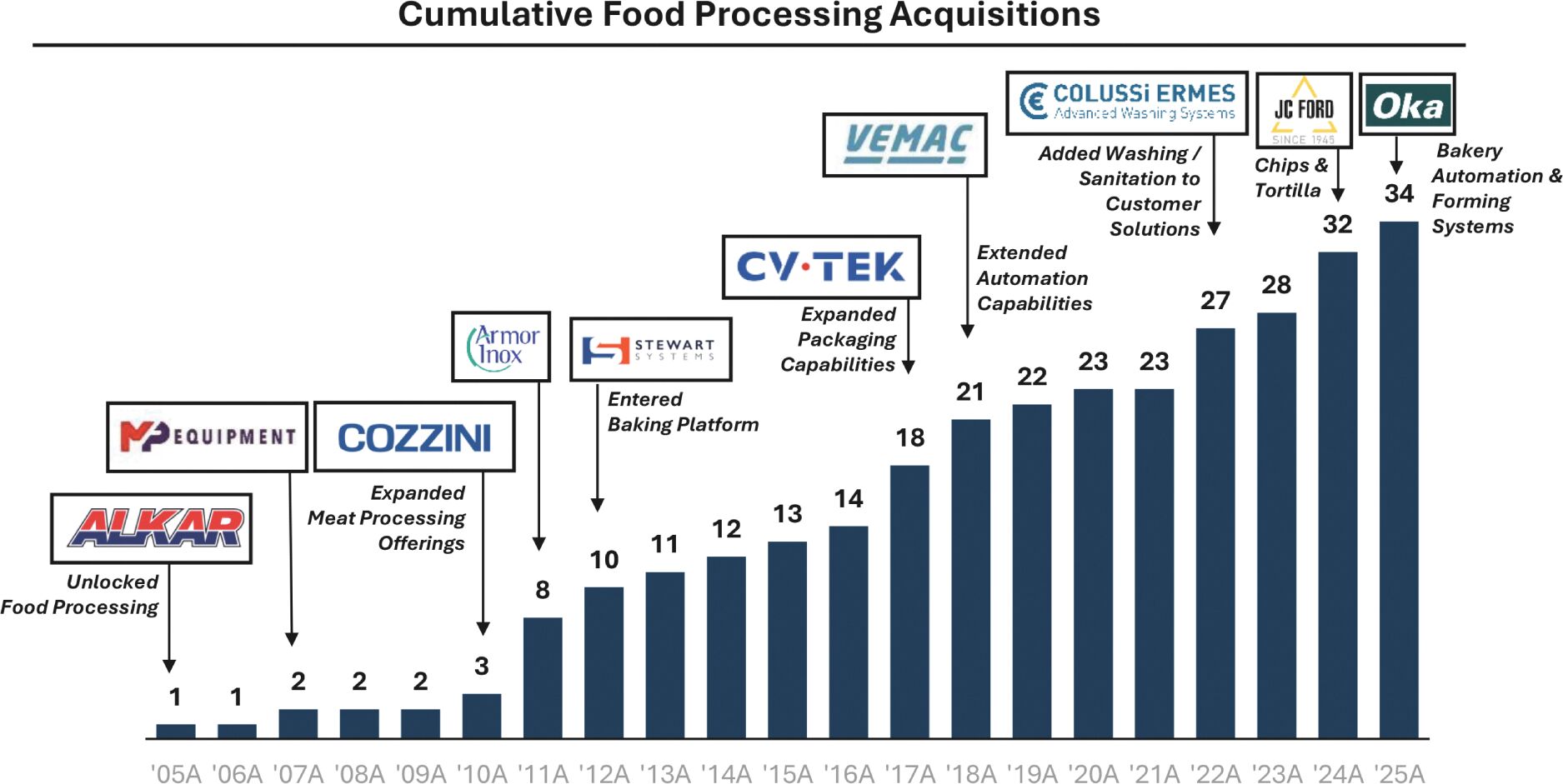
85
Table of Contents
There has been substantial consolidation among food processors across the industry, which is driving a need for equipment and solutions capable of processing large volumes of quality products consistently across the world in quicker cycle times for a variety of end product markets. Through the acquisition and integration of numerous equipment, packaging and automation solutions, SpinCo has created total line solutions for targeted value-added niches of the end product markets, including buns, bacon, charcuterie and hot dogs.
We believe the food processing equipment and packaging industry remains substantially fragmented and is in the early stages of a consolidation cycle which presents an opportunity for SpinCo. Our pipeline of prospective M&A targets is robust, and we expect to make strategic investments to offer additional high value solutions for our customers in attractive protein, bakery and snack end markets.
Customer Value Proposition
Through a proven, collaborative, customer-centric operating model, we provide innovative, customized solutions to meet our customers’ evolving needs. We aim to improve our customers’ ROI by lowering their cost of ownership and transforming their operations with unique solutions designed to:
86
Table of Contents
Our Competitive Strengths
| • | Industry-Leading Brands: We have grown to over 30 industry-leading brands across the global protein, bakery and snack food processing markets, led by passionate management teams with extensive experience within the industry. The combination of their proven track record in new technology development, food science, operations management and deep industry knowledge positions us to build upon our long-standing customer relationships, including with some of the largest international food processing companies. The strong balance of brand identity and collaboration on customer success supports both our decentralized operating model and our ability to offer integrated solutions to drive higher ROI for our customers. |
87
Table of Contents
| • | Technology, Automation and Innovation: We develop innovative new products and automation solutions designed to help our customers improve product quality and consistency, increase throughput and yields, reduce operating and capital expenses, maximize sanitation and practice sustainability. We operate four state-of-the-art innovation centers in the United States, Italy and India. The innovative culture of SpinCo is fostered in our innovation centers, havens for development with technical performance and product testing. Food scientists and specialized engineers are readily available and dedicated to helping customers achieve operational efficiency and exceptional product quality. Select highlights of our recent innovative product developments and the range of benefits to our customers are illustrated below: |
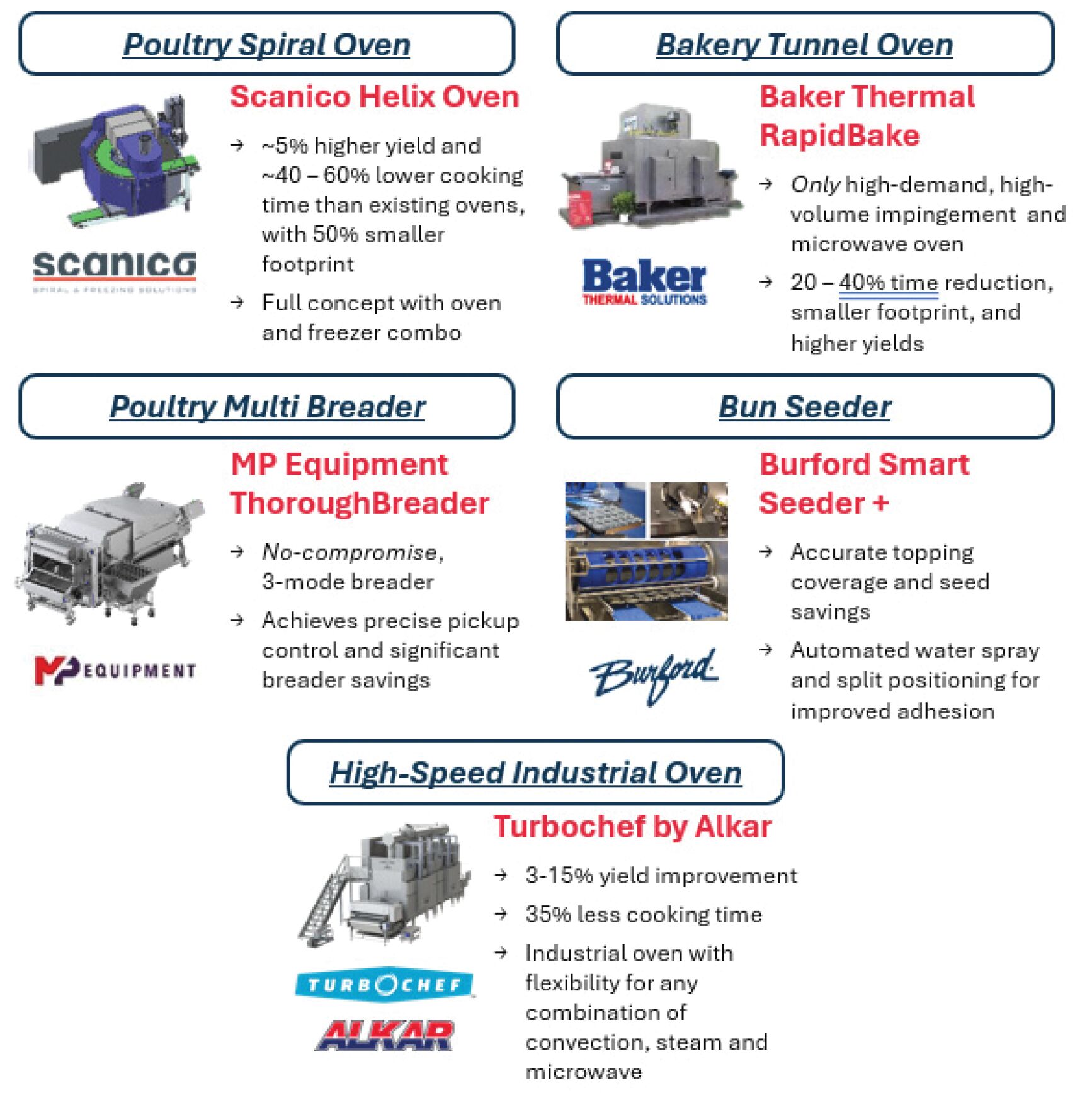
| • | Nimble, Decentralized Operating Model: We empower our brands to operate in an entrepreneurial fashion and take ownership of organic growth and profitability initiatives, while leveraging scaling opportunities at the SpinCo level in customer reach, supply chain and engineering and design services areas. We believe the attractive cash returns generated from this model enable us to enhance our value proposition for customers in an evolving food processing market through strategic organic and inorganic investments. |
88
Table of Contents
| • | M&A Track Record: SpinCo’s industry-leading food processing platform has been built with our expertise in identifying, executing and integrating over 30 strategic acquisitions within SpinCo’s business representing highly complementary brands and product innovations for targeted food applications since 2005. We strive to be the acquirer of choice in part due to our global reach, entrepreneurial operating model and strong corporate culture. As a pure-play food processing company, SpinCo will no longer have to compete for corporate resources and capital to execute on inorganic growth, a benefit which we believe will drive enhanced operating and strategic performance. |
| • | Leadership Team and Culture: Our management team carries deep industry expertise and a commitment to fostering a culture of innovation, collaboration and integrity to drive exceptional value for our customers. |
| • | Obsession with quality, which is our top priority |
| • | Lean cost structure preserving margins and contributing to our competitive advantage |
| • | Knowledgeable and passionate front-line managers who act as our ambassadors |
| • | Innovative spirit that permeates our people and our products |
| • | Entrepreneurial, brand-driven platform, with strong balance of brand identity and collaboration on customer success |
| • | Ease of conducting business, which has led to establishment of a sticky customer base |
| • | Strong global footprint with locally-based teams, designed to enable us to leverage existing relationships and drive continued growth in key markets |
Business and Growth Strategies
| • | Lead with Technology, Automation and Innovation: We expect food processors to increasingly demand new and innovative equipment that addresses food quality and safety, automation, reliability, flexibility and sustainability. We strive to extend our leadership in food processing technology, leveraging our industry expertise and proven, collaborative, customer-centric operating model to be considered the most valuable partner as food processors transform their operations. |
89
Table of Contents
| • | Drive Competitive Advantage with Total Line Solutions: The breadth of our industry-leading food processing brands, manufacturing and service capabilities positions us to offer highly integrated total line solutions in further processing through end-of-line, providing customers a uniquely integrated solution, lowering their total cost of ownership and streamlining their operations relative to disparate solutions across multiple partners. From food preparation, thermal processing, slicing, packaging, automation and equipment sanitation solutions, we’re able to construct valuable bundled and full line offerings for the protein and bakery markets, including the illustrative examples shown below: |
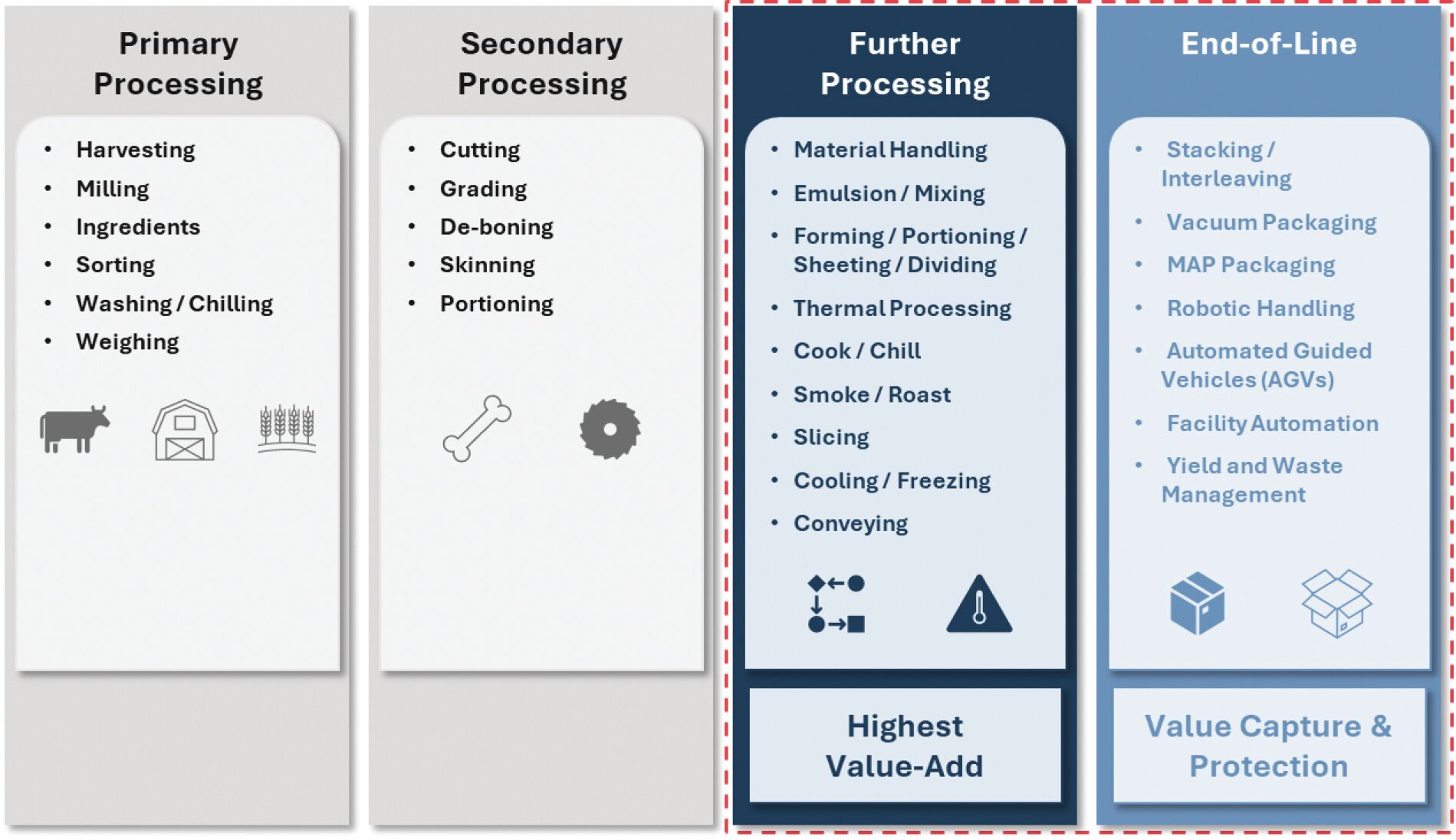
90
Table of Contents
91
Table of Contents
| • | Accelerate Growth and Profitability from Aftermarket: Leveraging our growing, global equipment installed base, we aim to aggressively grow our aftermarket parts and service revenues, maximizing this reoccurring and profitable portion of our portfolio. Our customer relationships include some that span multiple decades, and we recognize the ongoing value in sustaining performance and reducing downtime during food processing operations. We believe further localization of our parts and service platform and strategic investments in software and AI capabilities can allow us to improve speed and quality of service for our customers while expanding these profitable and reoccurring revenue sources. |
| • | Aligned Geographic Presence with Market Opportunity: The global food processing equipment and packaging industry is expected to grow at an annual rate of 3% to 4% through 2028, in part due to tailwinds fueled by secular growth drivers including those listed below. We believe our manufacturing, sales and aftermarket reach positions us well to capitalize on these growth trends including in Asia, Latin America and the Middle East. |
92
Table of Contents
| • | Expanding middle class in developing economies driving purchasing power and accelerated demand for protein, bakery and snack products |
| • | Food security initiatives are leading governments and industries to invest in domestic food processing capabilities to ensure supply chain resilience and support local manufacturing |
| • | M&A as a Strategic Pillar: We expect our strong cash flow generation will allow us to build upon our proven track record and prioritize M&A as a key pillar of our capital allocation strategy. We maintain a robust pipeline of acquisition targets and evaluate opportunities with a focus on driving innovation, advancing our bundled and total line solutions, accessing adjacent markets, improving post-acquisition profitability and generating attractive ROI. |
Our Products
Our products include a comprehensive suite of cooking and baking solutions, including mixers, make-up lines, batch ovens, proofers, conveyor belt ovens, spiral ovens, serpentine ovens and other continuous processing ovens, frying systems and automated thermal processing systems. SpinCo also provides a comprehensive portfolio of complementary food preparation equipment, such as tumblers, massagers, grinders, slicers, reduction and emulsion systems, mixers, blenders, battering equipment, breading equipment, seeding equipment, water cutting systems, food presses, food suspension equipment, filling and depositing solutions and forming equipment, as well as a variety of automated loading and unloading systems, automated washing systems, auto-guided vehicles, food safety, food handling, cooling, freezing, defrosting and packaging equipment.
Our Industry
The food processing industry historically was highly fragmented; however, increasing competition has led to more consolidation with the emergence of large conglomerates that possess a variety of food brands. The consolidation of food processing plants associated with industry mergers and acquisitions drives a need for more flexible and efficient equipment that is capable of processing large volumes of consistent quality products in quicker cycle times. In recent years, food processors have had to conform to the demands of “big box” retailers and the restaurant industry, including, most importantly, greater product consistency and exact package weights. Food processors increasingly are partnering with equipment manufacturers like SpinCo that develop technologies offering better process control for proven product consistency, innovative packaging designs and other solutions. To protect their own brands and reputations, retailers and large restaurant chains are also dictating food safety standards that are often stricter than government regulations.
Some of the positive trends and tailwinds we have identified in the industry are as follows:
Increased Importance on Technology and Innovation to Drive Productivity and Profitability
A number of factors, including raw material prices, cost of ownership of their equipment and labor and healthcare costs, are driving food processors to focus on ways to improve their profitability. In order to increase the profitability of and efficiency in processing plants, food processors increasingly pay more attention to the performance and flexibility in the functionality of their equipment. Further, food processors are continuously looking for ways to make their plants safer and reduce labor-intensive activities. Food processors are increasingly recognizing the value of new technology as an important vehicle to drive productivity and profitability in their plants. Due to customer requirements, food processors are expected to continue to demand new and innovative equipment that addresses food safety, food quality, automation, flexibility and sustainability.
Improved Living Standards in Developing Countries Leading to Increased Demand
Improving living standards in developing countries are spurring increased worldwide demand for pre-cooked and convenience food products. As industrializing countries create more jobs, consumers in these countries will have
93
Table of Contents
the means to buy pre-cooked food products. In industrialized regions, such as Western Europe and the United States, consumers are demanding more pre-cooked and convenience food products, such as deli tray variety packs, frozen food products and ready-to-eat varieties of ethnic foods.
Change in Consumer Preferences and Sentiment
A number of consumer trends across the industry have begun to change preference towards more attractive and convenient food alternatives, driving demand for supporting food processing equipment. The rise in “snacking culture,” paired with consumer preferences of on-the-go snacking options, has fueled demand for advanced processing equipment in the category. The convenience and ever-growing accessibility of eCommerce as a method of reaching end-consumers aligns with the fast-paced snacking culture, further fueling demand in the category. In the cake & pastry category, evolving celebration culture and growing demand for customized cakes is expected to catalyze demand for equipment.
SpinCo continues to monitor developments in the food industry related to rising consumer adoption of weight-loss treatments including Glucagon-like peptide-1 (GLP-1) products, particularly in the United States and Europe. While the expected long-term effect of such adoption is evolving, we expect a continued rise in adoption of GLP-1 products to create both disruption and opportunity for SpinCo and its food processing customers. The appetite suppression impact of GLP-1 products on its users could result in a decrease in food consumption volumes. However, we also observe changes in the types of food being consumed by GLP-1 users, including a greater focus on foods high in protein. Changes in consumer preferences, including those related to GLP-1 or otherwise, often result in food processors needing to invest in new or modified equipment and technology solutions to meet consumer demand. SpinCo believes it is well-positioned to continue partnering with its food processing customers to deliver solutions allowing them to meet evolving consumer demands.
Shift in Protein Sources
Change in consumer preferences is spearheading a shift from red meat products to other protein sources, such as poultry, driving increased demand in food processing equipment in the category. Red meat’s relatively higher price point versus poultry continues to prove a point of contention for customers making the change.
Backlog
The backlog of orders for the Food Processing business was $409.9 million at January 3, 2026, which is expected to be filled by the end of fiscal 2027. The 2025 acquisitions of the Frigomeccanica and Oka businesses accounted for $60.3 million of the backlog. The Food Processing business’s backlog was $257.6 million at December 28, 2024.
Marketing and Distribution
SpinCo maintains a direct sales force to market the brands and maintain direct relationships with each of its customers. In North America, SpinCo employs regional sales managers, each with responsibility for a group of customers and a particular region. This sales force is complemented with involvement of executive management to maintain relationships with customer executives and facilitate coordination amongst the brands for the key global accounts. Internationally, SpinCo maintains sales and distribution offices along with global sales managers supported by a network of independent sales representatives.
SpinCo’s sale process is highly consultative due to the highly technical nature of the equipment, especially in the case of total line solutions. During a typical sales process, salespeople make several visits to the customer’s facility to conceptually discuss the production requirements, footprint and configuration of the proposed equipment. SpinCo employs a technically proficient sales force, many of whom have previous technical experience with the company as well as education backgrounds in food science. The sales strategy of SpinCo is
94
Table of Contents
fostered by its own food technologists and with Protein and Bakery Innovation Centers in Chicago, Illinois, Dallas, Texas, India and Italy, which are available for development with technical performance and product testing for customers.
Services and Product Warranty
SpinCo maintains a technical service group of employees that oversees and performs installation and startup of equipment and completes warranty and repair work. This technical service group provides services for customers both domestically and internationally. Service technicians are trained regularly on new equipment to ensure the customer receives a high level of customer service. From time to time SpinCo utilizes trained third-party technicians supervised by SpinCo employees to supplement SpinCo employees on large projects.
Competition
The food processing equipment industry is highly competitive and fragmented. Within a given product line SpinCo may compete with a variety of companies, including companies that manufacture a broad line of products and those that specialize in a particular product category. Competition is based upon many factors, including brand recognition, product features, reliability, quality, price, delivery lead times, serviceability and after-sale service. SpinCo believes that its ability to compete depends on strong brand equity, exceptional product performance, short lead-times and timely delivery, competitive pricing and superior customer service support. In the international markets, SpinCo competes with U.S. manufacturers and numerous global and local competitors. Among SpinCo’s major competitors are AMF Bakery Systems, Duravant, The GEA Group, JBT Marel Corporation and ProMach.
Manufacturing and Quality Control
SpinCo’s manufacturing operations provide for an expertise in the design and production of specific products for the Food Processing business. SpinCo has from time to time either consolidated manufacturing facilities producing similar product or transferred production of certain products to another existing operation with a higher level of expertise or efficiency. The Food Processing business manufactures its products in 13 domestic and 16 international production facilities.
Metal fabrication, finishing, sub-assembly and assembly operations are typically conducted at each manufacturing facility. Equipment installed at individual manufacturing facilities includes numerically controlled turret presses and machine centers, shears, press brakes, welding equipment, polishing equipment, CAD/CAM systems and product testing and quality assurance measurement devices. SpinCo’s CAD/CAM systems enable virtual electronic prototypes to be created, reviewed and refined before the first physical prototype is built.
Detailed manufacturing drawings are quickly and accurately derived from the model and passed electronically to manufacturing for programming and optimal parts nesting on various numerically controlled punching cells. SpinCo believes that this integrated product development and manufacturing process is critical to assuring product performance, customer service and competitive pricing.
SpinCo has established comprehensive programs to ensure the quality of products, to analyze potential product failures and to certify vendors for continuous improvement. Products manufactured by SpinCo are tested prior to shipment to ensure compliance with company standards.
Sources of Supply
SpinCo purchases its raw materials and component parts from a number of suppliers. The majority of SpinCo’s material purchases are standard commodity-type materials, such as stainless steel, electrical components and hardware. These materials and parts generally are available in adequate quantities from numerous suppliers.
95
Table of Contents
Some component parts are obtained from sole sources of supply. In such instances, management believes it can substitute other suppliers as required. The majority of fabrication is done internally through the use of automated equipment. Certain equipment and accessories are manufactured by other suppliers for sale by SpinCo. SpinCo believes it enjoys good relationships with its suppliers.
Research and Development
SpinCo believes its future success will depend in part on its ability to develop new products and to improve existing products. Much of SpinCo’s research and development efforts are directed to the development and improvement of products designed to reduce cooking and processing time, increase capacity or throughput, reduce energy consumption, minimize labor costs, improve product yield and improve customer, employee and environmental safety, while maintaining consistency and quality of cooking production and food preparation. SpinCo has identified these issues as key concerns for most of its customers. SpinCo often identifies product improvement opportunities by working closely with customers on specific applications. Most research and development activities are performed by SpinCo’s technical service and engineering staff located at each manufacturing location. On occasion, SpinCo will contract outside engineering firms to assist with the development of certain technical concepts and applications.
SpinCo regularly evaluates opportunities to deliver additional value to customers through innovative solutions resulting from its research and development activities. Select highlights of recent innovative solutions are shown in the “Our Competitive Strengths” section of this information statement. SpinCo expects to continue launching new products in response to our customers’ demands. However, there are no yet-to-be launched products in development that are imminent and material to the business.
Trademarks, Patents and Licenses
SpinCo has developed, acquired and assembled a leading portfolio of trademarks and trade names. SpinCo believes that these trademarks and trade names help SpinCo compete due to their recognition with customers and the food processing marketplace.
SpinCo’s leading portfolio of trade names includes Alkar, Armor Inox, Auto-Bake, Baker Thermal Solutions, Burford, Colussi Ermes, Cozzini, CV-Tek, Danfotech, Drake, Escher, Filtration Automation, Frigomeccanica, GBT GmbH Bakery, Glimek, Gorreri, Hinds-Bock, Inline Filling Systems, JC Ford, Key-Log, Maurer-Atmos, Maxmac, MP Equipment, Oka, Pacproinc, Proxaut, RapidVisionPak, Scanico, Spooner Vicars, Stewart Systems, Sveba Dahlen, Thurne and Vemac.
SpinCo holds a broad portfolio of patents and licenses covering technology and applications related to various products, equipment and systems. Management believes the expiration of any one of these patents would not have a material adverse effect on the overall operations or profitability of SpinCo.
Human Capital
As of January 3, 2026, 2,843 persons were employed within the Food Processing business. Of this amount, 1,625 were sales, engineering, management, supervisory and administrative personnel, 1,114 were hourly production non-union workers and 104 were hourly production union members. Included in these totals were 1,647 individuals employed outside of the United States, of which 1,047 were sales, engineering, management, supervisory and administrative personnel and 600 were hourly production non-union workers. At its Lodi, Wisconsin facility, SpinCo has a contract with the International Association of Bridge, Structural, Ornamental and Reinforcing Ironworkers that expires on December 31, 2027. At its Algona, Iowa facility, SpinCo has a union contract with the United Food and Commercial Workers that expires on December 31, 2026. Management believes that the relationships between employees, unions and management are good.
96
Table of Contents
Properties
Our principal executive offices will be located at 10275 West Higgins Road, Suite 300, Rosemont, IL 60018. We operate 13 manufacturing facilities in the United States and 16 manufacturing facilities internationally.
The principal properties we use to conduct business operations are listed below:
| Location |
Principal Function |
Square |
Owned/ |
Lease | ||||
| Palmetto, FL |
Manufacturing, Warehousing and Offices |
61,300 | Leased | Dec-30 | ||||
| Gainesville, GA |
Manufacturing, Warehousing and Offices |
107,400 | Owned | N/A | ||||
| Algona, IA |
Manufacturing, Warehousing and Offices |
70,100 | Owned | N/A | ||||
| Elgin, IL |
Manufacturing, Warehousing and Offices |
75,000 | Owned | N/A | ||||
| Elk Grove, IL |
Manufacturing, Warehousing and Offices |
101,500 | Leased | Nov-29 | ||||
| Clayton, NC |
Manufacturing, Warehousing and Offices |
95,000 | Leased | Oct-29 | ||||
| Maysville, OK |
Manufacturing, Warehousing and Offices |
44,925 | Owned | N/A | ||||
| Souderton, PA |
Manufacturing, Warehousing and Offices |
50,000 | Owned | N/A | ||||
| Columbia, TN |
Manufacturing, Warehousing and Offices |
125,700 | Owned | N/A | ||||
| Mansfield, TX |
Manufacturing, Warehousing and Offices |
46,200 | Owned | N/A | ||||
| Plano, TX |
Manufacturing, Warehousing and Offices |
339,100 | Owned |
N/A | ||||
| Waynesboro, VA |
Manufacturing, Warehousing and Offices |
24,700 | Owned | N/A | ||||
| Lodi, WI |
Manufacturing, Warehousing and Offices |
114,600 | Owned | N/A | ||||
| Aalborg, Denmark |
Manufacturing, Warehousing and Offices |
71,800 | Leased | Jan-26 | ||||
| Mauron, France |
Manufacturing, Warehousing and Offices |
107,200 | Owned | N/A | ||||
| Darmstadt, Germany |
Manufacturing, Warehousing and Offices |
97,800 | Leased | Mar-27 | ||||
| Lunen, Germany |
Manufacturing, Warehousing and Offices |
22,800 | Leased | Feb-29 | ||||
| Reichenau, Germany |
Manufacturing, Warehousing and Offices |
57,900 | Owned | N/A | ||||
| Bangalore, India |
Manufacturing, Warehousing and Offices |
141,100 | Leased | Jul-30 | ||||
| Casarsa della Delizia, Italy |
Manufacturing, Warehousing and Offices |
359,900 | Owned | N/A | ||||
| Casarsa della Delizia, Italy |
Manufacturing, Warehousing and Offices |
67,300 | Leased | Aug-35 | ||||
| Castelnuovo Rangone, Italy** |
Manufacturing, Warehousing and Offices |
43,700 | Leased | Aug-30 | ||||
| Parma, Italy |
Warehousing and Offices |
37,600 | Owned | N/A | ||||
| Piumazzo, Italy |
Manufacturing, Warehousing and Offices |
37,200 | Leased | May-30 | ||||
| Regio Emillia, Italy |
Manufacturing, Warehousing and Offices |
59,400 | Owned | N/A | ||||
| Vicenza, Italy |
Manufacturing, Warehousing and Offices |
53,500 | Leased | Sep-32 | ||||
| Fristad, Sweden |
Manufacturing, Warehousing and Offices |
173,800 | Owned | N/A | ||||
| Norwich, the United Kingdom |
Manufacturing, Warehousing and Offices |
43,500 | Owned | N/A |
| ** | Contains three separate manufacturing facilities. |
We also lease small amounts of space in various other locations throughout the world for administrative, manufacturing, distribution and sales functions, and, in certain instances, limited short-term inventory storage. We believe our present facilities are adequate for the operation of our business as presently conducted.
Legal Proceedings
In the normal course of business, SpinCo is subject to legal proceedings, lawsuits and other claims. Although the ultimate aggregate amount of probable monetary liability or financial impact with respect to these matters is subject to many uncertainties, SpinCo’s management believes that any monetary liability or financial impact to SpinCo from these matters, individually and in the aggregate, would not be material to SpinCo’s financial condition, results of operations or cash flows. Given the inherent unpredictability of these types of proceedings, however, it is possible that any monetary liability and financial impact to SpinCo from these matters could differ materially from SpinCo’s expectations.
97
Table of Contents
MANAGEMENT’S DISCUSSION AND ANALYSIS OF FINANCIAL CONDITION AND RESULTS OF OPERATIONS
The following discussion and analysis of our financial condition and results of operations should be read in conjunction with our audited combined financial statements and corresponding notes, our unaudited condensed combined financial statements and corresponding notes, the unaudited pro forma condensed combined financial information and corresponding notes and other financial information included elsewhere in this Information Statement. This discussion contains forward-looking statements that are based upon current expectations and are subject to uncertainty and changes in circumstances. For additional information, see the section of this information statement entitled “Special Note Regarding Forward-Looking Statements.” Our actual results could differ materially from the results contemplated by these forward-looking statements due to a number of factors, including those discussed below and elsewhere in this Information Statement, particularly in “Risk Factors.”
Business Overview
Our Business
SpinCo is a technology-focused, global leader in the design and manufacturing of equipment and aftermarket service for a broad line of solutions for industrial protein, bakery and snack food processors. We are a growth-oriented, food processing pure-play, driven by our portfolio of innovative, complementary and industry-leading brands, with a nimble and profitable operating model and proven M&A track record. Our global reach—supported by established regional offices and dedicated local operating teams across key international markets—is a core strategic advantage, enabling us to serve customers with regional expertise and on-the-ground responsiveness at scale.
Our customers include some of the largest international food processing companies and producers of protein products, such as bacon, charcuterie, sausage and hot dogs, egg bites, poultry, alternative protein, case ready, lunch meat and pet food, and producers of bakery products, such as bread and buns, artisan bread, sweet goods, cakes and muffins, biscuits, crackers, pizza and pastries, tortilla and snacks. Through our broad and synergistic line of innovative technology and solutions, we are able to deliver a wide range of food preparation, thermal processing, slicing/packaging, automation and equipment sanitation solutions to service a variety of food processing requirements demanded by our customers across protein, bakery and snack categories. Further, we offer highly integrated total line solutions, from further processing through end-of-line, designed to provide our customers even greater financial and operational efficiencies. Following the installation of our solutions, we provide aftermarket parts and service allowing our customers to sustain performance and reduce downtime during food processing operations.
Trends and Factors Impacting Our Performance
We believe that our performance and future success depend on a number of factors that present significant opportunities for us but also pose risks and challenges, including those discussed below and in the section of this document titled “Risk Factors.” We focus on growing our total revenues, expanding margins and generating cash.
Increased Importance on Technology and Innovation to Drive Productivity and Profitability
A number of factors, including raw material prices, cost of ownership of their equipment and labor and healthcare costs, are driving food processors to focus on ways to improve their profitability. In order to increase the profitability of and efficiency in processing plants, food processors increasingly pay more attention to the performance and flexibility in the functionality of their equipment. Further, food processors are continuously looking for ways to leverage automation and other solutions to make their plants safer and reduce labor-intensive activities. Food processors are increasingly recognizing the value of new technology as an important vehicle to
98
Table of Contents
drive productivity and profitability in their plants. Due to customer requirements, food processors are expected to continue to demand new and innovative equipment that addresses food safety, food quality, automation, flexibility and sustainability.
Improved Living Standards in Developing Countries Leading to Increased Demand
Improving living standards in developing countries are spurring increased worldwide demand for pre-cooked and convenience food products. As industrializing countries create more jobs, consumers in these countries will have the means to buy pre-cooked food products. In industrialized regions, such as Western Europe and the United States, consumers are demanding more pre-cooked and convenience food products, such as deli tray variety packs, frozen food products and ready-to-eat varieties of ethnic foods.
Change in Consumer Preferences and Sentiment
A number of consumer trends across the industry have begun to change preference towards more attractive and convenient food alternatives, driving demand for supporting food processing equipment. The rise in “snacking culture,” paired with consumer preferences of on-the-go snacking options, has fueled demand for advanced processing equipment in the category. The convenience and ever-growing accessibility of eCommerce as a method of reaching end-consumers aligns with the fast-paced snacking culture, further fueling demand in the category. In the cake & pastry category, evolving celebration culture and growing demand for customized cakes is expected to catalyze demand for equipment.
SpinCo continues to monitor developments in the food industry related to rising consumer adoption of weight-loss treatments including Glucagon-like peptide-1 (GLP-1) products, particularly in the United States and Europe. While the expected long-term effect of such adoption is evolving, we expect a continued rise in adoption of GLP-1 products to create both disruption and opportunity for SpinCo and its food processing customers. The appetite suppression impact of GLP-1 products on its users could result in a decrease in food consumption volumes. However, we also observe changes in the types of food being consumed by GLP-1 users, including a greater focus on foods high in protein. Changes in consumer preferences, including those related to GLP-1 or otherwise, often result in food processors needing to invest in new or modified equipment and technology solutions to meet consumer demand. SpinCo believes it is well-positioned to continue partnering with its food processing customers to deliver solutions allowing them to meet evolving consumer demands.
Shift in Protein Sources
Change in consumer preferences is spearheading a shift from red meat products to other protein sources, such as poultry, driving increased demand in food processing equipment in the category. Red meat’s relatively higher price point versus poultry continues to prove a point of contention for customers making the change.
Impact of Acquisitions
SpinCo has completed over 30 acquisitions since 2005. SpinCo’s results of operations can be impacted by the nature and size of inorganic investments. SpinCo expects to continue pursuing acquisitions in line with its strategic and economic initiatives.
Transition to Standalone Company
On February 25, 2025, Middleby announced its intent to separate the Food Processing business into a standalone public company through a distribution of SpinCo common stock to Middleby stockholders. SpinCo will operate the Food Processing business, and Middleby will continue to operate the Commercial Foodservice business.
99
Table of Contents
The spin-off will be effected through a pro rata distribution of all of the outstanding shares of SpinCo common stock to holders of Middleby common stock in a transaction that is intended to be tax-free to holders of Middleby common stock for U.S. federal income tax purposes.
Completion of the spin-off is subject to certain conditions which are described more fully under “The Separation and Distribution—General—Conditions to the Distribution,” including receipt of the tax opinions from its tax counsel to the effect that the distribution will qualify as tax-free to Middleby and its stockholders for U.S. federal income tax purposes under Section 355 of the Code.
Relationship with Middleby
Historically, we have relied on Middleby to manage certain of our operations and provide us certain services, the costs of which have historically been either allocated or directly billed to us. Historical costs for such services may not necessarily reflect the actual expenses we would have incurred, or will incur, as an independent company. In connection with the spin-off, we intend to enter into a separation and distribution agreement with Middleby and we intend to enter into certain other agreements with Middleby, including a transition services agreement, a tax matters agreement, an employee matters agreement and an intellectual property matters agreement (collectively, the “ancillary agreements”), as described in “Certain Relationships and Related Transactions—Material Agreements with Middleby.” We generally expect to be able to utilize Middleby’s services for a transitional period following the spin-off before we replace these services over time with services supplied either internally or by third parties. The expenses for the services we will receive from Middleby initially and then internally or by third parties may vary from the historical costs directly billed and allocated to us for the same services. We will face challenges as we transition to becoming a stand-alone public company, including the establishment of new functions that were previously provided by Middleby. Addressing the needs that arise from becoming a stand-alone company will require significant resources, including time and attention from our senior management and others throughout the company.
Stand-Alone Company Expenses
As a result of the spin-off, we will become subject to the requirements of the federal and state securities laws and stock exchange requirements. We will have to establish additional procedures and practices as a stand-alone public company. As a result, we will incur additional costs related to external reporting, internal audit, treasury, investor relations, board of directors and officers and stock administration.
Current Events
Inflation and Interest Rate Environment
SpinCo has been negatively impacted by inflation in wages, logistics, energy, raw materials and component costs. Price increases and pricing strategies have been implemented to mitigate the impact of cost inflation on margins and SpinCo continues to actively monitor costs. High inflation and uncertainty surrounding the Federal Reserve’s interest rate policy decisions, combined with global macroeconomic uncertainty, have impacted and may continue to impact customer demand. Even in light of such headwinds, we remain focused on delivering strong financial results and executing on our long-term strategy and profitability objectives.
Supply Chain, Labor and Logistics Constraints
SpinCo continues to actively monitor global supply chain, labor and logistics constraints, which have had a negative impact on SpinCo’s ability to source parts and complete and ship units. While SpinCo is seeing improvement on certain supply chain and logistics constraints, supply chains for certain key components remain distressed. The decreased availability of resources and inflationary costs resulted in heightened inventory levels for certain components above current demand levels. To combat these pressures, SpinCo has evaluated
100
Table of Contents
alternative sourcing, dual sourcing and collaborated across the organization, where appropriate, without materially presenting new risks or increasing current risks around quality and reliability. Our capital resources have been and SpinCo expects they will continue to be sufficient to address these challenges.
Tariffs
SpinCo continues to actively monitor and navigate the evolving international tariff environment and its potential impact on our operations and financial performance. Impositions by the United States of tariffs, sanctions or other restrictions on goods exported from the United States or imported into the United States, or countermeasures imposed in response to such actions, could increase the cost of goods for our products or reduce our ability to sell our products globally. Our focus is to mitigate negative impacts from newly imposed tariffs.
Interim Results of Operations
The following table sets forth the condensed combined statements of earnings and respective financial statement line items as a percentage of net sales for the periods presented:
| Three Months Ended(1) | ||||||||||||||||
| (in thousands) | April 4, 2026 | March 29, 2025 | ||||||||||||||
| Net sales |
$ | 225,046 | 100.0 | % | $ | 168,500 | 100.0 | % | ||||||||
| Cost of sales |
147,638 | 65.6 | 107,548 | 63.8 | ||||||||||||
|
|
|
|
|
|
|
|
|
|||||||||
| Gross profit |
77,408 | 34.4 | 60,952 | 36.2 | ||||||||||||
| Selling, general and administrative expenses |
59,073 | 26.2 | 45,299 | 26.9 | ||||||||||||
| Restructuring expenses |
(57 | ) | — | 111 | 0.1 | |||||||||||
| Income from operations |
18,392 | 8.2 | 15,542 | 9.2 | ||||||||||||
| Interest income, net |
(2 | ) | — | (406 | ) | (0.2 | ) | |||||||||
| Other income, net |
(614 | ) | (0.2 | ) | (475 | ) | (0.3 | ) | ||||||||
|
|
|
|
|
|
|
|
|
|||||||||
| Earnings before income taxes |
19,008 | 8.4 | 16,423 | 9.7 | ||||||||||||
| Provision for income taxes |
4,689 | 2.0 | 4,179 | 2.4 | ||||||||||||
|
|
|
|
|
|
|
|
|
|||||||||
| Net earnings |
$ | 14,319 | 6.4 | % | $ | 12,244 | 7.3 | % | ||||||||
|
|
|
|
|
|
|
|
|
|||||||||
| (1) | SpinCo’s fiscal year ends on the Saturday nearest December 31. All fiscal quarters presented included 13 weeks. |
Three Months Ended April 4, 2026 as Compared to Three Months Ended March 29, 2025
NET SALES. Net sales for the three months ended April 4, 2026 increased by $56.5 million, or 33.6%, to $225.0 million as compared to $168.5 million in the three months ended March 29, 2025. Net sales increased by $7.5 million, or 4.5%, from the fiscal 2025 acquisitions of Frigomeccanica and Oka. Excluding acquisitions, net sales increased $49.0 million, or 29.1%, from the prior year period. The impact of foreign exchange rates on foreign sales translated into U.S. Dollars for the three months ended April 4, 2026 increased net sales by approximately $7.2 million, or 4.3%. Excluding the impact of foreign exchange and acquisitions, sales increased $41.8 million, or 24.8%, for the three months ended April 4, 2026 as compared to the prior year period.
Domestically, SpinCo realized a sales increase of $21.9 million, or 23.5%, to $115.3 million, as compared to $93.4 million in the prior year period. This includes an increase of $0.2 million from recent acquisitions. Excluding acquisitions, the net increase in domestic sales was $21.7 million, or 23.2%, primarily driven by increased customer investment in bakery and snack equipment following delays related to the prior year tariff environment and increases in aftermarket parts and service. International sales increased $34.6 million, or 46.1%, to $109.7 million, as compared to $75.1 million in the prior year period. This includes an increase of $7.3 million from the recent acquisitions and an increase of $7.2 million related to the favorable impact of exchange rates. Excluding the impact of foreign exchange and acquisitions, international sales increased $20.1 million, or 26.8%.
101
Table of Contents
The increase reflects higher sales of protein and snack equipment primarily related to projects in the European markets and increases in aftermarket parts and service.
GROSS PROFIT. Gross profit increased by $16.4 million, or 26.9%, to $77.4 million in the three months ended April 4, 2026, as compared to $61.0 million in the three months ended March 29, 2025. This includes an increase of $1.4 million from recent acquisitions and an increase of $2.6 million related to the favorable impact of exchange rates. Excluding the impact of foreign exchange and acquisitions, gross profit increased $12.4 million. Gross profit margin (gross profit as a percentage of net sales) decreased to 34.4% in the three months ended April 4, 2026, as compared to 36.2% in the prior year period. Excluding the impact of foreign exchange and acquisitions, the gross profit margin was 34.9% in the three months ended April 4, 2026. Excluding the impact of foreign exchange and acquisitions, the gross profit increase was driven by higher equipment and installation and aftermarket parts and service sales, and the gross profit margin decline was driven by tariffs, input cost inflation and product mix, partially offset by increases in relatively higher margin aftermarket parts and service sales.
SELLING, GENERAL AND ADMINISTRATIVE EXPENSES. Combined selling, general and administrative expenses increased to $59.1 million in the three months ended April 4, 2026, as compared to $45.3 million in the three months ended March 29, 2025. As a percentage of net sales, selling, general and administrative expenses were 26.2% in the three months ended April 4, 2026 as compared to 26.9% in the three months ended March 29, 2025. The increase in selling, general and administrative expenses of $13.8 million, or 30.4%, is primarily due to increased compensation costs, including share-based compensation, of $9.1 million, cost increases of $3.0 million associated with acquired businesses, including $0.5 million of intangible amortization expense, and higher separation costs of $2.6 million. Foreign exchange rates had an unfavorable impact of $1.9 million.
RESTRUCTURING EXPENSES. Restructuring expenses decreased $0.2 million to $(0.1) million for the three months ended April 4, 2026, as compared to $0.1 million for the three months ended March 29, 2025. Restructuring expenses related primarily to headcount reductions and facility consolidations.
INCOME FROM OPERATIONS. Income from operations increased $2.9 million to $18.4 million in the three months ended April 4, 2026 from $15.5 million in the three months ended March 29, 2025. Operating income as a percentage of net sales amounted to 8.2% in the three months ended April 4, 2026, as compared to 9.2% in the three months ended March 29, 2025.
NON-OPERATING INCOME. Interest income was less than $0.1 million in the three months ended April 4, 2026, as compared to $0.4 million in the prior year period. Other income was $0.6 million in the three months ended April 4, 2026, as compared to other income of $0.5 million in the prior year period, and consists mainly of net foreign exchange gains.
INCOME TAXES. A tax provision of $4.7 million, at an effective tax rate of 24.7%, was recorded during the three months ended April 4, 2026, as compared to a tax provision of $4.2 million at an effective tax rate of 25.4% in the prior year period. During the three months ended April 4, 2026, the effective tax rate was lower than the prior period due to the recognition of discrete tax items. The effective tax rates for the three months ended April 4, 2026 and March 29, 2025 were higher than the U.S. statutory federal tax rate of 21.0% primarily due to non-deductible expenses, state taxes and foreign tax rate differentials.
102
Table of Contents
Annual Results of Operations
The following table sets forth the combined statements of earnings and respective financial statement line items as a percentage of net sales for the periods presented:
| Fiscal Year Ended(1) | ||||||||||||||||||||||||
| (in thousands) | 2025 | 2024 | 2023 | |||||||||||||||||||||
| Net sales |
$ | 853,157 | 100.0 | % | $ | 771,996 | 100.0 | % | $ | 759,268 | 100.0 | % | ||||||||||||
| Cost of sales |
544,283 | 63.8 | 466,565 | 60.4 | 470,970 | 62.0 | ||||||||||||||||||
|
|
|
|
|
|
|
|
|
|
|
|
|
|||||||||||||
| Gross profit |
308,874 | 36.2 | 305,431 | 39.6 | 288,298 | 38.0 | ||||||||||||||||||
| Selling, general and administrative expenses |
207,023 | 24.2 | 146,619 | 19.0 | 138,509 | 18.2 | ||||||||||||||||||
| Restructuring expenses |
519 | 0.1 | 2,620 | 0.3 | 1,839 | 0.3 | ||||||||||||||||||
| Gain on sale of plant |
— | — | (1,139 | ) | (0.1 | ) | — | — | ||||||||||||||||
|
|
|
|
|
|
|
|
|
|
|
|
|
|||||||||||||
| Income from operations |
101,332 | 11.9 | 157,331 | 20.4 | 147,950 | 19.5 | ||||||||||||||||||
| Interest income, net |
(2,018 | ) | (0.2 | ) | (2,168 | ) | (0.3 | ) | (1,416 | ) | (0.2 | ) | ||||||||||||
| Other income, net |
(8,694 | ) | (1.0 | ) | (1,147 | ) | (0.1 | ) | (8,765 | ) | (1.1 | ) | ||||||||||||
|
|
|
|
|
|
|
|
|
|
|
|
|
|||||||||||||
| Earnings before income taxes |
112,044 | 13.1 | 160,646 | 20.8 | 158,131 | 20.8 | ||||||||||||||||||
| Provision for income taxes |
29,346 | 3.4 | 38,367 | 5.0 | 37,848 | 5.0 | ||||||||||||||||||
|
|
|
|
|
|
|
|
|
|
|
|
|
|||||||||||||
| Net earnings |
$ | 82,698 | 9.7 | % | $ | 122,279 | 15.8 | % | $ | 120,283 | 15.8 | % | ||||||||||||
|
|
|
|
|
|
|
|
|
|
|
|
|
|||||||||||||
| (1) | SpinCo’s fiscal year ends on the Saturday nearest December 31. Fiscal years 2025, 2024 and 2023 ended on January 3, 2026, December 28, 2024 and December 30, 2023, respectively, and included 53, 52 and 52 weeks, respectively. |
Fiscal Year Ended January 3, 2026 as Compared to December 28, 2024
NET SALES. Net sales in fiscal 2025 increased by $81.2 million, or 10.5%, to $853.2 million as compared to $772.0 million in fiscal 2024. Net sales increased by $101.0 million, or 13.1%, from the fiscal 2024 acquisitions of GBT, MaxMac, JC Ford and Gorreri and the fiscal 2025 acquisitions of Frigomeccanica and Oka. Excluding acquisitions, net sales decreased $19.8 million, or 2.6%, as compared to fiscal 2024. The impact of foreign exchange rates on foreign sales translated into U.S. dollars in fiscal 2025 increased net sales by approximately $13.8 million. Excluding the impact of foreign exchange and acquisitions, sales decreased $33.6 million, or 4.4%.
Domestically, SpinCo realized a sales increase of $30.6 million, or 6.8%, to $479.4 million, as compared to $448.8 million in fiscal 2024. This includes an increase of $41.1 million from recent acquisitions. Excluding acquisitions, the net decrease in domestic sales was $10.5 million, or 2.3%, primarily due to delays in customer investments in equipment resulting from macroeconomic uncertainty, including the evolving international tariff environment, partially offset by increases in aftermarket parts and service. International sales increased $50.6 million, or 15.7%, to $373.8 million, as compared to $323.2 million in the prior year. This includes an increase of $59.9 million from the recent acquisitions and an increase of $13.8 million related to the favorable impact of exchange rates. Excluding the impact of foreign exchange and acquisitions, international sales decreased $23.1 million, or 7.1%. The decrease in international sales reflects decreased sales of bakery and protein equipment primarily due to fewer projects in the European markets, partially offset by increases in aftermarket parts and service.
GROSS PROFIT. Gross profit in fiscal 2025 increased by $3.5 million, or 1.1%, to $308.9 million as compared to $305.4 million in fiscal 2024. This includes an increase of $27.0 million from recent acquisitions and an increase of $5.8 million related to the favorable impact of exchange rates. Excluding the impact of foreign exchange and acquisitions, gross profit decreased $29.3 million. Gross profit margin (gross profit as a percentage
103
Table of Contents
of net sales) decreased to 36.2% in 2025 as compared to 39.6% in 2024. Excluding the impact of foreign exchange and acquisitions, the gross profit margin in fiscal 2025 was 37.4%. Excluding the impact of foreign exchange and acquisitions, the gross profit and gross profit margin declines were driven by reduced operating leverage from lower equipment and installation sales, partially offset by increases in relatively higher margin aftermarket parts and service sales.
SELLING, GENERAL AND ADMINISTRATIVE EXPENSES. Combined selling, general and administrative expenses increased to $207.0 million in fiscal 2025, as compared to $146.6 million in fiscal 2024. As a percentage of net sales, selling, general and administrative expenses were 24.2% in fiscal 2025, as compared to 19.0% in fiscal 2024. The increase in selling, general and administrative expenses of $60.4 million, or 41.2%, is primarily due to increased costs of $22.9 million associated with acquired businesses, including $4.6 million of intangible amortization expense, separation costs of $16.6 million, higher advertising and trade show expenses of $5.0 million and increased cost allocations from Middleby. Foreign exchange rates had an unfavorable impact of $2.3 million.
RESTRUCTURING EXPENSES. Restructuring expenses decreased $2.1 million to $0.5 million in fiscal 2025 from $2.6 million in fiscal 2024. Restructuring expenses related primarily to headcount reductions and facility consolidations.
INCOME FROM OPERATIONS. Income from operations decreased $56.0 million to $101.3 million in fiscal 2025 from $157.3 million in fiscal 2024. Operating income as a percentage of net sales amounted to 11.9% in 2025 as compared to 20.4% in 2024.
NON-OPERATING INCOME. Interest income was $2.0 million in fiscal 2025, as compared to $2.2 million in fiscal 2024. Other income was $8.7 million in fiscal 2025, as compared to other income of $1.1 million in fiscal 2024, and consists mainly of foreign exchange gains.
INCOME TAXES. A tax provision of $29.3 million, at an effective rate of 26.2%, was recorded during fiscal 2025, as compared to $38.4 million at an effective rate of 23.9% in fiscal 2024. The effective tax rates were higher than the federal tax rate of 21.0% primarily due to state taxes and foreign tax rate differentials.
Fiscal Year Ended December 28, 2024 as Compared to December 30, 2023
NET SALES. Net sales in fiscal 2024 increased by $12.7 million, or 1.7%, to $772.0 million as compared to $759.3 million in fiscal 2023. Net sales increased by $24.7 million, or 3.2%, from the fiscal 2023 acquisition of Filtration Automation and the fiscal 2024 acquisitions of GBT, MaxMac, JC Ford and Gorreri. Excluding acquisitions, net sales decreased $12.0 million, or 1.6%, as compared to fiscal 2023. The impact of foreign exchange rates on foreign sales translated into U.S. dollars in fiscal 2024 decreased net sales by approximately $0.4 million. Excluding the impact of foreign exchange and acquisitions, sales decreased $11.6 million, or 1.5%.
Domestically, SpinCo realized a sales decrease of $36.7 million, or 7.6%, to $448.8 million, as compared to $485.5 million in fiscal 2023. This includes an increase of $7.3 million from recent acquisitions. Excluding acquisitions, the net decrease in domestic sales was $44.0 million, or 9.1%. The decrease in domestic sales is driven primarily by lower sales of protein equipment due to fewer major projects, partially offset by increases in aftermarket parts and service. International sales increased $49.4 million, or 18.0%, to $323.2 million, as compared to $273.8 million in the prior year. This includes an increase of $17.4 million from the recent acquisitions and a decrease of $0.4 million related to the unfavorable impact of exchange rates. Excluding the impact of foreign exchange and acquisitions, the net sales increase in international sales was $32.4 million, or 11.8%. The increase in international sales reflects growth driven primarily by bakery and protein equipment in the European markets and aftermarket parts and service.
104
Table of Contents
GROSS PROFIT. Gross profit in fiscal 2024 increased by $17.1 million, or 5.9%, to $305.4 million as compared to $288.3 million in fiscal 2023. This includes an increase of $9.7 million from recent acquisitions and a decrease of $0.1 million related to the unfavorable impact of exchange rates. Excluding the impact of foreign exchange and acquisitions, gross profit increased $7.5 million. Gross profit margin increased to 39.6% in 2024 as compared to 38.0% in 2023. Excluding the impact of foreign exchange and acquisitions, the gross profit margin in fiscal 2024 was 39.6%. Excluding the impact of foreign exchange and acquisitions, gross profit and gross profit margin increased in fiscal 2024 despite a decrease in net sales in part due to growth in relatively higher margin aftermarket parts and service as compared to equipment and installation.
SELLING, GENERAL AND ADMINISTRATIVE EXPENSES. Combined selling, general and administrative expenses increased to $146.6 million in fiscal 2024, as compared to $138.5 million in fiscal 2023. As a percentage of net sales, selling, general and administrative expenses were 19.0% in fiscal 2024, as compared to 18.2% in fiscal 2023.
The increase in selling, general and administrative expenses of $8.1 million, or 5.8% from prior year is primarily due to increased costs of $8.0 million associated with acquired businesses, including $1.2 million of intangible amortization expense.
RESTRUCTURING EXPENSES. Restructuring expenses increased $0.8 million to $2.6 million in fiscal 2024 from $1.8 million in fiscal 2023. Restructuring expenses in fiscal 2024 and in fiscal 2023 related primarily to headcount reductions and facility consolidations.
INCOME FROM OPERATIONS. Income from operations increased $9.3 million to $157.3 million in fiscal 2024 from $148.0 million in fiscal 2023. Operating income as a percentage of net sales amounted to 20.4% in 2024 as compared to 19.5% in 2023.
NON-OPERATING INCOME. Interest income was $2.2 million in fiscal 2024, as compared to $1.4 million in fiscal 2023. Other income was $1.1 million in fiscal 2024, as compared to other income of $8.8 million in fiscal 2023, and consists mainly of foreign exchange gains.
INCOME TAXES. A tax provision of $38.4 million, at an effective rate of 23.9%, was recorded during fiscal 2024, as compared to $37.8 million at an effective rate of 23.9% in fiscal 2023. The effective tax rates in 2024 and 2023 were higher than the federal tax rate of 21.0% primarily due to state taxes and foreign tax rate differentials.
Financial Condition and Liquidity
Overview
Historically, our business has generated positive cash flows from operations, a portion of which was transferred to Middleby. We participated in Middleby’s centralized cash management process and commingled accounts to manage liquidity and fund operations, the effect of which is presented as net parent investment in our combined financial statements included elsewhere in this information statement.
Upon completion of this spin-off, we will cease participation in Middleby commingled accounts and our cash and cash equivalents will be held and used solely for our own operations. Our capital structure, long-term commitments and sources of liquidity will change significantly from our historical practices. For additional detail regarding changes to our capital structure, see the sections entitled “Capitalization” and “Description of Certain Indebtedness” elsewhere in this information statement.
We believe our existing cash and cash flows generated from operations and indebtedness to be incurred in conjunction with the spin-off, discussed in detail elsewhere in this information statement, will be sufficient to meet the needs of our current and planned operations for the next 12 months and for the foreseeable future thereafter.
105
Table of Contents
Interim Cash Flows
The following table summarizes our cash flows for the three months ended April 4, 2026 and March 29, 2025:
| Three Months Ended | ||||||||
| (in thousands) | April 4, 2026 |
March 29, 2025 |
||||||
| Cash provided by (used in): |
||||||||
| Operating activities |
$ | 34,499 | $ | 39,198 | ||||
| Investing activities |
(3,035 | ) | (18,416 | ) | ||||
| Financing activities |
(63,267 | ) | (18,357 | ) | ||||
| Effect of exchange rate changes |
(1,181 | ) | 2,429 | |||||
|
|
|
|
|
|||||
| Net (decrease) increase in cash and cash equivalents |
$ | (32,984 | ) | $ | 4,854 | |||
|
|
|
|
|
|||||
Total cash and cash equivalents decreased by $33.0 million to $57.9 million at April 4, 2026 from $90.9 million at January 3, 2026.
OPERATING ACTIVITIES. Net cash provided by operating activities decreased by $4.7 million, or 12.0%, to $34.5 million during the three months ended April 4, 2026, as compared to $39.2 million during the three months ended March 29, 2025, primarily driven by working capital changes.
During the three months ended April 4, 2026, working capital changes impacted operating cash flows primarily driven by increased inventory levels of $16.3 million as a result of project timing, an increase in accrued expenses and other liabilities of $14.2 million, and a decrease in prepaid expenses and other assets of $12.0 million. The changes in accrued expenses and other liabilities and prepaid expenses and other assets were primarily driven by the timing of payments and status of over time revenue contracts.
During the three months ended March 29, 2025, working capital changes impacted operating cash flows primarily driven by a decrease in accounts receivable of $25.6 million due to timing of project billing and collections, a decrease in prepaid expenses and other assets of $6.2 million, an increase in accrued expenses and other liabilities of $5.9 million, and increased inventory levels of $18.8 million as a result of project timing. The changes in accrued expenses and other liabilities and prepaid expenses and other assets were primarily driven by the timing of payments and status of over time revenue contracts.
INVESTING ACTIVITIES. During the three months ended April 4, 2026, net cash used in investing activities decreased by $15.4 million to $3.0 million, as compared to $18.4 million in the three months ended March 29, 2025. Capital expenditures were $3.4 million and $19.3 million during the three months ended April 4, 2026 and March 29, 2025, respectively, primarily for upgrades of production equipment and manufacturing facilities. Capital expenditures during the three months ended March 29, 2025 also include investment in an innovation center in Italy. Net related party loan activities decreased net cash used in investing activities by $0.3 million and $0.9 million during the three months ended April 4, 2026 and March 29, 2025, respectively.
FINANCING ACTIVITIES. Net cash used in financing activities increased by $44.9 million to $63.3 million during the three months ended April 4, 2026, as compared to $18.4 million during the three months ended March 29, 2025. The increase relates to transfers to Middleby, which primarily represents cash management activities given cash is centrally managed at the Middleby level, and the payment of deferred purchase price for acquisitions.
106
Table of Contents
Annual Cash Flows
The following table summarizes our cash flows for the fiscal years ended January 3, 2026, December 28, 2024 and December 30, 2023:
| (in thousands) | 2025 | 2024 | 2023 | |||||||||
| Cash provided by (used in): |
||||||||||||
| Operating activities |
$ | 101,638 | $ | 129,011 | $ | 111,915 | ||||||
| Investing activities |
(47,683 | ) | (99,733 | ) | (45,426 | ) | ||||||
| Financing activities |
(30,474 | ) | (21,107 | ) | (55,560 | ) | ||||||
| Effect of exchange rate changes |
8,211 | (5,030 | ) | (409 | ) | |||||||
|
|
|
|
|
|
|
|||||||
| Net increase in cash and cash equivalents |
$ | 31,692 | $ | 3,141 | $ | 10,520 | ||||||
|
|
|
|
|
|
|
|||||||
Total cash and cash equivalents increased by $31.7 million to $90.9 million at January 3, 2026 from $59.2 million at December 28, 2024.
OPERATING ACTIVITIES. Net cash provided by operating activities decreased by $27.4 million in fiscal 2025, or 21.2%, to $101.6 million, as compared to $129.0 million in fiscal 2024, primarily driven by lower net earnings, exclusive of non-cash items, of $25.1 million.
Net cash provided by operating activities increased by $17.1 million in fiscal 2024, or 15.3%, to $129.0 million as compared to $111.9 million in fiscal 2023, primarily driven by working capital changes.
During fiscal 2024, working capital changes contributed to operating cash flows primarily driven by an increase in accounts receivable of $25.0 million due to timing of project billing and an increase in prepaid expenses and other assets of $18.4 million, including impacts from the timing of payments and status of over time revenue contracts, offset by decreased inventory levels of $23.1 million as a result of project timing and inventory control initiatives.
During fiscal 2023, working capital changes contributed to operating cash flows primarily driven by a decrease in accrued expenses and other liabilities of $58.3 million including the timing of payments and status of over time revenue contracts and a decrease in accounts payable of $19.4 million due to timing of vendor payments, offset by a decrease in accounts receivable of $17.4 million due to improved collections and a decrease in prepaid expenses and other assets of $15.0 million, including impacts from the timing of payments and status of over time revenue contracts.
In connection with SpinCo’s acquisition activities, SpinCo added assets and liabilities from the opening balance sheets of the acquired businesses in its combined balance sheets and accordingly these amounts are not reflected in the net changes in working capital.
INVESTING ACTIVITIES. Net cash used in investing activities decreased by $52.0 million, or 52.2%, in fiscal 2025 to $47.7 million as compared to $99.7 million in fiscal 2024, while net cash used in investing activities increased by $54.3 million, or 119.6%, to $99.7 million in fiscal 2024 as compared to $45.4 million in fiscal 2023. Cash used to fund the fiscal 2025 acquisitions of Frigomeccanica and Oka, the fiscal 2024 acquisitions of GBT, MaxMac, JC Ford and Gorreri and the fiscal 2023 acquisition of Filtration Automation amounted to $28.5 million, $88.0 million and $19.8 million, respectively. Additionally, capital expenditures were $41.4 million, $12.9 million and $16.3 million in fiscal 2025, 2024 and 2023, respectively, primarily for upgrades of production equipment and manufacturing facilities. Capital expenditures in fiscal 2025 also include investment in an innovation center in Italy. Net related party loan activities decreased net cash used in investing activities by $22.3 million in fiscal 2025 and increased net cash used in investing activities by $1.4 million and $9.4 million in fiscal 2024 and 2023, respectively.
107
Table of Contents
FINANCING ACTIVITIES. Net cash used in financing activities increased by $9.4 million, or 44.5%, to $30.5 million in fiscal 2025 as compared to $21.1 million in fiscal 2024, while the net cash used in financing activities decreased by $34.5 million, or 62.1%, to $21.1 million in fiscal 2024 as compared to $55.6 million in fiscal 2023. The increase in fiscal 2025 relates to transfers to Middleby, which primarily represents cash management activities given cash is centrally managed at the Middleby level, partially offset by foreign loan borrowings, while the decrease in fiscal 2024 relates to transfers to Middleby.
Material Cash Requirements
SpinCo’s material cash requirements from contractual obligations primarily consist of foreign loans, operating and finance lease obligations, tax obligations and contingent purchase price payments to the sellers that were deferred in conjunction with various acquisitions. See Notes 3, 5, 7 and 8 to the Combined Financial Statements for further information.
Debt
We have historically relied, via Middleby, on the debt capital markets to fund a significant portion of our operations. We plan to continue to rely on capital markets, and we expect to have access to credit facilities to fund operations. The cost and availability of debt financing will be influenced by our future credit ratings and market conditions.
As part of our capital structure, we expect to have debt. The servicing of this debt will be supported, in part, by cash flows from our existing operations. We believe that our financing arrangements, future cash from operations, and access to capital markets will provide adequate resources to fund our future cash flow needs.
Related Party Transactions
From December 31, 2022 through the date hereof, there were no transactions between SpinCo, its directors and executive officers that are required to be disclosed pursuant to Item 404 of Regulation S-K, promulgated under the Securities Exchange Act of 1934, as amended. See Note 9 to the Combined Financial Statements for further information on transactions with Middleby and related party entities.
Critical Accounting Policies and Estimates
Management’s discussion and analysis of financial condition and results of operations are based upon SpinCo’s combined financial statements, which have been prepared in accordance with accounting principles generally accepted in the United States. The preparation of these financial statements requires SpinCo to make significant estimates and judgments that affect the reported amounts of assets, liabilities, revenues and expenses, as well as related disclosures. On an ongoing basis, SpinCo evaluates its estimates and judgments based on historical experience and various other factors that are believed to be reasonable under the circumstances. Actual results may differ from these estimates under different assumptions or conditions and any such differences could be material to our combined financial statements.
Revenue Recognition
Revenue is recognized when the control of the promised goods or services are transferred to our customers, in an amount that reflects the consideration that we expect to receive in exchange for those goods or services.
A performance obligation is a promise in a contract to transfer a distinct good or service to the customer. A contract’s transaction price is allocated to each distinct performance obligation and recognized as revenue when, or as, the performance obligation is satisfied. SpinCo’s contracts can have multiple performance obligations or
108
Table of Contents
just a single performance obligation. For contracts with multiple performance obligations, the contract’s transaction price is allocated to each performance obligation using SpinCo’s best estimate of the standalone selling price of each distinct good or service in the contract.
SpinCo estimates the standalone selling price for equipment and services based on expected cost to manufacture the good or complete the service plus an appropriate profit margin. The estimated standalone selling price of aftermarket parts is based on observable prices.
As SpinCo’s standard payment terms are less than one year, SpinCo does not assess whether a contract has a significant financing component. SpinCo treats shipping and handling activities performed after the customer obtains control of the good as a contract fulfillment activity. Sales, use and value added taxes assessed by governmental authorities are excluded from the measurement of the transaction price within SpinCo’s contracts with its customers. SpinCo generally expenses sales commissions when incurred because the amortization period would have been less than one year. These costs are recorded within selling, general and administrative expenses.
Control may pass to the customer over time or at a point in time. In general, revenue from equipment sold under our long-term contracts is recognized over time as the equipment is manufactured and assembled. Equipment that is highly customized and for which we have a contractual, enforceable right to collect payment upon customer cancellation for performance completed to date qualifies for over time revenue recognition. With control transferring over time, revenue is recognized based on the extent of progress towards completion of the performance obligation. Installation services provided in connection with the delivery of the equipment are also generally recognized as those services are rendered. We generally use the cost-to-cost input method of progress for our contracts because it best depicts the transfer of control to the customer that occurs as we incur costs. Under the cost-to-cost input method, the extent of progress towards completion is measured based on the proportion of direct labor hours incurred to date to the total estimated direct labor hours at completion of the performance obligation. The selection of the method to measure progress towards completion requires judgment. These measures include forecasts based on the best information available and therefore reflect SpinCo’s judgment to faithfully depict the transfer of the goods. Revenue generated from standard equipment, contracts without an enforceable right to payment for performance completed to date, as well as aftermarket parts, are recognized at the point in time control transfers to the customer, which is typically based on contractual shipping terms.
Contract revenues are determined by negotiated contract prices, modified by our assumptions regarding contract modifications, which are common in the performance of our contracts. Contracts modified typically result from changes in scope, specifications, design, performance, or period of completion. In most cases, contract modifications are for services that are not distinct, and, therefore, are accounted for as part of the existing contract.
Contract estimates are based on various assumptions to project the outcome of future events. These assumptions are dependent upon the accuracy of a variety of estimates, including engineering progress, achievement of milestones, labor productivity, and cost estimates. Due to uncertainties inherent in the estimation process, it is possible that actual completion costs may vary from estimates. Contract estimates are regularly monitored and revised based on changes in circumstances. Impacts from changes in estimates of net sales and cost of sales are recognized on a cumulative catch-up basis, which recognizes in the current period the cumulative effect of the changes based on a performance obligation’s percentage of completion. If estimated total costs on contracts indicate a loss or reduction to the percentage of total contract revenues recognized to date, these losses or reductions are recognized in the period in which the revisions are known. SpinCo has not recognized material favorable or unfavorable changes in estimates related to its contracts with customers in the years ended January 3, 2026, December 28, 2024 or December 30, 2023.
109
Table of Contents
Inventories
Inventories are stated at the lower of cost or net realizable value using the first-in, first-out method for the majority of SpinCo’s inventories. SpinCo evaluates the need to record valuation adjustments for inventory on a regular basis. SpinCo’s policy is to evaluate all inventories including raw material, work-in-process, finished goods, and spare parts. Inventory in excess of estimated usage requirements is written down to its estimated net realizable value. Inherent in the estimates of net realizable value are estimates related to our future manufacturing schedules, customer demand, possible alternative uses and ultimate realization of potentially excess inventory.
Goodwill and Indefinite-Life Intangibles
SpinCo’s business acquisitions result in the recognition of goodwill and other intangible assets, which are a significant portion of SpinCo’s total assets. Goodwill represents the excess of acquisition costs over the fair value of the net tangible assets and identifiable intangible assets acquired in a business combination. Identifiable intangible assets are recognized separately from goodwill and include trademarks and trade names, technology, customer relationships and other specifically identifiable assets. Trademarks and trade names are deemed to be indefinite-lived. Goodwill and indefinite-lived intangible assets are not amortized but are subject to impairment testing.
On an annual basis on the first day of the fourth quarter, or more frequently if triggering events occur, SpinCo performs an impairment assessment for goodwill and indefinite-lived intangible assets. SpinCo considers qualitative factors to assess if it is more likely than not that the fair value of goodwill and indefinite-lived intangible assets is below the carrying value.
In conducting a qualitative assessment, SpinCo analyzes a variety of events or factors that may influence the fair value of the reporting unit, including, but not limited to, the results of prior quantitative assessments performed, changes in the carrying amount of the reporting unit, actual and projected revenue and operating margin, relevant market data for both SpinCo and its peer companies, industry outlooks, macroeconomic conditions, liquidity, changes in key personnel and SpinCo’s competitive position. Significant judgment is used to evaluate the totality of these events and factors to make the determination of whether it is more likely than not that the fair value of the reporting unit or indefinite-life intangible is less than its carrying value.
Goodwill Valuations
Food Processing Equipment Group comprises a single reportable and operating segment, which is also our single reporting unit. We test goodwill for impairment at our operating segment. If the fair value is less than its carrying value, an impairment loss, if any, is recorded for the difference between the implied fair value and the carrying value of goodwill.
In performing a quantitative assessment, if required, SpinCo estimates the reporting unit’s fair value under an income approach using a discounted cash flow model. The income approach uses the reporting unit’s projection of estimated operating results and cash flows that are discounted using a market participant discount rate based on a weighted-average cost of capital. The financial projections reflect management’s best estimate of economic and market conditions over the projected period including forecasted revenue growth, operating margins, tax rate, capital expenditures, depreciation, amortization and changes in working capital requirements. Other assumptions include discount rate and terminal growth rate. The estimated fair value of the reporting unit is compared to the respective carrying value.
As a result of the qualitative assessment for the Food Processing Equipment Group as of September 28, 2025 and September 29, 2024, SpinCo determined there were no impairment indicators for the period ended January 3, 2026 or the period ended December 28, 2024.
110
Table of Contents
In estimating the fair value of the business, management relies on a number of factors, including operating results, business plans, economic projections, anticipated future cash flows, comparable transactions and other market data. There are inherent uncertainties related to these factors and management’s judgment in applying them in the impairment tests of goodwill. If actual results are not consistent with management’s estimate and assumptions, a material impairment could have an adverse effect on SpinCo’s financial condition and results of operations.
Indefinite-Life Intangible Valuations
In performing a quantitative assessment of indefinite-life intangible assets other than goodwill, which consist of trademarks and trade names, we analyze a variety of events or factors that may impact the fair value, including, but not limited to, macroeconomic conditions, industry and market considerations, cost factors, overall financial performance and other relevant factors. We estimate the fair value of these intangible assets using the relief from royalty method which requires assumptions related to projected revenues from our long-range plans, assumed royalty rates that could be payable if we did not own the trademark and a discount rate using a market based weighted-average cost of capital. If the estimated fair value of the indefinite-life intangible asset is less than its carrying value, we would recognize an impairment loss.
Based on the qualitative assessments as of September 28, 2025 and September 29, 2024, SpinCo identified a single trademark with indicators of potential risk for impairment in each annual assessment and performed a quantitative assessment. The primary indicator of impairment was market conditions resulting in lower than expected revenue performance in the current year and forecasted revenues for future periods. In performing the quantitative analysis on these trademark assets, significant assumptions used in our relief from royalty model included revenue growth rates, assumed royalty rates and the discount rate, which are discussed further below.
| • | Revenue growth rates relate to projected revenues from our long-range plans and vary from brand to brand. Adverse changes in the operating environment or our inability to grow revenues at the forecasted rates may result in a material impairment charge. |
| • | In determining royalty rates for the valuation of our trademarks, we considered factors that affect the assumed royalty rates that would hypothetically be paid for the use of the trademarks. The most significant factors in determining the assumed royalty rates include the overall role and importance of the trademarks in the particular industry, the profitability of the products utilizing the trademarks, and the position of the trademarked products in the given market segment. |
| • | In developing discount rates for the valuation of our trademarks, we used the market based weighted average cost of capital, adjusted for higher relative level of risks associated with doing business in other countries, as applicable, as well as the higher relative levels of risks associated with intangible assets. |
For further details associated with SpinCo’s trademarks impairment testing, see Note 3(e) to the Combined Financial Statements. Based on the results of the quantitative assessments, SpinCo recorded an impairment charge of $1.3 million for the period ended January 3, 2026 and no impairment charge for the period ended December 28, 2024. The gross value of the trademarks and trade names tested during the period ended January 3, 2026 was $2.6 million. SpinCo believes the assumptions utilized within the quantitative analyses are reasonable and consistent with assumptions that would be used by other marketplace participants.
SpinCo continues to monitor global and regional economic market conditions and the underlying demand for its products to assess the impact on its business and financial performance. If actual results are not consistent with management’s estimates and assumptions, a material impairment charge of our trademarks and trade names could occur, which could have an adverse effect on SpinCo’s financial condition and results of operations.
111
Table of Contents
Income Taxes
SpinCo provides deferred income tax assets and liabilities based on the estimated future tax effects of differences between the financial and tax bases of assets and liabilities based on currently enacted tax laws. SpinCo’s deferred and other tax balances are based on management’s interpretation of the tax regulations and rulings in numerous jurisdictions. Income tax expense and liabilities recognized by SpinCo also reflect its best estimates and assumptions regarding, among other things, the level of future taxable income and uncertain tax positions. Future tax authority rulings and changes in tax laws, changes in projected levels of taxable income and future tax planning strategies could affect the actual effective tax rate and tax balances recorded by SpinCo. SpinCo follows the provisions under ASC 740-10-25 that provides a recognition threshold and measurement criteria for the financial statement recognition of a tax benefit taken or expected to be taken in a tax return. Tax benefits are recognized only when it is more likely than not, based on the technical merits, that the benefits will be sustained on examination. Tax benefits that meet the more-likely-than-not recognition threshold are measured using a probability weighting of the largest amount of tax benefit that has greater than 50% likelihood of being realized upon settlement. Whether the more-likely-than-not recognition threshold is met for a particular tax benefit is a matter of judgment based on the individual facts and circumstances evaluated in light of all available evidence as of the balance sheet date.
New Accounting Pronouncements
See Note 3(r) to the Combined Financial Statements for further information on the new accounting pronouncements.
Certain Risk Factors That May Affect Future Results
SpinCo believes the risks and uncertainties described in “Risk Factors” and in “Special Note Regarding Forward-Looking Statements” are the material risks it faces. Additional risks and uncertainties not currently known to SpinCo or that it currently deems immaterial may impair its business operations. If any of the risks identified in “Risk Factors” actually occurs, SpinCo’s business, results of operations and financial condition could be materially adversely affected.
Quantitative and Qualitative Disclosure about Market Risk
SpinCo is exposed to certain market risks that exist as part of its ongoing business operations, including fluctuations in changes in foreign currency exchange rates and price volatility for certain commodities.
Foreign Exchange Derivative Financial Instruments
SpinCo uses derivative financial instruments, principally foreign currency forward purchase and sale contracts with terms of less than one year, to hedge its exposure to changes in foreign currency exchange rates. SpinCo’s primary hedging activities are to mitigate its exposure to changes in exchange rates on intercompany and third-party trade receivables and payables. SpinCo does not currently enter into derivative financial instruments for trading or speculative purposes. In managing its foreign currency exposures, SpinCo identifies and aggregates naturally occurring offsetting positions and then hedges residual balance sheet exposures. Hedging activities are managed at Middleby and were included in the allocation of corporate expenses to the Food Processing business as further described in Note 9 to the Combined Financial Statements. Changes in the market value and related foreign exchange gains and losses identifiable to the Food Processing business were recorded in the Combined Statements of Earnings.
Commodity Risk
The operations of SpinCo require the use of various commodities, primarily including copper, nickel and steel. Fluctuations in the prices and availability of these commodities can impact our cost of sales and thus our profitability. To mitigate this risk, we have implemented various strategies, including commercial actions and
112
Table of Contents
diversification of our supplier base. We continually monitor our exposure to commodity price fluctuations and adjust our risk management strategies as necessary.
Non-GAAP Financial Measures
SpinCo supplements its combined financial statements presented on a GAAP basis with this non-GAAP financial information to provide investors with greater insight, increase transparency and allow for a more comprehensive understanding of the information used by management in its financial and operational decision-making. The non-GAAP financial measures disclosed by SpinCo should not be considered a substitute for, or superior to, financial measures prepared in accordance with GAAP, and the financial results prepared in accordance with GAAP and reconciliations from these results should be carefully evaluated. In addition, the non-GAAP financial measures do not have standard meanings and may vary from similarly titled non-GAAP financial measures used by other companies.
SpinCo believes that the Adjusted EBITDA and Adjusted EBITDA % measures are useful as supplements to its GAAP results of operations to evaluate certain aspects of its operations and financial performance, and its management team primarily focuses on non-GAAP items in evaluating performance for business planning purposes. SpinCo defines Adjusted EBITDA as net earnings before interest, income taxes, depreciation, and intangible amortization, or EBITDA, less restructuring, acquisition related adjustments, impairment charges, stock compensation and other items which management considers to be outside core operating results. SpinCo defines Adjusted EBITDA % as Adjusted EBITDA divided by net sales. SpinCo also believes that these measures assist it with comparing its performance between various reporting periods on a consistent basis, as these measures remove from operating results the impact of items that, in its opinion, do not reflect its core operating performance including, for example, intangibles amortization expense, restructuring expenses, and other charges which management considers to be outside core operating results.
SpinCo believes that its presentation of these non-GAAP financial measures is useful because it provides investors and securities analysts with the same information that SpinCo uses internally for purposes of assessing its core operating performance.
| Three Months Ended | Fiscal Years | |||||||||||||||||||
| (in thousands, except percentages) | April 4, 2026 | March 29, 2025 | 2025 | 2024 | 2023 | |||||||||||||||
| Net sales |
$ | 225,046 | $ | 168,500 | $ | 853,157 | $ | 771,996 | $ | 759,268 | ||||||||||
| Net earnings |
14,319 | 12,244 | 82,698 | 122,279 | 120,283 | |||||||||||||||
| Net earnings % of net sales |
6.4 | % | 7.3 | % | 9.7 | % | 15.8 | % | 15.8 | % | ||||||||||
| Interest income, net |
(2 | ) | (406 | ) | (2,018 | ) | (2,168 | ) | (1,416 | ) | ||||||||||
| Provision for income taxes |
4,689 | 4,179 | 29,346 | 38,367 | 37,848 | |||||||||||||||
| Depreciation expense |
3,851 | 3,050 | 13,321 | 10,543 | 8,988 | |||||||||||||||
| Amortization expense |
2,721 | 2,914 | 11,697 | 8,091 | 9,831 | |||||||||||||||
| Other income, net (1) |
(614 | ) | (475 | ) | (8,694 | ) | (1,147 | ) | (8,765 | ) | ||||||||||
| Non-cash share-based compensation |
2,508 | 417 | 3,167 | 6,905 | 8,908 | |||||||||||||||
| Restructuring expenses (2) |
(57 | ) | 111 | 519 | 2,620 | 1,839 | ||||||||||||||
| Acquisition related adjustments (3) |
689 | 570 | 3,618 | 1,702 | (2,420 | ) | ||||||||||||||
| Impairment charges |
— | — | 1,300 | — | — | |||||||||||||||
| Separation costs (4) |
6,055 | 3,473 | 16,595 | — | — | |||||||||||||||
| Gain on sale of plant |
— | — | — | (1,139 | ) | — | ||||||||||||||
|
|
|
|
|
|
|
|
|
|
|
|||||||||||
| Adjusted EBITDA |
$ | 34,159 | $ | 26,077 | $ | 151,549 | $ | 186,053 | $ | 175,096 | ||||||||||
|
|
|
|
|
|
|
|
|
|
|
|||||||||||
| Adjusted EBITDA % of net sales |
15.2 | % | 15.5 | % | 17.8 | % | 24.1 | % | 23.1 | % | ||||||||||
| (1) | Other income, net consists of foreign exchange gains and other nonoperating items which management considers to be outside core operating results. |
113
Table of Contents
| (2) | Restructuring expenses relate primarily to headcount reductions and facility consolidations. |
| (3) | Acquisition related adjustments consist of changes in the fair value of contingent consideration and inventory step-up charges. |
| (4) | Separation costs consist of professional services fees, including legal counsel, financial advisors, and accounting and tax advisors, and other third party costs associated with the separation of SpinCo into a standalone public company. |
114
Table of Contents
Directors and Executive Officers Following the Spin-Off
Executive Officers
Following the spin-off, we will be an independent, publicly traded company. The following table sets forth information regarding individuals who are expected to serve as SpinCo’s executive officers, including their positions after the spin-off, and is followed by biographies of each such executive officer. We expect that additional executive officers will be subsequently added. While some of SpinCo’s executive officers are currently employees of Middleby, after the spin-off, none of these individuals will be employees of Middleby. The information set forth below is as of May 4, 2026.
| Name |
Age | Position | ||
| Mark M. Salman |
66 | Chief Executive Officer | ||
| Amy A. Campbell |
49 | Chief Financial Officer | ||
| Mark S. Bowie |
50 | Chief Operating Officer | ||
| Matthew R. Fuchsen |
55 | Chief Strategy Officer |
Mark M. Salman will serve as SpinCo’s Chief Executive Officer and a member of the SpinCo Board. Mr. Salman has served as the President of Middleby’s Food Processing Group since January 2018. In that role, he led the growth and transformation of Middleby’s Food Processing Group, dramatically growing the business’ revenue, EBITDA and EBITDA margin through a combination of organic growth and integrating new companies into the Middleby Food Processing portfolio, and acted as the chief architect of strategies that expanded the business into new distribution channels and established a clear and differentiated position in the marketplace. Prior to becoming President, Mr. Salman served as President of Middleby Bakery from November 2015 to December 2017.
Amy A. Campbell will serve as SpinCo’s Chief Financial Officer. Ms. Campbell has served as the Chief Financial Officer of Middleby’s Food Processing Group since April 2026. Ms. Campbell has extensive financial leadership experience, most recently serving as CFO of REV Group, Inc. (NYSE: REVG), a leading manufacturer of specialty vehicles, from April 2024 until REV Group’s acquisition in February 2026. Before joining REV Group, Ms. Campbell served as CFO of ASC Engineered Solutions (July 2021 – April 2024) and CFO of BrandSafway’s Commercial and Industrial Division (June 2019 – July 2021), after spending 23 years at Caterpillar, Inc., serving in numerous roles including Vice President of Investor Relations (January 2016 – February 2019), Chief Audit Officer (November 2013 – January 2016) and several segment CFO roles.
Mark S. Bowie will serve as SpinCo’s Chief Operating Officer. Mr. Bowie has served as the Chief Operating Officer of Middleby’s Food Processing Group since January 2026. Prior to that, Mr. Bowie served as the CEO of In-Place Machining, a machining service company, from June 2024 until September 2025, and CEO of LPW Group, a leading manufacturer of flow control components, from January 2022 until July 2024. Prior to those experiences, Mr. Bowie was the President of Tipper Tie and Schroder, a division of JBT Corporation making food processing equipment and consumables, from April 2019 to January 2022.
Matthew R. Fuchsen will serve as SpinCo’s Chief Strategy Officer. Mr. Fuchsen has served as Middleby’s Chief Development Officer since May 2023. In that role, he has led Middleby’s key strategic growth initiative of adding and integrating new companies to the Middleby portfolio and overseen Middleby’s corporate tax function. Prior to becoming Chief Development Officer, Mr. Fuchsen was with Middleby for more than a decade in roles of increasing responsibility. After joining Middleby in 2011 as a Senior Tax Manager, he was promoted to VP of Tax in 2014 and, in 2018, assumed more responsibility identifying, managing and executing Middleby’s mergers and acquisitions strategy as VP of M&A and Tax. Mr. Fuchsen has over 20 years of extensive strategic transaction expertise and was a senior manager with Deloitte Tax LLP before joining Middleby.
115
Table of Contents
Directors
The following table sets forth information with respect to those persons who are expected to serve on the SpinCo Board following the completion of the spin-off, and is followed by biographies of each such individual. The Middleby Board will continue to evaluate the composition of the future SpinCo Board in order to reflect an appropriate mix of skills, experience and attributes, and additional individuals may be added to the SpinCo Board in the future. The information set forth below is as of May 4, 2026.
| Name |
Age | Position | ||
| Robert A. Nerbonne |
68 | Director and Chair of the Board | ||
| Mark M. Salman |
66 | Director and Chief Executive Officer | ||
| Carlos A. Fernandez Villena |
56 | Director | ||
| Timothy J. FitzGerald |
56 | Director | ||
| James T. Glerum, Jr. |
65 | Director | ||
| Brian M. Jacoby |
47 | Director | ||
| Cathy L. McCarthy |
78 | Director | ||
| Janet H. Zelenka |
67 | Director |
Robert A. Nerbonne has been a director of Middleby since 2019 was formerly the CEO and President of multiple commercial food service equipment companies. He was an officer and board member of Cooper-Atkins Corporation, a company that manufactures thermometers, timers and wireless monitoring solutions, from 2014 to 2018. He was a consultant for Cooper-Atkins Corporation from 2012 to 2014. Earlier in his career, Mr. Nerbonne was Chief Executive Officer of Ali Group North America, a manufacturer of equipment for the food service industry, from 2009 to 2011. He was Group President, Americas of Enodis (today Welbilt), and held other senior roles at that company, from 2002 to 2009. Prior to 2002, he held various leadership positions in the commercial food service industry, including President of Pitco from 1988 to 1998, before Middleby acquired Pitco. Mr. Nerbonne earned an M.B.A. from Southern New Hampshire University and a B.S. in Business Administration from University of New Hampshire. Mr. Nerbonne’s extensive and varied leadership roles within the commercial food service industry, as well as his background in mergers and acquisitions, are expected to provide the SpinCo Board with valuable insight on how to proactively address market conditions and develop long-term strategy. Mr. Nerbonne will resign from the Middleby Board upon the completion of the spin-off.
The biography of Mark M. Salman is set forth under “—Executive Officers.” Mr. Salman’s qualifications to serve as a director of SpinCo include his decades of global food processing and bakery industry leadership experience, his extensive experience leading organic and inorganic growth at the enterprise level and his deep understanding of the Food Processing business, including SpinCo’s customers, markets and external stakeholders.
Carlos A. Fernandez Villena served as CEO and Chairman of the Board of Villa Food Srl from January 2024 until June 2025. From 2012 until 2023, Mr. Fernandez was employed by JBT Corporation (“JBT”), now JBT Marel Corporation, where he held various positions, including Executive Vice President and President, Diversified Food & Health and Executive Vice President, Customer Sustainability & Market Development, overseeing customer sustainability initiatives, end-market development and strategic partnerships across JBT’s FoodTech segment, from 2017 until 2023, and Executive Vice President and President, Liquid Foods, leading the global Liquid Foods business, from 2016 until 2017, after previously holding the roles of Vice President (2014) and General Manager within JBT FoodTech’s Fruit & Juice Solutions division (2012–2014). Earlier in his career, Mr. Fernandez held a variety of finance and general management roles at FMC Corporation and FMC Technologies, beginning as a Business Analyst in Madrid in 1996. Mr. Fernandez earned a B.Sc. in Economics & Business from Universidad Autónoma de Madrid and completed additional executive education in strategy, marketing and leadership. Mr. Fernandez has been an independent Board Member at OptiCept Technologies since May 2024 and is a partner at Stratumm Partners. We believe Mr. Fernandez’s experience in the food industry makes him well-qualified to serve as a director of SpinCo.
116
Table of Contents
Timothy J. FitzGerald has been Chief Executive Officer and a director of Middleby since February 2019. He joined Middleby in 1998, serving as Vice President and Chief Financial Officer from 2003 to 2019. Before joining Middleby, Mr. FitzGerald was a manager with Arthur Anderson LLP for seven years in the consulting and audit practices. Mr. FitzGerald has broad-based experience in manufacturing, distribution, mergers and acquisitions and global operations. Mr. FitzGerald led the development of Middleby’s Food Processing Group since its inception in 2005, making him uniquely qualified to serve as a director of SpinCo. Mr. FitzGerald also has significant expertise in the food processing industry, along with insights specifically with respect to the SpinCo business. Mr. FitzGerald earned his CPA in 1991 and his MBA in 2004 from the University of Chicago Booth School of Business majoring in Finance and International Business.
James T. Glerum, Jr. retired as Vice Chairman, Investment Banking at Citigroup in July 2024. Prior to joining Citigroup in 2011, Mr. Glerum held senior leadership positions in investment banking at UBS and Credit Suisse in Chicago and New York City. Over his 40-year investment banking career, Mr. Glerum executed corporate finance and strategic transactions with an aggregate value of over $500 billion. Mr. Glerum’s clients spanned multiple industry sectors, including manufacturing, healthcare, consumer and retail. Mr. Glerum serves on the Board of Directors of Amcor plc (NYSE: AMCR), a global leader in consumer and health care packaging, and Tennant Company (NYSE: TNC), a manufacturer of specialized industrial equipment. Further, Mr. Glerum serves on the Board of Trustees of Denison University and The Ravinia Festival. Mr. Glerum earned an M.B.A. from The Harvard Business School and a B.A. cum laude in Economics and Mathematics from Denison University. We believe Mr. Glerum’s long career in investment banking and recent public company board experience qualify him to serve as a director of SpinCo.
Brian M. Jacoby is a Founding Partner and Head of Research at Garden Investments. Since 2023, Mr. Jacoby has led the firm’s investment sourcing, directed due diligence, managed the investment team and engaged with portfolio companies. Prior to founding Garden Investments, Mr. Jacoby spent nearly two decades as a Partner and Senior Analyst at Trian Fund Management and its predecessor, where he helped oversee investments including Domino’s, DowDuPont, Hu Chocolate, InterContinental Hotels Group, PPG, Tiffany and Wendy’s. During his tenure, the firm scaled assets under management to over $13 billion. Mr. Jacoby began his career in investment banking at Salomon Smith Barney, rebranded as Citigroup. He received a B.B.A. with high distinction in Finance and Accounting from the University of Michigan. Mr. Jacoby previously served on the boards of Arby’s, Inspire Brands and Meridian Audio. He also brings hands-on operating experience as a former Wendy’s franchisee in Fairfield County, Connecticut. Mr. Jacoby’s investment and capital allocation skills, operating perspective and deep sector expertise in consumer and industrials qualify him to serve as a director of SpinCo.
Cathy L. McCarthy has been a director of Middleby since 2015, and since 2011, has served as President and Chief Executive Officer of Cross Tack Consulting, Inc., a management consulting firm. From 2007 to 2011, Ms. McCarthy served as President and Chief Executive Officer of SM&A, a public company that provides business strategy, competition management and project management consulting services. Before becoming President and Chief Executive Officer, Ms. McCarthy served in various senior executive positions at SM&A, including Executive Vice President, Chief Financial Officer and Corporate Secretary from 2005 to mid-2007. Prior to her time at SM&A, Ms. McCarthy was Chief Financial Officer of PIA Merchandising, an in-store merchandising company; Giant Group, Ltd., an investment firm; and Wherehouse Entertainment, a major music and video retailer. Ms. McCarthy began her career at Mellon Bank, N.A., where she was Vice President of several lending departments responsible for the oversight of highly leveraged and distressed assets and commercial lending. Ms. McCarthy’s operating experience as a Chief Executive Officer and a Chief Financial Officer of numerous public and private companies, combined with her extensive background in strategy, mergers and acquisitions, financial reporting and internal controls, is expected to provide the SpinCo Board with valuable strategy and financial oversight capabilities. Ms. McCarthy will resign from the Middleby Board upon the completion of the spin-off.
Janet H. Zelenka joined the board of directors of FTI Consulting, Inc. (NYSE: FCN) in March 2025 and serves as a member of the Audit Committee and the Nominating, Corporate Governance and Social Responsibility
117
Table of Contents
Committee at FTI. Ms. Zelenka also currently serves on the boards of IDEAL Industries, a global manufacturer of power management devices, interconnect solutions and electrician tools and supplies, and U.S. Venture, a distributor of energy, tires, lubricants and transportation products, and is the Audit Committee Chair and a member of the Compensation Committee on both boards. Ms. Zelenka is the former Executive Vice President, Chief Financial Officer and Chief Information Officer of Stericycle, Inc., a medical waste disposal company, which she joined in 2019 and retired from in 2024 following its acquisition. Prior to Stericycle, Ms. Zelenka served as a leader for 15 years with Essendant Inc. (formerly known as United Stationers), culminating in serving as Chief Financial Officer. While at Essendant, she also served in the roles of Chief Information Officer and Senior Vice President of Business Integration. Earlier at Essendant, she served in Vice President roles in finance, pricing and internal audit. Earlier, Ms. Zelenka worked at SBC Ameritech (now AT&T), serving in a range of IT, financial and operational roles, including Chief Financial Officer of the IT division and Vice President of IT. Ms. Zelenka received an M.B.A. from Northern Illinois University and a B.A. in Economics from Rockford University. Ms. Zelenka brings to the SpinCo Board her experience as a chief financial officer and chief information officer and knowledge of corporate finance, accounting, internal controls, mergers and acquisitions, IT, cybersecurity and artificial intelligence. In addition, Ms. Zelenka possesses experience serving on the audit and other committees of various public and private company boards. We believe that each of these experiences qualifies Ms. Zelenka to serve as a director of SpinCo.
Our Board Following the Spin-Off and Corporate Governance Guidelines
Upon completion of the spin-off, we expect that the SpinCo Board will be comprised of eight directors. After completion of the spin-off, the SpinCo Board is expected to consist of such number of directors as shall be determined from time to time solely by resolution of a majority of the SpinCo Board. Each director will be elected annually by the stockholders at each annual meeting of stockholders for a term expiring at the next annual meeting of stockholders. We have not yet set the date of the first annual meeting of stockholders to be held following the spin-off.
Prior to the completion of the spin-off, the SpinCo Board will adopt corporate governance guidelines (the “Corporate Governance Guidelines”) which, in conjunction with our amended and restated certificate of incorporation, amended and restated bylaws and the charters of the SpinCo Board’s committees, constitute the framework of our corporate governance. A copy of the Corporate Governance Guidelines will be available at our website at www.midera.com.
Director Independence
A majority of SpinCo’s directors must be “independent” as such term is defined under Nasdaq listing standards. The SpinCo Board will review annually the relationships that each director has with SpinCo (either directly or as a partner, stockholder or officer of an organization that has a relationship with SpinCo). The SpinCo Board expects that all directors except Mr. Salman and Mr. FitzGerald will meet the independence requirements set forth in the listing standards of Nasdaq at the time of the spin-off.
Board Committees
Effective upon the completion of the spin-off, the SpinCo Board is expected to have three standing committees: an Audit Committee, a Compensation Committee and a Nominating and Corporate Governance Committee. The principal functions of each committee are briefly described below. We intend to comply with the listing requirements and other rules and regulations of Nasdaq, as amended or modified from time to time, with respect to each of these committees, and each of these committees will be comprised exclusively of independent directors. Additionally, the SpinCo Board may, from time to time, establish other committees to facilitate its oversight of management of the business and affairs of SpinCo.
118
Table of Contents
Audit Committee
The Audit Committee of the SpinCo Board (the “Audit Committee”) is appointed by the SpinCo Board for the primary purposes of: (i) fulfilling the SpinCo Board’s oversight responsibilities as they relate to SpinCo’s accounting and internal controls policies and practices, financial reporting practices, risk management and legal and regulatory compliance; and (ii) maintaining, through regularly scheduled meetings, a line of communication between the SpinCo Board, SpinCo’s financial management team, SpinCo’s internal audit function and SpinCo’s external auditor. Among other things, the Audit Committee will be responsible for:
| • | selecting SpinCo’s external auditor and overseeing the external audit process; |
| • | reviewing the audit plan, including the timing and scope of audit activities, and pre-approving permitted non-audit services; |
| • | reviewing SpinCo’s quarterly and annual financial statements; |
| • | reviewing, on a regular basis, the adequacy and effectiveness of SpinCo’s accounting and internal control policies and practices and any significant findings and recommendations of the external auditor with respect thereto; |
| • | reviewing and approving any proposed transaction between SpinCo and any related party (other than transactions that are subject to review by the SpinCo Board as a whole or any other independent committee of the SpinCo Board) in accordance with SpinCo’s then-current policies; and |
| • | overseeing management’s enterprise risk management processes including with respect to financial reporting, disclosure requirements, internal control over financial reporting, tax, credit and liquidity matters, operations, data security, cybersecurity, artificial intelligence, regulatory matters and compliance programs. |
Compensation Committee
The primary purposes of the Compensation Committee of the SpinCo Board (the “Compensation Committee”) will be to: (i) oversee SpinCo’s compensation and employee benefit plans and practices, including its executive and director compensation plans and its incentive-compensation and equity-based plans; (ii) review and discuss with management SpinCo’s compensation-related disclosure to be included in SpinCo’s annual proxy statement or annual report on Form 10-K; and (iii) prepare the report of the Compensation Committee (to the extent required by the rules of the SEC). Among other things, the Compensation Committee will be responsible for:
| • | reviewing and approving the compensation of the non-employee members of the SpinCo Board and all executive officers; and |
| • | administering incentive and equity-based compensation plans. |
Nominating and Corporate Governance Committee
The primary purposes of the Nominating and Corporate Governance Committee of the SpinCo Board (the “Nominating and Corporate Governance Committee”) will be to: (i) identify and recommend to the SpinCo Board individuals qualified to serve as directors of SpinCo; (ii) develop and recommend to the SpinCo Board a set of corporate governance principles applicable to SpinCo; and (iii) oversee the evaluation of the SpinCo Board. Among other things, the Nominating and Corporate Governance Committee will be responsible for:
| • | discussing, reviewing, evaluating and maintaining a slate of potential director nominees, and recommending potential director nominees to the SpinCo Board; |
| • | administering the annual SpinCo Board and committee evaluation and skillset assessment process; |
| • | developing and reviewing SpinCo’s corporate governance guidelines and recommending any desirable changes to the SpinCo Board; |
119
Table of Contents
| • | overseeing SpinCo’s program to monitor compliance with the SpinCo code of conduct; |
| • | overseeing succession planning for SpinCo’s executive officers; |
| • | overseeing and reviewing sustainability policies and initiatives; and |
| • | evaluation of the SpinCo Board’s composition and size. |
Leadership Structure
The SpinCo Board will oversee management’s performance to help ensure that SpinCo operates in an effective, efficient and ethical manner in order to produce value for its stockholders. To achieve this goal, the SpinCo Board will monitor both the performance of SpinCo (in relation to goals, strategy and competitors) and the performance of the Chief Executive Officer, and offer constructive advice and feedback.
The Corporate Governance Guidelines will require the offices of the Chairman of the SpinCo Board and the Chief Executive Officer to be separate. We believe having an independent director serve as Chairman of the SpinCo Board best serves SpinCo and its stockholders, as we believe this leadership structure provides a broader depth of experience that informs strategy, strengthens the SpinCo Board’s integrity and independence and reduces potential conflicts in the areas of performance evaluation, executive compensation, succession planning and the recruitment of new directors.
Role of the SpinCo Board in Risk Oversight
The SpinCo Board will have responsibility for oversight of risk management. The SpinCo Board and its committees will regularly review information regarding SpinCo’s credit, liquidity and operations and other reports that are designed to inform the SpinCo Board and its committees about how we identify, assess and manage critical risks and our risk mitigation strategies.
The Audit Committee will oversee management’s enterprise risk management processes, including with respect to financial reporting, disclosure requirements, internal control over financial reporting, tax, credit and liquidity matters, operations, data security, cybersecurity, artificial intelligence, regulatory matters and compliance programs.
The Compensation Committee will be responsible for overseeing the management of risks relating to our executive compensation plans, SpinCo Board compensation and executive incentive plan design.
The Nominating and Corporate Governance Committee will be responsible for evaluating risk associated with management succession planning, overseeing our sustainability reporting and evaluating SpinCo’s environmental, social and governance policies and initiatives.
Management will advise the SpinCo Board about material risks as part of its broader responsibility to keep the SpinCo Board well informed on all matters of significance to SpinCo. The SpinCo Board believes its planned leadership structure will facilitate a clear delineation of responsibility with respect to risk management. Additionally, maintaining an independent board with an independent Chairman of the SpinCo Board promotes open discussion and assessment of SpinCo’s ability to manage risk.
Selection of Nominees for Directors
The Nominating and Corporate Governance Committee will periodically review the overall composition of the SpinCo Board and recommend, if necessary, measures to help ensure the SpinCo Board reflects an appropriate
120
Table of Contents
balance of knowledge, experience, skills and expertise. The Nominating and Corporate Governance Committee will periodically evaluate SpinCo Board succession, including succession planning for the SpinCo Board leadership positions. The Nominating and Corporate Governance Committee will use the annual SpinCo Board evaluation and skillset assessment to understand the SpinCo Board’s existing strengths and identify opportunities to improve the SpinCo Board’s overall composition. The Nominating and Corporate Governance Committee will leverage the expertise of third party search firms when appropriate in connection with this process. The Nominating and Corporate Governance Committee will consider this information when selecting qualified SpinCo Board candidates for succession planning purposes.
The Nominating and Corporate Governance Committee will recommend potential new director nominees to the full SpinCo Board for approval. The Nominating and Corporate Governance Committee and the SpinCo Board may apply several criteria in identifying and selecting nominees, including the nominees’ professional experience, experience with business segments relevant to SpinCo, reputation, skillset and other attributes, as well as how each potential nominee’s skillset complements talents already represented on the SpinCo Board. Given the global and complex nature of SpinCo’s business, the SpinCo Board also believes it is important to consider a range of educational and professional experiences when evaluating the pool of candidates.
The Nominating and Corporate Governance Committee policy will be to consider any candidate recommended by SpinCo stockholders by evaluating the needs of the SpinCo Board and the qualifications of the candidate. The Nominating and Corporate Governance Committee may establish a formal procedure regarding submission of candidates by SpinCo stockholders in the future.
Code of Conduct
Prior to the completion of the spin-off, the SpinCo Board will adopt a code of conduct (the “Code of Conduct”) that applies to all directors, officers and employees. A copy of the Code of Conduct will be available at our website at www.midera.com. We will post any amendment to, or waiver from, the Code of Conduct, on our website.
Compensation Committee Interlocks and Insider Participation
During SpinCo’s fiscal year ended January 3, 2026, SpinCo was not yet incorporated for the full fiscal year, was not an independent company and did not have a compensation committee or any other committee serving a similar function. Decisions as to the compensation of those who will serve as SpinCo executive officers were made by Middleby, as described in the section of this information statement entitled “Executive Compensation.”
121
Table of Contents
While the anticipated SpinCo executive compensation programs and policies have been discussed with the Middleby Board, those programs and policies remain subject to review and approval by SpinCo’s own Compensation Committee. SpinCo is currently a part of Middleby, and its Compensation Committee has not yet been formed.
For purposes of this Executive Compensation discussion and the disclosure that follows, Mr. Salman, who currently serves as the President of the Middleby Food Processing Group and is expected to serve as our Chief Executive Officer following the spin-off, and Mr. Fuchsen, who currently serves as the Chief Development Officer of Middleby and is expected to serve as our Chief Strategy Officer following the spin-off, are the only individuals expected to serve as executive officers of SpinCo who would have been considered executives of Middleby or the Middleby Food Processing Group in 2025. We refer to these individuals as our “named executive officers” or “NEOs” only for purposes of the Executive Compensation discussion and the disclosure that follows. The Executive Compensation discussion describes Middleby’s historical compensation programs as applied to Mr. Salman and Mr. Fuchsen, and outlines certain aspects of our anticipated post-distribution compensation structure for those individuals.
Ms. Campbell, who is expected to serve as our Chief Financial Officer following the spin-off, and Mr. Bowie, who is expected to serve as our Chief Operating Officer following the spin-off, were not employed by Middleby in 2025.
After the spin-off, we will review the compensation for all of our executive officers and determine the appropriate compensation, benefits and perquisites for them, and accordingly the compensation, benefits and perquisites provided to them after the spin-off will not necessarily be the same as those discussed below.
Compensation Objectives and Philosophy
Middleby Practice
Middleby’s compensation and benefits programs are influenced by Middleby’s business culture and are designed to maximize strategic Middleby goals. The objectives of Middleby’s compensation program are described below.
| • | Attract and Retain Executive Talent—Middleby offers compensation packages that aim to attract and retain qualified executive talent and deliver increasing rewards for extraordinary performance. |
| • | Link Executive Compensation with Financial and Operating Performance—The Middleby Compensation Committee structures a portion of the compensation for Middleby’s named executive officers and senior management to vary based on Middleby’s financial and operating performance in order to drive a sustained increase in stockholder value. In a typical year, a significant portion of an executive’s annual compensation is at risk and linked to the achievement of corporate goals that are tailored to Middleby’s strategic plan. |
| • | Link Executive Equity Incentive Compensation with Stockholder Interests—Long-term equity incentive compensation granted to Middleby’s named executive officers in fiscal year 2025 was divided between performance-based (67%) and time-based restricted stock units (33%) (assuming target performance levels for the PSUs) to (i) align Middleby’s named executive officers’ interests with stockholder interests through the shared experience of stock ownership; (ii) tie performance goals and payouts directly to metrics that are critical drivers of financial and operational success, stockholder value creation and strategic objectives; (iii) enhance the alignment between Middleby performance and executive pay by weighing the performance-based portion of Long-Term Incentive (“LTI”) more heavily than time-based vesting and (iv) include a time-based component that encourages executive retention and discourages excess risk-taking by executives. |
122
Table of Contents
| • | Facilitate a High-Growth Company Strategy—Middleby provides incentive compensation that rewards executives for strong growth in earnings, which is expected to generate strong stockholder return. Performance goals are generally consistent with Middleby’s performance expectations, but are tiered to help ensure that awards will increase when Middleby out-performs its performance targets. Likewise, Middleby’s incentive compensation programs are designed to result in no payouts when Middleby underperforms threshold goals. |
Going Forward
We anticipate that our executive compensation objectives and approach will initially be similar to Middleby’s. Following the spin-off, our Compensation Committee will review these objectives and approach to ensure they meet our business needs and strategic objectives. As part of such review, our Compensation Committee may approve a new peer group of companies and will determine how to use peer group data.
Parties Involved in Compensation Decisions
Middleby Practice
Role of the Compensation Committee
The Middleby Compensation Committee, consisting entirely of independent directors, is responsible for establishing, implementing and monitoring Middleby’s compensation program and providing input to the Middleby Board with respect to management development and succession planning.
The Middleby Compensation Committee evaluates Middleby’s named executive officers’ performance and, either as a committee or together with the other independent directors (as directed by the Middleby Board), determines and approves their compensation.
Role of the Compensation Committee’s Independent Compensation Consultant
The Middleby Compensation Committee has the power to retain independent compensation consultants, legal counsel, or other advisors as it may deem appropriate to assist it in the performance of its duties and responsibilities, without consulting or obtaining the approval of management. The Middleby Compensation Committee recognizes the importance of objective, independent expertise and advice in carrying out its responsibilities.
The Middleby Compensation Committee retained Aon’s Human Capital Solutions practice, a division of Aon plc (“Aon”), as its independent consultant. Aon reports directly to, and is directly accountable to, the Middleby Compensation Committee, and the Middleby Compensation Committee has the sole authority to retain, terminate and obtain Aon’s advice at Middleby’s expense. The Middleby Compensation Committee selected Aon as consultants because of Aon’s public company compensation experience, understanding of compensation governance and access to market competitive data.
With Aon’s assistance, the Middleby Compensation Committee monitors market compensation practices and developments, as well as the appropriateness of the various components of Middleby’s executive pay program. The Middleby Compensation Committee believes that obtaining relevant market and benchmark data is very important because it provides helpful context and a solid reference point for making decisions. When making determinations about compensation for Middleby executives, the Middleby Compensation Committee also considers corporate and individual performance, any shifts in the current or anticipated future duties and function of the executive officers, the competitive market for executive talent and the overall labor market and the input of other directors who are not members of the Middleby Compensation Committee.
123
Table of Contents
Market Factors in Setting Compensation
The Middleby Compensation Committee uses comparative compensation information from a relevant group of peer companies as one of several points of reference when setting the compensation of Middleby’s named executive officers. The Middleby Compensation Committee considers data from the companies in the peer group to compare total compensation and individual compensation elements for Middleby’s named executive officers with compensation for officers in comparable positions, and the Middleby Compensation Committee retains discretion in determining how it will use peer group data. The Middleby Compensation Committee typically reviews peer company compensation data on an annual basis.
Aon compiled compensation data at the 25th percentile, median and 75th percentile levels from the peer group, for base salaries, target annual cash incentive awards, target long-term equity awards and total target direct compensation for individual executive officer positions. Using this data and considering the other factors described above under the heading “Role of the Compensation Committee’s Independent Compensation Consultant,” the Middleby Compensation Committee approved adjustments to 2025 compensation packages for our NEOs to maintain an appropriate level of total compensation in comparison to the market that is consistent with emphasizing pay for performance.
Going Forward
We anticipate that our executive compensation process upon the spin-off will generally follow a similar process as Middleby’s executive compensation process. Following the spin-off, our Compensation Committee will review all aspects of its process and may make adjustments that it believes are appropriate in establishing our executive compensation process.
Compensation Elements; Fiscal Year 2025 Compensation Decisions
Middleby Practice
Middleby’s compensation program is generally divided into three elements: base salary, annual cash incentive and long-term equity-based incentive. Middleby uses the mix of these elements to emphasize pay for performance and to recognize the different value brought by individual jobs within Middleby.
Base Salary
Base salary is fixed and provides some stable income since the other elements of our NEOs’ compensation packages are at significant risk. Annual base salary levels and any increases are budgeted based on Middleby’s current business environment and the individual’s level of responsibility and merit within Middleby.
For fiscal year 2025, the Middleby Compensation Committee approved increases to the base salaries of certain of our NEOs in alignment with market compensation data provided by Aon. Among other factors, the Middleby Compensation Committee also recognized additional duties and responsibilities for each position, the importance of retaining key executive talent and the status of the labor market generally.
| Named Executive Officer |
2024 Base Salary |
2025 Base Salary |
Percentage Change |
|||||||||
| Mark M. Salman (President, Food Processing Group) |
$ | 400,000 | $ | 400,000 | 0.00 | % | ||||||
| Matthew R. Fuchsen (Chief Development Officer) |
$ | 420,000 | $ | 432,600 | 3.00 | % | ||||||
Annual Performance-Based Incentive Program
Middleby provides annual performance-based cash incentives pursuant to the Value Creation Incentive Plan (“VCIP”). Under the VCIP, the Middleby Compensation Committee can establish performance goals utilizing
124
Table of Contents
multiple metrics, with the flexibility to adjust metrics and goals to address changing business needs. The VCIP is intended to provide an incentive for strong performance and to motivate eligible employees toward the highest level of achievement and business results by tying their goals and interests to those of Middleby and its stockholders.
In fiscal year 2025, the Middleby Compensation Committee approved and implemented an annual cash-based incentive compensation program under the VCIP for Middleby’s named executive officers. The annual incentive compensation program for 2025 includes bonus opportunities based upon performance against goals for Middleby’s organic adjusted EBITDA$ (“EBITDA$”) and Middleby’s organic adjusted EBITDA% (“EBITDA%”) for fiscal year 2025. These metrics, which emphasize different aspects of Middleby’s performance than the metrics used for the long-term incentive plan, were implemented in part due to prior stockholder outreach, are consistent with leading governance practices and serve as an effective reference for senior managers when making decisions for their respective operations. The Middleby Compensation Committee retains discretion regarding the determination of achievement of the performance metrics.
The following table shows 2025 target Middleby EBITDA$ and EBITDA% goals and the corresponding annual performance-based cash compensation for each of our NEOs under the VCIP. The target bonus opportunity for each of our NEOs under the VCIP for fiscal year 2025 was set at 100% of base salary and a maximum of 200% of base salary, as set forth below:
2025 Annual Performance-Based Cash Incentive Plan Performance
| Performance Metric |
Relative Weighting |
Threshold | Target | Target+ | Maximum | Annual Performance- Based Cash Compensation(3) |
||||||||||||||||||
| EBITDA$ (in millions) (1)(2) |
65 | % | $ | 880 | $ | 900 | $ | 920 | $ | 940 | ||||||||||||||
| Percentage of Base Salary |
33 | % | 65 | % | 98 | % | 130 | % | 0 | % | ||||||||||||||
| EBITDA% (1)(2) |
35 | % | 22.05 | % | 22.30 | % | 22.55 | % | 22.80 | % | ||||||||||||||
| Percentage of Base Salary |
18 | % | 35 | % | 53 | % | 70 | % | 0 | % | ||||||||||||||
| (1) | When applicable, Middleby’s EBITDA$ and EBITDA% Annual Performance-Based Cash Compensation is calculated based upon the percentage of base salary at the adjusted result, calculated on a linear basis between the performance targets. |
| (2) | EBITDA$ and EBITDA% are not prepared in accordance with GAAP. Middleby defines EBITDA$ as operating income less depreciation, intangible amortization, restructuring, acquisition related adjustments, impairments, stock compensation and other non-recurring items which Middleby’s management considers to be outside core operating results. Middleby believes that this measure generally illustrates the underlying performance of its business. EBITDA% is calculated as EBITDA$ divided by GAAP revenue. |
| (3) | In fiscal year 2025, Middleby’s Adjusted EBITDA$ and EBITDA% thresholds for annual performance- based cash compensation were not met, and as a result there was no annual performance-based cash compensation paid in fiscal year 2025. |
| Named Executive Officer |
Annual Performance-Based Cash Compensation for 2025 |
|||
| Mark M. Salman (President, Food Processing Group) |
$ | 0 | ||
| Matthew R. Fuchsen (Chief Development Officer) |
$ | 0 | ||
For 2025, the annual performance-based cash compensation earned by our NEOs at 0% of target demonstrates the alignment of Middleby’s annual incentive compensation with Middleby’s short-term performance and the interests of Middleby’s shareholders.
125
Table of Contents
Equity-Based Incentive Compensation
The LTI award granted to our NEOs in fiscal year 2025 contained all of the features of the current LTI program described above and summarized below.
| Component |
Current LTI Practices | |
| Award Type | Performance-based PSUs (2/3 weight) Time-based RSUs (1/3 weight) | |
| Award Timing | LTI awards made annually | |
| Term | Three years | |
| Performance and Vesting Period | Time-based awards: ratable over three years, but shares must be held until the end of the three-fiscal-year period to which they relate Performance-based awards: cliff vest to the extent earned, at the end of the three-year performance period | |
| Performance Criteria | Adjusted EPS Growth (65% weight) Return on Invested Capital (35% weight) | |
| TSR Modifier | • Vested performance shares increase by 30% for three-year TSR performance that is at or above the 75th percentile versus the peer group
• Vested performance shares are unchanged for three-year TSR performance that is between the 25th and 75th percentile versus peer group
• Vested performance shares decrease by 30% for three-year TSR performance that is at or below the 25th percentile versus the peer group | |
2025 Long-Term Equity Incentive Awards
In May 2025, the Middleby Compensation Committee approved LTI equity awards to Middleby’s named executive officers consisting of performance-based PSUs (66.7% of target LTI value) and time-based RSUs (33.3% of target LTI value). The performance period for the performance-based PSUs covers fiscal years 2025, 2026 and 2027, and vesting, if any, will be approved by the Middleby Compensation Committee in the first quarter of fiscal year 2028. The time-based RSUs will vest, subject to the named executive officer’s continued employment, in equal increments, in March 2026, March 2027 and March 2028. The shares underlying the time-based RSUs must be held until the end of the three-fiscal-year period to which they relate. All future performance-based equity grants made during Middleby’s annual grant cycle are currently expected also to have a three-year performance and vesting period.
Target LTI awards for our Named Executive Officers are shown below.
| Named Executive Officer |
Grant date target value of award (1) |
Target performance- based PSUs |
Target time- based RSUs |
|||||||||
| Mark M. Salman |
$ | 1,574,055 | 7,000 | 3,500 | ||||||||
| Matthew R. Fuchsen |
$ | 1,467,319 | 6,527 | 3,264 | ||||||||
| (1) | The Middleby Compensation Committee determined the number of PSUs and RSUs to grant based on the price of Middleby common stock on May 13, 2025, which was $149.91 per Middleby share. The numbers in this column will differ from the fiscal 2025 numbers in the “Stock Awards” column in the Summary |
126
Table of Contents
| Compensation Table for Fiscal Year 2025 because in that table, values are calculated in accordance with Financial Accounting Standards Board Accounting Standards Codification Topic 718 (“FASB ASC Topic 718”). |
Performance Targets for 2025 LTI Awards
The performance-based PSUs have two primary metrics: Adjusted EPS Growth (65%) and Return on Invested Capital (35%).
| Metric |
Definition |
Rationale | ||
| Adjusted EPS Growth | Net Earnings plus the following: amortization, restructuring expenses, acquisition-related inventory step-up charges, facility consolidation expense, net periodic pension benefit other than service costs, one-time restructuring costs and income tax effect of pre-tax adjustments, with the result divided by shares outstanding. | This is an easily understood metric that is reported in Middleby’s earnings releases, that closely aligns with stockholder growth expectations and that is closely aligned with the valuation of Middleby. | ||
| Return on Invested Capital | Adjusted net operating profit after tax for a fiscal year period divided by average invested capital for the same fiscal year period. | This metric closely aligns to stockholder value creation by measuring how well Middleby is using its capital it has invested to generate profit. It rewards the improvement of EBITDA while using resources wisely, supporting smart investments and focusing on long-term value. | ||
Performance targets are set based on management’s multi-year forecast of Adjusted EPS Growth and Return on Invested Capital. The maximum possible payout is 200% of target based on Middleby’s performance against goals for these measures, subject to a further TSR modifier as described below.
Once awards are calculated based on Middleby’s performance for the three-year performance period (“Pre-TSR Vested Shares”), the Middleby Compensation Committee will calculate whether the TSR modifier applies. If Middleby’s TSR for the three-year performance period is at or above the 75th percentile versus the peer group, the final grants to Middleby’s named executive officers will equal the number of Pre-TSR Vested Shares multiplied by 130%. Conversely, if Middleby’s TSR for the three-year performance period is at or below the 25th percentile versus the peer group, the final grants to Middleby’s named executive officers will equal the number of Pre-TSR Vested Shares multiplied by 70% (meaning that there is a negative adjustment of 30%). Final awards will equal the number of Pre-TSR Vested Shares if Middleby’s TSR for the three-year performance period falls between the 25th and 75th percentiles versus the peer group.
Time-Based RSUs; Holding Period
The time-based LTI awards vest ratably over three years, so long as the recipient is still employed by Middleby. However, the shares underlying the vested RSUs may not be sold or otherwise transferred until the associated performance-based PSUs vest (or fail to vest based on performance). The TSR modifier will not affect the number of time-based RSUs that vest.
Going Forward
We anticipate that our executive compensation program upon the spin-off will generally include similar elements to Middleby’s executive compensation programs. Following the spin-off, our Compensation Committee
127
Table of Contents
will review the primary elements of our executive compensation program, and the mix of such elements, to ensure they meet our business needs and strategic objectives. This will include a review of base salary as well as short-term and long-term incentive programs and other elements of compensation.
In accordance with his employment agreement, Mr. Salman is expected to receive an annual salary increase, which will be effective at the time of the spin-off, from $650,000 to $750,000. Additionally, as further described below under “—Other NEO Arrangements—Spin-Off Incentive Grants,” we expect to grant certain of our executive officers an equity award following the spin-off comprising of SpinCo RSUs and SpinCo PSUs.
Initial Compensation
The Middleby Board has approved of the initial compensation for each of Mr. Salman, Ms. Campbell, Mr. Bowie, and Mr. Fuchsen (our anticipated CEO, CFO, Chief Operating Officer, and Chief Strategy Officer, respectively) as provided in the table below.
| Approved Compensation for Anticipated Executives | ||||||||||||||||||
| Name |
Salary ($) | STI ($)(1) | STI Target / Max (%) | LTI ($)(2) | Total ($)(3) | |||||||||||||
| Mark M. Salman |
750,000 | 750,000 | 100% / 200% | 3,000,000 | 4,500,000 | |||||||||||||
| Amy A. Campbell |
545,000 | 545,000 | 100% / 150% | 1,362,500 | 2,452,500 | |||||||||||||
| Mark S. Bowie |
475,000 | 475,000 | 100% / 150% | 1,187,500 | 2,137,500 | |||||||||||||
| Matthew R. Fuchsen |
450,000 | 450,000 | 100% / 150% | 1,125,000 | 2,025,000 | |||||||||||||
| (1) | The amounts in this column represent the target annual cash incentive (“STI”) compensation for each of the executives that was approved by the Middleby Board. |
| (2) | The amounts in this column represent the target LTI compensation for each of the executives that was approved by the Middleby Board. |
| (3) | The amounts in this column represent total compensation amounts for each of the executives, assuming STI and LTI at target-level achievement. |
Short-Term Incentive Plan
We expect the SpinCo Board to adopt the SpinCo Value Creation Incentive Plan (the “SpinCo VCIP”) for the benefit of certain of our current and future employees. We believe annual incentive compensation is an important element of compensation that serves to attract and retain the best possible talent and to motivate employees to achieve goals that will create value for SpinCo and its stockholders. The SpinCo VCIP provides an array of performance criteria that may be selected in order to drive corporate results, and payment of awards under the SpinCo VCIP is contingent on SpinCo achieving designated performance goals established by our Compensation Committee.
Each of Messrs. Salman, Fuchsen and Bowie, and Ms. Campbell, are expected to participate in the SpinCo VCIP. As listed above, each of Messrs. Salman, Fuchsen, and Bowie, and Ms. Campbell, are to have a target short-term incentive compensation opportunity equal to 100% of their base salary, with a maximum short-term incentive compensation opportunity of 200% of base salary for Mr. Salman and 150% of base salary for Messrs. Fuchsen and Bowie and Ms. Campbell.
Bonuses under the SpinCo VCIP will be paid based on attainment of performance goals with respect to a designated performance period, which will be a fiscal year of SpinCo or such longer period as the committee administering the SpinCo VCIP may determine. The committee administering the plan will have the flexibility to (i) pay pro-rata bonuses to employees who would otherwise be eligible, but who are not employed by SpinCo on the last business day of the fiscal year, provided that the pre-established performance goals approved by such committee are attained and (ii) pay pro-rata bonuses based on a period shorter than a full fiscal year, subject to attainment of prorated performance goals.
128
Table of Contents
Executive Severance Plan
We anticipate adopting an executive severance plan (the “ESP”), under which certain executives, including Messrs. Salman, Fuchsen and Bowie and Ms. Campbell, will be eligible to participate. Under the ESP, if a participant’s employment is terminated by us without “cause” outside of the period of time spanning 24 months following a change in control, the participant will be entitled to, subject to the release of claims and adherence to certain restrictive covenant requirements:
| • | for Tier I Participants, an amount equal to 3.00 times the sum of (i) the annual base salary and (ii) the target annual bonus; |
| • | for Tier II Participants, an amount equal to 1.00 times the sum of (i) the annual base salary and (ii) the target annual bonus; |
| • | for Tier III Participants, an amount equal to 1.00 times the sum of (i) the annual base salary and (ii) the target annual bonus; |
| • | for Tier I, Tier II and Tier III participants, an amount equal to the participant’s annual bonus at the actual level of performance, pro-rated through the date of employment termination; and |
| • | for U.S. Tier I, Tier II and Tier III participants only, COBRA health care continuation coverage for up to 18 months for Tier I participants, up to 12 months for Tier II participants and up to 12 months for Tier III participants. |
In the alternative event that a participant’s employment is terminated by us without cause (as defined in the ESP) or a participant resigns their employment for good reason (as defined in the ESP), in either case, within 24 months following a change in control (as defined in the ESP), subject to the participant’s timely execution of a release of claims and continued compliance with customary restrictive covenants thereafter, the participant will be entitled to the following severance payments and benefits:
| • | for Tier I Participants, an amount equal to 3.00 times the sum of (i) the annual base salary and (ii) the target annual bonus; |
| • | for Tier II Participants, an amount equal to 2.00 times the sum of (i) the annual base salary and (ii) the target annual bonus; |
| • | for Tier III Participants, an amount equal to 1.00 times the sum of (i) the annual base salary and (ii) the target annual bonus; |
| • | for Tier I, Tier II and Tier III participants, an amount equal to the participant’s target annual bonus for the year of termination, pro-rated through the date of employment termination; and |
| • | for U.S. Tier I, Tier II and Tier III participants only, COBRA health care continuation coverage for up to 18 months for Tier I participants, up to 18 months for Tier II participants and up to 18 months for Tier III participants. |
Mr. Salman is expected to be classified as a Tier I participant in the ESP. Each of Messrs. Fuchsen and Bowie, and Ms. Campbell, are expected to be classified as Tier II participants in the ESP.
The ESP provides for the reimbursement of a participant’s reasonable legal fees in the event of a dispute arising under the ESP on or following a change in control.
Middleby Practice
Limited Perquisites; 401(k) Plan
Our Named Executive Officers and senior executives receive only limited perquisites. Middleby does not offer the NEOs automobile allowances, club memberships or other professional fee reimbursements.
129
Table of Contents
Middleby maintains a 401(k) retirement savings plan for its employees in the United States, including its Named Executive Officers, and Middleby’s Named Executive Officers are eligible to participate in the 401(k) plan on the same terms as other full-time employees. The Named Executive Officers do not participate in any other Middleby retirement plans.
Going Forward
We have adopted a similar retirement plan to that maintained by Middleby upon the spin-off. Following the spin-off, our Compensation Committee will review the retirement plans we have adopted to ensure that they meet our business needs and strategic objectives.
Summary Compensation Table for Fiscal Year 2025
The following table sets forth information concerning the annual and long-term compensation for services to Middleby in all capacities received by the Named Executive Officers for fiscal year 2025.
| Name and |
Fiscal Year |
Salary ($) |
Bonus ($) |
Stock Awards ($)(1) |
Option Awards ($) |
Non-Equity Incentive Plan Compensation ($) |
All Other Compensation ($) |
Total ($) |
||||||||||||||||||||||||
| Mark M. Salman President, Food Processing Group |
2025 | 400,000 | 0 | 1,737,715 | 0 | 0 | 19,192 | (2) | 2,156,907 | |||||||||||||||||||||||
| Matthew R. Fuchsen Chief Development Officer |
2025 | 432,600 | 0 | 1,620,370 | 0 | 0 | 12,245 | (3) | 2,065,215 | |||||||||||||||||||||||
| (1) | The amounts reported in the “Stock Awards” column of the table reflect the fair value on the grant date of equity awards granted to the NEOs determined in accordance with FASB ASC Topic 718, excluding the effect of estimated forfeitures. For time-based RSUs, fair value is computed by multiplying the total number of shares subject to the award (or target number of shares, if applicable) by the closing price per share of our common stock as reported on the date of grant. For the PSUs, fair value has been calculated based on the probable outcome of the applicable performance conditions and a Monte Carlo simulation valuation model to reflect the impact of the TSR modifier, incorporating the following significant assumptions with respect to the May 13, 2025 grant: (a) a risk-free interest rate of 4.01%, based on the U.S. constant maturity treasury rates commensurate with the expected term; (b) expected dividend yield of 0.0%; (c) expected volatility of 30.6%, based on the historical trading prices of Middleby with look-back periods commensurate with the expected term; and (d) expected term of 2.63 years. The closing trading value of Middleby’s common stock was $149.91 per share on May 13, 2025. The fair value on the grant date of the PSUs granted to the NEOs during 2025 based upon the maximum possible level of achievement under such awards would be $3,153,878 for Mr. Salman and $2,940,766 for Mr. Fuchsen. |
| (2) | All other compensation amounts in 2025 for Mr. Salman include a $1,375 Middleby contribution to a health savings account, $7,163 in Middleby-paid life insurance premiums and a 401(k) Middleby company matching contribution of $10,654. |
| (3) | All other compensation amounts in 2025 for Mr. Fuchsen include a $1,375 Middleby contribution to a health savings account, $3,870 in Middleby company-paid life insurance premiums and a 401(k) Middleby company matching contribution of $7,000. |
130
Table of Contents
Outstanding Equity Awards at 2025 Fiscal Year End
The following table sets forth certain information concerning outstanding Middleby stock awards held by the Named Executive Officers under the LTIP at the end of fiscal year 2025.
| Name |
Number of Shares or Units of Stock That Have Not Vested (#) |
Market Value of Shares or Units of Stock That Have Not Vested ($)(1) |
Equity Incentive Plan Awards: Number of Unearned Shares, Units or Other Rights That Have Not Vested (#) |
Equity Incentive Plan Awards: Market or Payout Value of Unearned Shares, Units or Other Rights That Have Not Vested ($)(2) |
||||||||||||
| Mark M. Salman |
2,370 | (3) | 357,325 | — | — | |||||||||||
| 1,588 | (4) | 239,423 | 4,766 | (4) | 718,570 | |||||||||||
| 3,500 | (5) | 527,695 | 7,000 | (5) | 1,055,390 | |||||||||||
| Matthew R. Fuchsen |
3,373 | (6) | 508,547 | — | — | |||||||||||
| 2,312 | (7) | 348,580 | 6,934 | (7) | 1,045,439 | |||||||||||
| 3,264 | (8) | 492,113 | 6,527 | (8) | 984,076 | |||||||||||
| (1) | This column reflects time-based RSUs awarded to the NEOs. This column also reflects PSUs that were outstanding at fiscal year end for which the performance period completed on January 3, 2026 based on their actual performance. Market value is computed by multiplying the total number of shares subject to the award by the closing price of Middleby common stock of $150.77 per share on January 2, 2026, Middleby’s last trading day of fiscal year 2025. |
| (2) | This column reflects performance-based PSUs awarded to the NEOs. Market value is computed by multiplying the total number of shares subject to the award as reported in the column immediately to the left by the closing price of Middleby common stock of $150.77 per share on January 2, 2026. The PSUs included in this column and the column immediately to the left are included assuming target performance levels, because performance for such PSUs was tracking between threshold and target performance as of January 3, 2026. |
| (3) | On August 9, 2023, Mr. Salman was awarded (i) 4,334 target number of PSUs that included potential for maximum vesting of 11,270 PSUs, and (ii) 2,166 RSUs. The RSUs are scheduled to vest in 1/3 increments on each of March 1, 2024, March 1, 2025 and March 1, 2026. 722 RSUs vested on each of March 1, 2024 and March 1, 2025. The PSU component of the award provides that shares may be earned based on the achievement of Adjusted EPS growth and EV growth per share performance targets with respect to the January 1, 2023 to January 3, 2026 performance period. |
| (4) | On May 14, 2024, Mr. Salman was awarded (i) 4,766 target number of PSUs that included potential for maximum vesting of 12,392 PSUs, and (ii) 2,384 RSUs. The RSUs are scheduled to vest in 1/3 increments on each of March 1, 2025, March 1, 2026 and March 1, 2027. 796 RSUs vested on March 1, 2025. The PSU component of the award provides that shares may be earned based on the achievement of Adjusted EPS growth and EV growth per share performance targets with respect to the December 31, 2023 to January 2, 2027 performance period. |
| (5) | On May 13, 2025, Mr. Salman was awarded (i) 7,000 target number of PSUs that included potential for maximum vesting of 18,200 PSUs, and (ii) 3,500 RSUs. The RSUs are scheduled to vest in 1/3 increments on each of March 1, 2026, March 1, 2027 and March 1, 2028. The PSU component of the award provides that shares may be earned based on the achievement of Adjusted EPS growth and Return on Invested Capital performance targets with respect to the December 29, 2024 to January 1, 2028 performance period, subject to a TSR modifier for the three-year performance period, and is scheduled to vest in the first quarter of fiscal year 2028. |
| (6) | On August 9, 2023, Mr. Fuchsen was awarded (i) 6,166 target number of PSUs that included potential for maximum vesting of 16,032 PSUs, and (ii) 3,084 RSUs. The RSUs are scheduled to vest in 1/3 increments on each of March 1, 2024, March 1, 2025 and March 1, 2026. 1,028 RSUs vested on each of March 1, 2024 and March 1, 2025. The PSU component of the award provides that shares may be earned based on the achievement of Adjusted EPS growth and EV growth per share performance targets with respect to the January 1, 2023 to January 3, 2026 performance period. |
131
Table of Contents
| (7) | On May 14, 2024, Mr. Fuchsen was awarded (i) 6,934 target number of PSUs that included potential for maximum vesting of 18,030 PSUs, and (ii) 3,467 RSUs. The RSUs are scheduled to vest in 1/3 increments on each of March 1, 2025, March 1, 2026 and March 1, 2027. 1,155 RSUs vested on March 1, 2025. The PSU component of the award provides that shares may be earned based on the achievement of Adjusted EPS growth and EV growth per share performance targets with respect to the December 31, 2023 to January 2, 2027 performance period. |
| (8) | On May 13, 2025, Mr. Fuchsen was awarded (i) 6,527 target number of PSUs that included potential for maximum vesting of 16,971 PSUs, and (ii) 3,264 RSUs. The RSUs are scheduled to vest in 1/3 increments on each of March 1, 2026, March 1, 2027 and March 1, 2028. The PSU component of the award provides that shares may be earned based on the achievement of Adjusted EPS growth and Return on Invested Capital performance targets with respect to the December 29, 2024 to January 1, 2028 performance period, subject to a TSR modifier for the three-year performance period, and is scheduled to vest in the first quarter of fiscal year 2028. |
Employment Agreements with Our Named Executive Officers
Mark M. Salman
We anticipate entering into an employment agreement with Mark M. Salman, who will serve as our Chief Executive Officer following the spin-off (the “Salman Agreement”). The Salman Agreement, which has an initial term ending on the third anniversary of the effective date of the spin-off, provides Mr. Salman with a base salary of $750,000 and eligibility to participate in our management incentive programs.
Under the Salman Agreement, Mr. Salman’s employment may be terminated by us or by Mr. Salman at any time. If we terminate Mr. Salman’s employment without “cause” (as defined in the Salman Agreement), or if Mr. Salman resigns his employment due to a material diminution of his duties as Chief Executive Officer, under the terms of the Salman Agreement, Mr. Salman will be entitled to (i) a lump sum payment equal to two times (or three times in the event of a termination occurring within 24 months of a change of control) the sum of: (A) his annual base salary as in effect immediately prior to the date of termination and (B) the amount of his target annual incentive bonus for the performance period in which the termination occurs and (ii) health care continuation coverage under any medical, dental, vision, disability and life insurance program or policy maintained by us for 18 months. In the event that Mr. Salman’s employment is terminated by us without cause or due to his death or disability, or if Mr. Salman terminates his employment with us due to a material diminishment in the duties assigned to him by us, to the extent that incentive compensation would be earned and payable under any of our annual incentive program(s) had Mr. Salman remained employed on the last day of the fiscal year of termination, Mr. Salman will be entitled to receive a pro-rated payment based on the number of days he was employed during the fiscal year of termination. The benefits pursuant to the Salman Agreement shall not be provided to Mr. Salman to the extent they would result in duplication of benefits with respect to the severance benefits to which Mr. Salman would be entitled under the ESP.
In the event that any amount payable to Mr. Salman is deemed under the Code to be made in connection with a change in control of the Company, and would result in imposition of an excise tax on “excess parachute payments” under the Code (the “Excise Tax”), the Salman Agreement provides that Mr. Salman’s payments will be reduced to an amount that would not result in the imposition of the Excise Tax, to the extent that such reduction would result in a greater after-tax benefit to Mr. Salman.
Other NEO Arrangements
Spin-Off Incentive Grants
We anticipate granting certain executive officers of SpinCo a one-time equity award with a target amount of (i) $1,500,000 for Mr. Salman and (ii) $1,000,000 for each of Ms. Campbell, Mr. Fuchsen and Mr. Bowie. It is anticipated that 50% of each of these awards will be in the form of a time-based RSU grant that will vest in full
132
Table of Contents
in July 2029, and the remaining 50% will be in the form of a PSU grant that will vest in March 2027 based on achievement of fiscal year 2026 organic revenue and organic adjusted EBITDA targets.
2026 Long-Term Incentive Plan
We expect the SpinCo Board to adopt, and Middleby, in its capacity as our sole stockholder, to approve, the SpinCo 2026 Long-Term Incentive Plan (the “LTIP”) for the benefit of certain of our current and future employees and other service providers, including our non-employee directors. Under the LTIP, we may grant cash and equity incentive awards to eligible service providers in order to attract, motivate, and retain the talent for which we compete. The material terms of the LTIP are summarized below.
Eligibility
All employees of SpinCo and its subsidiaries and affiliates are eligible to be selected as participants. The Company’s non-employee directors as well as non-employee service providers are also eligible to be selected for grants under the LTIP.
Shares Available for Grant; Individual Grant Limits
The LTIP provides that the SpinCo Board has authorized up to 3,000,000 shares of common stock for issuance under the LTIP. If a grant expires or is canceled, any shares which were not issued or fully vested under the grant at the time of expiration or cancellation will again be available for grants.
Any shares of common stock used for the payment of required tax withholding amounts or the exercise price applicable to a grant shall count against the total number of shares available for issuance under the LTIP. Shares of common stock underlying grants that can only be settled in cash will not be counted against the aggregate number of shares available for grants under the LTIP.
The shares of common stock deliverable under the LTIP may consist in whole or in part of unissued shares or reacquired shares.
Adjustments
The number and kind of shares of common stock available for grants under the LTIP, the number and kind of shares of common stock issued in respect of outstanding grants, the exercise price, grant price or purchase price and any individual limitations applicable to grants are subject to adjustment if there are changes affecting the common stock, such as a merger, consolidation, stock dividend, split-up, combination or exchange of shares, recapitalization or change in capitalization with respect to the shares of common stock. Each such adjustment, however, with respect to incentive stock options shall be made in accordance with the provisions of Section 424(h) of the Code and any regulations or guidance promulgated thereunder; and no such adjustment shall cause any grant under the LTIP which is or becomes subject to Section 409A of the Code to fail to comply with the requirements of such section.
No Repricing
Except as required by the adjustment provision described above, the 2026 LTIP prohibits the repricing of stock options or stock appreciation rights either by amendment of an outstanding award grant or through the substitution of a new option award at a lower price, unless such action is approved by the stockholders of the Company.
Types of Awards
The LTIP permits the grant of any or all of the following types of awards: (1) stock options, including incentive stock options and nonqualified stock options, (2) stock appreciation rights (“SARs”), in tandem with stock
133
Table of Contents
options or free-standing, (3) restricted stock and restricted stock units, (4) performance stock, (5) phantom units and (6) other equity-based awards, including dividend equivalents.
Stock Options
Options may be either “Incentive Stock Options,” as defined in Section 422 of the Code, or options not intended to be so qualified (“Nonqualified Options”). The SpinCo Board may grant more than one option to a participant during the life of the LTIP, and such option may be in addition to an option or options previously granted. However, the aggregate fair market value of stock with respect to which Incentive Stock Options are exercisable for the first time by such individual during any calendar year (under all stock option plans of the Company and its subsidiaries) may not exceed $100,000. Incentive Stock Options may not be granted at less than 100% of the fair market value of the shares on the date of grant. However, if any Incentive Stock Option is granted to an individual who owns more than 10% of the total combined voting power of all classes of stock of the Company, actually or constructively under Section 424 of the Code, the exercise price shall be at least 110% of the fair market value of the stock subject to the option on the date of grant. Incentive Stock Options may only be granted to eligible employees.
The LTIP also provides that Nonqualified Options may not be granted at less than 100% of the fair market value of shares on the date of grant.
Options granted pursuant to the LTIP will generally be transferable only by will or by laws governing descent and distribution, and during the lifetime of an optionee, will be exercisable only by the optionee. However, subject to the approval of the SpinCo Board, the LTIP provides that an option may be transferable, as permitted under the Exchange Act, as long as: (i) such transfers are made to one or more (A) family members of the optionee, including the children, spouse or grandchildren of the optionee, (B) trusts for such family members or (C) charities (“Transferees”); (ii) such transfer is a bona fide gift and, accordingly, the optionee receives no consideration for the transfer; and (iii) the options transferred continue to be subject to the same terms and conditions that were applicable to the options immediately prior to the transfer. In the event of such a transfer, the Transferee may not subsequently transfer such option. However, the designation of a beneficiary will not constitute a transfer.
Unless otherwise provided in a stock option award agreement, no option will be exercisable following three months after termination of employment with the Company (or such shorter or longer period as the option may provide) unless such termination of employment occurs by reason of disability or death. In the event of the disability or death of an optionee while employed or in service of the Company or any subsidiary of the Company, the options or unexercisable portions thereof, to the extent exercisable on the date of disability or death, shall be exercisable for a period not to exceed the expiration of one year from the date of disability or death, subject to the terms of the stock option agreement. In no event, however, shall an option be exercisable after the expiration of ten years from the date such option was granted (five years in the case of Incentive Stock Options granted to an optionee owning more than 10% of the voting power of stock of the Company), or beyond the term for which it was granted.
Payment for shares of common stock purchased upon exercise of an option granted under the LTIP shall be made in full at the time of such exercise, in cash or in shares of common stock (valued at fair market value), or in a combination of cash and shares of common stock, or by such other methods as may be approved by the Compensation Committee (as defined in the LTIP).
Stock Appreciation Rights (“SARs”)
A SAR represents the right to receive, upon exercise, a payment which is equal to the increase (if any) in the fair market value of a share of common stock between the date of grant and the date of exercise. The payment for the increase in value may be made in the form of common stock, cash or in a combination of common stock and cash. The exercise price of a SAR may not be less than the fair market value per share of common stock on the date of grant.
134
Table of Contents
A SAR may be granted free-standing or in tandem with new options. However, a SAR which is issued in tandem with an Incentive Stock Option will be subject to the following rules: (i) it will expire no later than at the expiration of the Incentive Stock Option; (ii) payment under the SAR will not exceed 100% of the difference between the exercise price of the option and the fair market value of stock on the date the SAR is exercised; (iii) it will be transferable only when the option is transferable, and under the same conditions; (iv) it will be exercisable only when the option is exercisable; and (v) it may only be exercised when the fair market value of the Company’s stock exceeds the exercise price of the option. Subject to applicable law, payment by the Company upon exercise of a SAR will be in cash, stock or any combination thereof as the SpinCo Board shall determine.
Unless otherwise provided in an award agreement, no SAR will be exercisable following three months after termination of employment with the Company (or such shorter or longer period as the SAR may provide) unless such termination of employment occurs by reason of disability or death. In the event of the disability or death of the grantee while employed or in service of the Company or any subsidiary of the Company, the SAR or unexercisable portion thereof, to the extent exercisable on the date of disability or death, shall be exercisable for a period not to exceed the expiration of one year from the date of disability or death, subject to the terms of the award agreement. In no event, however, shall a SAR be exercisable after the expiration of ten years from the date such SAR was granted.
Restricted Stock and Restricted Stock Units
The LTIP provides that each grant of restricted stock or restricted stock units shall include a description of the restrictions applicable to the grant and the conditions on which the restrictions may be removed. Each grant will also provide whether the recipient must pay any amount in connection with the grant and, if so, the amount and terms of the payment. Restricted stock units give the grantee the right to acquire a specified number of shares of stock, or in the Compensation Committee’s discretion, the equivalent value in cash, at a future date upon the satisfaction of certain vesting conditions based upon a vesting schedule or performance criteria established by the administrator. Unlike restricted stock, the stock underlying stock units will not be issued until the stock units have vested, and the grantee of restricted stock units generally will have no voting or dividend rights prior to the time the vesting conditions are satisfied. Additionally, each grant will provide for treatment upon the participant’s termination of employment or service with the Company, or upon a change of control of the Company.
Performance Stock
The LTIP provides that each grant of performance stock shall include a description of any applicable provisions relating to the performance period and performance goals. In general, performance stock awards offer certain employees or non-employee directors the potential for substantial financial incentives based on continued service and the achievement of long-term Company performance goals, but in a manner that also places such individuals’ compensation at risk in the event of poor Company performance. Additionally, each grant will provide for treatment upon the participant’s termination of employment or service with the Company, or upon a change of control of the Company.
Performance Goals
As noted above, performance criteria established by the Compensation Committee may include or relate to stock price, earnings per share before or after extraordinary items, earnings before interest, taxes, depreciation, amortization or extraordinary items, return on equity (gross or net), before or after extraordinary items, net income, earnings before any or all of interest, taxes, minority interest, depreciation and amortization, sales or revenue, return on assets, capital or investment, invested capital, expense reduction goals, implementation or completion of critical projects or processes, cash flow measures, profit or margins, achievement of strategic goals, performance of the Company’s sales force or product line, economic value added (net operating profit after tax minus the sum of capital multiplied by the cost of capital), operating measures (including, but not limited to, productivity, efficiency and quality) or any combination of, or a specified increase in, any of the
135
Table of Contents
foregoing. In addition, performance goals may be based on one or more business criteria, one or more business units, divisions, products or geographic areas of the Company, its subsidiaries or affiliates or the Company as a whole, and, if so desired by the Compensation Committee, by comparison with a peer group of companies. A performance goal need not be based upon an increase or positive result under a particular business criterion and could include, for example, maintaining the status quo or limiting economic losses (measured, in each case, by reference to specific business criteria). As determined in the sole discretion of the Compensation Committee, the performance goals for any performance period may be measured on an absolute basis or in relation to a pre-established target, prior year’s results or a peer group or an index.
The Compensation Committee also has the authority in its sole discretion to make equitable adjustments as it deems necessary to reflect the impact of extraordinary items not reflected in performance goals, including but not limited to profits or loss attributable to acquisitions or dispositions of stock or assets, intangibles/goodwill amortization charges attributable to acquisitions or dispositions of stock or assets, changes in accounting standards, items of gain, loss or expense related to restructuring charges, items of gain, loss or expense determined to be extraordinary or unusual in nature or infrequent in occurrence or related to the disposal of a segment of a business, items of gain, loss or expense for the year related to discontinued operations, capital expenditures, share repurchases and other changes in the number of outstanding shares, fees and expenses associated with a business transaction such as investment banking fees and/or legal, accounting or tax planning fees, and charges or amortization related to intangibles/goodwill. The performance goals may include a threshold level of performance below which no compensation will be earned, levels of performance at which specified compensation will be earned, and a maximum level of performance beyond which no additional compensation will be earned.
Phantom Units
The LTIP provides that each grant of phantom units, subject to Section 409A of the Code, shall include a description of the restrictions applicable to the grant and the conditions on which the restrictions may be removed, including vesting dates. Additionally, each grant will contain provisions for treatment upon the participant’s termination of employment or service with the Company, or upon a change of control of the Company. The terms of each grant of phantom units shall include the number of shares of common stock underlying the grant, or in the case of phantom units denominated in cash, the amount of cash represented by each phantom unit. Upon vesting, unless otherwise provided at the time of grant, a grant of phantom units denominated in shares of common stock will be settled for a per-unit value equal to (1) the fair market value of a share of common stock on the vesting date, plus (2) the aggregate amount of cash dividends paid on a share of common stock for the period beginning on the grant date and ending on the vesting date. Payment may be made in cash, common stock or a combination thereof as determined by the Compensation Committee.
Other Equity-Based Awards
The LTIP provides that other forms of grants valued by reference to or otherwise based on common stock, including dividend equivalents, may be granted alone or in addition to other LTIP grants (except for stock options and SARs), and subject to such vesting conditions (including performance goal achievement) as determined in the sole discretion of the SpinCo Board, subject to the terms of the LTIP.
Amendment or Termination of the Plan
The SpinCo Board may suspend, amend or terminate the LTIP at any time and in such respects as it shall deem advisable, provided that stockholder approval will be required for any amendment that would (a) increase the aggregate number of shares available for issuance under the LTIP, (b) extend the term of the LTIP, (c) materially expand the types of awards available under the LTIP, (d) change the categories of individuals eligible to participate in the LTIP, (e) delete or limit the LTIP’s provisions prohibiting repricing or (f) otherwise require stockholder approval in order to comply with applicable law or Nasdaq rules. The SpinCo Board may not amend or terminate the LTIP to the extent that such amendment or termination would adversely affect a participant’s rights pursuant to an outstanding grant without the consent of the participant.
136
Table of Contents
Introduction
The initial SpinCo non-employee director compensation program is expected to be similar in structure to the existing Middleby director compensation program, and will be designed to provide competitive compensation that is necessary to attract and retain qualified non-management directors.
Director Stock Ownership Guidelines
We expect to adopt stock ownership guidelines that require our non-employee directors to own a prescribed amount of our common stock, which we anticipate will be expressed as five times their annual cash compensation. Unvested time-based restricted stock units (“RSUs”) count toward a non-employee director’s required holdings. New non-employee directors who have not yet met their stock ownership requirements are required to meet their stock ownership requirements within five years after becoming a non-employee director. Stock options are not counted in the ownership calculation.
Middleby Practice
Director Compensation
Middleby believes that having highly qualified non-employee directors is critical to its success. Non-employee directors represent the interests of Middleby stockholders, and they contribute their experience and wisdom to guide the company, its strategy and its management. The Middleby Board believes that compensation for directors should reflect the work required in both their ongoing oversight and governance role and their continuous focus on driving long-term performance and stockholder value.
Following the spin-off, we expect that our Compensation Committee will periodically review and make recommendations to the full SpinCo Board regarding the form and amount of compensation for non-employee directors. Directors who are also our employees are expected to receive no compensation for service on the SpinCo Board. We anticipate approving an initial director compensation program for the company that is designed to ensure that compensation for directors reflects the work required in both their ongoing oversight and governance role and their continuous focus on driving long-term performance and stockholder value.
We anticipate that non-employee director compensation will initially consist of cash and equity components. The following table shows the anticipated compensation structure. Directors will not receive meeting fees.
| Type of compensation |
How paid |
Amount | ||||
| Annual cash compensation for every non-employee director |
Cash, paid in quarterly installments | $90,000 | ||||
| Additional cash compensation for Chairman of the Board |
Cash, paid in quarterly installments | $50,000 | ||||
| Additional cash compensation for chairpersons of the Audit Committee, the Compensation Committee and the Nominating and Corporate Governance Committee |
Cash, paid in quarterly installments | $15,000 | ||||
137
Table of Contents
| Type of compensation |
How paid |
Amount | ||||
| Additional cash compensation for Audit Committee, Compensation Committee and Nominating and Corporate Governance Committee members |
Cash, paid in quarterly installments | $7,500 | ||||
| Equity for every non-employee director |
RSUs typically awarded in March of each year with a one-year vesting period |
|
Aggregate value of $145,000 |
| ||
Following completion of the spin-off, we anticipate issuing to the non-employee directors serving on the SpinCo Board their first annual restricted stock unit grant, valued at $145,000, except that each of Mr. Nerbonne’s and Ms. McCarthy’s grant will be valued at $152,500 in recognition of their service on the Middleby Board prior to the spin-off, and each such grant to the non-employee directors serving on the SpinCo Board will be scheduled to vest in March 2027.
Spin-Off–Related Non-Employee Director Awards
Following completion of the spin-off, in addition to the annual restricted stock unit grants discussed above, we anticipate granting one-time “founder grant” awards of restricted stock units to the non-employee directors serving on our SpinCo Board. We anticipate the grants will be valued at an amount equal to (i) $100,000 for the Chairman of the SpinCo Board, (ii) $75,000 to Ms. McCarthy (in recognition of her efforts in effecting the spin-off), (iii) $50,000 for the Audit Committee Chair of the SpinCo Board and (iv) $25,000 for each other member of the SpinCo Board. These awards are expected to vest immediately upon grant and be subject to a two-year holding period.
Additionally, following completion of the spin-off, Middleby anticipates granting a one-time Middleby restricted stock unit award, valued at an amount equal to $75,000, to Sarah Palisi Chapin, the Nominating and Corporate Governance Committee Chair of the Middleby Board, in recognition of her efforts in effecting the spin-off. This award is expected to vest immediately upon grant and be subject to a two-year holding period.
138
Table of Contents
CERTAIN RELATIONSHIPS AND RELATED TRANSACTIONS
Procedures for Approval of Related Person Transactions
The SpinCo Board will establish related person transactions procedures to identify, review, approve and disclose, if necessary, any transaction, arrangement or relationship (or any series of similar transactions, arrangements or relationships) in which: (i) SpinCo was, is or will be a participant; (ii) the aggregate amount involved exceeds or is expected to exceed $120,000; and (iii) a related person has or will have a direct or indirect material interest. For these purposes, a related person is: (i) any person who is, or at any time since the beginning of our last fiscal year was, one of our directors or executive officers or a nominee to become a director; (ii) any person who is known to be the beneficial owner of more than 5% of SpinCo common stock (or any other class of voting securities); or (iii) any immediate family member of any of the foregoing persons.
The Audit Committee will be responsible for reviewing and approving any proposed transaction between SpinCo and any related person (other than transactions that are subject to review by the SpinCo Board as a whole or any other independent committee of the SpinCo Board). In fulfilling this responsibility, the Audit Committee will consider all of the relevant facts and circumstances available to the Audit Committee.
Related Party Transactions
Other than as described below, there have not been, nor are there currently proposed, any transactions or series of similar transactions meeting the above criteria to which we have been or will be a party other than compensation arrangements, which are described where required under the sections of this information statement entitled “Executive Compensation” and “Director Compensation”. If SpinCo enters into any related party transactions prior to the effectiveness of our registration statement, of which this information statement forms a part, a description of such arrangements will be included in an amendment to this information statement.
The Distribution from Middleby
The distribution will be accomplished by Middleby distributing all of its shares of SpinCo common stock to holders of Middleby common stock entitled to such distribution, as described in the section of this information statement entitled “The Separation and Distribution.” Completion of the distribution will be subject to satisfaction or waiver by Middleby of the conditions to the distribution, as described in the section of this information statement entitled “The Separation and Distribution—General—Conditions to the Distribution.”
Material Agreements with Middleby
Following the completion of the spin-off, Middleby and SpinCo will be independent companies. Middleby will not own any shares of SpinCo common stock, and we expect that the relationship between Middleby and SpinCo will be governed by the ancillary agreements. These agreements will provide for the allocation between SpinCo and Middleby of Middleby and SpinCo’s assets, employees, liabilities and obligations (including employee benefits and tax-related assets and liabilities) attributable to periods prior to, at and after the spin-off.
The material agreements described below are filed as exhibits to the registration statement on Form 10 of which this information statement is a part, and the summaries below set forth the current terms of the agreements that SpinCo believes are material. These summaries are qualified in their entireties by reference to the full text of the applicable agreements, which are incorporated by reference into this information statement. The terms of the agreements described below that will be in effect following the spin-off have not yet been finalized; changes to these agreements, some of which may be material, may be made prior to the spin-off.
139
Table of Contents
The Separation and Distribution Agreement
The separation and distribution agreement will set forth SpinCo’s agreement with Middleby regarding the principal transactions necessary to separate SpinCo from Middleby. It will also set forth other agreements that govern certain aspects of SpinCo’s relationship with Middleby after the completion of the distribution. The parties intend to enter into the separation and distribution agreement immediately before the distribution of SpinCo common stock to Middleby stockholders.
Transfer of Assets and Assumption of Liabilities. The separation and distribution agreement will identify assets to be transferred to or retained by, liabilities to be assumed or retained by, and contracts to be assigned to each of SpinCo and Middleby as part of the reorganization of Middleby, and will describe when and how these transfers, assumptions and assignments will occur, although many of the transfers, assumptions and assignments will have already occurred prior to the parties’ entering into the separation and distribution agreement. In particular, the separation and distribution agreement will provide that, subject to the terms and conditions contained in the separation and distribution agreement:
| • | Generally, all assets primarily relating to the Food Processing business (“SpinCo Assets”) will be retained by or transferred to SpinCo. SpinCo Assets consist of, among other things, to the extent primarily related to the Food Processing business and except as otherwise set forth in the separation and distribution agreement, contracts and any rights to causes of action arising thereunder, intellectual property rights, certain owned and leased real properties, licenses and permits and certain financial assets, among other things. All other assets of Middleby that are not SpinCo Assets will be retained by or transferred to Middleby. These retained assets include, among others, assets that do not relate primarily to the Food Processing business. |
| • | Middleby will transfer to SpinCo, and SpinCo will assume (or retain, as applicable), certain liabilities, whether arising prior to, at or after the distribution, regardless of when and where such liabilities arose or where, or against whom, such liabilities are asserted or determined, to the extent relating primarily to the conduct and operation of the Food Processing business and/or the ownership, operation or use of any SpinCo Assets, liabilities relating to the operation or conduct of any business that has been divested or discontinued prior to the distribution, certain environmental liabilities arising from owned or leased real properties designated as SpinCo Assets, and product liability claims primarily relating to Food Processing products, among other liabilities allocated to SpinCo under the terms of the separation and distribution agreement. Middleby will retain all liabilities not assumed by SpinCo. |
| • | Except as otherwise provided in the separation and distribution agreement or any ancillary agreement, Middleby will be responsible for all costs and expenses incurred on or prior to the distribution by Middleby or SpinCo in connection with the preparation, execution, delivery and implementation of the separation and distribution agreement or any ancillary agreement, and SpinCo shall bear all out-of-pocket costs and expenses incurred from and after the distribution in connection with the implementation of the separation and distribution agreement or any ancillary agreement (except to the extent incurred in connection with services requested by Middleby). |
The allocation of liabilities with respect to taxes, except for payroll taxes and reporting and other tax matters expressly covered by the employee matters agreement, are solely covered by the tax matters agreement.
Except as may expressly be set forth in the separation and distribution agreement or any ancillary agreement, all assets will be transferred on an “as is,” “where is” basis and the respective transferees will bear the economic and legal risks that any conveyance will prove to be insufficient to vest in the transferee good title, free and clear of any security interest, that any necessary consents or governmental approvals are not obtained, and that any requirements of laws or judgments are not complied with.
Information in this information statement with respect to the assets and liabilities of the parties following the separation is presented based on the allocation of such assets and liabilities pursuant to the separation and
140
Table of Contents
distribution agreement, unless the context otherwise requires. Certain of the liabilities and obligations to be assumed by one party or for which one party will have an indemnification obligation under the separation and distribution agreement and the other agreements relating to the separation may be, and following the separation may continue to be, the legal or contractual liabilities or obligations of another party. Each such party that continues to be subject to such legal or contractual liability or obligation will rely on the applicable party that assumed the liability or obligation or the applicable party that undertook an indemnification obligation with respect to the liability or obligation, as applicable, under the separation and distribution agreement, to satisfy the performance and payment obligations or indemnification obligations with respect to such legal or contractual liability or obligation.
The Distribution. The separation and distribution agreement will also govern the rights and obligations of the parties regarding the proposed distribution. The separation and distribution agreement provides that Middleby will cause its agent to distribute to Middleby stockholders that hold shares of Middleby’s common stock as of the applicable record date for the distribution all of the outstanding shares of SpinCo’s common stock. Middleby will have the sole and absolute discretion to determine (and change) the terms of, and whether to proceed with, the distribution and, to the extent it determines to so proceed, to determine the date of the distribution.
Conditions. The separation and distribution agreement will provide that the distribution is subject to several conditions that must be satisfied or waived by Middleby in its sole discretion. For further information regarding the conditions relating to SpinCo’s separation from Middleby, see the section entitled “The Separation and Distribution—General—Conditions to the Distribution.”
Releases and Indemnifications. Except as otherwise provided in the separation and distribution agreement or any ancillary agreement, each party will release and forever discharge the other party and its subsidiaries and affiliates and all persons who are or have been stockholders, directors, partners, managers, managing members, officers, agents or employees of the other party or any of their respective subsidiaries, as applicable (in each case, in their respective capacities as such) (excluding any stockholder of Middleby or SpinCo) (the “Indemnified Parties”), from all liabilities existing or arising from any acts or events occurring or failing to occur or alleged to have occurred or to have failed to occur or any conditions existing or alleged to have existed on or before the distribution, whether or not known as of the distribution, including in connection with the transactions and all other activities to implement the separation or the distribution. The releases will not extend to obligations from and after the separation under or relating to any agreement between the parties that is not to terminate as of the distribution. In addition, the separation and distribution agreement will provide for cross-indemnities that, except as otherwise provided in the separation and distribution agreement, are principally designed to place financial responsibility for the obligations and liabilities of the Food Processing business with SpinCo and financial responsibility for the obligations and liabilities of Middleby’s business with Middleby. Specifically, each party will, and will cause its subsidiaries to, indemnify, defend and hold harmless the other party and the applicable Indemnified Parties for any losses that proximately results from:
| • | the liabilities each such party assumed or retained pursuant to the separation and distribution agreement, including failure of a party to pay, perform or otherwise discharge any liability assumed or retained, as applicable, pursuant to the separation and distribution agreement in accordance with their respective terms; and |
| • | any breach by such party of any covenants or obligations to be performed from and after the separation by such persons pursuant to the separation and distribution agreement or any ancillary agreement, unless such ancillary agreement expressly provides for separate indemnification therein, in which case any such indemnification claims will be made thereunder. |
Each party’s aforementioned indemnification obligations will be uncapped, provided that the amount of each party’s indemnification obligations will be subject to reduction by any insurance proceeds (net of premium increases) or other proceeds received by the party being indemnified. The separation and distribution agreement will also specify procedures with respect to claims subject to indemnification and related matters. Indemnification with respect to taxes will be governed by the tax matters agreement.
141
Table of Contents
Insurance. SpinCo will generally be responsible for obtaining and maintaining SpinCo’s own insurance coverage and will no longer be an insured party under Middleby’s insurance policies following the separation; however, Middleby will use commercially reasonable efforts to provide SpinCo with access to Middleby’s insurance policies for certain matters that arise out of or relate to acts, omissions or occurrences that occurred prior to the spin-off, subject to the terms and conditions of such policies.
Dispute Resolution. Subject to certain exceptions, if a dispute arises with Middleby out of, in connection with, or in relation to the separation and distribution agreement or any ancillary agreement or the transactions contemplated thereby, then such representatives of SpinCo and Middleby, as the parties may designate, will negotiate to resolve any disputes for a period of time not exceeding 60 days. If the parties are unable to resolve the dispute in this manner, then such dispute shall be resolved through binding arbitration.
Other Matters Governed by the Separation and Distribution Agreement. Other matters governed by the separation and distribution agreement include access to information, confidentiality, treatment of shared contracts, any transfers to be completed following the distribution, the receipt of any related third-party consents and separation of guarantees, among other matters.
Transition Services Agreement
Middleby and SpinCo intend to enter into a transition services agreement pursuant to which Middleby and SpinCo will each provide specified services to the other on a transitional basis to help ensure an orderly transition following the spin-off. These services may include information technology, payroll and benefits, accounting, finance, compliance and administrative activities. The services will be provided at a volume and scope materially consistent with the provision of such services prior to the distribution date and at substantially the same quality of service as was provided prior to the distribution. The transition services agreement will specify the calculation of costs for these services. The charges for such services are generally intended to allow the service provider to recover all of its costs, including internal and out-of-pocket costs and a reasonable allocation of overhead costs. Each party as service recipient will have the ability to extend service terms, subject to providing written notice prior to the expiration of the initial service term and where applicable, payment of a surcharge as set forth in the applicable services schedule, provided that no service term may extend beyond 24 months after the distribution date. We have not yet determined the final schedule of services that will be provided under the transition services agreement, and we intend to update this information statement once these services are finalized.
Tax Matters Agreement
In connection with the separation, Middleby and SpinCo will enter into a tax matters agreement that will govern the parties’ respective rights, responsibilities and obligations with respect to tax liabilities and benefits, tax attributes, the preparation and filing of tax returns, the control of audits and other tax proceedings and other matters regarding taxes.
The tax matters agreement will provide special rules that allocate tax liabilities in the event the distribution or certain related transactions fail to qualify as transactions that are tax-free for U.S. federal income tax purposes or fail to qualify for certain tax-neutral or tax-free regimes under non-U.S. tax laws. Under the tax matters agreement, SpinCo will generally agree to indemnify Middleby and its affiliates against any and all tax-related liabilities incurred by them relating to the distribution and certain related transactions, to the extent caused by any representation by SpinCo being incorrect or an acquisition of SpinCo’s stock or assets or by any other action undertaken by SpinCo. This indemnification will apply even if Middleby has permitted SpinCo to take an action that would otherwise have been prohibited under the tax-related covenants described below.
Pursuant to the tax matters agreement, SpinCo will agree to certain covenants that contain restrictions intended to preserve the tax-free status for U.S. federal income tax purposes and certain non-U.S. tax purposes of the distribution and certain related transactions. SpinCo may take certain actions prohibited by these covenants only
142
Table of Contents
if SpinCo obtains and provides to Middleby an opinion from a U.S. tax counsel or accountant of recognized national standing, in either case satisfactory to Middleby, to the effect that such action would not jeopardize the tax-free status of these transactions, or if SpinCo obtains prior written consent of Middleby, in its sole and absolute discretion, waiving such requirement. SpinCo will be barred from taking any action, or failing to take any action, where such action or failure to act adversely affects or could reasonably be expected to adversely affect the tax-free status of these transactions, for all relevant time periods. In addition, during the period ending two years after the date of the distribution, these covenants will include, among other things, specific restrictions on SpinCo (i) discontinuing the active conduct of SpinCo’s trade or business; (ii) issuing or selling stock or other securities (including securities convertible into SpinCo stock, but excluding certain compensatory arrangements); (iii) liquidating, merging or consolidating with any other person; (iv) amending SpinCo’s certificate of incorporation (or other organizational documents) or taking any other action, whether through a stockholder vote or otherwise, affecting the voting rights of SpinCo common stock; (v) selling assets outside the ordinary course of business; (vi) redeeming or repurchasing SpinCo stock unless certain requirements are met or (vii) entering into any other corporate transaction which would cause SpinCo to undergo a 40% or greater change in its stock ownership.
Employee Matters Agreement
Middleby and SpinCo will enter into an employee matters agreement in connection with the spin-off to allocate liabilities and responsibilities relating to employment matters, employee compensation and benefit plans and programs and other related matters. The employee matters agreement will govern certain compensation and employee benefit obligations with respect to the current and former employees and non-employee directors of each company, including the terms of equity-based awards granted by Middleby prior to the separation. The employee matters agreement will also set forth the general principles relating to employee matters with respect to both domestic and international employees, including with respect to collective bargaining agreements, allocation of assets and liabilities, workers’ compensation, payroll matters, regulatory filings, paid time off, commencing or continuing participation in employee benefit plans and the sharing of employee information, in each case as it relates to the separation.
Treatment of Equity Awards. As described in the section of this Information Statement entitled “Executive Compensation—2026 Long-Term Incentive Plan,” we expect our Board to adopt, and Middleby, in its capacity as our sole stockholder, to approve, the LTIP for the benefit of certain of our current and future employees and other service providers, including our non-employee directors.
Generally, employees and non-employee directors who are affiliated with Middleby will have their outstanding Middleby RSU awards adjusted, while employees and non-employee directors who transition to SpinCo will have their outstanding Middleby RSU awards (if any) converted into SpinCo RSU awards. Each adjustment or conversion is anticipated to be calculated using a predetermined ratio based on the quotient obtained by dividing the sum of the volume-weighted average price of a share of Middleby common stock and the volume-weighted average price of a share of SpinCo common stock, each determined for the ten-trading-day period following the distribution date by the volume-weighted average price of a share of SpinCo or Middleby common stock, as applicable, determined for the ten-trading-day period following the distribution date. Performance goals relating to any RSUs that are performance stock units (or PSUs) will be adjusted by the entity to which the underlying shares relate. Generally, the terms and conditions applicable to SpinCo’s equity awards will be substantially identical to the terms and conditions applicable to the original Middleby equity award, such that all SpinCo equity awards will become vested upon the date the underlying Middleby equity award would have otherwise vested in accordance with the existing terms and vesting schedule.
Treatment of Employee Benefits. With regard to employee benefits, SpinCo will credit service accrued by each of its employees during the time they were employed by either SpinCo or Middleby prior to the distribution date. Immediately after the distribution date, SpinCo plans to establish a standard complement of health and welfare benefit plans for SpinCo employees, including a 401(k) plan. Middleby will have no responsibility with respect to SpinCo’s 401(k) plan.
143
Table of Contents
Intellectual Property Matters Agreement
Middleby and SpinCo intend to enter into an intellectual property matters agreement that will provide for intellectual property cross-licenses, intellectual property ownership, prosecution, enforcement and other arrangements. Middleby will grant SpinCo a freedom-to-operate license under certain patents and other intellectual property rights (including a trademark license for specified trademarks) owned by Middleby and used in the Food Processing business as of immediately prior to the separation, on the same terms. SpinCo will grant Middleby a reciprocal license under certain patents and other intellectual property rights (excluding trademarks) owned by SpinCo and used in Middleby’s retained businesses as of immediately prior to the separation, on the same terms. Each party will have limited sublicensing rights solely for the purposes of having products designed, tested, manufactured, distributed or sold on its behalf. We have not yet finalized all of the terms of these agreements, and we intend to update this information statement to include additional details on the terms of these agreements.
144
Table of Contents
SECURITY OWNERSHIP OF CERTAIN BENEFICIAL OWNERS AND MANAGEMENT
As of the date hereof, all of the outstanding shares of SpinCo common stock are owned by Middleby. Immediately following the distribution, Middleby will own no shares of SpinCo common stock.
The following table provides information with respect to the expected beneficial ownership of SpinCo common stock immediately after the distribution by (i) each person whom we believe will be a beneficial owner of more than 5% of the outstanding shares of SpinCo common stock, (ii) each of our expected directors, director nominees and named executive officers and (iii) all expected directors, director nominees and executive officers as a group.
Following the separation and distribution, SpinCo expects to have an aggregate of 45,214,588 shares of SpinCo common stock outstanding based upon 45,214,588 shares of Middleby common stock issued and outstanding on May 21, 2026, excluding treasury shares, assuming no issuance of any shares under Middleby equity compensation awards and applying the distribution ratio to each share of Middleby common stock. Beneficial ownership is determined in accordance with the rules of the SEC.
To the extent our directors and officers own shares of Middleby common stock at the time of the spin-off, they will participate in the distribution on the same terms as other holders of shares of Middleby common stock.
Unless otherwise indicated, the business address of each director, director nominee and executive officer shown in the table below is 10275 West Higgins Road, Suite 300, Rosemont, IL 60018. None of SpinCo’s directors or executive officers are expected to own 1% or more of SpinCo’s common stock.
| Name and Address of Beneficial Owner |
Shares of SpinCo Common Stock to Be Beneficially Owned Upon the Distribution |
% of Class | ||||||
| Director Nominees and Named Executive Officers: |
||||||||
| Robert A. Nerbonne |
25,001 | * | ||||||
| Mark M. Salman |
28,637 | * | ||||||
| Carlos A. Fernandez Villena |
— | * | ||||||
| Timothy J. FitzGerald(1) |
433,002 | * | ||||||
| James T. Glerum, Jr |
— | * | ||||||
| Brian M. Jacoby |
— | * | ||||||
| Cathy L. McCarthy |
9,719 | * | ||||||
| Janet H. Zelenka |
— | * | ||||||
| Amy A. Campbell |
— | * | ||||||
| Mark S. Bowie |
— | * | ||||||
| Matthew R. Fuchsen |
38,268 | * | ||||||
| All Director Nominees and Current Executive Officers as a Group |
534,627 | 1.18 | % | |||||
| Greater than 5% Stockholders: |
||||||||
| T. Rowe Price Associates, Inc.(2) 1307 Point Street, Baltimore, MD 21231 |
6,420,118 | 14.20 | % | |||||
| BlackRock, Inc.(3) 50 Hudson Yards, New York, NY 10001 |
4,457,976 | 9.86 | % | |||||
| Edward P. Garden(4) 73 Arch Street, 2nd Floor, Greenwich, CT, 06830 |
3,380,845 | 7.48 | % | |||||
| Vanguard Capital Management LLC(5) 100 Vanguard Boulevard, Malvern, PA 19355 |
2,408,209 | 5.33 | % | |||||
| JPMorgan Chase & Co(6) 270 Park Avenue, New York, NY 10017 |
2,367,289 | 5.24 | % | |||||
145
Table of Contents
* Indicates beneficial ownership of less than 1%
| (1) | Based on 331,552 shares of Middleby common stock held by Mr. FitzGerald, 20,000 shares of Middleby common stock held by Mr. FitzGerald’s spouse as trustee, 56,250 shares of Middleby common stock held by Mr. FitzGerald as trustee and 25,200 shares of Middleby common stock held by Mr. FitzGerald’s spouse and children. |
| (2) | Based on a Schedule 13G/A filed with the SEC on May 15, 2026, by T. Rowe Price Associates, Inc. with respect to Middleby common stock, T. Rowe Price Associates, Inc. beneficially owns 6,420,118 shares of Middleby common stock and has (a) sole voting power with respect to 6,078,369 shares of Middleby common stock and (b) sole dispositive power with respect to 6,420,118 shares of Middleby common stock. |
| (3) | Based on a Schedule 13G/A filed with the SEC on January 25, 2024, by BlackRock, Inc. with respect to Middleby common stock, Blackrock, Inc. beneficially owns 4,457,976 shares of Middleby common stock and has (a) sole voting power with respect to 4,348,606 shares of Middleby common stock and (b) sole dispositive power with respect to 4,457,976 shares of Middleby common stock. |
| (4) | Based on a Form 4 filed with the SEC on March 10, 2026, by Mr. Garden with respect to Middleby common stock, Mr. Garden directly beneficially owns 1,108 shares of Middleby common stock. Based on a Schedule 13D/A filed with the SEC on January 6, 2026, by GI SPV I L.P. with respect to Middleby common stock, GI SPV I L.P. directly beneficially owns 3,379,737 shares of Middleby common stock and has (a) shared voting power with respect to 3,379,737 shares of Middleby common stock and (b) shared dispositive power with respect to 3,379,737 shares of Middleby common stock. Mr. Garden is the sole member of Garden Investment Management GP, LLC, which serves as the general partner of Garden Investment Management, L.P., which serves as the management company for GI SPV I L.P. GI SPV I GP LLC is the general partner of GI SPV I L.P. Mr. Garden disclaims beneficial ownership of such securities directly beneficially owned by GI SPV I L.P. except to the extent of his pecuniary interests therein. |
| (5) | Based on a Schedule 13G filed with the SEC on April 30, 2026, by Vanguard Capital Management LLC with respect to Middleby common stock, Vanguard Capital Management LLC beneficially owns 2,408,209 shares of Middleby common stock and has (a) sole voting power with respect to 355,580 shares of Middleby common stock and (b) sole dispositive power with respect to 2,408,209 shares of Middleby common stock. |
| (6) | Based on a Schedule 13G filed with the SEC on May 13, 2026, by JPMorgan Chase & Co with respect to Middleby common stock, JPMorgan Chase & Co beneficially owns 2,367,289 shares of Middleby common stock and has (a) sole voting power with respect to 2,197,689 shares of Middleby common stock, (b) shared voting power with respect to 15 shares of Middleby common stock, (c) sole dispositive power with respect to 2,367,213 shares of Middleby common stock and (d) shared dispositive power with respect to 76 shares of Middleby common stock. |
146
Table of Contents
DESCRIPTION OF CERTAIN INDEBTEDNESS
Concurrently with or prior to the consummation of the spin-off, SpinCo anticipates entering into an approximately $1.0 billion senior secured credit facility (the “Senior Secured Credit Facility”). There can be no assurance that SpinCo will enter into the Senior Secured Credit Facility on the terms described herein, or at all.
The obligations under the Senior Secured Credit Facility are expected to be guaranteed by SpinCo and certain of its subsidiaries, subject to certain exceptions to be agreed. The obligations under the Senior Secured Credit Facility are expected to be secured by SpinCo’s assets and the assets of certain of SpinCo’s subsidiaries, subject, in each case, to certain exceptions to be agreed.
It is anticipated that the Senior Secured Credit Facility will include covenants and other terms and provisions customary for a facility of its type.
147
Table of Contents
Our certificate of incorporation and bylaws will be amended and restated prior to the spin-off. The following is a summary of the material terms of our capital stock that will be contained in our amended and restated certificate of incorporation and amended and restated bylaws. These descriptions contain all information which we consider to be material but may not contain all of the information that is important to you. The summaries and descriptions below do not purport to be complete statements of the relevant provisions of our amended and restated certificate of incorporation or of our amended and restated bylaws to be in effect at the time of the distribution and is qualified by reference to Delaware statutory and common law and the full texts of such documents. The summary is qualified in its entirety by reference to these documents, which you should read, along with the applicable provisions of Delaware law, for complete information on SpinCo’s capital stock at the time of the distribution. Our amended and restated certificate of incorporation and our amended and restated bylaws that will be in effect at the time of the distribution are included as exhibits to the registration statement of which this information statement is a part.
General
Immediately following the spin-off, our authorized capital stock will consist of 95,000,000 shares of common stock, par value $0.01 per share, and 2,000,000 shares of preferred stock, par value $0.01 per share.
Common Stock
Immediately following the spin-off, we expect that 45,214,588 shares of SpinCo common stock will be issued and outstanding, based on 45,214,588 shares of Middleby common stock outstanding as of May 21, 2026.
Dividends. Payment of dividends on SpinCo common stock may be made at the discretion of the SpinCo Board out of legally available funds, subject to any preferential dividend rights of any then outstanding shares of SpinCo preferred stock.
Voting Rights. Holders of SpinCo common stock will be entitled to one vote for each share held of record on all matters submitted to a vote of SpinCo stockholders. With certain exceptions, a majority of votes cast at a duly called SpinCo stockholder meeting at which a quorum is present shall decide all stockholder matters. Except with respect to vacancies and newly created directorships, our amended and restated bylaws will provide that the SpinCo Board’s directors are elected by the vote of a majority of the votes cast with respect to that director (meaning the number of shares voted “for” a director must exceed the number of shares voted “against” that director) at any meeting for the election of directors at which a quorum is present. However, if there are more nominees for election than the number of directors to be elected, directors will be elected by a plurality of votes cast on the election of directors. Our amended and restated certificate of incorporation will not provide for cumulative voting.
Other Rights. In the event of SpinCo’s liquidation, dissolution or winding up, the holders of SpinCo common stock will be entitled to share ratably in all assets remaining after satisfaction of liabilities and the liquidation preference of any then outstanding shares of SpinCo preferred stock. Holders of SpinCo common stock will have no preemptive rights and no right to convert their SpinCo common stock into any other securities. There will be no redemption or sinking fund provisions applicable to the SpinCo common stock. The rights, preferences and privileges of holders of SpinCo common stock will be subject to, and could be adversely affected by, the rights of holders of shares of any series of SpinCo preferred stock which SpinCo may designate and issue in the future without further SpinCo stockholder approval.
Listing. We intend to apply to list SpinCo common stock on Nasdaq under the symbol “MFP.”
148
Table of Contents
Preferred Stock
The SpinCo Board is expressly authorized to provide for the issuance from time to time, without further SpinCo stockholder approval, of up to an aggregate of 2,000,000 shares of SpinCo preferred stock in one or more classes or series, and to fix each such class or series such voting powers, fully or limited, or no voting powers, and such designations, preferences and relative, participating, optional or other special rights and such qualifications, limitations or restrictions of the shares of each class or series, including the dividend rights, dividend rates, conversion rights, voting rights, terms of redemption, redemption price or prices, liquidation preferences and the number of shares constituting any series or designations of any series.
Anti-Takeover Effect of Our Certificate of Incorporation and Bylaws and Delaware Law
Certain provisions of our amended and restated certificate of incorporation, our amended and restated bylaws and the DGCL could have the effect of delaying, deferring or discouraging another party from acquiring SpinCo. These provisions encourage persons considering unsolicited tender offers or other unilateral takeover proposals to negotiate with the SpinCo Board rather than pursue non-negotiated takeover attempts. These provisions include the below summarized items.
DGCL Section 203. SpinCo is subject to the provisions of Section 203 of the DGCL. In general, Section 203 of the DGCL prohibits a publicly held Delaware corporation from engaging in a “business combination” with an “interested stockholder” for a period of three years following the date of the transaction in which such person becomes an interested stockholder, unless:
| • | Prior to such time the board of directors of the corporation approved either the business combination or the transaction which resulted in the stockholder becoming an interested stockholder; |
| • | Upon consummation of the transaction which resulted in the stockholder becoming an interested stockholder, the interested stockholder owned at least 85% of the voting stock of the corporation outstanding at the time the transaction commenced, excluding for purposes of determining the voting stock outstanding (but not the outstanding voting stock owned by the interested stockholder) those shares owned (i) by persons who are directors and also officers and (ii) employee stock plans in which employee participants do not have the right to determine confidentially whether shares held subject to the plan will be tendered in a tender or exchange offer; or |
| • | At or subsequent to such time the business combination is approved by the board of directors and authorized at an annual or special meeting of stockholders, and not by written consent, by the affirmative vote of at least 66-2/3% of the outstanding voting stock which is not owned by the interested stockholder. |
In general, Section 203 of the DGCL defines an interested stockholder as any entity or person beneficially owning 15% or more of the outstanding voting stock of SpinCo and any entity or person affiliated with or controlling or controlled by the entity or person.
Special Stockholder Approval for Certain Transactions. Pursuant to our amended and restated certificate of incorporation, no agreement or plan providing for the dissolution, liquidation, merger or consolidation of SpinCo or the sale, lease or transfer of substantially all of its assets, will be effective, unless approved by the affirmative vote of not less than two-thirds of the votes of all the shares of stock outstanding and entitled to vote thereon.
Board Composition and Powers. The amended and restated bylaws will provide that a majority of the SpinCo Board may remove any officer or member of any SpinCo Board committee with or without cause. The SpinCo Board will have the power to fix the number of directors by resolution, subject to our amended and restated bylaws’ requirement that the SpinCo Board consist of not fewer than three nor more than 11 directors. Vacancies
149
Table of Contents
and newly created directorships resulting from any increase in the authorized number of directors may be filled by a majority of the directors then in office, even though less than a quorum, and the directors chosen in this manner will hold office until a successor is chosen and qualified.
Advance Notice Requirements for Stockholder Proposals and Director Nominations. The amended and restated bylaws will provide that in order for a SpinCo stockholder to make a nomination or propose business at an annual meeting of SpinCo stockholders, a SpinCo stockholder’s notice must be received at the principal executive offices of SpinCo not less than 90 days nor more than 120 days prior to the anniversary date of the immediately preceding annual meeting of SpinCo stockholders; provided, however, that if the annual meeting is called for a date that is not within 30 days before or after such anniversary date, notice by the stockholder in order to be timely must be so received not later than the close of business on the tenth day following the day on which such notice of the date of the annual meeting was mailed or public disclosure of the date of the annual meeting was made, whichever occurs first.
Special Meetings of Stockholders. The amended and restated bylaws will prohibit the ability of SpinCo stockholders to call special meetings of SpinCo stockholders. Special meetings of SpinCo stockholders may be called for any purpose at any time upon the call of only the Chairman of the SpinCo Board, the President or a majority of the SpinCo Board.
Undesignated Preferred Stock. Pursuant to the amended and restated certificate of incorporation, SpinCo will be able to issue preferred stock in ways which may delay, defer or prevent a change of control of SpinCo without further action by the SpinCo stockholders.
Stockholder Action by Written Consent
Delaware law provides that, unless otherwise stated in the certificate of incorporation, any action which may be taken at an annual meeting or special meeting of stockholders may be taken without a meeting if a consent in writing is signed by the holders of the outstanding stock having the minimum number of votes necessary to authorize the action at a meeting of stockholders. Our amended and restated certificate of incorporation will not expressly eliminate the right of our stockholders to act by written consent and, as such, stockholder action may be taken without a meeting in the manner prescribed by the DGCL.
No Cumulative Voting
Under Delaware law, cumulative voting for the election of directors is not permitted unless a corporation’s certificate of incorporation authorizes cumulative voting.
Our amended and restated certificate of incorporation and our amended and restated bylaws will not provide for cumulative voting in the election of directors. The absence of cumulative voting will make it more difficult for a minority stockholder to gain a seat on the SpinCo Board to influence the SpinCo Board’s decision regarding a takeover.
Authorized but Unissued Shares
Subject to the requirements of Nasdaq and other applicable law, authorized but unissued shares of SpinCo common stock may be available for future issuance without stockholder approval. SpinCo may use these additional shares for a variety of corporate purposes, including future public offerings to raise additional capital, corporate acquisitions and employee benefit plans. The existence of authorized but unissued shares of SpinCo common stock could render more difficult or discourage an attempt to obtain control of SpinCo by means of a proxy contest, tender offer, merger or otherwise.
150
Table of Contents
Amendment of Provisions in Certificate of Incorporation and Bylaws
Our amended and restated certificate of incorporation will provide that our amended and restated certificate of incorporation may be amended in accordance with Delaware law. The amended and restated bylaws will provide that our amended and restated bylaws, or any of them, may be altered, amended or repealed, and new bylaws may be adopted, (i) by the affirmative vote of at least a majority of the entire SpinCo Board or (ii) by the affirmative vote of the holders of a majority of outstanding capital stock entitled to vote thereon.
Exclusive Forum
Our amended and restated certificate of incorporation will provide that, unless we consent in writing to the selection of an alternative forum, the Court of Chancery of the State of Delaware will be the sole and exclusive forum for (i) any derivative action or proceeding brought on our behalf, (ii) any action asserting a claim of breach of a duty (including any fiduciary duty) owed by any of our current or former directors, officers, employees or agents to us or our stockholders, (iii) any action asserting a claim against us or any of our current or former directors or officers or other employees arising pursuant to any provision of the DGCL, or our amended and restated certificate of incorporation or our amended and restated bylaws, or as to which the DGCL confers jurisdiction on the Court of Chancery of the State of Delaware, or (iv) any action asserting a claim against us or any of our current or former directors or officers or other employees governed by the internal affairs doctrine of the law of the State of Delaware. Our amended and restated certificate of incorporation will also provide that, unless we consent in writing to the selection of an alternative forum, the federal district courts of the United States of America will, to the fullest extent permitted by law, be the sole and exclusive forum for resolving any complaint asserting a cause of action arising under the Securities Act.
Moreover, Section 27 of the Exchange Act creates exclusive federal jurisdiction over all claims brought to enforce any duty or liability created by the Exchange Act or the rules and regulations thereunder and our amended and restated certificate of incorporation will provide that the exclusive forum provision does not apply to suits brought to enforce any duty or liability created by the Exchange Act. Accordingly, actions by our stockholders to enforce any duty or liability created by the Exchange Act or the rules and regulations thereunder must be brought in federal court.
Our amended and restated certificate of incorporation will also provide that any person or entity purchasing or otherwise acquiring any interest in shares of SpinCo common stock will be deemed to have notice of and to have consented to the foregoing provisions; provided, however, that stockholders will not be deemed to have waived our compliance with the federal securities laws and the rules and regulations thereunder. We recognize that the forum selection clause in our amended and restated certificate of incorporation may impose additional litigation costs on stockholders in pursuing any such claims, particularly if the stockholders do not reside in or near the State of Delaware. Additionally, the forum selection clause in our amended and restated certificate of incorporation may limit the ability of our stockholders to bring a claim in a forum that they find favorable for disputes with us or our directors, officers, employees or agents, which may discourage such lawsuits against us and our directors, officers, employees and agents even though an action, if successful, might benefit our stockholders. The Court of Chancery of the State of Delaware may also reach different judgments or results than would other courts, including courts where a stockholder considering an action may be located or would otherwise choose to bring the action, and such judgments may be more or less favorable to us than our stockholders.
For more information on the risks associated with our choice of forum provision, see “Risk Factors—Risks Related to SpinCo Common Stock—Our amended and restated certificate of incorporation will provide that certain courts in the State of Delaware or the federal district courts of the United States will be the sole and exclusive forum for substantially all disputes between us and our stockholders, which could limit our stockholders’ ability to bring or obtain a favorable judicial forum for such disputes and may discourage lawsuits against us and any of our directors, officers or other employees.”
151
Table of Contents
Comparison of Rights of Holders of Middleby Common Stock and SpinCo Common Stock
We expect that the rights associated with owning shares of SpinCo common stock will generally be the same as those associated with owning shares of Middleby common stock, except with respect to the exclusive forum provisions in our amended and restated certificate of incorporation, which will provide that Delaware courts will be the exclusive forum for any stockholder derivative action and for certain other types of claims brought against us, and that the federal district courts of the United States will be the exclusive forum for any claims arising under the Securities Act (versus no such provision in Middleby’s organizational documents).
Limitations on Director and Officer Liability
Under the DGCL, SpinCo may indemnify any person who was or is a party or is threatened to be made a party to any threatened, pending or completed action, suit or proceeding, whether civil, criminal, administrative or investigative (other than an action by or in the right of SpinCo), by reason of the fact that they are or were SpinCo’s director, officer, employee or agent, or are or were serving at SpinCo’s request as a director, officer, employee or agent of another corporation, partnership, joint venture, trust or other enterprise, against expenses (including attorneys’ fees), judgments, fines and amounts paid in settlement actually and reasonably incurred in connection with such action, suit or proceeding if they acted in good faith and in a manner they reasonably believed to be in or not opposed to SpinCo’s best interests and, with respect to any criminal action or proceeding, had no reasonable cause to believe their conduct was unlawful. Under the provisions of our amended and restated certificate of incorporation and bylaws, each of our directors, officers, employees and agents will be indemnified by us as of right to the fullest extent permitted by law.
In addition, Section 102(b)(7) of the DGCL authorizes corporations to limit or eliminate the personal liability of directors and officers to the corporation and its stockholders for monetary damages for breach of fiduciary duty as a director or officer, as applicable. Our amended and restated certificate of incorporation will contain such a director exculpation provision.
The limitation of liability and indemnification provisions that will be in our amended and restated certificate of incorporation and bylaws may discourage stockholders from bringing a lawsuit against directors for breach of their fiduciary duty. These provisions may also have the effect of reducing the likelihood of derivative litigation against our directors and officers, even though such an action, if successful, might otherwise benefit us and our stockholders. However, these provisions will not limit or eliminate our rights, or those of any stockholder, to seek non-monetary relief such as an injunction or rescission in the event of a breach of a director’s duty of care. The provisions will not alter the liability of directors under the federal securities laws.
Sale of Unregistered Securities
On July 18, 2025, we issued 100 shares of SpinCo common stock to Middleby Marshall Inc . We did not register the issuance of these securities under the Securities Act because each issuance did not constitute a public offering and therefore was exempt from registration pursuant to Section 4(a)(2) of the Securities Act.
Transfer Agent and Registrar
We expect that the transfer agent and registrar for the shares of SpinCo common stock will be Computershare Trust Company, N.A. The transfer agent and registrar’s address is 150 Royall Street, Canton, MA 02021.
152
Table of Contents
WHERE YOU CAN FIND MORE INFORMATION
We have filed with the SEC a registration statement on Form 10 with respect to the shares of SpinCo common stock being distributed as contemplated by this information statement. This information statement is a part of, and does not contain all of the information set forth in, the registration statement and the exhibits and schedules to the registration statement. For further information with respect to us and SpinCo common stock, please refer to the registration statement, including its other exhibits and schedules. Statements made in this information statement relating to any contract or other document are not necessarily complete, and you should refer to the exhibits attached to the registration statement for copies of the actual contract or document. You may review a copy of the registration statement, including its exhibits and schedules, on the website maintained by the SEC at www.sec.gov.
As a result of the distribution, SpinCo will become subject to the information and reporting requirements of the Exchange Act and, in accordance with the Exchange Act, we will file periodic reports (including annual reports on Form 10-K, quarterly reports on Form 10-Q and current reports on Form 8-K), proxy statements and other information with the SEC. The SEC maintains a website, www.sec.gov, that contains periodic reports, proxy statements and information statements and other information regarding issuers, like us, that file electronically with the SEC. The registration statement, including its exhibits and schedules, and the periodic reports, proxy statements and information statements and other information that we file with the SEC will be available for your review at the SEC’s website.
You can also find a copy of the registration statement, and our annual reports on Form 10-K, quarterly reports on Form 10-Q, current reports on Form 8-K and amendments to those reports, in each case when available and when filed with or furnished to the SEC pursuant to the Exchange Act, on our website, www.midera.com (which we expect to be operational on or prior to the distribution date).
Information contained on, or connected to, or accessible from, any website referenced in this information statement does not and will not constitute a part of this information statement or the registration statement of which this information statement is a part.
You should rely only on the information contained in this information statement or to which we have referred you. We have not authorized any person to provide you with different information or to make any representation not contained in this information statement.
153
Table of Contents
INDEX TO COMBINED FINANCIAL STATEMENTS
| Audited Combined Financial Statements |
||||
| F-2 | ||||
| F-3 | ||||
| F-4 | ||||
| F-5 | ||||
| Combined Statements of Changes in Parent Company Net Investment |
F-5 | |||
| F-6 | ||||
| F-7 | ||||
| Interim Unaudited Condensed Combined Financial Statements |
||||
| F-30 | ||||
| F-31 | ||||
| F-32 | ||||
| Condensed Combined Statements of Changes in Parent Company Net Investment |
F-33 | |||
| F-34 | ||||
| F-35 | ||||
F-1
Table of Contents
REPORT OF INDEPENDENT REGISTERED PUBLIC ACCOUNTING FIRM
To the Stockholders and the Board of Directors of The Middleby Corporation
Opinion on the Financial Statements
We have audited the accompanying Combined Balance Sheets of The Middleby Corporation’s Food Processing Equipment Group (the Company) as of January 3, 2026 and December 28, 2024, the related Combined Statements of Earnings, Comprehensive Income, Changes in Parent Company Net Investment and Cash Flows for each of the three years in the period ended January 3, 2026, and the related notes (collectively referred to as the “combined financial statements”). In our opinion, the combined financial statements present fairly, in all material respects, the financial position of the Company at January 3, 2026 and December 28, 2024, and the results of its operations and its cash flows for each of the three years in the period ended January 3, 2026, in conformity with U.S. generally accepted accounting principles.
Basis for Opinion
These financial statements are the responsibility of the Company’s management. Our responsibility is to express an opinion on the Company’s financial statements based on our audits. We are a public accounting firm registered with the Public Company Accounting Oversight Board (United States) (PCAOB) and are required to be independent with respect to the Company in accordance with the U.S. federal securities laws and the applicable rules and regulations of the Securities and Exchange Commission and the PCAOB.
We conducted our audits in accordance with the standards of the PCAOB and in accordance with auditing standards generally accepted in the United States of America. Those standards require that we plan and perform the audit to obtain reasonable assurance about whether the financial statements are free of material misstatement, whether due to error or fraud. The Company is not required to have, nor were we engaged to perform, an audit of its internal control over financial reporting. As part of our audits, we are required to obtain an understanding of internal control over financial reporting but not for the purpose of expressing an opinion on the effectiveness of the Company’s internal control over financial reporting. Accordingly, we express no such opinion.
Our audits included performing procedures to assess the risks of material misstatement of the financial statements, whether due to error or fraud, and performing procedures that respond to those risks. Such procedures included examining, on a test basis, evidence regarding the amounts and disclosures in the financial statements. Our audits also included evaluating the accounting principles used and significant estimates made by management, as well as evaluating the overall presentation of the financial statements. We believe that our audits provide a reasonable basis for our opinion.
/s/ Ernst & Young LLP
We have served as the Company’s auditor since 2025.
Chicago, Illinois
March 18, 2026
F-2
Table of Contents
MIDDLEBY FOOD PROCESSING GROUP
JANUARY 3, 2026 AND DECEMBER 28, 2024
(amounts in thousands)
| January 3, 2026 |
December 28, 2024 |
|||||||
| ASSETS |
||||||||
| Current assets: |
||||||||
| Cash and cash equivalents |
$ | 90,913 | $ | 59,221 | ||||
| Accounts receivable, net of reserve for doubtful accounts of $9,140 and $6,802 |
215,310 | 171,256 | ||||||
| Related party accounts receivable |
2,184 | 6,103 | ||||||
| Inventories, net |
193,571 | 151,687 | ||||||
| Prepaid expenses and other |
79,584 | 75,953 | ||||||
|
|
|
|
|
|||||
| Total current assets |
581,562 | 464,220 | ||||||
| Property, plant and equipment, net |
163,246 | 119,379 | ||||||
| Goodwill |
502,317 | 461,889 | ||||||
| Other intangibles, net |
173,256 | 165,810 | ||||||
| Long-term deferred tax assets |
1,366 | 256 | ||||||
| Related party loans receivable |
11,656 | 45,610 | ||||||
| Other assets |
27,610 | 25,733 | ||||||
|
|
|
|
|
|||||
| Total assets |
$ | 1,461,013 | $ | 1,282,897 | ||||
|
|
|
|
|
|||||
| LIABILITIES AND EQUITY |
||||||||
| Current liabilities: |
||||||||
| Current maturities of long-term debt |
$ | 4,765 | $ | 1,192 | ||||
| Accounts payable |
77,148 | 53,995 | ||||||
| Related party accounts payable |
2,106 | 5,909 | ||||||
| Accrued expenses |
217,187 | 150,434 | ||||||
|
|
|
|
|
|||||
| Total current liabilities |
301,206 | 211,530 | ||||||
| Long-term debt |
28,722 | 6,450 | ||||||
| Related party loans payable |
— | 1,763 | ||||||
| Long-term deferred tax liability |
35,100 | 25,263 | ||||||
| Other non-current liabilities |
35,248 | 38,104 | ||||||
| Commitments and contingencies (Note 3) |
||||||||
| Parent company net investment: |
||||||||
| Net Parent Investment (NPI) |
1,088,251 | 1,038,094 | ||||||
| Accumulated other comprehensive loss |
(27,514 | ) | (38,307 | ) | ||||
|
|
|
|
|
|||||
| Total Parent company net investment |
1,060,737 | 999,787 | ||||||
|
|
|
|
|
|||||
| Total liabilities and Parent company net investment |
$ | 1,461,013 | $ | 1,282,897 | ||||
|
|
|
|
|
|||||
The accompanying Notes to Combined Financial Statements
are an integral part of these combined financial statements.
F-3
Table of Contents
MIDDLEBY FOOD PROCESSING GROUP
COMBINED STATEMENTS OF EARNINGS
FOR THE FISCAL YEARS ENDED JANUARY 3, 2026, DECEMBER 28, 2024, AND DECEMBER 30, 2023
(amounts in thousands)
| 2025 | 2024 | 2023 | ||||||||||
| Net sales |
$ | 853,157 | $ | 771,996 | $ | 759,268 | ||||||
| Cost of sales |
544,283 | 466,565 | 470,970 | |||||||||
|
|
|
|
|
|
|
|||||||
| Gross profit |
308,874 | 305,431 | 288,298 | |||||||||
| Selling, general and administrative expenses |
207,023 | 146,619 | 138,509 | |||||||||
| Restructuring expenses |
519 | 2,620 | 1,839 | |||||||||
| Gain on sale of plant |
— | (1,139 | ) | — | ||||||||
|
|
|
|
|
|
|
|||||||
| Income from operations |
101,332 | 157,331 | 147,950 | |||||||||
| Interest income, net |
(2,018 | ) | (2,168 | ) | (1,416 | ) | ||||||
| Other income, net |
(8,694 | ) | (1,147 | ) | (8,765 | ) | ||||||
|
|
|
|
|
|
|
|||||||
| Earnings before income taxes |
112,044 | 160,646 | 158,131 | |||||||||
| Provision for income taxes |
29,346 | 38,367 | 37,848 | |||||||||
|
|
|
|
|
|
|
|||||||
| Net earnings |
$ | 82,698 | $ | 122,279 | $ | 120,283 | ||||||
|
|
|
|
|
|
|
|||||||
The accompanying Notes to Combined Financial Statements
are an integral part of these combined financial statements.
F-4
Table of Contents
MIDDLEBY FOOD PROCESSING GROUP
COMBINED STATEMENTS OF COMPREHENSIVE INCOME
FOR THE FISCAL YEARS ENDED JANUARY 3, 2026, DECEMBER 28, 2024, AND DECEMBER 30, 2023
(amounts in thousands)
| 2025 | 2024 | 2023 | ||||||||||
| Net earnings |
$ | 82,698 | $ | 122,279 | $ | 120,283 | ||||||
|
|
|
|
|
|
|
|||||||
| Other comprehensive income (loss): |
||||||||||||
| Foreign currency translation adjustments |
10,793 | (17,784 | ) | 10,553 | ||||||||
|
|
|
|
|
|
|
|||||||
| Other comprehensive income (loss) |
$ | 10,793 | $ | (17,784 | ) | $ | 10,553 | |||||
|
|
|
|
|
|
|
|||||||
| Comprehensive income |
$ | 93,491 | $ | 104,495 | $ | 130,836 | ||||||
|
|
|
|
|
|
|
|||||||
The accompanying Notes to Combined Financial Statements
are an integral part of these combined financial statements.
MIDDLEBY FOOD PROCESSING GROUP
COMBINED STATEMENTS OF CHANGES IN PARENT COMPANY NET INVESTMENT
FOR THE FISCAL YEARS ENDED JANUARY 3, 2026, DECEMBER 28, 2024, AND DECEMBER 30, 2023
(amounts in thousands)
| Net Parent Investment |
Accumulated Other Comprehensive Loss |
Total Parent Company Net Investment |
||||||||||
| Balance as of December 31, 2022 |
$ | 841,668 | $ | (31,076 | ) | $ | 810,592 | |||||
|
|
|
|
|
|
|
|||||||
| Net earnings |
120,283 | — | 120,283 | |||||||||
| Foreign currency translation adjustments |
— | 10,553 | 10,553 | |||||||||
| Net transfers to Parent |
(37,239 | ) | — | (37,239 | ) | |||||||
|
|
|
|
|
|
|
|||||||
| Balance as of December 30, 2023 |
$ | 924,712 | $ | (20,523 | ) | $ | 904,189 | |||||
|
|
|
|
|
|
|
|||||||
| Net earnings |
122,279 | — | 122,279 | |||||||||
| Foreign currency translation adjustments |
— | (17,784 | ) | (17,784 | ) | |||||||
| Net transfers to Parent |
(8,897 | ) | — | (8,897 | ) | |||||||
|
|
|
|
|
|
|
|||||||
| Balance as of December 28, 2024 |
$ | 1,038,094 | $ | (38,307 | ) | $ | 999,787 | |||||
|
|
|
|
|
|
|
|||||||
| Net earnings |
82,698 | — | 82,698 | |||||||||
| Foreign currency translation adjustments |
— | 10,793 | 10,793 | |||||||||
| Net transfers to Parent |
(32,541 | ) | — | (32,541 | ) | |||||||
|
|
|
|
|
|
|
|||||||
| Balance as of January 3, 2026 |
$ | 1,088,251 | $ | (27,514 | ) | $ | 1,060,737 | |||||
|
|
|
|
|
|
|
|||||||
The accompanying Notes to Combined Financial Statements
are an integral part of these combined financial statements.
F-5
Table of Contents
MIDDLEBY FOOD PROCESSING GROUP
COMBINED STATEMENTS OF CASH FLOWS
FOR THE FISCAL YEARS ENDED JANUARY 3, 2026, DECEMBER 28, 2024, AND DECEMBER 30, 2023
(amounts in thousands)
| 2025 | 2024 | 2023 | ||||||||||
| Cash flows from operating activities: |
||||||||||||
| Net earnings |
$ | 82,698 | $ | 122,279 | $ | 120,283 | ||||||
| Adjustments to reconcile net earnings to net cash provided by operating activities |
||||||||||||
| Depreciation and amortization |
25,018 | 18,634 | 18,819 | |||||||||
| Non-cash share-based compensation |
3,167 | 6,905 | 8,908 | |||||||||
| Deferred income taxes |
8,597 | (1,683 | ) | 186 | ||||||||
| Gain on sale of plant |
— | (1,139 | ) | — | ||||||||
| Impairment charges |
1,300 | — | — | |||||||||
| Other non-cash items |
(174 | ) | 670 | (114 | ) | |||||||
| Changes in assets and liabilities, net of acquisitions |
||||||||||||
| Accounts receivable, net |
(18,643 | ) | (24,956 | ) | 17,405 | |||||||
| Inventories, net |
(11,331 | ) | 23,101 | 9,098 | ||||||||
| Prepaid expenses and other assets |
6,203 | (18,380 | ) | 14,994 | ||||||||
| Accounts payable |
1,492 | 9,340 | (19,367 | ) | ||||||||
| Accrued expenses and other liabilities |
3,311 | (5,760 | ) | (58,297 | ) | |||||||
|
|
|
|
|
|
|
|||||||
| Net cash provided by operating activities |
101,638 | 129,011 | 111,915 | |||||||||
|
|
|
|
|
|
|
|||||||
| Cash flows from investing activities: |
||||||||||||
| Additions to property, plant and equipment |
(41,449 | ) | (12,863 | ) | (16,307 | ) | ||||||
| Proceeds from sale of property, plant and equipment |
— | 2,507 | — | |||||||||
| Acquisitions, net of cash acquired |
(28,518 | ) | (88,006 | ) | (19,757 | ) | ||||||
| Collections on loans to related parties |
49,157 | 10,126 | 25,946 | |||||||||
| Loans made to related parties |
(26,873 | ) | (11,497 | ) | (35,308 | ) | ||||||
|
|
|
|
|
|
|
|||||||
| Net cash used in investing activities |
(47,683 | ) | (99,733 | ) | (45,426 | ) | ||||||
|
|
|
|
|
|
|
|||||||
| Cash flows from financing activities: |
||||||||||||
| Net transfers to Parent |
(44,964 | ) | (18,029 | ) | (53,592 | ) | ||||||
| Borrowings under foreign loans |
23,224 | — | — | |||||||||
| Payments of deferred purchase price |
(4,849 | ) | (2,281 | ) | (2,015 | ) | ||||||
| Payments of finance lease obligations |
(1,389 | ) | (573 | ) | (636 | ) | ||||||
| Other, net |
(2,496 | ) | (224 | ) | 683 | |||||||
|
|
|
|
|
|
|
|||||||
| Net cash used in financing activities |
(30,474 | ) | (21,107 | ) | (55,560 | ) | ||||||
|
|
|
|
|
|
|
|||||||
| Effect of exchange rates on cash and cash equivalents |
8,211 | (5,030 | ) | (409 | ) | |||||||
|
|
|
|
|
|
|
|||||||
| Changes in cash and cash equivalents: |
||||||||||||
| Net increase in cash and cash equivalents |
31,692 | 3,141 | 10,520 | |||||||||
| Cash and cash equivalents at beginning of year |
59,221 | 56,080 | 45,560 | |||||||||
|
|
|
|
|
|
|
|||||||
| Cash and cash equivalents at end of year |
$ | 90,913 | $ | 59,221 | $ | 56,080 | ||||||
|
|
|
|
|
|
|
|||||||
The accompanying Notes to Combined Financial Statements
are an integral part of these combined financial statements.
F-6
Table of Contents
MIDDLEBY FOOD PROCESSING GROUP
NOTES TO COMBINED FINANCIAL STATEMENTS
FOR THE FISCAL YEARS ENDED JANUARY 3, 2026, DECEMBER 28, 2024, AND DECEMBER 30, 2023
| (1) | NATURE OF OPERATIONS AND BASIS OF PRESENTATION |
| (a) | Nature of Operations |
The Middleby Corporation’s Food Processing Equipment Group (the “Middleby Food Processing Group”, “Food Processing Equipment Group”, the “company” or “FPG”) is engaged in the design, manufacture and sale of food processing equipment. The company manufactures and assembles this equipment at thirteen U.S. and sixteen international manufacturing facilities.
The Food Processing Equipment Group offers a broad portfolio of processing solutions for customers producing protein products, such as bacon, salami and dry cure, sausage and hot dogs, egg bites, poultry, alternative protein, case ready, lunch meat and pet food, and producers of bakery products, such as bread and buns, artisan bread, sweet goods, cakes and muffins, cookies, crackers, pizza and pastries, tortilla and snacks. Through its broad line of products, the company is able to deliver a wide array of cooking solutions to service a variety of food processing requirements demanded by its customers. The company can offer highly integrated solutions that provide a food processing operation a uniquely integrated solution providing for the highest level of food quality, product consistency, and reduced operating costs resulting from increased product yields, increased capacity and greater throughput and reduced labor costs through automation. The products include a comprehensive suite of cooking and baking solutions, including mixers, make-up lines, batch ovens, proofers, conveyor belt ovens, spiral ovens, serpentine ovens and other continuous processing ovens, frying systems, and automated thermal processing systems. The company also provides a comprehensive portfolio of complementary food preparation equipment such as tumblers, massagers, grinders, slicers, reduction and emulsion systems, mixers, blenders, battering equipment, breading equipment, seeding equipment, water cutting systems, food presses, food suspension equipment, filling and depositing solutions and forming equipment, as well as a variety of automated loading and unloading systems, automated washing systems, auto-guided vehicles, food safety, food handling, cooling, freezing, defrosting and packaging equipment. This portfolio of equipment can be integrated to provide customers a highly efficient and customized solution.
For the avoidance of doubt, when using the terms “we”, “us” or “our” throughout this report, it is in reference to the company.
| (b) | Basis of Presentation |
The company has historically operated as part of The Middleby Corporation (“Middleby” or “Parent”) and not as a separate entity. These Combined Financial Statements of the company have been derived from the historical consolidated financial statements and accounting records of the Parent to present the Food Processing Equipment Group’s Combined Financial Statements as if the company had been operated on a standalone basis for the periods presented. The audited historical combined financial statements (together with the notes thereto, the “combined financial statements”) reflect our financial position, results of operations and cash flows as we were historically managed, in conformity with generally accepted accounting principles in the United States (“U.S. GAAP”).
The Combined Financial Statements include the assets, liabilities, net sales and expenses that management has determined are specifically or primarily identifiable to us, as well as direct and indirect costs that are attributable to our operations. Indirect costs have been allocated to us for the purposes of preparing the Combined Financial Statements based on a specific identification basis or, when specific identification is not practicable, a proportional cost allocation method, primarily based on net sales, headcount or other allocation methodologies that are considered to be a reasonable reflection of the utilization of services provided or the benefit received by
F-7
Table of Contents
us during the periods presented. As a result, the financial information included in these Combined Financial Statements may not necessarily reflect what our financial condition, results of operations or cash flows would have been had we been a standalone company during the periods presented, including changes that will occur in our operations and capital structure as a result of becoming a separate company.
All intercompany transactions and balances within the company have been eliminated. All transactions between the company and the Parent are considered to be settled in the Combined Financial Statements at the time the transaction is recorded, with the exception of indemnified amounts which could potentially be settled in future periods. The effects of the settlement of these transactions between the company and the Parent are reflected in the Combined Statements of Cash Flows as “Net transfers to Parent” within financing activities, and in the Combined Balance Sheets and Combined Statements of Changes in Parent Company Net Investment as “Net Parent Investment”. Other transactions with Middleby subsidiaries that are cash settled are recorded as amounts due to or due from related parties.
The preparation of these financial statements requires the company to make estimates and judgments that affect the reported amounts of assets, liabilities, revenues and expenses as well as related disclosures. On an ongoing basis, the company evaluates its estimates and assumptions based on historical experience and various other factors that are believed to be reasonable under the circumstances. Actual results may differ from these estimates under different assumptions or conditions.
The company’s fiscal year ends on the Saturday nearest December 31. Fiscal years 2025, 2024 and 2023 ended on January 3, 2026, December 28, 2024 and December 30, 2023, respectively, and included 53, 52 and 52 weeks, respectively.
| (c) | Reclassifications |
Certain prior period amounts have been reclassified to conform to the current year presentation.
| (2) | ACQUISITIONS |
The following represents summarized information on acquisitions made by FPG legal entities in 2024 and 2025 that were not individually material.
F-8
Table of Contents
2024 Acquisitions
During 2024, the company completed various acquisitions that were not individually material. The final allocation of consideration paid, which included a combination of cash paid by FPG and issuance of Middleby common stock, for the 2024 acquisitions is summarized as follows:
| (in thousands) | Preliminary Opening Balance Sheet |
Measurement Period Adjustments |
Adjusted Opening Balance Sheet |
|||||||||
| Cash |
$ | 7,124 | $ | 9 | $ | 7,133 | ||||||
| Other current assets |
39,936 | (1,996 | ) | 37,940 | ||||||||
| Property, plant and equipment |
29,999 | (504 | ) | 29,495 | ||||||||
| Goodwill |
46,859 | 3,002 | 49,861 | |||||||||
| Other intangibles |
24,024 | — | 24,024 | |||||||||
| Long-term deferred tax asset |
9 | 96 | 105 | |||||||||
| Other assets |
72 | 1,119 | 1,191 | |||||||||
| Current maturities of long-term debt |
(290 | ) | — | (290 | ) | |||||||
| Other current liabilities |
(40,110 | ) | 795 | (39,315 | ) | |||||||
| Long-term debt |
(369 | ) | — | (369 | ) | |||||||
| Long-term deferred tax liability |
(1,132 | ) | — | (1,132 | ) | |||||||
| Other non-current liabilities |
(9,095 | ) | (466 | ) | (9,561 | ) | ||||||
|
|
|
|
|
|
|
|||||||
| Consideration paid at closing |
$ | 97,027 | $ | 2,055 | $ | 99,082 | ||||||
|
|
|
|
|
|
|
|||||||
| Deferred payments |
— | 76 | 76 | |||||||||
| Contingent consideration |
7,112 | — | 7,112 | |||||||||
|
|
|
|
|
|
|
|||||||
| Net assets acquired and liabilities assumed |
$ | 104,139 | $ | 2,131 | $ | 106,270 | ||||||
|
|
|
|
|
|
|
|||||||
The goodwill recognized is attributable primarily to anticipated growth opportunities and synergies with existing businesses. The goodwill and $10.8 million of other intangibles associated with the trade names are subject to the non-amortization provisions of Accounting Standards Codification (“ASC”) 350. Other intangibles also include $10.0 million allocated to customer relationships, $1.2 million allocated to developed technology, and $2.0 million allocated to backlog, which are being amortized over periods of 5 to 7 years, 7 years, and 6 to 9 months, respectively. Of these assets, goodwill of $40.1 million and intangibles of $19.8 million are expected to be deductible for tax purposes.
A purchase agreement included earnout provisions providing for a contingent payment due to the sellers for the achievement of certain targets. The earnout is payable to the extent certain EBITDA targets are met with a measurement date ending in 2026. The contractual obligation associated with the contingent earnout provision recognized on the acquisition date amounts to $7.1 million.
F-9
Table of Contents
2025 Acquisitions
During 2025, the company completed various acquisitions that were not individually material. The preliminary allocation of cash consideration paid to assets acquired and liabilities assumed is based on the information that was available as of the acquisition date for the 2025 acquisitions and is summarized as follows:
| (in thousands) | Preliminary Opening Balance Sheet |
|||
| Cash |
$ | 7,434 | ||
| Other current assets |
41,596 | |||
| Property, plant and equipment |
6,073 | |||
| Goodwill |
13,312 | |||
| Other intangibles |
10,263 | |||
| Other assets |
5,500 | |||
| Current maturities of long-term debt |
(875 | ) | ||
| Other current liabilities |
(36,709 | ) | ||
| Long-term debt |
(696 | ) | ||
| Long-term deferred tax liability |
(2,317 | ) | ||
| Other non-current liabilities |
(10,064 | ) | ||
|
|
|
|||
| Consideration paid at closing |
$ | 33,517 | ||
|
|
|
|||
| Contingent consideration |
4,698 | |||
|
|
|
|||
| Net assets acquired and liabilities assumed |
$ | 38,215 | ||
|
|
|
|||
The goodwill recognized is attributable primarily to anticipated growth opportunities and synergies with existing businesses. The goodwill and $4.6 million of other intangibles associated with the trade names are subject to the non-amortization provisions of ASC 350. Other intangibles also include $2.6 million allocated to customer relationships, $1.1 million allocated to developed technology, and $2.0 million allocated to backlog, which are being amortized over periods of 7 years, 7 years, and 6 months, respectively. Of these assets, goodwill of $7.6 million and intangibles of $5.5 million are expected to be deductible for tax purposes.
Two purchase agreements included earnout provisions providing for contingent payments due to the sellers for the achievement of certain targets. The earnouts are payable to the extent certain EBITDA targets are met with measurement dates ending in 2028. The contractual obligation associated with the contingent earnout provisions recognized on the acquisition date amounts to $4.7 million.
The company believes that information gathered to date provides a reasonable basis for estimating the fair values of assets acquired and liabilities assumed, but the company is waiting for additional information necessary to finalize those fair values for the acquisitions completed during 2025. Certain intangible assets are preliminarily valued using historical information from the Food Processing Equipment Group and qualitative assessment of the businesses at the respective acquisition dates. Specifically, the company estimated the fair values of the intangible assets based on the percentage of purchase price assigned to similar intangible assets in previous acquisitions. Thus, the provisional measurements of fair values set forth above are subject to change. The company expects to complete the purchase price allocation as soon as practicable but no later than one year from the acquisition date.
Pro Forma Financial Information
In accordance with ASC 805, Business Combinations, the following unaudited pro forma results of operations for the fiscal years ended January 3, 2026 and December 28, 2024 assumes the 2025 and 2024 acquisitions described above were completed on December 31, 2023 (first day of fiscal year 2024). The following pro forma results
F-10
Table of Contents
include adjustments to reflect amortization of intangibles associated with the acquisitions and the effects of adjustments made to the carrying value of certain assets:
| (in thousands) | 2025 | 2024 | ||||||
| Net sales |
$ | 873,166 | $ | 889,105 | ||||
| Net earnings |
86,172 | 120,580 | ||||||
Pro forma data may not be indicative of the results that would have been obtained had these acquisitions occurred at the beginning of the periods presented, nor is it intended to be a projection of future results. Additionally, the pro forma financial information does not reflect the costs which the company has incurred or may incur to integrate the acquired businesses.
| (3) | SUMMARY OF SIGNIFICANT ACCOUNTING POLICIES |
| (a) | Cash and Cash Equivalents |
The company considers all short-term investments with original maturities of three months or less when acquired to be cash equivalents. The company’s policy is to invest its excess cash in interest-bearing deposits with major banks that are subject to minimal credit and market risk.
| (b) | Accounts Receivable |
Accounts receivable, as shown in the combined balance sheets, are net of allowances for doubtful accounts. The company estimates allowances for expected credit losses using an aging methodology and establishes customer-specific reserves for higher risk trade customers. We consider a combination of specific customer circumstances, credit conditions, market conditions and the history of write-offs and collections in developing the allowances.
| (c) | Inventories |
Inventories are composed of material, labor and overhead and are stated at the lower of cost or net realizable value. Costs for inventory have been determined primarily using the first-in, first-out (“FIFO”) method. The company estimates reserves for inventory obsolescence and shrinkage based on its judgment of future realization. Inventories are as follows:
| (in thousands) | January 3, 2026 | December 28, 2024 | ||||||
| Raw materials and parts |
$ | 103,368 | $ | 95,534 | ||||
|
Work-in-process |
56,585 | 32,400 | ||||||
| Finished goods |
33,618 | 23,753 | ||||||
|
|
|
|
|
|||||
| Inventories, net |
$ | 193,571 | $ | 151,687 | ||||
|
|
|
|
|
|||||
| (d) | Property, Plant and Equipment |
Property, plant and equipment are carried at cost as follows:
| (in thousands) | January 3, 2026 | December 28, 2024 | ||||||
| Land |
$ | 19,604 | $ | 13,057 | ||||
| Building and improvements |
121,058 | 86,925 | ||||||
| Furniture and fixtures |
10,933 | 9,331 | ||||||
| Machinery and equipment |
77,500 | 60,768 | ||||||
|
|
|
|
|
|||||
| Total |
229,095 | 170,081 | ||||||
| Less accumulated depreciation |
(65,849 | ) | (50,702 | ) | ||||
|
|
|
|
|
|||||
| Property, plant and equipment, net |
$ | 163,246 | $ | 119,379 | ||||
|
|
|
|
|
|||||
F-11
Table of Contents
Property, plant and equipment are depreciated or amortized on a straight-line basis over their useful lives based on management’s estimates of the period over which the assets will be utilized to benefit the operations of the company. The useful lives are estimated based on historical experience with similar assets, taking into account anticipated technological or other changes. The company periodically reviews these lives relative to physical factors, economic factors and industry trends. If there are changes in the planned use of property and equipment or if technological changes were to occur more rapidly than anticipated, the useful lives assigned to these assets may need to be shortened, resulting in the recognition of increased depreciation and amortization expense in future periods.
The following is a summary of the estimated useful lives:
| Description |
Life | |
| Building and improvements |
20 to 40 years | |
| Furniture and fixtures |
3 to 7 years | |
| Machinery and equipment |
3 to 10 years |
Depreciation expense amounted to $13.3 million, $10.5 million and $9.0 million in fiscal 2025, 2024 and 2023, respectively.
Expenditures which significantly extend useful lives are capitalized. Maintenance and repairs are charged to expense as incurred. Asset impairments are recorded whenever events or changes in circumstances indicate that the recorded value of an asset is greater than the sum of its expected future undiscounted cash flows. Asset impairments are recorded at the amount by which the recorded value of an asset exceeds its fair value.
| (e) | Goodwill and Other Intangibles |
The company’s business acquisitions result in the recognition of goodwill and other intangible assets, which are a significant portion of the company’s total assets. Goodwill represents the excess of acquisition costs over the fair value of the net tangible assets and identifiable intangible assets acquired in a business combination. Identifiable intangible assets are recognized separately from goodwill and include trademarks and trade names, technology, customer relationships and other specifically identifiable assets. Trademarks and trade names are deemed to be indefinite-lived. Goodwill and indefinite-lived intangible assets are not amortized but are subject to impairment testing.
The company performs the annual impairment assessment for goodwill and indefinite-lived intangible assets as of the first day of the fourth quarter of the fiscal year and more frequently if indicators of impairment exist. The goodwill impairment test is performed over the business as a whole. The company initially performs a qualitative analysis to determine if it is more likely than not that the goodwill balance or indefinite-life intangible asset is impaired. In conducting a qualitative assessment, the company analyzes a variety of events or factors that may influence the fair value of the business or indefinite-life intangible, including, but not limited to: macroeconomic conditions, industry and market considerations, cost factors, overall financial performance, share price and other relevant factors. If an indicator of impairment is determined from the qualitative analysis, then the company will perform a quantitative analysis.
The company performed a qualitative assessment for goodwill as of September 28, 2025 and September 29, 2024 over the business. Based on the assessment it was determined there were no impairment indicators for the period ended January 3, 2026 or the period ended December 28, 2024.
F-12
Table of Contents
The changes in the net carrying amount of goodwill are as follows for the periods presented:
| (in thousands) | ||||
| Balance as of December 30, 2023 |
$ | 426,544 | ||
|
|
|
|||
| Goodwill acquired during the year |
46,745 | |||
| Measurement period adjustments to goodwill acquired in prior year |
57 | |||
| Exchange effect |
(11,457 | ) | ||
|
|
|
|||
| Balance as of December 28, 2024 |
$ | 461,889 | ||
|
|
|
|||
| Goodwill acquired during the year |
13,312 | |||
| Measurement period adjustments to goodwill acquired in prior year |
3,116 | |||
| Exchange effect |
24,000 | |||
|
|
|
|||
| Balance as of January 3, 2026 |
$ | 502,317 | ||
|
|
|
|||
Intangible assets consist of the following:
| January 3, 2026 | December 28, 2024 | |||||||||||||||||||||||
| (in thousands) | Gross Carrying Amount |
Accumulated Amortization |
Net Carrying Amount |
Gross Carrying Amount |
Accumulated Amortization |
Net Carrying Amount |
||||||||||||||||||
| Amortized intangible assets: |
||||||||||||||||||||||||
| Customer relationships |
$ | 106,529 | $ | (80,550 | ) | $ | 25,979 | $ | 99,662 | $ | (70,615 | ) | $ | 29,047 | ||||||||||
| Developed technology |
25,284 | (11,629 | ) | 13,655 | 22,041 | (9,283 | ) | 12,758 | ||||||||||||||||
| Backlog |
3,463 | (3,069 | ) | 394 | 2,045 | (682 | ) | 1,363 | ||||||||||||||||
|
|
|
|
|
|
|
|
|
|
|
|
|
|||||||||||||
| Total amortized intangible assets |
135,276 | (95,248 | ) | 40,028 | 123,748 | (80,580 | ) | 43,168 | ||||||||||||||||
| Indefinite-lived assets: |
||||||||||||||||||||||||
| Trademarks and tradenames |
133,228 | — | 133,228 | 122,642 | — | 122,642 | ||||||||||||||||||
|
|
|
|
|
|
|
|
|
|
|
|
|
|||||||||||||
| Other intangibles, net |
$ | 268,504 | $ | (95,248 | ) | $ | 173,256 | $ | 246,390 | $ | (80,580 | ) | $ | 165,810 | ||||||||||
|
|
|
|
|
|
|
|
|
|
|
|
|
|||||||||||||
The company completed its annual impairment assessment for indefinite-lived intangible assets as of September 28, 2025 and September 29, 2024. We identified indicators of impairment with a single trademark in each annual assessment. The primary indicator of impairment was market conditions resulting in lower than expected revenue performance in the current year and forecasted revenues for future periods.
The company estimated the fair value of the trademarks and trade names using a relief from royalty method under the income approach. In performing the quantitative analyses on the trademarks and trade names, significant assumptions included revenue growth rates, assumed royalty rates and discount rates, which are considered level 3 inputs in the fair value hierarchy. The company believes the assumptions utilized within the quantitative analyses are reasonable and consistent with assumptions that would be used by other marketplace participants.
Based on the results of the quantitative assessments, the company recorded an impairment charge of $1.3 million within selling, general and administrative expenses for the period ended January 3, 2026 and no impairment charge for the period ended December 28, 2024. The gross value of the trademarks and trade names tested during the period ended January 3, 2026 was $2.6 million.
The estimates of future cash flows used in determining the fair value of indefinite-lived intangible assets involve significant management judgment and are based upon assumptions about expected future operating performance,
F-13
Table of Contents
economic conditions, market conditions and cost of capital. Inherent in estimating the future cash flows are uncertainties beyond our control, such as changes in capital markets. The company continues to monitor global and regional economic market conditions and the underlying demand for its products to assess the impact on its business and financial performance. The actual cash flows could differ materially from management’s estimates due to changes in business conditions, operating performance and economic conditions.
The company performed a qualitative assessment as of September 28, 2025 and September 29, 2024 for all other trademarks and trade names and determined there were no impairment indicators for the period ended January 3, 2026 or the period ended December 28, 2024.
Definite-lived intangible assets are amortized over their estimated useful lives and tested for impairment whenever events or changes in circumstances indicate that the recorded value of an asset is greater than the sum of its expected future undiscounted cash flows.
The aggregate intangible amortization expense was $11.7 million, $8.1 million and $9.8 million in 2025, 2024 and 2023, respectively. The estimated future amortization expense of intangible assets is as follows:
| (in thousands) | ||||
| 2026 |
$ | 8,678 | ||
| 2027 |
7,080 | |||
| 2028 |
7,080 | |||
| 2029 |
6,470 | |||
| 2030 |
4,564 | |||
| Thereafter |
6,156 | |||
|
|
|
|||
| Total |
$ | 40,028 | ||
|
|
|
|||
(f) Accrued Expenses
Accrued expenses consist of the following:
| (in thousands) | January 3, 2026 |
December 28, 2024 |
||||||
| Contract liabilities |
$ | 131,144 | $ | 74,031 | ||||
| Accrued payroll and related expenses |
35,366 | 32,171 | ||||||
| Accrued contingent consideration |
12,308 | 9,112 | ||||||
| Accrued warranty |
8,860 | 6,710 | ||||||
| Accrued agent commission |
5,276 | 4,527 | ||||||
| Accrued sales and other tax |
5,272 | 2,035 | ||||||
| Operating lease liabilities |
4,407 | 4,031 | ||||||
| Accrued professional fees |
3,784 | 2,303 | ||||||
| Accrued product liability and workers compensation |
1,182 | 945 | ||||||
| Other accrued expenses |
9,588 | 14,569 | ||||||
|
|
|
|
|
|||||
| Accrued expenses |
$ | 217,187 | $ | 150,434 | ||||
|
|
|
|
|
|||||
(g) Leases
At the commencement date of a lease, the company recognizes a liability to make lease payments and an asset representing the right to use the underlying asset during the lease term. The lease liability is measured at the present value of lease payments over the lease term, including variable lease payments that are determined to be probable. The lease liability includes lease component fees, while non-lease component fees are expensed as
F-14
Table of Contents
incurred for all asset classes. The company’s lease terms include options to extend or terminate the lease when it is reasonably certain that we will exercise that option. When a contract excludes an implicit rate, the company utilizes an incremental borrowing rate based on information available at the lease commencement date including lease term and geographic region. The initial valuation of the right-of-use (“ROU”) asset includes the initial measurement of the lease liability, lease payments made in advance of the lease commencement date and initial direct costs incurred by the company and excludes lease incentives.
Leases with an initial term of 12 months or less are classified as short-term leases and are not recorded on the Combined Balance Sheets. The lease expense for short-term leases is recognized on a straight-line basis over the lease term.
(h) Commitments and Contingencies
From time to time, the company is subject to proceedings, lawsuits and other claims related to products, suppliers, employees, customers and competitors. The company maintains insurance to partially cover product liability, workers compensation, property and casualty, and general liability matters. The company is required to assess the likelihood of any adverse judgments or outcomes to these matters as well as potential ranges of probable losses. A determination of the amount of accrual required, if any, for these contingencies is made after assessment of each matter and the related insurance coverage. The required accrual may change in the future due to new developments or changes in approach such as a change in settlement strategy in dealing with these matters. The company does not believe that any such matter will have a material adverse effect on its financial condition, results of operations or cash flows.
(i) Net Parent Investment
Middleby’s net investment in the Food Processing Equipment Group business represents Middleby’s equity in the Combined Balance Sheets of FPG. This is presented as “Net Parent Investment” in lieu of stockholders’ equity. The Combined Statements of Changes in Parent Company Net Investment reflect net cash transfers and other property transfers between Middleby and FPG, including intercompany receivables and payables that are considered settled on a current basis. Middleby performs cash management and other treasury-related functions on a centralized basis for its legal entities, including FPG. Middleby also performs certain corporate functions on behalf of FPG. These encompass services like information technology, accounting, legal, real estate and facilities management, and other corporate functions. The expenses related to these shared services and other allocated costs are reflected in the Combined Statements of Earnings of FPG.
All transactions reflected in Net Parent Investment in the accompanying Combined Balance Sheets are treated as cash receipts and payments for the purposes of the Combined Statements of Cash Flows and are reflected in financing activities in the accompanying Combined Statements of Cash Flows.
(j) Accumulated Other Comprehensive Loss
The only component of accumulated other comprehensive loss, foreign currency translation adjustments, amounted to $(27.5) million and $(38.3) million as of January 3, 2026 and December 28, 2024, respectively.
F-15
Table of Contents
Changes in accumulated other comprehensive income (loss) were as follows:
| (in thousands) | Currency Translation Adjustment |
|||
| Balance as of December 31, 2022 |
$ | (31,076 | ) | |
|
|
|
|||
| Other comprehensive income before reclassification |
10,553 | |||
| Amounts reclassified from accumulated other comprehensive loss |
— | |||
|
|
|
|||
| Net current-period other comprehensive income |
10,553 | |||
|
|
|
|||
| Balance as of December 30, 2023 |
$ | (20,523 | ) | |
|
|
|
|||
| Other comprehensive loss before reclassification |
(17,784 | ) | ||
| Amounts reclassified from accumulated other comprehensive loss |
— | |||
|
|
|
|||
| Net current-period other comprehensive loss |
(17,784 | ) | ||
|
|
|
|||
| Balance as of December 28, 2024 |
$ | (38,307 | ) | |
|
|
|
|||
| Other comprehensive income before reclassification |
10,793 | |||
| Amounts reclassified from accumulated other comprehensive loss |
— | |||
|
|
|
|||
| Net current-period other comprehensive income |
10,793 | |||
|
|
|
|||
| Balance as of January 3, 2026 |
$ | (27,514 | ) | |
|
|
|
|||
| (k) | Fair Value Measures |
ASC 820, Fair Value Measurement, defines fair value as the price that would be received for an asset or paid to transfer a liability (an exit price) in the principal most advantageous market for the asset or liability in an orderly transaction between market participants on the measurement date. ASC 820 establishes a fair value hierarchy, which prioritizes the inputs used in measuring fair value into the following levels:
Level 1 – Quoted prices in active markets for identical assets or liabilities
Level 2 – Inputs, other than quoted prices in active markets, which are observable either directly or indirectly
Level 3 – Unobservable inputs based on our own assumptions
The company’s financial liabilities that are measured at fair value and are categorized using the fair value hierarchy are as follows:
| (in thousands) | Level 1 | Level 2 | Level 3 | Total | ||||||||||||
| As of January 3, 2026 |
||||||||||||||||
| Financial Liabilities: |
||||||||||||||||
| Contingent consideration |
$ | — | $ | — | $ | 16,460 | $ | 16,460 | ||||||||
| As of December 28, 2024 |
||||||||||||||||
| Financial Liabilities: |
||||||||||||||||
| Contingent consideration |
$ | — | $ | — | $ | 19,303 | $ | 19,303 | ||||||||
The contingent consideration as of January 3, 2026 and December 28, 2024 relates to the earnout provisions recorded in conjunction with various purchase agreements.
F-16
Table of Contents
The earnout provisions associated with these acquisitions are based upon performance measurements related to sales and EBITDA, as defined in the respective purchase agreements. On a quarterly basis, the company assesses the projected results for each of the acquisitions in comparison to the earnout targets and adjusts the liability accordingly. Discount rates for valuing contingent consideration are determined based on the company rates and specific acquisition risk considerations. Changes to the fair value of the contingent consideration liabilities can result from changes to one or a number of inputs, including discount rates, the probabilities of achieving the earnout targets, the time required to achieve the targets and estimated future sales and EBITDA. Judgment is employed in determining the appropriateness of certain of these inputs. Changes to the inputs described above could have a material impact on the company’s financial position and results of operations in any given period. Changes in fair value associated with the earnout provisions are recognized in Selling, general and administrative expenses within the Combined Statements of Earnings. The contingent consideration liabilities are included in accrued expenses and other non-current liabilities. Contingent consideration payments of amounts up to the initial acquisition date fair value are classified as cash outflows from financing activities and payments of amounts in excess of the initial acquisition date fair value are classified as cash outflows from operating activities in the Combined Statements of Cash Flows.
The following table represents changes in the fair value of the contingent consideration liabilities:
| (in thousands) | 2025 | 2024 | ||||||
| Beginning balance |
$ | 19,303 | $ | 15,842 | ||||
| Payments of contingent consideration |
(9,639 | ) | (2,414 | ) | ||||
| New contingent consideration |
4,698 | 7,112 | ||||||
| Changes in fair value and exchange effect |
2,098 | (1,237 | ) | |||||
|
|
|
|
|
|||||
| Ending balance |
$ | 16,460 | $ | 19,303 | ||||
|
|
|
|
|
|||||
| (l) | Revenue Recognition |
The company’s revenue recognition policy is discussed in Note 4, “Revenue Recognition.”
| (m) | Foreign Currency |
The income statements of the company’s foreign operations are translated at the monthly average exchange rates. Assets and liabilities of the company’s foreign operations are translated at exchange rates at the balance sheet date. These translation adjustments are not included in determining net income for the period but are disclosed and accumulated in a separate component of total Parent company net investment. Exchange gains and losses on foreign currency transactions are included in determining net income for the period in which they occur. These transactions amounted to a gain of $9.3 million, $0.1 million and $6.8 million in 2025, 2024 and 2023, respectively, and are included in other income, net on the Combined Statements of Earnings.
| (n) | Shipping and Handling Costs |
Fees billed to the customer for shipping and handling are classified as a component of net revenues. Shipping and handling costs are included in cost of products sold.
| (o) | Warranty Costs |
In the normal course of business, the company issues product warranties for specific product lines and provides for the estimated future warranty cost in the period in which the sale is recorded. The estimate of warranty cost is based on contract terms and historical warranty loss experience that is periodically adjusted for recent actual experience. Because warranty estimates are forecasts that are based on the best available information, claims costs may differ from amounts provided. Adjustments to initial obligations for warranties are made as changes in the obligations become reasonably estimable.
F-17
Table of Contents
A rollforward of the warranty reserve is as follows:
| (in thousands) | 2025 | 2024 | 2023 | |||||||||
| Beginning balance |
$ | 6,710 | $ | 6,996 | $ | 4,776 | ||||||
| Warranty reserve related to acquisitions |
709 | 420 | (10 | ) | ||||||||
| Warranty expense |
4,691 | 3,277 | 6,015 | |||||||||
| Warranty claims paid |
(3,532 | ) | (3,864 | ) | (3,840 | ) | ||||||
| Exchange effect |
282 | (119 | ) | 55 | ||||||||
|
|
|
|
|
|
|
|||||||
| Ending balance |
$ | 8,860 | $ | 6,710 | $ | 6,996 | ||||||
|
|
|
|
|
|
|
|||||||
| (p) | Research and Development Costs |
Research and development costs, included in cost of sales in the combined statements of earnings, are charged to expense when incurred. These costs were $23.3 million, $18.7 million and $17.1 million in fiscal 2025, 2024 and 2023, respectively.
| (q) | Non-Cash Share-Based Compensation |
Middleby maintains the 2021 Stock Incentive Plan (the “2021 Plan”), which allows for the granting of stock options, stock appreciation rights, restricted stock and restricted stock units, performance stock, phantom units and other equity-based awards to related parties or the company. Middleby estimates the fair value of restricted stock grants, restricted stock units and performance stock units at the time of grant and recognizes compensation costs over the vesting period of the grants. The expense, net of forfeitures, is recognized using the straight-line method. Non-cash share-based compensation expense is only recognized for those grants expected to vest. Non-cash share-based compensation costs have been specifically identified for employees who exclusively support FPG operations and include expenses allocated to FPG for corporate or shared employees primarily based on net sales as part of the cost allocations from Middleby. See Note 6, “Non-Cash Share-Based Compensation” for further information on Middleby’s share-based incentive plans.
| (r) | New Accounting Pronouncements |
Accounting Pronouncements - Recently Adopted
In November 2023, the Financial Accounting Standards Board (“FASB”) issued Accounting Standards Update (“ASU”) 2023-07, Segment Reporting (Topic 280): Improvements to Reportable Segment Disclosures, which expanded annual and interim disclosure requirements for reportable segments, primarily through enhanced disclosures about significant segment expenses. The company adopted this standard effective January 1, 2024 using a retrospective method. For further information, refer to Note 10, “Segment Information.”
In December 2023, the FASB issued ASU 2023-09 Income Taxes (Topic 740): Improvements to Income Tax Disclosures, which expands the disclosures required in an entity’s income tax rate reconciliation table. This ASU requires consistent categories and greater disaggregation of information presented in the effective tax rate reconciliation and requires disclosure of income taxes paid in both domestic and foreign jurisdictions. The company adopted this standard prospectively by providing the revised disclosures for the year ended January 3, 2026 and by providing pre-ASU disclosures for the prior periods. These changes did not impact the company’s Combined Financial Statements but provide additional information for users of the financial statements. See Note 7, “Income Taxes” for further details.
Accounting Pronouncements - To be adopted
In November 2024, the FASB issued ASU 2024-03, Income Statement - Reporting Comprehensive Income - Expense Disaggregation Disclosures (Subtopic 220-40): Disaggregation of Income Statement Expenses, which
F-18
Table of Contents
requires disclosure of disaggregated information about specific categories underlying certain income statement expense line items in the footnotes to the financial statements for both annual and interim periods. This ASU is effective for fiscal years beginning after December 15, 2026, and interim reporting periods beginning after December 15, 2027. Adoption of the standard should be applied prospectively, but may be applied retrospectively to all prior periods presented in the financial statements. Early adoption is permitted. The company is currently evaluating the impact of the adoption of this standard.
| (s) | Subsequent Events |
Subsequent events were evaluated through March 18, 2026, the date the Combined Financial Statements were issued.
| (4) | REVENUE RECOGNITION |
Revenue is recognized when the control of the promised goods or services are transferred to our customers, in an amount that reflects the consideration that we expect to receive in exchange for those goods or services.
A performance obligation is a promise in a contract to transfer a distinct good or service to the customer. A contract’s transaction price is allocated to each distinct performance obligation and recognized as revenue when, or as, the performance obligation is satisfied. The company’s contracts can have multiple performance obligations or just a single performance obligation. For contracts with multiple performance obligations, the contract’s transaction price is allocated to each performance obligation using the company’s best estimate of the standalone selling price of each distinct good or service in the contract.
The company estimates the standalone selling price for equipment and services based on expected cost to manufacture the good or complete the service plus an appropriate profit margin. The estimated standalone selling price of parts is based on observable prices.
As the company’s standard payment terms are less than one year, the company does not assess whether a contract has a significant financing component. The company treats shipping and handling activities performed after the customer obtains control of the good as a contract fulfillment activity. Sales, use and value added taxes assessed by governmental authorities are excluded from the measurement of the transaction price within the company’s contracts with its customers. The company generally expenses sales commissions when incurred because the amortization period would have been less than one year. These costs are recorded within selling, general and administrative expenses.
Control may pass to the customer over time or at a point in time. In general, revenue from equipment sold under our long-term contracts is recognized over time as the equipment is manufactured and assembled. Equipment that is highly customized and for which we have a contractual, enforceable right to collect payment upon customer cancellation for performance completed to date qualifies for over time revenue recognition. Installation services provided in connection with the delivery of the equipment are also generally recognized as those services are rendered. We generally use the cost-to-cost input method of progress for our contracts because it best depicts the transfer of control to the customer that occurs as we incur costs. Under the cost-to-cost input method, the extent of progress towards completion is measured based on the proportion of direct labor hours incurred to date to the total estimated direct labor hours at completion of the performance obligation. The selection of the method to measure progress towards completion requires judgment. These measures include forecasts based on the best information available and therefore reflect the company’s judgment to faithfully depict the transfer of the goods. Revenue generated from standard equipment, contracts without an enforceable right to payment for performance completed to date, as well as aftermarket parts, are recognized at the point in time control transfers to the customer, which is typically based on contractual shipping terms.
F-19
Table of Contents
Contract Estimates
Accounting for long-term contracts involves the use of various techniques to estimate total contract revenue and costs. For the company’s long-term contracts that qualify for over time revenue recognition, estimated profit for the equipment performance obligations is recognized as the equipment is manufactured and assembled. Profit on the equipment performance obligations is estimated as the difference between the total estimated revenue and expected costs to complete a contract. Contract cost estimates are based on anticipated labor and materials, and the performance of subcontractors. The company does not disclose information about remaining performance obligations that have original expected durations of one year or less. The company has not recognized material favorable or unfavorable changes in estimates related to the long-term contracts with customers in the years ended January 3, 2026, December 28, 2024, or December 30, 2023.
Disaggregation of Revenue
We disaggregate our net sales by geographical location and revenue streams as we believe it best depicts how the nature, timing and uncertainty of our net sales and cash flows are affected by economic factors. The following table summarizes our net sales by geographical location and revenue streams:
| (in thousands) | 2025 | 2024 | 2023 | |||||||||
| United States and Canada |
$ | 479,404 | $ | 448,834 | $ | 485,486 | ||||||
| Europe, Middle East and Africa |
260,650 | 226,902 | 174,553 | |||||||||
| Latin America |
78,290 | 65,438 | 56,235 | |||||||||
| Asia Pacific |
34,813 | 30,822 | 42,994 | |||||||||
|
|
|
|
|
|
|
|||||||
| Total |
$ | 853,157 | $ | 771,996 | $ | 759,268 | ||||||
|
|
|
|
|
|
|
|||||||
| Equipment and Installation |
$ | 512,512 | $ | 482,956 | $ | 487,264 | ||||||
| Aftermarket Parts and Service |
340,645 | 289,040 | 272,004 | |||||||||
|
|
|
|
|
|
|
|||||||
| Total |
$ | 853,157 | $ | 771,996 | $ | 759,268 | ||||||
|
|
|
|
|
|
|
|||||||
Contract Balances
Payments on equipment contracts are typically due based on contractually stated milestones. Contract assets primarily relate to the company’s right to consideration for work completed but not billed at the reporting date and are recorded in prepaid expenses and other in the Combined Balance Sheets. Contract assets are transferred to receivables when the right to consideration becomes unconditional. Changes in contract assets and contract liabilities associated with the timing of payments and status of over time revenue contracts are recorded in prepaid expenses and other assets and accrued expenses and other liabilities, respectively, within operating activities in the Combined Statements of Cash Flows.
Contract liabilities relate to advance consideration received from customers for which revenue has not been recognized. Current contract liabilities are recorded in accrued expenses in the Combined Balance Sheets. Non-current contract liabilities are recorded in other non-current liabilities in the Combined Balance Sheets. Contract liabilities are reduced when the associated revenue from the contract is recognized.
The following table provides information about contract assets and contract liabilities from contracts with customers:
| (in thousands) | January 3, 2026 | December 28, 2024 | ||||||
| Contract assets |
$ | 55,991 | $ | 58,734 | ||||
| Contract liabilities |
$ | 131,144 | $ | 74,031 | ||||
During fiscal 2025 and 2024, the company reclassified $39.5 million and $36.6 million, respectively, to accounts receivable which was included in the contract asset balance at the beginning of the period. During fiscal 2025 and
F-20
Table of Contents
2024, the company recognized revenue of $59.3 million and $51.4 million, respectively, which was included in the contract liability balance at the beginning of the period. During fiscal 2025 and 2024, additions to contract liabilities representing amounts billed to clients in excess of revenue recognized were $97.0 million and $43.4 million, respectively. Additions to contract liabilities were $20.5 million related to companies acquired during fiscal 2025 and $26.9 million related to companies acquired during fiscal 2024. Substantially all of the company’s outstanding performance obligations will be satisfied within 12 to 36 months. There were no contract asset impairments during the periods presented.
| (5) | DEBT |
Debt consists of the following:
| (in thousands) | January 3, 2026 |
December 28, 2024 |
||||||
| Foreign loans |
$ | 25,050 | $ | 1,323 | ||||
| Finance lease obligations |
8,529 | 6,319 | ||||||
| Unamortized debt issuance costs and discount |
(92 | ) | — | |||||
|
|
|
|
|
|||||
| Total debt |
33,487 | 7,642 | ||||||
| Less: Current maturities of long-term debt |
4,765 | 1,192 | ||||||
|
|
|
|
|
|||||
| Long-term debt |
$ | 28,722 | $ | 6,450 | ||||
|
|
|
|
|
|||||
On October 23, 2025, a foreign subsidiary of the company entered into a term loan with an initial principal amount of €20.0 million (“Foreign Term Loan”). The Foreign Term Loan, which matures on September 30, 2035, will be repaid in equal quarterly installments beginning in the first quarter of 2026. Interest is payable quarterly in arrears based on a three-month Euro interbank offered rate plus 0.83%. At January 3, 2026, the weighted average per annum interest rate for foreign loans was approximately 2.71%. The carrying value of foreign loans approximates fair value. As of January 3, 2026, the company’s foreign subsidiaries were in compliance with all debt covenants, none of which are material to FPG.
As of January 3, 2026, future contractual maturities of debt, excluding finance lease obligations, are as follows:
| (in thousands) |
|
|||
| 2026 |
$ | 3,311 | ||
| 2027 |
3,065 | |||
| 2028 |
2,445 | |||
| 2029 |
2,404 | |||
| 2030 |
2,404 | |||
| Thereafter |
11,421 | |||
|
|
|
|||
| Total |
$ | 25,050 | ||
|
|
|
|||
Refer to Note 8, “Lease Commitments” for additional information regarding finance lease obligations.
| (6) | NON-CASH SHARE-BASED COMPENSATION |
Certain FPG employees participate in Middleby’s equity-based incentive plans. Middleby maintains an incentive plan under which share-based awards are granted to key employees. On May 10, 2021, the 2021 Plan was approved, which included a maximum amount of 1,350,000 shares allowed to be awarded plus the shares remaining for future grants under the 2011 Stock Incentive Plan (the “2011 Plan”) as of the approval date and any shares outstanding that are subsequently forfeited or expired. Thus, no further shares are available to grant under the 2011 Plan and the maximum amount of shares available for future grants under the 2021 Plan as of January 3, 2026 is 292,453.
F-21
Table of Contents
Non-cash share-based compensation costs have been specifically identified for employees who exclusively support FPG operations and are allocated as part of the cost allocations from Middleby. The company includes the related expenses as Selling, general and administrative expense within the Combined Statements of Earnings. Expenses related to FPG employee participation in Middleby’s incentive plan were $1.7 million, $2.9 million and $3.7 million in fiscal 2025, 2024 and 2023, respectively. Additionally, expenses allocated to FPG for corporate or shared employees was primarily based on net sales and totaled $1.5 million, $4.0 million and $5.2 million in fiscal 2025, 2024 and 2023, respectively. The total non-cash share-based compensation expense recognized in the Combined Statements of Earnings was $3.2 million, $6.9 million and $8.9 million in fiscal 2025, 2024 and 2023, respectively. The company recorded a related tax benefit of $0.2 million, less than $0.1 million and $0.2 million in fiscal 2025, 2024 and 2023, respectively.
| (7) | INCOME TAXES |
The company’s income taxes as presented are calculated on a separate tax return basis, although the operations have historically been included in Middleby’s U.S. federal and unitary and separate state tax returns or non-U.S. jurisdictions’ tax returns. The use of the separate return method may result in differences when the amounts included in the stand-alone tax provision are compared with amounts presented in the Consolidated Financial Statements of Middleby. As such, certain deferred tax assets and liabilities included in the Consolidated Financial Statements of Middleby may not be included in the Combined Financial Statements of Food Processing Equipment Group. Similarly, there may be certain deferred tax assets and liabilities within the Combined Financial Statements of Food Processing Equipment Group which would not be found in the Consolidated Financial Statements and tax returns of Middleby. Examples of such items include net operating losses, tax credits, carry forwards and valuation allowances, which may exist in the stand-alone financial statements but not in the Parent’s Consolidated Financial Statements.
The company accounts for income taxes using the asset and liability method. We recognize current tax liabilities and assets for the estimated taxes payable or refundable on the tax returns for the current year. Deferred tax balances reflect the impact of temporary differences between the carrying amount of assets and liabilities and their tax basis. Amounts are stated at enacted tax rates expected to be in effect when taxes are actually paid or recovered. In addition, realization of certain deferred tax assets is dependent upon our ability to generate future taxable income. Food Processing Equipment Group records a valuation allowance to reduce its deferred tax assets to the amount that it believes is more likely than not to be realized. The company has elected to account for Global Intangible Low-Taxed Income (“GILTI”) tax in the period in which it is incurred, and therefore has not provided any deferred tax impacts of GILTI in its Combined Financial Statements. In addition, Food Processing Equipment Group estimates tax reserves to cover potential taxing authority claims for income taxes and interest attributable to audits of open tax years.
Earnings before income taxes is summarized as follows:
| (in thousands) | 2025 | 2024 | 2023 | |||||||||
| Domestic |
$ | 72,179 | $ | 95,507 | $ | 106,966 | ||||||
| Foreign |
39,865 | 65,139 | 51,165 | |||||||||
|
|
|
|
|
|
|
|||||||
| Earnings before income taxes |
$ | 112,044 | $ | 160,646 | $ | 158,131 | ||||||
|
|
|
|
|
|
|
|||||||
F-22
Table of Contents
The provision for income taxes is summarized as follows:
| (in thousands) | 2025 | 2024 | 2023 | |||||||||
| Federal |
$ | 15,431 | $ | 17,964 | $ | 19,706 | ||||||
| State and local |
4,232 | 4,712 | 5,275 | |||||||||
| Foreign |
9,683 | 15,691 | 12,867 | |||||||||
|
|
|
|
|
|
|
|||||||
| Provision for income taxes |
$ | 29,346 | $ | 38,367 | $ | 37,848 | ||||||
|
|
|
|
|
|
|
|||||||
| Current |
$ | 20,749 | $ | 40,050 | $ | 37,662 | ||||||
| Deferred |
8,597 | (1,683 | ) | 186 | ||||||||
|
|
|
|
|
|
|
|||||||
| Provision for income taxes |
$ | 29,346 | $ | 38,367 | $ | 37,848 | ||||||
|
|
|
|
|
|
|
|||||||
The reconciliation of the differences between income taxes computed at the federal statutory rate to the effective rate for fiscal 2025 is as follows:
| 2025 | ||||||||
| (in thousands) | $ | % | ||||||
| Provision for income taxes at the U.S. federal statutory tax rate |
$ | 23,529 | 21.0 | % | ||||
| State and local taxes, net of federal benefit (1) |
2,886 | 2.6 | ||||||
| Nontaxable or nondeductible items |
2,680 | 2.4 | ||||||
| Foreign tax effects |
2,138 | 1.9 | ||||||
| Tax credits and incentives |
(1,612 | ) | (1.4 | ) | ||||
| Other items |
(275 | ) | (0.3 | ) | ||||
|
|
|
|
|
|||||
| Provision for income taxes and effective tax rate |
$ | 29,346 | 26.2 | % | ||||
|
|
|
|
|
|||||
| (1) | State taxes in Illinois, Oklahoma, Tennessee and Texas made up the majority of this category. |
The reconciliations of the differences between income taxes computed at the federal statutory rate to the effective rate for fiscal 2024 and 2023 are as follows:
| 2024 | 2023 | |||||||
| U.S. federal statutory tax rate |
21.0 | % | 21.0 | % | ||||
| State taxes, net of federal benefit |
2.4 | 2.8 | ||||||
| Nontaxable or nondeductible items |
(0.1 | ) | 0.3 | |||||
| Foreign income tax rate at rates other than U.S. statutory |
1.7 | 1.7 | ||||||
| Change in valuation allowances |
0.3 | (0.4 | ) | |||||
| Tax Reform |
(0.8 | ) | (0.8 | ) | ||||
| Other |
(0.6 | ) | (0.7 | ) | ||||
|
|
|
|
|
|||||
| Combined effective tax |
23.9 | % | 23.9 | % | ||||
|
|
|
|
|
|||||
A tax provision of $29.3 million, at an effective rate of 26.2%, was recorded for fiscal 2025 as compared to $38.4 million and $37.8 million for fiscal 2024 and 2023, respectively, both at an effective rate of 23.9%. The effective rates in 2025, 2024 and 2023 were higher than the federal tax rate of 21.0% primarily due to state taxes and foreign tax rate differentials.
F-23
Table of Contents
Cash taxes paid, net of refunds, by jurisdiction is as follows:
| (in thousands) | 2025 | |||
| Federal (1) |
$ | — | ||
| State and local (1) |
— | |||
| Foreign (1) |
||||
| Italy |
10,133 | |||
| Germany |
3,358 | |||
| UK |
2,492 | |||
| France |
1,722 | |||
| Other |
4,241 | |||
|
|
|
|||
| Cash taxes paid, net of refunds |
$ | 21,946 | ||
|
|
|
|||
| (1) | The Combined Financial Statements of Food Processing Equipment Group do not reflect any significant amounts due to or due from the Parent for income tax related matters. These matters were settled through net parent investment at the end of each year with the exception of foreign entities that submitted taxes directly to a taxing authority. |
Cash payments, net of refunds, totaling $21.0 million and $14.0 million were made for income taxes during fiscal 2024 and 2023, respectively.
The company recorded the following deferred tax assets and liabilities:
| (in thousands) | January 3, 2026 | December 28, 2024 | ||||||
| Deferred tax assets: |
||||||||
| Compensation related |
$ | 5,569 | $ | 5,520 | ||||
| Inventory reserves |
5,746 | 5,645 | ||||||
| Accrued liabilities and reserves |
6,422 | 1,884 | ||||||
| Warranty reserves |
1,509 | 1,238 | ||||||
| Operating lease liability |
2,880 | 2,107 | ||||||
| Capitalized R&D costs |
9,775 | 15,074 | ||||||
| Net operating loss carryforwards |
1,375 | 656 | ||||||
| Other |
2,562 | 4,086 | ||||||
|
|
|
|
|
|||||
| Gross deferred tax assets |
35,838 | 36,210 | ||||||
| Valuation allowance |
(710 | ) | (656 | ) | ||||
|
|
|
|
|
|||||
| Deferred tax assets |
$ | 35,128 | $ | 35,554 | ||||
|
|
|
|
|
|||||
| Deferred tax liabilities: |
||||||||
| Intangible assets |
$ | (48,000 | ) | $ | (42,749 | ) | ||
| Depreciable assets |
(5,732 | ) | (5,748 | ) | ||||
| Operating lease right-of-use assets |
(2,834 | ) | (2,038 | ) | ||||
| Other |
(12,296 | ) | (10,026 | ) | ||||
|
|
|
|
|
|||||
| Deferred tax liabilities |
$ | (68,862 | ) | $ | (60,561 | ) | ||
|
|
|
|
|
|||||
| Net deferred tax liabilities |
$ | (33,734 | ) | $ | (25,007 | ) | ||
|
|
|
|
|
|||||
| Long-term deferred tax assets |
$ | 1,366 | $ | 256 | ||||
| Long-term deferred tax liability |
(35,100 | ) | (25,263 | ) | ||||
|
|
|
|
|
|||||
| Net deferred tax liabilities |
$ | (33,734 | ) | $ | (25,007 | ) | ||
|
|
|
|
|
|||||
F-24
Table of Contents
The company has recorded tax reserves on undistributed foreign earnings not permanently reinvested of less than $0.1 million and $0.2 million at January 3, 2026 and December 28, 2024, respectively. Determination of the total amount of unrecognized deferred income taxes on undistributed earnings net of foreign subsidiaries is not practicable.
The company has a deferred tax asset on net operating loss carryforwards totaling $1.4 million and $0.7 million as of January 3, 2026 and December 28, 2024, respectively. These net operating losses are available to reduce future taxable earnings of certain foreign subsidiaries. There are no United States federal and state loss carryforwards.
As of January 3, 2026 and December 28, 2024, the total amount of liability for unrecognized tax benefits related to federal, state and foreign taxes was approximately $6.2 million (of which $6.2 million would impact the effective tax rate if recognized) plus approximately $2.3 million of accrued interest and $1.4 million of penalties and $6.2 million (of which $6.2 million would impact the effective tax rate if recognized) plus approximately $1.9 million of accrued interest and $1.4 million of penalties, respectively. The company recognizes interest and penalties accrued related to unrecognized tax benefits in income tax expense. Interest recognized in fiscal years 2025, 2024 and 2023 was $0.4 million, $0.4 million and $0.3 million, respectively. Penalties recognized in fiscal years 2025, 2024 and 2023 were less than $0.1 million, $0.1 million and $0.2 million, respectively. These amounts do not reflect indemnification receivables from the Parent of $4.4 million and $4.6 million as of January 3, 2026 and December 28, 2024, respectively, which are recorded in other assets in the Combined Balance Sheets.
The following table summarizes the activity related to the unrecognized tax benefits:
| (in thousands) | ||||
| Balance as of December 30, 2023 |
$ | 5,657 | ||
|
|
|
|||
| Increases to current year tax positions |
572 | |||
| Lapse of statute of limitations |
(78 | ) | ||
|
|
|
|||
| Balance at December 28, 2024 |
$ | 6,151 | ||
|
|
|
|||
| Increases to current year tax positions |
257 | |||
| Lapse of statute of limitations |
(254 | ) | ||
|
|
|
|||
| Balance as of January 3, 2026 |
$ | 6,154 | ||
|
|
|
|||
In the normal course of business, income tax authorities in various income tax jurisdictions both in the United States and internationally conduct routine audits of our income tax returns filed in prior years. These audits are generally designed to determine if individual income tax authorities are in agreement with our interpretations of complex tax regulations regarding the allocation of income to the various income tax jurisdictions. Income tax years are open from 2022 through the current year for the United States federal jurisdiction. Income tax years open for our other major jurisdictions range from 2019 through the current year. Although the company believes its tax returns are correct, the final determination of tax examinations may be different than what was reported on the tax returns. In the opinion of management, adequate tax provisions have been made for the years subject to examination.
| (8) | LEASE COMMITMENTS |
The company leases manufacturing and warehouse space, office facilities and equipment under operating and finance leases. The company had operating lease costs of $7.2 million, $6.0 million and $5.2 million in fiscal 2025, 2024 and 2023, respectively, including short-term lease expense and variable lease costs, which were immaterial in these fiscal years. The company had finance lease costs of $1.4 million in fiscal 2025, of which $1.1 million was ROU asset amortization expense and $0.3 million was interest on lease obligations, $0.7 million in fiscal 2024, of which $0.5 million was ROU asset amortization expense and $0.2 million was interest on lease
F-25
Table of Contents
obligations, and $0.7 million in fiscal 2023, of which $0.5 million was ROU asset amortization expense and $0.2 million was interest on lease obligations.
| Leases (in thousands) |
Classification |
January 3, 2026 | December 28, 2024 | |||||||
| ROU assets: |
||||||||||
| Operating |
Other assets | $ | 20,552 | $ | 16,634 | |||||
| Finance |
Property, plant and equipment, net | 9,973 | 7,280 | |||||||
|
|
|
|
|
|||||||
| Total ROU assets |
$ | 30,525 | $ | 23,914 | ||||||
|
|
|
|
|
|||||||
| Liabilities: |
||||||||||
| Current |
||||||||||
| Operating |
Accrued expenses | $ | 4,407 | $ | 4,031 | |||||
| Finance |
Current maturities of long-term debt | 1,454 | 572 | |||||||
| Noncurrent |
||||||||||
| Operating |
Other non-current liabilities | 16,709 | 13,087 | |||||||
| Finance |
Long-term debt | 7,075 | 5,747 | |||||||
|
|
|
|
|
|||||||
| Total lease liabilities |
$ | 29,645 | $ | 23,437 | ||||||
|
|
|
|
|
|||||||
| Total Lease Commitments (in thousands) | Operating Leases | Finance Leases | ||||||
| 2026 |
$ | 5,536 | $ | 1,724 | ||||
| 2027 |
4,930 | 1,487 | ||||||
| 2028 |
4,723 | 1,244 | ||||||
| 2029 |
3,777 | 1,063 | ||||||
| 2030 |
1,724 | 1,483 | ||||||
| Thereafter |
3,538 | 2,438 | ||||||
|
|
|
|
|
|||||
| Total future lease commitments |
24,228 | 9,439 | ||||||
| Less imputed interest |
3,112 | 910 | ||||||
|
|
|
|
|
|||||
| Total |
$ | 21,116 | $ | 8,529 | ||||
|
|
|
|
|
|||||
| Other Lease Information (in thousands, except lease term and discount rate) |
2025 | 2024 | 2023 | |||||||||
| Supplemental cash flow information |
||||||||||||
| Cash paid for amounts included in the measurement of lease liabilities: |
||||||||||||
| Operating cash flows for operating leases |
$ | 5,727 | $ | 5,795 | $ | 4,669 | ||||||
| Operating cash flows for finance leases |
284 | 224 | 203 | |||||||||
| Financing cash flows for finance leases |
1,389 | 573 | 636 | |||||||||
| Right-of-use assets obtained in exchange for lease obligations: |
||||||||||||
| Operating leases |
$ | 7,868 | $ | 8,135 | $ | 3,533 | ||||||
| Finance leases |
809 | — | 2,202 | |||||||||
| January 3, 2026 | December 28, 2024 | |||||||
| Weighted-average remaining lease term - Operating |
5.7 years | 4.7 years | ||||||
| Weighted-average remaining lease term - Finance |
5.9 years | 7.8 years | ||||||
| Weighted-average discount rate - Operating |
4.7 | % | 4.8 | % | ||||
| Weighted-average discount rate - Finance |
3.8 | % | 3.3 | % | ||||
F-26
Table of Contents
| (9) | RELATIONSHIP WITH PARENT AND RELATED ENTITIES |
Related Party Transactions
Throughout the periods covered by the Combined Financial Statements, FPG engaged in sales and purchases of finished goods to and from Middleby subsidiaries. These related party sales to other Middleby entities amount to $3.0 million, $2.1 million and $2.5 million, and purchases amount to $4.9 million, $4.3 million and $4.3 million, for the fiscal years ended January 3, 2026, December 28, 2024 and December 30, 2023, respectively.
Related Party Balances
Amounts due to and due from Middleby affiliates are summarized in the table below:
| (in thousands) | January 3, 2026 | December 28, 2024 | ||||||
| Trade receivables |
$ | 2,184 | $ | 6,103 | ||||
| Trade payables |
2,106 | 5,909 | ||||||
| Loans receivable (1) |
11,656 | 45,610 | ||||||
| Loans payable |
— | 1,763 | ||||||
| (1) | Decrease in balance in fiscal 2025 includes non-cash settlements of $16.1 million. |
The loans receivable and payable represent international revolving credit facilities to fund working capital needs outside the United States. At January 3, 2026 and December 28, 2024, these revolving credit facilities had a weighted average per annum interest rate of approximately 3.82% and 4.53%, respectively.
Allocation of Corporate Expenses
The Parent has incurred costs for various corporate services provided to FPG in the ordinary course of business, including executive management, finance, accounting, tax, treasury, human resources, legal, information technology, employee benefits administration, internal audit, supply chain, and other shared services. These corporate expenses have been allocated to FPG based on direct usage or benefit, where identifiable, with the remainder allocated based on headcount, revenue or other relevant measures. Management believes the basis on which the expenses have been allocated to be a reasonable reflection of the utilization of services provided to or the benefit received by us.
Cash Management
Cash is managed centrally at the Middleby level. The cash presented in the Combined Balance Sheets represents cash not subject to the Middleby centralized cash management process. Cash held in the Middleby centralized cash management process and commingled accounts with the Parent, or its subsidiaries, is presented within Net Parent Investment in the Combined Balance Sheets. Only cash amounts held in bank accounts controlled by FPG entities are reflected in the Combined Balance Sheets. Middleby provides funding for our operating and investing activities including pooled cash managed by Middleby treasury to fund operating expenses and capital expenditures. Middleby also directly collects certain of our receivables. These activities are reflected as a component of Parent company net investment, and this arrangement is not reflective of the manner in which we would operate on a standalone business separate from Middleby during the periods presented.
Net Parent Investment
Net Parent Investment on the Combined Balance Sheets represents Middleby’s historical investment in FPG, the net effect of allocations from and transactions with Middleby, FPG’s retained earnings and cumulative effect adjustments from the adoption of new accounting standards.
F-27
Table of Contents
Transfers to Parent
As discussed in Note 1 in the basis of presentation section, Net Parent Investment is primarily impacted by contributions from Parent which are the result of treasury activity and net funding provided by or distributed to Parent. The components of net parent investment are:
| (in thousands) | 2025 | 2024 | 2023 | |||||||||
| Net transfers to Parent as reflected in the Combined Statements of Cash Flows |
$ | (44,964 | ) | $ | (18,029 | ) | $ | (53,592 | ) | |||
| Non-cash share-based compensation expense |
3,167 | 6,905 | 8,908 | |||||||||
| Non-cash deferred tax and other |
9,256 | 330 | 329 | |||||||||
| Non-cash stock issuance related to acquisition |
— | 1,897 | 7,116 | |||||||||
|
|
|
|
|
|
|
|||||||
| Net transfers to Parent as reflected in the Combined Statements of Changes in Parent Company Net Investment |
$ | (32,541 | ) | $ | (8,897 | ) | $ | (37,239 | ) | |||
|
|
|
|
|
|
|
|||||||
| (10) | SEGMENT INFORMATION |
The company has one operating and reportable segment which reflects the manner in which the company’s Chief Operating Decision Maker (the “CODM”), the Middleby Chief Executive Officer, reviews and assesses the performance of the business and allocates resources. The company determined that the Chief Executive Officer of Middleby is the CODM who possesses the ultimate authority with respect to assessment of performance, allocation of resources, and all strategic actions of the company. In performing this responsibility, the CODM regularly reviews key internal management reports, financial information, and quarterly results.
In accordance with ASC 280-10, Segment Reporting, FPG is reported as a single operating segment, encompassing all business activities and financial reporting for the company. The CODM does not evaluate the performance of the company or allocate resources at any level below the combined level or based on the company’s assets or liabilities.
Adjusted EBITDA is the profitability metric reported to the CODM for purposes of making decisions about allocation of resources and assessing performance. The company defines Adjusted EBITDA as net earnings before interest, income taxes, depreciation, and intangible amortization, or EBITDA, less restructuring, acquisition related adjustments, impairment charges, stock compensation and other items which management considers to be outside core operating results. The CODM reviews this metric regularly to assess profitability, identify trends, and evaluate requirements for additional resources or strategic adjustments. The CODM uses Adjusted EBITDA to support the allocation of resources predominantly in the annual budget and forecasting process. The company believes that investors find this measure useful in comparing our operating performance to that of other companies in our industry because this measure generally illustrates the underlying performance of the business.
The following table summarizes the results of operations for the company’s business segment:
| (in thousands) | 2025 | 2024 | 2023 | |||||||||
| Net sales |
$ | 853,157 | $ | 771,996 | $ | 759,268 | ||||||
| Cost of sales |
544,283 | 466,565 | 470,970 | |||||||||
| Other segment items (1) |
157,325 | 119,378 | 113,202 | |||||||||
| Segment adjusted EBITDA (2) |
151,549 | 186,053 | 175,096 | |||||||||
| Depreciation expense (3) |
13,321 | 10,543 | 8,988 | |||||||||
| Amortization expense |
11,697 | 8,091 | 9,831 | |||||||||
| Capital expenditures |
41,449 | 12,863 | 16,307 | |||||||||
| Total assets |
1,461,013 | 1,282,897 | 1,146,825 | |||||||||
| Long-lived assets (4) |
190,856 | 145,112 | 110,080 | |||||||||
F-28
Table of Contents
| (1) | Other segment items includes operating expenses, which primarily consists of selling, general and administrative expenses and the 2024 gain on sale of plant. Other segment items excludes the impact of depreciation, intangible amortization, restructuring, impairment charges, stock compensation and other items that neither relate to the ordinary course of the Company’s business nor reflect the Company’s underlying business performance. |
| (2) | Excludes the impacts mentioned in Other segment items. |
| (3) | Includes amortization of finance lease ROU assets. |
| (4) | Long-lived assets consist of property, plant and equipment and other assets. |
A reconciliation of segment Adjusted EBITDA to net earnings is as follows:
| (in thousands) | 2025 | 2024 | 2023 | |||||||||
| Adjusted EBITDA |
$ | 151,549 | $ | 186,053 | $ | 175,096 | ||||||
| Less: Other segment operating expenses (1) |
50,217 | 28,722 | 27,146 | |||||||||
|
|
|
|
|
|
|
|||||||
| Income from operations |
101,332 | 157,331 | 147,950 | |||||||||
| Interest income, net |
(2,018 | ) | (2,168 | ) | (1,416 | ) | ||||||
| Other income, net |
(8,694 | ) | (1,147 | ) | (8,765 | ) | ||||||
|
|
|
|
|
|
|
|||||||
| Earnings before income taxes |
112,044 | 160,646 | 158,131 | |||||||||
| Provision for income taxes |
29,346 | 38,367 | 37,848 | |||||||||
|
|
|
|
|
|
|
|||||||
| Net earnings |
$ | 82,698 | $ | 122,279 | $ | 120,283 | ||||||
|
|
|
|
|
|
|
|||||||
| (1) | Consists of the impact of depreciation, intangible amortization, restructuring, impairment charges, stock compensation and other items that neither relate to the ordinary course of the Company’s business nor reflect the Company’s underlying business performance. |
Geographic Information
Long-lived assets, excluding goodwill and other intangibles is as follows:
| (in thousands) | January 3, 2026 | December 28, 2024 | ||||||
| United States |
$ | 101,623 | $ | 91,363 | ||||
| Europe, Middle East and Africa (1) |
84,859 | 48,914 | ||||||
| Asia Pacific |
3,340 | 4,084 | ||||||
| Latin America |
1,034 | 751 | ||||||
|
|
|
|
|
|||||
| Total International |
89,233 | 53,749 | ||||||
|
|
|
|
|
|||||
| Total |
$ | 190,856 | $ | 145,112 | ||||
|
|
|
|
|
|||||
| (1) | Includes long-lived assets in Italy of $54.7 million and $29.9 million as of January 3, 2026 and December 28, 2024, respectively. |
F-29
Table of Contents
MIDDLEBY FOOD PROCESSING GROUP
CONDENSED COMBINED BALANCE SHEETS
(amounts in thousands)
(unaudited)
| April 4, 2026 | January 3, 2026 | |||||||
| ASSETS |
||||||||
| Current assets: |
||||||||
| Cash and cash equivalents |
$ | 57,929 | $ | 90,913 | ||||
| Accounts receivable, net of reserve for doubtful accounts of $8,902 and $9,140 |
208,354 | 215,310 | ||||||
| Related party accounts receivable |
3,051 | 2,184 | ||||||
| Inventories, net |
208,187 | 193,571 | ||||||
| Prepaid expenses and other |
66,493 | 79,584 | ||||||
|
|
|
|
|
|||||
| Total current assets |
544,014 | 581,562 | ||||||
| Property, plant and equipment, net of accumulated depreciation of $68,898 and $65,849 |
161,612 | 163,246 | ||||||
| Goodwill |
498,701 | 502,317 | ||||||
| Other intangibles, net |
169,019 | 173,256 | ||||||
| Long-term deferred tax assets |
1,336 | 1,366 | ||||||
| Related party loans receivable |
11,496 | 11,656 | ||||||
| Other assets |
27,497 | 27,610 | ||||||
|
|
|
|
|
|||||
| Total assets |
$ | 1,413,675 | $ | 1,461,013 | ||||
|
|
|
|
|
|||||
| LIABILITIES AND EQUITY | ||||||||
| Current liabilities: |
||||||||
| Current maturities of long-term debt |
$ | 4,482 | $ | 4,765 | ||||
| Accounts payable |
73,839 | 77,148 | ||||||
| Related party accounts payable |
2,492 | 2,106 | ||||||
| Accrued expenses |
220,934 | 217,187 | ||||||
|
|
|
|
|
|||||
| Total current liabilities |
301,747 | 301,206 | ||||||
| Long-term debt |
27,547 | 28,722 | ||||||
| Long-term deferred tax liability |
33,699 | 35,100 | ||||||
| Other non-current liabilities |
34,084 | 35,248 | ||||||
| Commitments and contingencies (Note 11) |
||||||||
| Parent company net investment: |
||||||||
| Net Parent Investment (NPI) |
1,049,926 | 1,088,251 | ||||||
| Accumulated other comprehensive loss |
(33,328 | ) | (27,514 | ) | ||||
|
|
|
|
|
|||||
| Total Parent company net investment |
1,016,598 | 1,060,737 | ||||||
|
|
|
|
|
|||||
| Total liabilities and Parent company net investment |
$ | 1,413,675 | $ | 1,461,013 | ||||
|
|
|
|
|
|||||
The accompanying Notes to Condensed Combined Financial Statements
are an integral part of these condensed combined financial statements.
F-30
Table of Contents
MIDDLEBY FOOD PROCESSING GROUP
CONDENSED COMBINED STATEMENTS OF EARNINGS
(amounts in thousands)
(unaudited)
| Three Months Ended | ||||||||
| April 4, 2026 | March 29, 2025 | |||||||
| Net sales |
$ | 225,046 | $ | 168,500 | ||||
| Cost of sales |
147,638 | 107,548 | ||||||
|
|
|
|
|
|||||
| Gross profit |
77,408 | 60,952 | ||||||
| Selling, general and administrative expenses |
59,073 | 45,299 | ||||||
| Restructuring expenses |
(57 | ) | 111 | |||||
|
|
|
|
|
|||||
| Income from operations |
18,392 | 15,542 | ||||||
| Interest income, net |
(2 | ) | (406 | ) | ||||
| Other income, net |
(614 | ) | (475 | ) | ||||
|
|
|
|
|
|||||
| Earnings before income taxes |
19,008 | 16,423 | ||||||
| Provision for income taxes |
4,689 | 4,179 | ||||||
|
|
|
|
|
|||||
| Net earnings |
$ | 14,319 | $ | 12,244 | ||||
|
|
|
|
|
|||||
The accompanying Notes to Condensed Combined Financial Statements
are an integral part of these condensed combined financial statements.
F-31
Table of Contents
MIDDLEBY FOOD PROCESSING GROUP
CONDENSED COMBINED STATEMENTS OF COMPREHENSIVE INCOME
(amounts in thousands)
(unaudited)
| Three Months Ended | ||||||||
| April 4, 2026 | March 29, 2025 | |||||||
| Net earnings |
$ | 14,319 | $ | 12,244 | ||||
|
|
|
|
|
|||||
| Other comprehensive (loss) income: |
||||||||
| Foreign currency translation adjustments |
(5,814 | ) | 13,834 | |||||
|
|
|
|
|
|||||
| Other comprehensive (loss) income |
(5,814 | ) | 13,834 | |||||
|
|
|
|
|
|||||
| Comprehensive income |
$ | 8,505 | $ | 26,078 | ||||
|
|
|
|
|
|||||
The accompanying Notes to Condensed Combined Financial Statements
are an integral part of these condensed combined financial statements.
F-32
Table of Contents
MIDDLEBY FOOD PROCESSING GROUP
CONDENSED COMBINED STATEMENTS OF CHANGES IN PARENT COMPANY NET INVESTMENT
(amounts in thousands)
(unaudited)
| Net Parent Investment |
Accumulated Other Comprehensive Loss |
Total Parent Company Net Investment |
||||||||||
| Balance as of January 3, 2026 |
$ | 1,088,251 | $ | (27,514 | ) | $ | 1,060,737 | |||||
|
|
|
|
|
|
|
|||||||
| Net earnings |
14,319 | — | 14,319 | |||||||||
| Foreign currency translation adjustments |
— | (5,814 | ) | (5,814 | ) | |||||||
| Net transfers to Parent |
(52,644 | ) | — | (52,644 | ) | |||||||
|
|
|
|
|
|
|
|||||||
| Balance as of April 4, 2026 |
$ | 1,049,926 | $ | (33,328 | ) | $ | 1,016,598 | |||||
|
|
|
|
|
|
|
|||||||
| Net Parent Investment |
Accumulated Other Comprehensive Loss |
Total Parent Company Net Investment |
||||||||||
| Balance as of December 28, 2024 |
$ | 1,038,094 | $ | (38,307 | ) | $ | 999,787 | |||||
|
|
|
|
|
|
|
|||||||
| Net earnings |
12,244 | — | 12,244 | |||||||||
| Foreign currency translation adjustments |
— | 13,834 | 13,834 | |||||||||
| Net transfers to Parent |
(19,352 | ) | — | (19,352 | ) | |||||||
|
|
|
|
|
|
|
|||||||
| Balance as of March 29, 2025 |
$ | 1,030,986 | $ | (24,473 | ) | $ | 1,006,513 | |||||
|
|
|
|
|
|
|
|||||||
The accompanying Notes to Condensed Combined Financial Statements
are an integral part of these condensed combined financial statements.
F-33
Table of Contents
MIDDLEBY FOOD PROCESSING GROUP
CONDENSED COMBINED STATEMENTS OF CASH FLOWS
(amounts in thousands)
(unaudited)
| Three Months Ended | ||||||||
| April 4, 2026 | March 29, 2025 | |||||||
| Cash flows from operating activities: |
||||||||
| Net earnings |
$ | 14,319 | $ | 12,244 | ||||
| Adjustments to reconcile net earnings to net cash provided by operating activities |
||||||||
| Depreciation and amortization |
6,572 | 5,964 | ||||||
| Non-cash share-based compensation |
2,508 | 417 | ||||||
| Deferred income taxes |
(1,372 | ) | (88 | ) | ||||
| Other non-cash items |
(85 | ) | (174 | ) | ||||
| Changes in assets and liabilities, net of acquisitions |
||||||||
| Accounts receivable, net |
4,639 | 25,644 | ||||||
| Inventories, net |
(16,260 | ) | (18,788 | ) | ||||
| Prepaid expenses and other assets |
11,976 | 6,159 | ||||||
| Accounts payable |
(2,009 | ) | 1,899 | |||||
| Accrued expenses and other liabilities |
14,211 | 5,921 | ||||||
|
|
|
|
|
|||||
| Net cash provided by operating activities |
34,499 | 39,198 | ||||||
|
|
|
|
|
|||||
| Cash flows from investing activities: |
||||||||
| Capital expenditures |
(3,403 | ) | (19,291 | ) | ||||
| Proceeds from sale of property, plant and equipment |
195 | — | ||||||
| Acquisitions, net of cash acquired |
(109 | ) | 9 | |||||
| Collections of loans to related parties |
11,801 | 3,022 | ||||||
| Loans made to related parties |
(11,519 | ) | (2,156 | ) | ||||
|
|
|
|
|
|||||
| Net cash used in investing activities |
(3,035 | ) | (18,416 | ) | ||||
|
|
|
|
|
|||||
| Cash flows from financing activities: |
||||||||
| Net transfers to Parent |
(55,298 | ) | (17,963 | ) | ||||
| Payments of foreign loans |
(489 | ) | (84 | ) | ||||
| Payments of deferred purchase price |
(7,112 | ) | — | |||||
| Payments of finance lease obligations |
(368 | ) | (310 | ) | ||||
|
|
|
|
|
|||||
| Net cash used in financing activities |
(63,267 | ) | (18,357 | ) | ||||
|
|
|
|
|
|||||
| Effect of exchange rates on cash and cash equivalents |
(1,181 | ) | 2,429 | |||||
|
|
|
|
|
|||||
| Changes in cash and cash equivalents: |
||||||||
| Net (decrease) increase in cash and cash equivalents |
(32,984 | ) | 4,854 | |||||
| Cash and cash equivalents at beginning of year |
90,913 | 59,221 | ||||||
|
|
|
|
|
|||||
| Cash and cash equivalents at end of period |
$ | 57,929 | $ | 64,075 | ||||
|
|
|
|
|
|||||
| Supplemental cash flow information: |
||||||||
| Cash paid for income taxes, net of refunds |
$ | 3,309 | $ | 4,168 | ||||
The accompanying Notes to Condensed Combined Financial Statements
are an integral part of these condensed combined financial statements.
F-34
Table of Contents
MIDDLEBY FOOD PROCESSING GROUP
NOTES TO CONDENSED COMBINED FINANCIAL STATEMENTS
(unaudited)
| (1) | NATURE OF OPERATIONS AND BASIS OF PRESENTATION |
| (a) | Nature of Operations |
The Middleby Corporation’s Food Processing Equipment Group (the “Middleby Food Processing Group”, “Food Processing Equipment Group”, the “company” or “FPG”) is engaged in the design, manufacture and sale of food processing equipment. The company manufactures and assembles this equipment at thirteen U.S. and sixteen international manufacturing facilities. For the avoidance of doubt, when using the terms “we”, “us” or “our” throughout this report, it is in reference to the company.
| (b) | Basis of Presentation |
The company has historically operated as part of The Middleby Corporation (“Middleby” or “Parent”) and not as a separate entity. These Condensed Combined Financial Statements of the company have been derived from the historical condensed consolidated financial statements and accounting records of the Parent to present the Food Processing Equipment Group’s Condensed Combined Financial Statements as if the company had been operated on a standalone basis for the periods presented. The historical condensed combined financial statements (together with the notes thereto, the “condensed combined financial statements”) reflect our financial position, results of operations and cash flows as we were historically managed, in conformity with generally accepted accounting principles in the United States (“U.S. GAAP”).
The Condensed Combined Financial Statements include the assets, liabilities, net sales and expenses that management has determined are specifically or primarily identifiable to us, as well as direct and indirect costs that are attributable to our operations. Indirect costs have been allocated to us for the purposes of preparing the Condensed Combined Financial Statements based on a specific identification basis or, when specific identification is not practicable, a proportional cost allocation method, primarily based on net sales, headcount or other allocation methodologies that are considered to be a reasonable reflection of the utilization of services provided or the benefit received by us during the periods presented. As a result, the financial information included in these Condensed Combined Financial Statements may not necessarily reflect what our financial condition, results of operations or cash flows would have been had we been a standalone company during the periods presented, including changes that will occur in our operations and capital structure as a result of becoming a separate company.
All intercompany transactions and balances within the company have been eliminated. All transactions between the company and the Parent are considered to be settled in the Condensed Combined Financial Statements at the time the transaction is recorded, with the exception of loans and indemnified amounts which could potentially be settled in future periods. The effects of the settlement of these transactions between the company and the Parent are reflected in the Condensed Combined Statements of Cash Flows as “Net transfers to Parent” within financing activities, and in the Condensed Combined Balance Sheets and Condensed Combined Statements of Changes in Parent Company Net Investment as “Net Parent Investment”. Other transactions with Middleby subsidiaries that are cash settled are recorded as amounts due to or due from related parties.
The accompanying unaudited interim Condensed Combined Financial Statements have been prepared pursuant to the rules and regulations of the Securities and Exchange Commission applicable to interim financial information and do not include all of the information and note disclosures required by U.S. GAAP for complete financial statements. These unaudited interim Condensed Combined Financial Statements should be read in conjunction with the audited Combined Financial Statements and Notes thereto for the fiscal year ended January 3, 2026.
The preparation of these financial statements requires the company to make estimates and judgments that affect the reported amounts of assets, liabilities, revenues and expenses as well as related disclosures. On an
F-35
Table of Contents
ongoing basis, the company evaluates its estimates and assumptions based on historical experience and various other factors that are believed to be reasonable under the circumstances. Actual results may differ from these estimates under different assumptions or conditions. The unaudited interim Condensed Combined Financial Statements reflect all adjustments of a normal, recurring nature that are, in the opinion of management, necessary for a fair presentation of the interim periods. The company’s interim results are not necessarily indicative of the results to be expected for the full fiscal year.
The company’s fiscal year ends on the Saturday nearest December 31. All fiscal quarters presented included 13 weeks.
| (c) | Subsequent Events |
Subsequent events were evaluated through May 27, 2026, the date the Condensed Combined Financial Statements were issued.
| (2) | RECENTLY ISSUED ACCOUNTING STANDARDS |
Accounting Standards - To be adopted
In November 2024, the Financial Accounting Standards Board issued Accounting Standards Update (“ASU”) 2024-03, Income Statement - Reporting Comprehensive Income—Expense Disaggregation Disclosures (Subtopic 220-40): Disaggregation of Income Statement Expenses, which requires disclosure of disaggregated information about specific categories underlying certain income statement expense line items in the footnotes to the financial statements for both annual and interim periods. This ASU is effective for fiscal years beginning after December 15, 2026, and interim reporting periods beginning after December 15, 2027. Adoption of the standard should be applied prospectively, but may be applied retrospectively to all prior periods presented in the financial statements. Early adoption is permitted. The company is currently evaluating the impact of the adoption of this standard.
| (3) | ACQUISITIONS |
2026 Acquisitions
No acquisitions were completed during the three months ended April 4, 2026.
2025 Acquisitions
During 2025, the company completed various acquisitions that were not individually material. The preliminary allocation of cash consideration paid to assets acquired and liabilities assumed is based on the information that was available as of the acquisition date for the 2025 acquisitions and is summarized as follows:
| (in thousands) | Preliminary Opening Balance Sheet |
|||
| Cash |
$ | 7,434 | ||
| Other current assets |
41,596 | |||
| Property, plant and equipment |
6,073 | |||
| Goodwill |
13,312 | |||
| Other intangibles |
10,263 | |||
| Other assets |
5,500 | |||
| Current maturities of long-term debt |
(875 | ) | ||
| Other current liabilities |
(36,709 | ) | ||
| Long-term debt |
(696 | ) | ||
F-36
Table of Contents
| (in thousands) | Preliminary Opening Balance Sheet |
|||
| Long-term deferred tax liability |
(2,317 | ) | ||
| Other non-current liabilities |
(10,064 | ) | ||
|
|
|
|||
| Consideration paid at closing |
$ | 33,517 | ||
|
|
|
|||
| Contingent consideration |
4,698 | |||
|
|
|
|||
| Net assets acquired and liabilities assumed |
$ | 38,215 | ||
|
|
|
|||
The goodwill recognized is attributable primarily to anticipated growth opportunities and synergies with existing businesses. The goodwill and $4.6 million of other intangibles associated with the trade names are subject to the non-amortization provisions of Accounting Standards Codification (“ASC”) 350. Other intangibles also include $2.6 million allocated to customer relationships, $1.1 million allocated to developed technology, and $2.0 million allocated to backlog, which are being amortized over periods of 7 years, 7 years, and 6 months, respectively. Of these assets, goodwill of $7.6 million and intangibles of $5.5 million are expected to be deductible for tax purposes.
Two purchase agreements include earnout provisions providing for contingent payments due to the sellers for the achievement of certain targets. The earnouts are payable to the extent certain EBITDA targets are met with measurement dates ending in 2028. The contractual obligation associated with the contingent earnout provisions recognized on the acquisition date amounts to $4.7 million.
The company believes that information gathered to date provides a reasonable basis for estimating the fair values of assets acquired and liabilities assumed, but the company is waiting for additional information necessary to finalize those fair values for the acquisitions completed during 2025. Certain intangible assets are preliminarily valued using historical information from the Food Processing Equipment Group and qualitative assessment of the businesses at the respective acquisition dates. Specifically, the company estimated the fair values of the intangible assets based on the percentage of purchase price assigned to similar intangible assets in previous acquisitions. Thus, the provisional measurements of fair values set forth above are subject to change. The company expects to complete the purchase price allocation as soon as practicable but no later than one year from the acquisition date.
Pro Forma Financial Information
In accordance with ASC 805, Business Combinations, the following unaudited pro forma results of operations for the three months ended April 4, 2026 and March 29, 2025 assumes the 2025 acquisitions described above were completed on December 29, 2024 (first day of fiscal year 2025). The following pro forma results include adjustments to reflect amortization of intangibles associated with the acquisitions and the effects of adjustments made to the carrying value of certain assets:
| Three Months Ended | ||||||||
| (in thousands) | April 4, 2026 | March 29, 2025 | ||||||
| Net sales |
$ | 225,046 | $ | 176,978 | ||||
| Net earnings |
15,176 | 9,575 | ||||||
Pro forma data may not be indicative of the results that would have been obtained had these acquisitions occurred at the beginning of the periods presented, nor is it intended to be a projection of future results. Additionally, the pro forma financial information does not reflect the costs which the company has incurred or may incur to integrate the acquired businesses.
F-37
Table of Contents
| (4) | REVENUE RECOGNITION |
Disaggregation of Revenue
We disaggregate our net sales by geographical location and revenue streams as we believe it best depicts how the nature, timing and uncertainty of our net sales and cash flows are affected by economic factors. The following table summarizes our net sales by geographical location, which are classified based on the customer’s location, and revenue streams:
| Three Months Ended | ||||||||
| (in thousands) | April 4, 2026 | March 29, 2025 | ||||||
| United States and Canada |
$ | 115,350 | $ | 93,416 | ||||
| Europe, Middle East, and Africa |
72,097 | 54,965 | ||||||
| Latin America |
26,657 | 16,351 | ||||||
| Asia Pacific |
10,942 | 3,768 | ||||||
|
|
|
|
|
|||||
| Total |
$ | 225,046 | $ | 168,500 | ||||
|
|
|
|
|
|||||
| Equipment and Installation |
$ | 120,145 | $ | 88,793 | ||||
| Aftermarket Parts and Service |
104,901 | 79,707 | ||||||
|
|
|
|
|
|||||
| Total |
$ | 225,046 | $ | 168,500 | ||||
|
|
|
|
|
|||||
Contract Estimates
Accounting for long-term contracts involves the use of various techniques to estimate total contract revenue and costs. For the company’s long-term contracts that qualify for over time revenue recognition, estimated profit for the equipment performance obligations is recognized as the equipment is manufactured and assembled. Profit on the equipment performance obligations is estimated as the difference between the total estimated revenue and expected costs to complete a contract. Contract cost estimates are based on anticipated labor and materials, and the performance of subcontractors. The company does not disclose information about remaining performance obligations that have original expected durations of one year or less. The company has not recognized material favorable or unfavorable changes in estimates related to long-term contracts with customers in the three months ended April 4, 2026 or March 29, 2025.
Contract Balances
Payments on equipment contracts are typically due based on contractually stated milestones. Contract assets primarily relate to the company’s right to consideration for work completed but not billed at the reporting date and are recorded in prepaid expenses and other in the Condensed Combined Balance Sheets. Contract assets are transferred to receivables when the right to consideration becomes unconditional. Changes in contract assets and contract liabilities associated with the timing of payments and status of over time revenue contracts are recorded in prepaid expenses and other assets and accrued expenses and other liabilities, respectively, within operating activities in the Condensed Combined Statements of Cash Flows.
Contract liabilities relate to advance consideration received from customers for which revenue has not been recognized. Current contract liabilities are recorded in accrued expenses in the Condensed Combined Balance Sheets. Non-current contract liabilities are recorded in other non-current liabilities in the Condensed Combined Balance Sheets. Contract liabilities are reduced when the associated revenue from the contract is recognized.
The following table provides information about contract assets and contract liabilities from contracts with customers:
| (in thousands) | April 4, 2026 | January 3, 2026 | ||||||
| Contract assets |
$ | 39,843 | $ | 55,991 | ||||
| Contract liabilities |
139,028 | 131,144 | ||||||
F-38
Table of Contents
During the three months ended April 4, 2026, the company reclassified $13.5 million to accounts receivable, which was included in the contract asset balance at the beginning of the period. During the three months ended April 4, 2026, the company recognized revenue of $34.0 million, which was included in the contract liability balance at the beginning of the period. Additions to contract liabilities representing amounts billed to clients in excess of revenue recognized were $48.2 million during the three months ended April 4, 2026. Substantially all of the company’s outstanding performance obligations will be satisfied within 12 to 36 months. There were no contract asset impairments during the periods presented.
| (5) | BALANCE SHEET COMPONENTS |
| (a) | Inventories |
Inventories are as follows:
| (in thousands) | April 4, 2026 | January 3, 2026 | ||||||
| Raw materials and parts |
$ | 107,506 | $ | 103,368 | ||||
|
Work-in-process |
66,181 | 56,585 | ||||||
| Finished goods |
34,500 | 33,618 | ||||||
|
|
|
|
|
|||||
| Inventories, net |
$ | 208,187 | $ | 193,571 | ||||
|
|
|
|
|
|||||
| (b) | Goodwill |
The changes in the net carrying amount of goodwill are as follows:
| (in thousands) |
||||
| Balance as of January 3, 2026 |
$ | 502,317 | ||
|
|
|
|||
| Exchange effect |
(3,616 | ) | ||
|
|
|
|||
| Balance as of April 4, 2026 |
$ | 498,701 | ||
|
|
|
| (c) | Other Intangibles |
Other intangibles, net consist of the following:
| April 4, 2026 | January 3, 2026 | |||||||||||||||||||||||
| (in thousands) | Gross Carrying Amount |
Accumulated Amortization |
Net Carrying Amount |
Gross Carrying Amount |
Accumulated Amortization |
Net Carrying Amount |
||||||||||||||||||
| Amortized intangible assets: |
||||||||||||||||||||||||
| Customer relationships |
$ | 105,790 | $ | (81,807 | ) | $ | 23,983 | $ | 106,529 | $ | (80,550 | ) | $ | 25,979 | ||||||||||
| Developed technology |
25,103 | (12,045 | ) | 13,058 | 25,284 | (11,629 | ) | 13,655 | ||||||||||||||||
| Backlog |
— | — | — | 3,463 | (3,069 | ) | 394 | |||||||||||||||||
|
|
|
|
|
|
|
|
|
|
|
|
|
|||||||||||||
| Total amortized intangible assets |
130,893 | (93,852 | ) | 37,041 | 135,276 | (95,248 | ) | 40,028 | ||||||||||||||||
| Indefinite-lived assets: |
||||||||||||||||||||||||
| Trademarks and tradenames |
131,978 | — | 131,978 | 133,228 | — | 133,228 | ||||||||||||||||||
|
|
|
|
|
|
|
|
|
|
|
|
|
|||||||||||||
| Other intangibles, net |
$ | 262,871 | $ | (93,852 | ) | $ | 169,019 | $ | 268,504 | $ | (95,248 | ) | $ | 173,256 | ||||||||||
|
|
|
|
|
|
|
|
|
|
|
|
|
|||||||||||||
F-39
Table of Contents
The aggregate intangible amortization expense was $2.7 million and $2.9 million for the three months ended April 4, 2026 and March 29, 2025, respectively. The estimated future amortization expense of intangible assets is as follows:
| (in thousands) | ||||
| Remainder of 2026 |
$ | 6,099 | ||
| 2027 |
7,025 | |||
| 2028 |
7,025 | |||
| 2029 |
6,419 | |||
| 2030 |
4,501 | |||
| Thereafter |
5,972 | |||
|
|
|
|||
| Total |
$ | 37,041 | ||
|
|
|
|||
| (d) | Accrued Expenses |
Accrued expenses consist of the following:
| (in thousands) | April 4, 2026 | January 3, 2026 | ||||||
| Contract liabilities |
$ | 139,028 | $ | 131,144 | ||||
| Accrued payroll and related expenses |
38,102 | 35,366 | ||||||
| Accrued warranty |
9,907 | 8,860 | ||||||
| Accrued agent commission |
5,059 | 5,276 | ||||||
| Operating lease liabilities |
4,931 | 4,407 | ||||||
| Accrued contingent consideration |
4,230 | 12,308 | ||||||
| Accrued professional fees |
4,048 | 3,784 | ||||||
| Accrued sales and other tax |
3,217 | 5,272 | ||||||
| Accrued product liability and workers compensation |
1,080 | 1,182 | ||||||
| Other accrued expenses |
11,332 | 9,588 | ||||||
|
|
|
|
|
|||||
| Accrued expenses |
$ | 220,934 | $ | 217,187 | ||||
|
|
|
|
|
|||||
(e) Warranty Costs
In the normal course of business, the company issues product warranties for specific product lines and provides for the estimated future warranty cost in the period in which the sale is recorded. The estimate of warranty cost is based on contract terms and historical warranty loss experience that is periodically adjusted for recent actual experience. Because warranty estimates are forecasts that are based on the best available information, claims costs may differ from amounts provided. Adjustments to initial obligations for warranties are made as changes in the obligations become reasonably estimable.
A rollforward of the warranty reserve is as follows:
| (in thousands) | Three Months Ended April 4, 2026 |
|||
| Beginning balance |
$ | 8,860 | ||
| Warranty expense |
2,410 | |||
| Warranty claims paid |
(1,299 | ) | ||
| Exchange effect |
(64 | ) | ||
|
|
|
|||
| Ending balance |
$ | 9,907 | ||
|
|
|
|||
F-40
Table of Contents
| (6) | DEBT |
| (in thousands) | April 4, 2026 | January 3, 2026 | ||||||
| Foreign loans |
$ | 23,941 | $ | 25,050 | ||||
| Finance lease obligations |
8,176 | 8,529 | ||||||
| Unamortized debt issuance costs and discount |
(88 | ) | (92 | ) | ||||
|
|
|
|
|
|||||
| Total debt |
32,029 | 33,487 | ||||||
| Less: Current maturities of long-term debt |
4,482 | 4,765 | ||||||
|
|
|
|
|
|||||
| Long-term debt |
$ | 27,547 | $ | 28,722 | ||||
|
|
|
|
|
|||||
On October 23, 2025, a foreign subsidiary of the company entered into a term loan with an initial principal amount of €20.0 million (“Foreign Term Loan”). The Foreign Term Loan, which matures on September 30, 2035, will be repaid in equal quarterly installments beginning in the first quarter of 2026. Interest is payable quarterly in arrears based on a three-month Euro interbank offered rate plus 0.83%. At April 4, 2026, the weighted average per annum interest rate for foreign loans was approximately 2.73%. The carrying value of foreign loans approximates fair value. As of April 4, 2026, the company’s foreign subsidiaries were in compliance with all debt covenants, none of which are material to FPG.
| (7) | NON-CASH SHARE-BASED COMPENSATION |
Middleby maintains an incentive plan under which share-based awards are granted to key employees. Certain FPG employees participate in Middleby’s equity-based incentive plans. Non-cash share-based compensation costs have been specifically identified for employees who exclusively support FPG operations and include expenses allocated to FPG for corporate or shared employees primarily based on net sales as part of the cost allocations from Middleby. The company includes the related expenses as Selling, general and administrative expense within the Condensed Combined Statements of Earnings. Expenses related to FPG employee participation in Middleby’s incentive plan were $1.1 million and $0.2 million for the three months ended April 4, 2026 and March 29, 2025, respectively. Additionally, expenses allocated to FPG for corporate or shared employees was primarily based on net sales and totaled $1.4 million and $0.2 million for the three months ended April 4, 2026 and March 29, 2025, respectively. The total non-cash share-based compensation expense recognized in the Condensed Combined Statements of Earnings was $2.5 million and $0.4 million for the three months ended April 4, 2026 and March 29, 2025, respectively. The company recorded a related tax expense of $0.1 million and tax benefit of less than $0.1 million for the three months ended April 4, 2026 and March 29, 2025, respectively.
| (8) | ACCUMULATED OTHER COMPREHENSIVE LOSS |
The only component of accumulated other comprehensive loss, foreign currency translation adjustments, amounted to $(33.3) million and $(27.5) million as of April 4, 2026 and January 3, 2026, respectively.
Changes in accumulated other comprehensive loss were as follows:
| (in thousands) | Currency Translation Adjustment |
|||
| Balance as of January 3, 2026 |
$ | (27,514 | ) | |
|
|
|
|||
| Other comprehensive loss before reclassification |
(5,814 | ) | ||
| Amounts reclassified from accumulated other comprehensive loss |
— | |||
|
|
|
|||
| Net current-period other comprehensive loss |
(5,814 | ) | ||
|
|
|
|||
| Balance as of April 4, 2026 |
$ | (33,328 | ) | |
|
|
|
|||
F-41
Table of Contents
| (in thousands) | Currency Translation Adjustment |
|||
| Balance as of December 28, 2024 |
$ | (38,307 | ) | |
|
|
|
|||
| Other comprehensive income before reclassification |
13,834 | |||
| Amounts reclassified from accumulated other comprehensive loss |
— | |||
|
|
|
|||
| Net current-period other comprehensive income |
13,834 | |||
|
|
|
|||
| Balance as of March 29, 2025 |
$ | (24,473 | ) | |
|
|
|
|||
| (9) | INCOME TAXES |
A tax provision of $4.7 million, at an effective tax rate of 24.7%, was recorded during the three months ended April 4, 2026, as compared to a tax provision of $4.2 million at an effective tax rate of 25.4% in the prior year period. During the three months ended April 4, 2026, the effective tax rate was lower than the prior period due to the recognition of discrete tax items. The effective tax rates for the three months ended April 4, 2026 and March 29, 2025 were higher than the U.S. statutory federal tax rate of 21.0% primarily due to non-deductible expenses, state taxes and foreign tax rate differentials.
| (10) | FAIR VALUE MEASUREMENTS |
ASC 820, Fair Value Measurement, defines fair value as the price that would be received for an asset or paid to transfer a liability (an exit price) in the principal most advantageous market for the asset or liability in an orderly transaction between market participants on the measurement date. ASC 820 establishes a fair value hierarchy, which prioritizes the inputs used in measuring fair value into the following levels:
Level 1 – Quoted prices in active markets for identical assets or liabilities
Level 2 – Inputs, other than quoted prices in active markets, which are observable either directly or indirectly
Level 3 – Unobservable inputs based on our own assumptions
The company’s financial liabilities that are measured at fair value and are categorized using the fair value hierarchy are as follows:
| (in thousands) | Level 1 | Level 2 | Level 3 | Total | ||||||||||||
| As of April 4, 2026 |
||||||||||||||||
| Financial Liabilities: |
||||||||||||||||
| Contingent consideration |
$ | — | $ | — | $ | 8,365 | $ | 8,365 | ||||||||
| As of January 3, 2026 |
||||||||||||||||
| Financial Liabilities: |
||||||||||||||||
| Contingent consideration |
$ | — | $ | — | $ | 16,460 | $ | 16,460 | ||||||||
The contingent consideration as of April 4, 2026 and January 3, 2026 relates to the earnout provisions recorded in conjunction with various purchase agreements.
The earnout provisions associated with these acquisitions are based upon performance measurements related to sales and EBITDA, as defined in the respective purchase agreements. On a quarterly basis, the company assesses the projected results for each of the acquisitions in comparison to the earnout targets and adjusts the liability accordingly. Discount rates for valuing contingent consideration are determined based on the company rates and specific acquisition risk considerations. Changes to the fair value of the contingent consideration liabilities can result from changes to one or a number of inputs, including discount rates, the probabilities of achieving the earnout targets, the time required to achieve the targets and estimated future
F-42
Table of Contents
sales and EBITDA. Judgment is employed in determining the appropriateness of certain of these inputs. Changes to the inputs described above could have a material impact on the company’s financial position and results of operations in any given period. Changes in fair value associated with the earnout provisions are recognized in Selling, general and administrative expenses within the Condensed Combined Statements of Earnings. The contingent consideration liabilities are included in accrued expenses and other non-current liabilities. Contingent consideration payments of amounts up to the initial acquisition date fair value are classified as cash outflows from financing activities and payments of amounts in excess of the initial acquisition date fair value are classified as cash outflows from operating activities in the Condensed Combined Statements of Cash Flows.
The following table represents changes in the fair value of the contingent consideration liabilities:
| (in thousands) | Three Months Ended April 4, 2026 |
|||
| Beginning balance |
$ | 16,460 | ||
| Payments of contingent consideration |
(8,161 | ) | ||
| Changes in fair value and exchange effect |
66 | |||
|
|
|
|||
| Ending balance |
$ | 8,365 | ||
|
|
|
|||
| (11) | COMMITMENTS AND CONTINGENCIES |
From time to time, the company is subject to proceedings, lawsuits and other claims related to products, suppliers, employees, customers and competitors. The company maintains insurance to partially cover product liability, workers compensation, property and casualty, and general liability matters. The company is required to assess the likelihood of any adverse judgments or outcomes to these matters as well as potential ranges of probable losses. A determination of the amount of accrual required, if any, for these contingencies is made after assessment of each matter and the related insurance coverage. The required accrual may change in the future due to new developments or changes in approach such as a change in settlement strategy in dealing with these matters. The company does not believe that any such matter will have a material adverse effect on its financial condition, results of operations or cash flows.
| (12) | SEGMENT INFORMATION |
The company has one operating and reportable segment which reflects the manner in which the company’s Chief Operating Decision Maker (the “CODM”), the Middleby Chief Executive Officer, reviews and assesses the performance of the business and allocates resources. The company determined that the Chief Executive Officer of Middleby is the CODM who possesses the ultimate authority with respect to assessment of performance, allocation of resources, and all strategic actions of the company. In performing this responsibility, the CODM regularly reviews key internal management reports, financial information, and quarterly results.
In accordance with ASC 280-10, Segment Reporting, FPG is reported as a single operating segment, encompassing all business activities and financial reporting for the company. The CODM does not evaluate the performance of the company or allocate resources at any level below the combined level or based on the company’s assets or liabilities.
Adjusted EBITDA is the profitability metric reported to the CODM for purposes of making decisions about allocation of resources and assessing performance. The company defines Adjusted EBITDA as net earnings before interest, income taxes, depreciation, and intangible amortization, or EBITDA, less restructuring, acquisition related adjustments, impairment charges, stock compensation and other items which management considers to be outside core operating results. The CODM reviews this metric regularly to assess profitability, identify trends, and evaluate requirements for additional resources or strategic adjustments. The CODM uses Adjusted EBITDA to support the allocation of resources predominantly in the
F-43
Table of Contents
annual budget and forecasting process. The company believes that investors find this measure useful in comparing our operating performance to that of other companies in our industry because this measure generally illustrates the underlying performance of the business.
The following table summarizes the results of operations for the company’s business segment:
| Three Months Ended | ||||||||
| (in thousands) | April 4, 2026 | March 29, 2025 | ||||||
| Net sales |
$ | 225,046 | $ | 168,500 | ||||
| Cost of sales |
147,638 | 107,548 | ||||||
| Other segment items (1) |
43,249 | 34,875 | ||||||
| Segment adjusted EBITDA (2) |
34,159 | 26,077 | ||||||
| Depreciation expense (3) |
3,851 | 3,050 | ||||||
| Amortization expense |
2,721 | 2,914 | ||||||
| Capital expenditures |
3,403 | 19,291 | ||||||
| (1) | Other segment items includes operating expenses, which primarily consists of selling, general and administrative expenses. Other segment items excludes the impact of depreciation, intangible amortization, restructuring, stock compensation and other items that neither relate to the ordinary course of the Company’s business nor reflect the Company’s underlying business performance. |
| (2) | Excludes the impacts mentioned in Other segment items. |
| (3) | Includes amortization of finance lease ROU assets. |
A reconciliation of segment Adjusted EBITDA to net earnings is as follows:
| Three Months Ended | ||||||||
| (in thousands) | April 4, 2026 | March 29, 2025 | ||||||
| Adjusted EBITDA |
$ | 34,159 | $ | 26,077 | ||||
| Less: Other segment operating expenses (1) |
15,767 | 10,535 | ||||||
|
|
|
|
|
|||||
| Income from operations |
18,392 | 15,542 | ||||||
| Interest income, net |
(2 | ) | (406 | ) | ||||
| Other income, net |
(614 | ) | (475 | ) | ||||
|
|
|
|
|
|||||
| Earnings before income taxes |
19,008 | 16,423 | ||||||
| Provision for income taxes |
4,689 | 4,179 | ||||||
|
|
|
|
|
|||||
| Net earnings |
$ | 14,319 | $ | 12,244 | ||||
|
|
|
|
|
|||||
(1) Consists of the impact of depreciation, intangible amortization, restructuring, stock compensation and other items that neither relate to the ordinary course of the Company’s business nor reflect the Company’s underlying business performance.
Total assets for the Company’s segment were $1,413.7 million and $1,461.0 million as of April 4, 2026 and January 3, 2026, respectively.
| (13) | RELATIONSHIP WITH PARENT AND RELATED ENTITIES |
Related Party Transactions
Throughout the periods covered by the Condensed Combined Financial Statements, FPG engaged in sales and purchases of finished goods to and from Middleby subsidiaries. These related party sales to other Middleby entities amount to $0.7 million and $0.6 million, and purchases amount to $1.9 million and $1.3 million, for the three months ended April 4, 2026 and March 29, 2025, respectively.
F-44
Table of Contents
Related Party Balances
Amounts due to and due from Middleby affiliates are summarized in the table below:
| (in thousands) | April 4, 2026 | January 3, 2026 | ||||||
| Trade receivables |
$ | 3,051 | $ | 2,184 | ||||
| Trade payables |
2,492 | 2,106 | ||||||
| Loans receivable |
11,496 | 11,656 | ||||||
The loans receivable represent international revolving credit facilities to fund working capital needs outside the United States. At April 4, 2026 and January 3, 2026, these revolving credit facilities had a weighted average per annum interest rate of approximately 4.36% and 3.82%, respectively.
Allocation of Corporate Expenses
The Parent has incurred costs for various corporate services provided to FPG in the ordinary course of business, including executive management, finance, accounting, tax, treasury, human resources, legal, information technology, employee benefits administration, internal audit, supply chain, and other shared services. These corporate expenses have been allocated to FPG based on direct usage or benefit, where identifiable, with the remainder allocated based on headcount, revenue or other relevant measures. Management believes the basis on which the expenses have been allocated to be a reasonable reflection of the utilization of services provided to or the benefit received by us.
Cash Management
Cash is managed centrally at the Middleby level. The cash presented in the Condensed Combined Balance Sheets represents cash not subject to the Middleby centralized cash management process. Cash held in the Middleby centralized cash management process and commingled accounts with the Parent, or its subsidiaries, is presented within Net Parent Investment in the Condensed Combined Balance Sheets. Only cash amounts held in bank accounts controlled by FPG entities are reflected in the Condensed Combined Balance Sheets. Middleby provides funding for our operating and investing activities including pooled cash managed by Middleby treasury to fund operating expenses and capital expenditures. Middleby also directly collects certain of our receivables. These activities are reflected as a component of Parent company net investment, and this arrangement is not reflective of the manner in which we would operate on a standalone business separate from Middleby during the periods presented.
Net Parent Investment
Net Parent Investment on the Condensed Combined Balance Sheets represents Middleby’s historical investment in FPG, the net effect of allocations from and transactions with Middleby, FPG’s retained earnings and cumulative effect adjustments from the adoption of new accounting standards.
Transfers to Parent
As discussed in Note 1 in the basis of presentation section, Net Parent Investment is primarily impacted by contributions from Parent which are the result of treasury activity and net funding provided by or distributed to Parent. The components of net parent investment are:
| Three Months Ended | ||||||||
| (in thousands) | April 4, 2026 | March 29, 2025 | ||||||
| Net transfers to Parent as reflected in the Condensed Combined Statements of Cash Flows |
$ | (55,298 | ) | $ | (17,963 | ) | ||
| Non-cash share-based compensation expense |
2,508 | 417 | ||||||
| Non-cash deferred tax and other |
146 | (1,806 | ) | |||||
|
|
|
|
|
|||||
| Net transfers to Parent as reflected in the Condensed Combined Statements of Changes in Parent Company Net Investment |
$ | (52,644 | ) | $ | (19,352 | ) | ||
|
|
|
|
|
|||||
F-45
Exhibit 99.2